

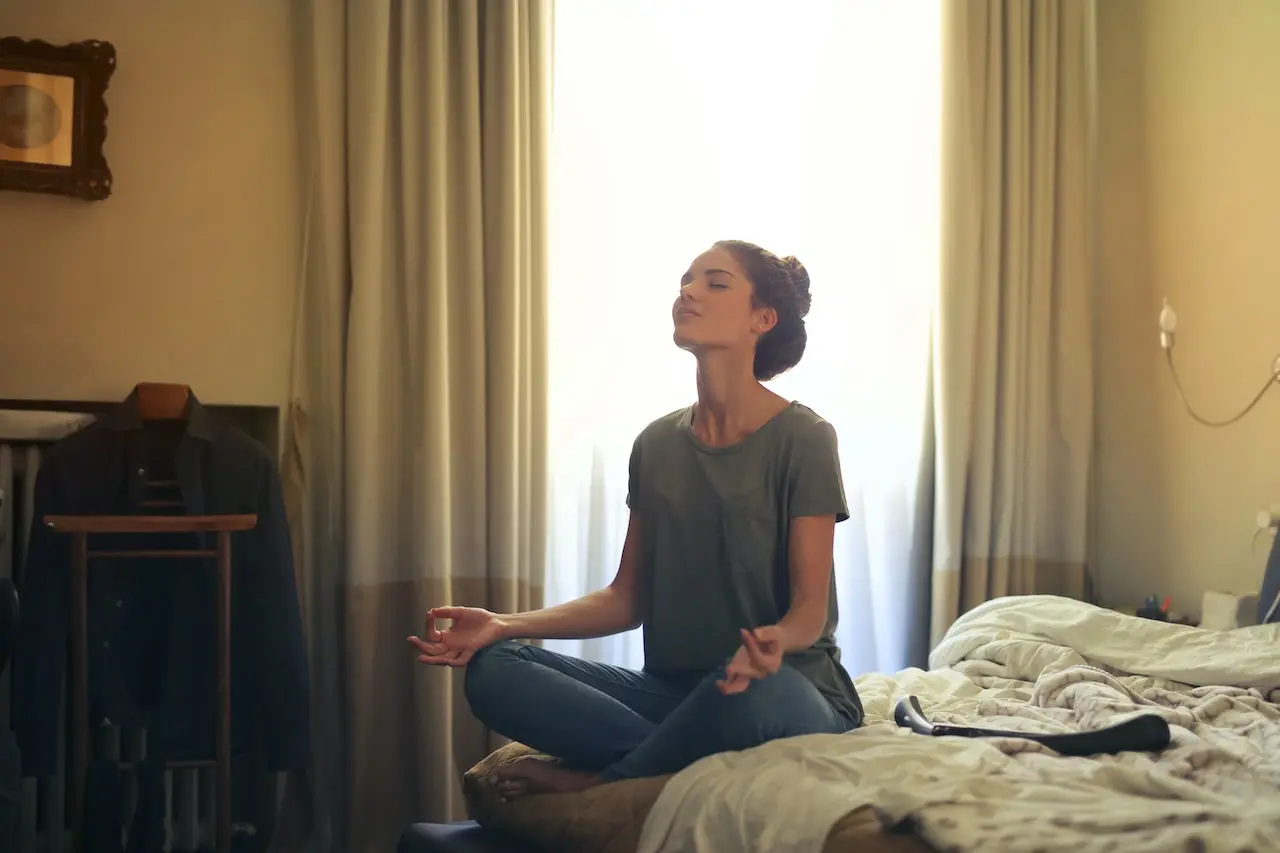
Gentle yoga may be a useful part of winding down, especially if you enjoy the combination of easy movement, breathing, and focused attention. Research suggests that some yoga programs improve how people rate their sleep, but the evidence does not show that a particular pose or sequence makes you fall asleep. Yoga is not a cure for insomnia or a replacement for medical care. If you want to try it, keep the movements comfortable, use support, and treat the routine below as a flexible starting point rather than a proven sleep prescription.
What the research says about yoga and sleep
Research is most encouraging for perceived sleep quality. The National Center for Complementary and Integrative Health says yoga may improve sleep quality but not necessarily insomnia. That distinction matters because feeling that you slept better is not the same outcome as treating a persistent sleep disorder 1. A 2020 review combined 19 randomized trials involving 1,832 women with sleep problems. On average, participants assigned to yoga reported better sleep quality on the Pittsburgh Sleep Quality Index. However, the smaller set of trials that measured insomnia severity found no clear benefit. Two trials using wrist activity monitors also found no clear improvement in total sleep time or sleep efficiency 2. These measures answer different questions. A sleep questionnaire can capture whether someone feels rested, struggles at night, or functions poorly during the day. A wrist monitor or sleep study measures different features of sleep. Feeling better and sleeping longer are not interchangeable claims. Individual trials also show why the conclusion needs limits:
-
In a small trial of adults with chronic difficulty falling asleep, 40 participants supplied at least four weeks of data. An eight-week Kundalini yoga program produced larger improvements than an instructor-supported sleep-hygiene program on several sleep diaries and questionnaires. The study did not use wrist monitors or laboratory sleep studies, and the researchers called for objective testing in future trials 3.
-
A larger trial assigned 410 cancer survivors with sleep disruption to standard care or standard care plus a four-week yoga program. The program included breathing exercises, 16 gentle and restorative postures, and meditation in two 75-minute classes each week. Participants reported better sleep quality, and wrist monitoring found improvements in time awake after sleep onset and sleep efficiency. Most participants were women, and three quarters had survived breast cancer, so the result may not apply in the same way to other groups 4.
The studies tested programs, not isolated poses. Yoga may combine movement, paced or natural breathing, attention, relaxation, meditation, instruction, and regular practice. A study of the whole package usually cannot tell us which part helped. It also cannot show that a forward fold, an inversion, or any other individual position has a sleep-inducing effect.
Does yoga have to happen at bedtime?
There is no established best time or exact dose for yoga to support sleep. Many positive studies used repeated sessions over several weeks, and their schedules and styles varied. They do not validate a five-minute sequence at lights-out or a rule such as finishing 30 minutes before bed. Evening practice is reasonable if it feels comfortable and helps you shift out of the day's activity. If it leaves you alert, warm, uncomfortable, or focused on doing the poses correctly, move it earlier or practice during the day. Your response matters more than calling a pose “restorative.”
A short, adaptable evening routine
This five-to-ten-minute routine stays seated or supported and does not require balancing or placing your head below your heart. It is a practical starting point, not the sequence used in a clinical trial. A stable chair is usually safer than standing or balancing on a soft mattress.
1. Find a supported seat
Sit in a sturdy chair with your back supported and your feet on the floor or on a firm footrest. If you use a wheelchair, secure it as you normally would for exercise. Rest your hands on your thighs. Let your breathing stay easy for about one minute. You do not need to breathe only through your nose, make the exhale unusually long, or hold your breath. Skip any breathing pattern that makes you lightheaded or uncomfortable.
2. Move your shoulders gently
Slowly lift your shoulders a little toward your ears, move them back, and let them settle. Repeat three to five times in a pain-free range. Then slide your hands forward on your thighs and return them toward your hips without forcing your shoulders. Keep the movement smaller, move one arm at a time, or stay still if shoulder or neck motion hurts.
3. Try a supported side reach
Keep both sitting bones on the chair. Rest your right hand on the seat or your thigh and reach your left hand slightly outward or overhead, only as far as your shoulder allows. Stay for one or two easy breaths, return to the center, and change sides. The arm can remain below shoulder height. If side bending is uncomfortable, replace this step with another round of shoulder movements.
4. Add a small seated spine movement, if appropriate
Sit tall with your hands on your thighs. Without forcing your lower back, gently tip your pelvis forward enough for your chest to move a little forward. Return to a comfortable neutral position. Repeat three to five times. Do not round deeply, twist, or chase a stretch. If you have osteoporosis, a vertebral fracture, recent back pain, or instructions to keep your spine neutral, skip this step and stay upright.
5. Finish in a supported rest
Remain seated with your back supported, or lie on your side with pillows supporting your head and knees. Settle for two to five minutes with ordinary breathing. You can keep your eyes open, soften your gaze, or close them if that feels safe. Side-lying is also an option for people who cannot comfortably lie on their back. If getting down to the floor or back up is difficult, finish in the chair.
When to adapt the routine or ask for guidance
Yoga is generally considered safe for healthy people when it is performed properly, but sprains and strains can occur. NCCIH advises beginners to avoid headstands, shoulder stands, lotus position, and forceful breathing. It also identifies injuries, lumbar spine disease, severe high blood pressure, balance problems, and glaucoma as reasons a practice may need to change 5. Use these condition-specific boundaries:
-
Pain, limited mobility, or disability: Work within movements you already know are safe. A chair, pillows, smaller ranges, or staying still with comfortable breathing are valid options. A qualified instructor or physical therapist can help adapt movements to your body, mobility aids, and transfer needs.
-
Pregnancy: Ask your obstetric care professional whether you need restrictions. Avoid hot yoga. After 20 weeks, prolonged exercise flat on your back can reduce blood return to the heart, so use a side-lying or supported seated rest instead. Pregnancy complications may require an individual plan 6.
-
Osteoporosis or a vertebral fracture: Do not use this routine as clearance to bend or twist your spine. The Bone Health and Osteoporosis Foundation advises people with spinal bone loss to avoid forward bending from the waist and extreme trunk twisting. A physical therapist can show you safer modifications for your fracture risk and history 7.
-
Glaucoma or pressure-sensitive eye disease: Do not add inversions such as headstands or shoulder stands. Ask your eye-care professional whether other positions need changing. This routine deliberately leaves out head-down positions.
-
Recent surgery, a new injury, or medical movement restrictions: Follow the instructions from your surgeon or rehabilitation team. Wait for clearance rather than using a general online routine to test a restricted joint or incision.
Stop the session if you develop sharp or increasing pain, dizziness, faintness, chest pain, unusual trouble breathing, new numbness or weakness, or a visual change. Seek urgent care for severe or persistent symptoms.
Yoga is an option, not insomnia treatment
If poor sleep is frequent, persistent, or affecting daytime function, talk with a health care professional. Snoring or gasping, uncomfortable urges to move the legs, pain, mood symptoms, medications, and other conditions can each call for a different approach. For adults with chronic insomnia, the American Academy of Sleep Medicine gives its strong recommendation to multicomponent cognitive behavioral therapy for insomnia, or CBT-I 8. Yoga can be a personal wind-down practice alongside appropriate care, but it should not delay evaluation, replace CBT-I, or prompt you to change prescribed treatment on your own.