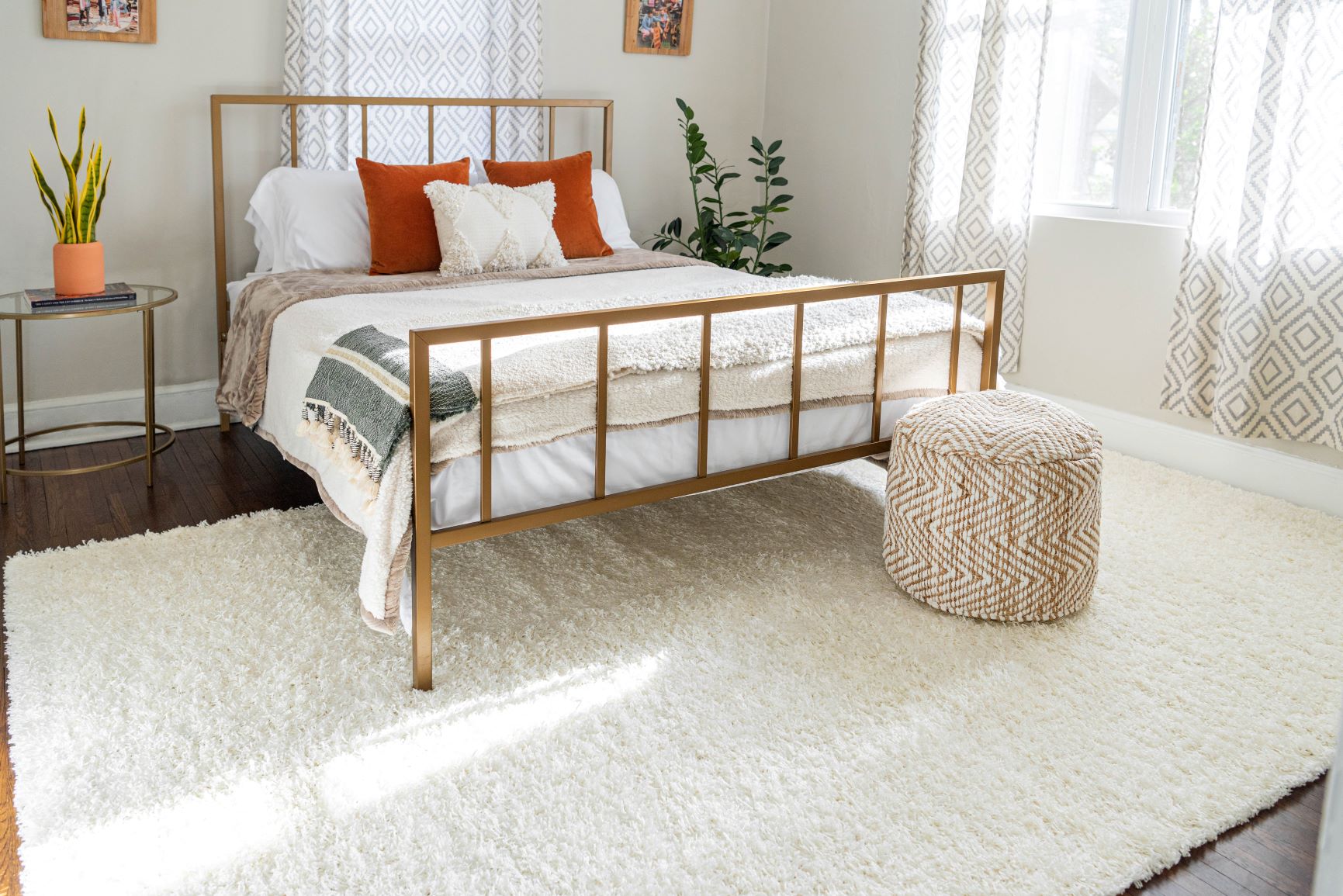


A canopy bed can work well when you want a strong visual frame around the mattress and have enough room for its posts and overhead rails. The decision should start with fit and compatibility, not style alone.
A queen canopy bed and a standard queen bed may accept the same mattress size but have very different outer dimensions, heights, support systems, capacities, and assembly requirements. Curtains are optional on many models, and the frame itself does not guarantee better sleep, warmth, quiet, privacy, or insect protection.
What counts as a canopy bed?
Retailers use the name broadly, so identify the structure rather than relying on the label.
- Canopy bed: Usually a bed frame with tall corner posts connected by overhead rails. It may be sold as an open frame, without fabric.
- Four-poster bed: A bed with a tall post at each corner. Some four-posters have connecting top rails that can hold manufacturer-approved drapery, while others are only decorative posts.
- Half-canopy or crown canopy: A smaller structure over the head or part of the bed. It may attach to the headboard, wall, or ceiling instead of standing on four bedposts.
- Bed curtain, hoop canopy, or mosquito net: Fabric suspended from a frame, wall, or ceiling. It is an accessory, not a structural bed frame, and its mounting and safety requirements are separate.
Historical and museum terminology is more precise than modern retail language. The Getty vocabulary distinguishes a ceiling-suspended bed canopy from a tester supported by posts 1. A historical lit à la duchesse, for example, has a full canopy suspended from the ceiling without supporting bedposts 2. These names can help describe a style, but they do not tell you whether a modern product fits your mattress or can safely hold curtains.
Measure the frame, room, and delivery route
Do not plan from the mattress size alone. Get the manufacturer's drawing and record:
- Overall width, depth, and maximum assembled height
- The inside mattress opening
- Floor-to-slat or floor-to-foundation height
- Side-rail height and under-bed clearance
- Post and overhead-rail thickness
- Carton dimensions and the longest unassembled component
Compare the bed's highest and widest points with the intended location. Check the ceiling above every post and rail, including slopes, beams, crown molding, light fixtures, ceiling fans, vents, smoke alarms, and sprinkler heads. For a fan, account for the full moving blade path, not just the center fixture. There is no universal minimum ceiling height for a canopy bed because frame height and room obstructions vary.
Leave enough access to assemble the top rails, tighten hardware, clean the frame, change bedding, and walk around the bed. Mark the full outer footprint on the floor with painter's tape. This gives a better sense of circulation than outlining only the mattress.
Also measure the path from the building entrance to the bedroom. Doorways, hallways, stair turns, landings, elevators, handrails, and low fixtures can stop a long post or headboard even when the finished bed fits the room. Pottery Barn's delivery guide similarly recommends measuring the interior height and width of every doorway, staircase, elevator, and hallway and accounting for low fixtures 3.
Check the support system before buying
"Canopy" describes the upper structure, not what supports the mattress. Underneath, the bed may use:
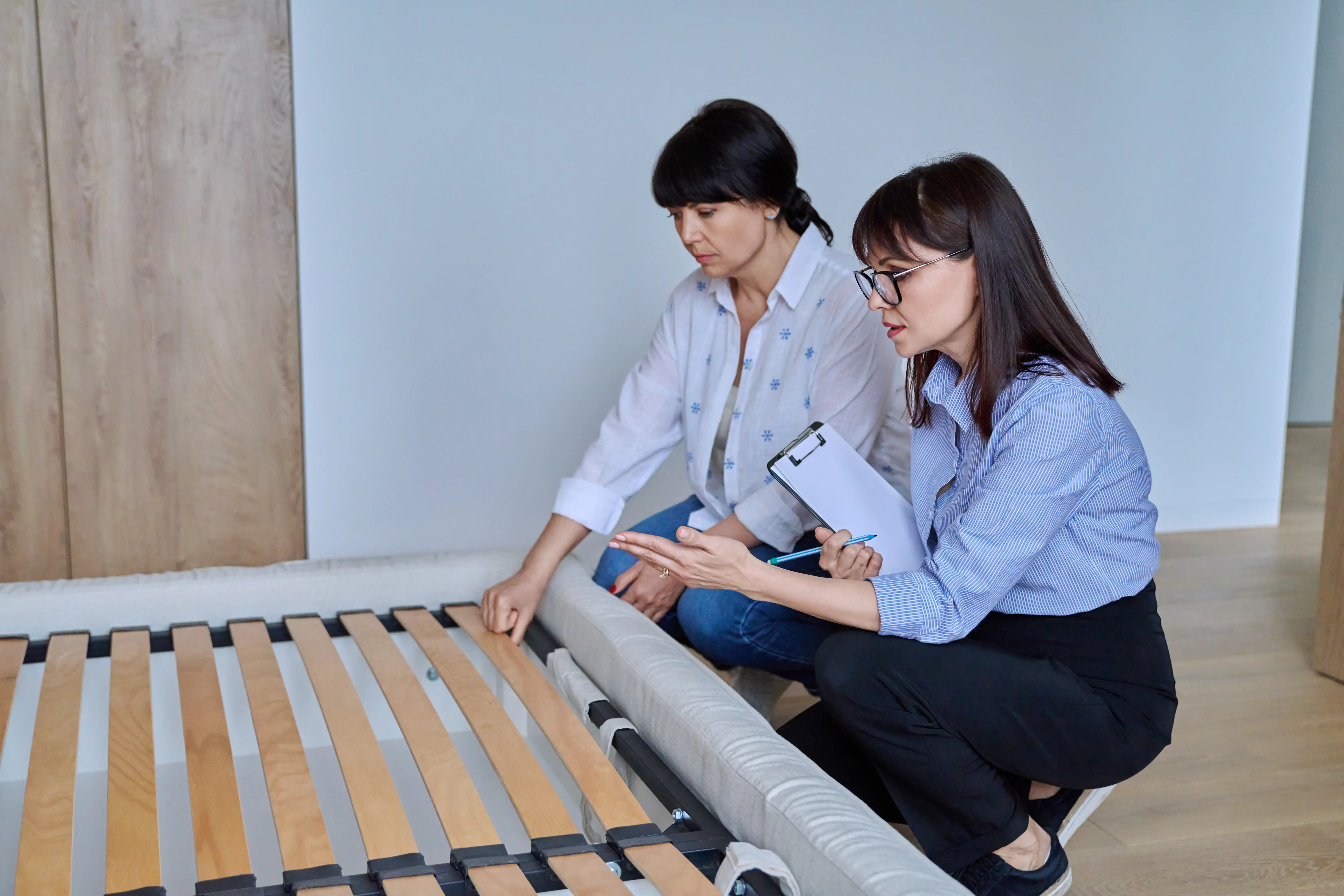
- Closely spaced slats with center support
- A platform or solid panel
- Slats designed to hold a separate foundation
- Side rails and cross supports that require a box spring
Read both the bed instructions and the mattress warranty. The requirements can conflict. Pottery Barn's Atwell canopy-bed instructions say that model must be used with a box spring 4. Tempur-Pedic, by contrast, says its mattresses should not use a traditional box spring and gives model-specific requirements for a solid or slatted support 5. Neither rule applies to every bed or mattress.
Confirm all of the following for the exact combination:
- Whether the bed needs a foundation, box spring, bunkie board, or mattress directly on its slats
- The allowed mattress size, thickness, and weight
- Required slat width, spacing, attachment, and center support
- Whether support legs must contact the floor
- Whether the arrangement preserves both the bed and mattress warranties
Do not add plywood, remove a center rail, substitute thinner slats, or use an unsupported foundation simply to make the pieces fit unless the applicable instructions permit the change. If the two manufacturers' requirements cannot be satisfied at the same time, choose a different bed, mattress, or approved support.
Treat capacity as a model-specific number
Look for a stated weight capacity and ask the seller what it includes. The answer may refer to occupants only or to the combined load of occupants, mattress, and foundation. Do not assume the posts or overhead rails share the sleeping-surface capacity.
Product details should also identify the number of center supports, slat spacing, and under-bed clearance. For example, West Elm lists those details separately from overall dimensions and capacity for its Hargrove canopy bed 6. Use the specifications for the exact size and version you are buying, since a full, queen, king, or storage variant may be built differently.
The canopy is not a pull-up bar, clothes rack, swing support, or place to suspend plants. Add fabric or accessories only when the instructions identify an attachment method and allowable load.
Can a canopy bed work with an adjustable base?
Sometimes. The posts do not determine compatibility by themselves. The important area is usually inside the side rails.
Check:
- The adjustable base's exact outer dimensions and leg configuration
- The bed frame's clear inside width and length
- Whether the canopy bed's slats and center rail are removable
- Whether the adjustable base is approved for zero-clearance use or needs its own legs
- Clearance for motors, wiring, support legs, and moving sections
- Whether the raised mattress can contact the headboard, footboard, side rails, or fabric
- Whether split bases, sync cables, and controls remain accessible
Tempur-Pedic says its power bases can fit many solid frames or frames with removable slats, but may not fit antique or nonstandard frames. It advises comparing the clear inside dimensions with the exact base dimensions 7. That guidance is specific to Tempur-Pedic products, but the measuring principle applies to any pairing.
Get written compatibility confirmation from both manufacturers when possible. Do not fasten a moving base to canopy-bed rails or remove structural parts unless the applicable instructions expressly allow it. Keep curtains, ties, and electrical cords outside the base's full movement path.
Assembly and overhead safety
Read the complete instructions before opening every hardware bag. Confirm that all posts, rails, brackets, center supports, levelers, and fasteners are present. Assemble the bed in its final room if the completed frame will not pass through the doorway.
Use the number of installers and tools the instructions call for. Long overhead rails can be awkward even when individual pieces are not very heavy. Keep the frame unloaded until all connections are fully seated and tightened, then make sure every support leg contacts the floor as directed.
Do not let anyone climb, pull on, or hang from the canopy. The Atwell instructions give this warning specifically for children 4. Apply the same no-hanging rule to adults, pets, luggage, and decorations because a canopy rail is not designed as load-bearing exercise or storage equipment.
Check the brand, model, and identifying numbers for recalls before buying used and periodically after purchase. In a 2019 recall of one RH canopy-bed line, horizontal canopy rails could detach and fall. The company had received 29 reports of unexpected rail detachment 8. That was a product-specific defect, not evidence that all canopy beds are unsafe, but it shows why loose or shifting overhead parts deserve prompt attention.
Recheck hardware at the interval in the manual and after moving the bed. Stop using the canopy portion if a rail sags, a connector pulls out, a post leans, wood splits near a joint, metal bends, or hardware repeatedly loosens. Ask the manufacturer whether the bed can be used safely while awaiting a replacement part.
Does a canopy bed need wall anchoring?
A freestanding canopy bed needs wall anchoring when its instructions require it. Do not add a generic tip restraint or drill into the frame without confirming that method with the manufacturer.
A wall-mounted crown or ceiling-suspended canopy is different. Its safety depends on the product's weight, the ceiling or wall construction, the approved fasteners, and correct placement. Never suspend it from a light fitting, ceiling fan, sprinkler, smoke alarm, curtain rod, or another part not designed to carry it. If the mounting instructions do not match the structure in your home, ask the manufacturer or a qualified installer rather than improvising.
Adding curtains or netting
First confirm that the frame is designed for fabric and how the maker says to attach it. Heavy curtains place more load on rails and joints than lightweight panels. Rings, ties, rods, and clips can also scratch a finish or create concentrated loads.
Decide what you actually want the fabric to do:
- Visual enclosure: Sheer or decorative panels can soften the frame without fully closing it.
- Light reduction: This depends on fabric opacity, coverage, and gaps. A canopy is not automatically a blackout system.
- Privacy: Curtains may limit sightlines when fully closed, but gaps at the top, sides, and foot matter.
- Warmth or airflow: Enclosing a bed can change airflow around it, but the result depends on fabric and room conditions. It is not a reliable temperature-control method.
- Sound: Ordinary drapery should not be treated as acoustic treatment.
Keep panels clear of floor vents, fans, doors, walking paths, and any adjustable-base mechanism. Tie them back only with attachments that do not form accessible loops or pull heavily on the frame.
Children and pets need extra care
Loose, sagging fabric and long loops can entangle a child. A CPSC recall of one ceiling-hung bed canopy followed a report of a child waking with netting around the neck 9. Use only a canopy intended for the child's age and sleep setting, follow its placement instructions, and remove it if the child can pull it into the bed, climb it, or make loops in it.
Do not attach an adult decorative canopy to a crib. Keep ties and cords inaccessible, and do not place climbable furniture next to the posts. If a pet climbs the fabric, chews ties or wiring, or pulls the frame, leave the curtains and electrical decorations off.
Keep fabric away from heat and flame
Canopy fabric adds combustible material around a sleep space. The U.S. Fire Administration advises keeping anything that can burn at least 3 feet from heating sources and turning space heaters off when leaving the room or going to bed 10. Arrange the bed and curtains so they cannot drift toward a radiator, heater, fireplace, or other heat source.
Do not use a lit candle in a bedroom or sleeping area. The U.S. Fire Administration recommends battery-operated flameless alternatives and says lit candles should be extinguished when you leave or go to bed 11.
Be cautious with decorative lights. In one 2019 recall, lights built into mesh bed canopies overheated, melted wiring or mesh, and damaged nearby bedding 12. Do not wrap ordinary light strings around fabric or canopy rails unless both the lighting and furniture instructions allow that use. Check for recalls, keep wiring unpinched, and unplug a product that becomes hot, flickers, smells unusual, or has damaged insulation.
A decorative curtain is not a mosquito net
Open curtains do not keep insects out, and decorative panels may leave large gaps. For mosquito protection, use a net designed for that purpose and follow its label.
CDC guidance recommends a net long enough to tuck under the mattress, with holes and tears checked before use. It also advises pulling netting tight around young children, keeping the sleeper from resting directly against it, and keeping the net away from candles, cigarettes, and open fire 13. In settings where mosquito-borne disease is a concern, follow current public-health and travel advice rather than assuming a decorative canopy provides protection.
Cleaning and maintenance
A canopy adds high rails, joints, and possibly fabric to the cleaning routine. Follow the finish and textile labels rather than using one method on every material.
- Dust top rails and posts with the method recommended for the wood, metal, upholstery, or finish.
- Remove and wash or dry-clean fabric only as its care label allows.
- Clean spills promptly using the frame maker's directions.
- Inspect fasteners, brackets, fabric attachments, and ceiling or wall mounts while the surfaces are accessible.
- Look for torn netting, frayed ties, pinched electrical cords, rust, split wood, or movement at joints.
- Lift the bed as directed rather than dragging it by a post.
West Elm's Hargrove instructions, for example, call for dry dusting, lifting rather than dragging, and periodic hardware checks 6. Those directions are appropriate for that product. Your frame's finish or construction may require different care.
A canopy bed does not inherently cause or prevent allergies. It simply adds surfaces that may collect dust. Whether that matters depends on the user, the materials, and how easily the frame and textiles can be cleaned.
A canopy-bed buying checklist
Before ordering, confirm:
- The exact model and size, including any storage or upholstered variation
- Overall dimensions, inside mattress opening, and assembled height
- Clearance from ceiling slopes, fans, lights, vents, sprinklers, and alarms
- An unobstructed delivery and assembly route
- The required mattress, foundation, slats, and center support
- Compatibility with an adjustable base, if used
- The stated capacity and what the number includes
- Whether curtains or accessories are permitted and how they attach
- Assembly labor, tools, replacement parts, and warranty terms
- Any anchoring or professional-installation requirement
- Current recall status for a new or used product
- A practical plan for cleaning high rails and any fabric
Frequently asked questions
Do canopy beds require high ceilings?
They require a ceiling and fixture layout that clears the exact frame. A low-profile canopy may fit a room where a taller model will not. Compare the assembled height with the lowest obstruction and leave working room for assembly, cleaning, and hardware checks. Do not rely on a universal ceiling-height rule.
Can a canopy bed fit in a small bedroom?
Yes, if its full footprint leaves usable paths, door clearance, and access for bedding and cleaning. A thin metal frame may occupy less visual and physical space than a thick upholstered model with the same mattress size. Mark the outer dimensions on the floor before buying.
Can you add a canopy to any bed?
Not by attaching parts to any existing frame. Bedposts and headboards are not automatically designed for added overhead loads. A separate wall- or ceiling-mounted canopy may be possible, but it needs its own compatible product, mounting instructions, structural support, and safe clearance.
Are curtains required?
No. Many contemporary canopy beds are intended to remain open. Add curtains only if the frame maker permits them and you can keep the fabric clear of heat, moving parts, children, pets, and walking paths.
Are wood canopy beds stronger than metal ones?
Material alone does not establish strength, stability, or capacity. Joint design, section thickness, hardware, center support, workmanship, damage, assembly, and maintenance all matter. Compare the exact specifications and warranty rather than choosing from a material label.
Can a canopy bed keep a room warmer or quieter?
Do not buy one on that promise. Fabric may alter airflow or block some light, but ordinary canopy curtains are not a rated heating, cooling, blackout, or sound-control system. Choose the bed for its structure and appearance, then address room temperature, light, and noise with products designed for those jobs.
The bottom line
A canopy bed is primarily a bed frame with a strong visual presence. It can be practical in a large or small room when its true outer dimensions, support system, capacity, and access needs are a good match.
The safest purchase is the exact combination you can verify on paper: bed instructions, mattress requirements, foundation or adjustable-base compatibility, room and delivery measurements, accessory rules, and recall status. Once installed, keep the overhead structure tight and free of unapproved loads, and treat any fabric as an added item with its own cleaning, entanglement, and fire considerations.