

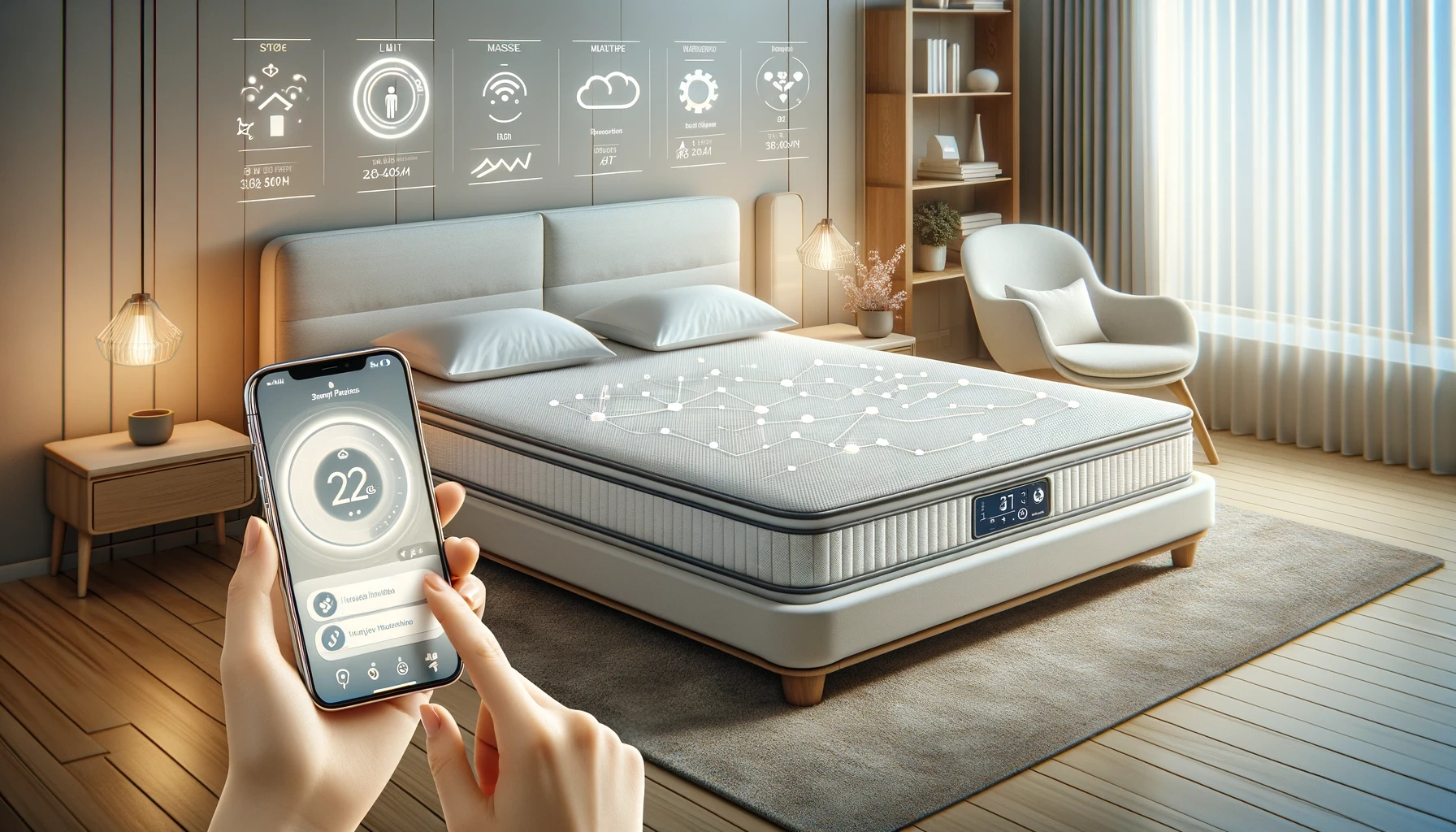
A smart mattress is not one defined type of bed. The label can describe an air-adjustable mattress, a powered heating and cooling cover, a sensor-equipped adjustable base, or an ordinary mattress used with a separate sleep sensor. Some systems combine several of these parts.
Start by asking what the product physically is and what it does without the app. A feature that changes firmness, surface temperature, or bed position can change how the bed feels. A sensor that produces a sleep score changes no part of the sleep surface. It estimates what happened from signals and an algorithm.
That distinction makes smart beds easier to compare. It also prevents a tracker, convenience feature, or marketing score from being mistaken for medical testing.
What counts as a smart mattress?
Manufacturers use the term differently, so compare the actual components rather than the category name.
| System type | What it can physically change | What it may measure or require | What to verify |
|---|---|---|---|
| Mattress with embedded sensors | Nothing unless another powered system is included | Movement, pressure, sound, or signals used to estimate sleep and vital signs | Sensor location, partner separation, validation, and whether tracking works offline |
| Adjustable-air mattress | Air pressure and the feel of one or more chambers | Pump, hoses, pressure settings, power, and sometimes sleep data | Number of chambers, independent sides, replacement parts, pump noise, and manual controls |
| Active heating or cooling layer | Surface temperature through air or liquid circulation | Hub, fan or pump, power, app, and sometimes sensors | Temperature zones, mattress fit, cleaning, condensation or leak instructions, and subscription needs |
| Smart adjustable base | Head, foot, or lumbar position, depending on the model | Motors, remote, sensors, app, and clearance under the bed | Mattress compatibility, split behavior, outlet count, weight limits, and emergency lowering |
| Separate under-mattress sensor | Nothing | Movement or vibration used to estimate sleep and breathing patterns | Mattress and base compatibility, placement, partner interference, and the exact validated model |
A system can occupy more than one row. For example, a mattress may use separate air chambers for firmness while an optional base raises the head and feet. A thermal cover may sit on a conventional mattress and send data to an app. Buying the word “smart” does not guarantee any particular feature.
Separate comfort features from sleep tracking
Three questions keep the comparison grounded:
- What changes physically? Firmness, surface temperature, and bed angle are physical settings. Whether any setting feels better is personal and can be judged during a trial.
- What is only measured or inferred? Movement, sound, pressure, heart rate, and respiratory signals may feed an algorithm. Sleep stages, scores, readiness, snoring events, and coaching are interpretations of those inputs.
- What health outcome is being claimed? A company should not move from “tracks sleep” to “treats insomnia,” “detects sleep apnea,” or “improves deep sleep” without evidence for that exact product, algorithm version, population, comparator, and outcome.
Consumer trackers do not all perform alike. In a prospective study comparing 11 wearable, bedside, and app-based trackers with laboratory polysomnography, agreement varied substantially by device and sleep measure. Results also differed across subgroups defined by factors such as body mass index, sleep efficiency, and apnea-hypopnea index 1. Evidence for one tested model does not validate another model, and a major algorithm update may limit how well an older study applies.
The American Academy of Sleep Medicine states that consumer sleep technology should not be used to diagnose or treat sleep disorders without appropriate validation and FDA clearance. The data can still help a patient describe patterns to a clinician, but it does not replace a clinical evaluation or validated diagnostic testing 2.
FDA guidance draws a similar line between low-risk general-wellness functions and claims about diagnosing, screening, monitoring, or managing a disease. The guidance also notes that fitting the general-wellness policy does not establish that a product is safe or effective for its intended use 3. If a bed advertises apnea detection, insomnia treatment, pain treatment, or another medical use, look for the exact intended use and regulatory status of that feature, not a general statement about the brand.
Identify the product stack
Write down every component in the quoted system:
- mattress;
- cover or active temperature layer;
- pump, thermal hub, or control box;
- foundation or adjustable base;
- sensors;
- remote;
- phone app and account;
- required subscription; and
- optional accessories needed for the advertised feature.
Current products show why this matters. As checked on July 25, 2026, Sleep Number documents both single-chamber and dual-chamber smart-bed configurations, with air chambers, hoses, and a control system operated through an app or remote 4. Eight Sleep describes its Pod 5 as a powered cover placed on an existing mattress, with an external hub and an optional base rather than a replacement mattress 5. Tempur-Pedic's current Ergo Smart Base is a powered base with a remote, sensors, and app-linked functions 6.
These examples clarify architecture, not which product is best. Product names, included parts, plans, and terms can change. Confirm the current product page, manual, and order summary before paying.
Check size, sides, foundation, and power
A familiar size name does not tell you how a connected bed behaves. A king may be one mattress over two linked base sections, two Twin XL mattresses that move independently, or a single mattress with only the head split. Temperature or firmness zones may be independent even when the base position is not.
For couples, ask:
- Is the mattress physically split, and where?
- Can firmness, temperature, and position each be changed separately?
- Does adjusting one side move the shared foot section?
- Can both people have separate accounts and remotes?
- What happens to each side when only one person is in bed?
- Will fitted sheets, protectors, and headboards fit the configuration?
Confirm the foundation and frame in writing. Some mattresses can sit on a rigid platform but not widely spaced slats. An adjustable base needs a flexible, compatible mattress, enough clearance to move, and room for cables. Measure doorways, stairs, the inside of the bed frame, and the available under-bed clearance as well as the mattress footprint.
Count outlets and examine cable routing before delivery. Powered air systems, thermal hubs, and adjustable bases may each need a plug. Use the outlet, surge protection, extension-cord rules, and placement specified in the current manual. Keep cords and bedding away from hinges and moving parts. If a system circulates liquid, follow its instructions for filling, draining, spills, leaks, storage, and freezing temperatures.
For a used or older bed, record the model and serial number and check the CPSC recall database before purchase 7. Do not assume a current manual or replacement part fits an earlier generation.
Test controls, connectivity, and software dependence
A connected bed may need Bluetooth for setup, a supported Wi-Fi band for cloud features, a current phone operating system, and a vendor account. Those requirements can outlast the phone or router you own today.
Ask the seller to demonstrate:
- which functions work from a physical remote;
- which functions work when the internet is down;
- whether setup requires a supported phone;
- whether two sleepers need separate accounts;
- whether the app exports usable data;
- which features stop if a subscription ends; and
- how long the company promises app, security, and server support.
Current Sleep Number compatibility guidance, for example, says the app is required to get a smart bed online and use smart features, and that most beds require a 2.4 GHz network. Its support material also says an unsupported phone, operating system, or router can prevent online features from working 8. The current Tempur-Pedic manual says the remote operates base functions, while the Sleeptracker app is needed for the full set of smart functions 6.
These are model-specific examples. For any bed, test the failure state that matters most: no Wi-Fi, no cloud service, a lost phone, an expired plan, or a missing remote. Basic comfort control should not become a surprise after one of those events.
Read the privacy policy as a product specification
A bed can collect highly personal information for years. Before creating an account, identify:
- the raw signals and inferred health or sleep data collected;
- whether a microphone or precise location is used;
- where data is processed and stored;
- whether advertising, analytics, research, or AI training uses the data;
- which service providers, integrations, or linked household members can see it;
- what can be exported and in which format;
- how to stop new collection; and
- how to delete a profile, account, and historical data.
Do not assume sleep data in a consumer app is protected by HIPAA. The FTC explains that many health apps and connected devices are not covered by HIPAA, while certain products that maintain personal health records may fall under the FTC Health Breach Notification Rule 9. That rule concerns notification after certain breaches. It is not a promise that every connected bed follows the same collection, retention, or sharing practices.
Manufacturer policies also show why the details matter. Eight Sleep's consumer health data policy lists categories that may include heart rate, sleep conditions, derived health information, precise location, integrations, and linked users. It describes certain access, deletion, and consent-withdrawal rights that depend on location and applicable law 10. Sleep Number's current support page says Privacy Mode stops transmission of new sleep data but also disables some features, and account deletion requires contacting the company 11.
Read the policy for your country and save the version that applied when you bought the product. Ask whether unlinking a partner stops only future access or also removes past data from that person's account.
Plan for noise, cleaning, and repairs
Smart-bed parts age differently. Foam, fabric, air chambers, hoses, pumps, fans, water lines, sensors, motors, control boxes, and remotes may have separate care needs and warranty periods.
Listen to the system in a quiet room if possible. A pump may run only during a firmness change, while a thermal hub may circulate air or water for much of the night. An adjustable base makes sound while moving. A showroom demonstration will not reveal every bedroom condition, but it can identify an immediately unacceptable tone or vibration.
Read the care instructions for the exact model. A fabric layer that unzips may still contain sensors or tubing and may not be machine washable. Confirm what can be removed, spot cleaned, washed, dried, refilled, or sanitized. Also ask what must be done before moving or storing the bed.
Before purchase, request prices and availability for the parts most likely to stop the feature you value:
- pump, hose, air chamber, or connector;
- thermal cover, hub, filter, or water line;
- sensor, processor, or control box;
- base motor or actuator;
- power supply;
- remote; and
- delivery, diagnosis, labor, and return freight.
A long mattress warranty does not necessarily give electronics the same coverage. Find out whether a failed component can be replaced alone, whether the replacement requires a technician, and whether the product still works in a basic mode while waiting for service.
Compare the trial, return, and warranty separately
A mattress trial may exclude the adjustable base, thermal layer, accessories, delivery fee, or subscription. Ask when the trial starts, whether a minimum use period applies, how a return is authorized, who disassembles the system, what packaging must be kept, and who pays pickup or freight.
Current terms show how large the differences can be. Sleep Number's March 2026 return page lists adjustable bases and FlexFit smart adjustable bases as final-sale items even though eligible mattresses have an in-home trial 12. Eight Sleep's current warranty page states that Pod models have a two-year limited warranty, while five-year coverage requires a qualifying active membership; coverage is also limited to the original purchaser and direct purchases 13. These terms are snapshots, not promises about a future order.
Read the full warranty, not just its headline duration. Check:
- which component and defect are covered;
- whether coverage is full, prorated, or membership-dependent;
- original-purchaser and authorized-seller requirements;
- exclusions for stains, liquids, cleaning, moving, misuse, or an improper base;
- labor, inspection, shipping, and installation charges;
- whether a replacement is new, refurbished, or a current equivalent; and
- how long a replacement part remains covered.
Calculate total ownership cost
Compare the cost of the function you want, not just the initial hardware price. Include:
- mattress, cover, hub, base, and required accessories;
- delivery, setup, and removal of the old bed;
- subscription fees over the years you expect to keep the system;
- electricity and any routine supplies;
- replacement remotes, pumps, covers, filters, or other parts;
- service visits, return freight, and moving costs; and
- a replacement plan if the app or cloud service is discontinued.
A separate temperature layer or sensor can be easier to replace than a whole mattress, but it may add another plan, cable, cleaning rule, and failure point. An integrated system may feel simpler while making future repairs more dependent on one manufacturer. Neither approach is automatically better.
Are smart mattresses worth it?
A smart bed can be worth considering when one specific physical function addresses a clearly defined comfort problem and the trial lets you test it. Examples include independently adjustable firmness, a preferred surface temperature, or a base position that is comfortable for reading or resting.
Tracking alone is a weaker reason to replace a comfortable mattress. Compare a built-in sensor with a wearable or separate bedside device, and judge it by the exact metric you care about, independent validation for the current model, data access, and privacy. A higher price or a location under the mattress does not guarantee better sleep-stage accuracy.
Do not buy a smart bed as treatment for insomnia, sleep apnea, chronic pain, or another health condition unless the exact feature has the appropriate evidence and regulatory status for that use. Persistent insomnia, witnessed breathing pauses or gasping, or substantial daytime sleepiness needs appropriate clinical assessment regardless of what a bed score reports 2. Persistent or worsening pain also deserves condition-specific assessment.
The most useful comparison is concrete: what part changes, what outcome you expect, how you will judge it during the return window, and what the system will cost and still do if its app, subscription, or smart features disappear.