

A split mattress system can provide separate mattress feels, independently moving base sections, easier-to-handle pieces, or some combination of those features. The word “split” does not tell you which benefit the product provides.
Treat the purchase as a system. Confirm the exact mattress components, base sections, frame, retainers, sheets, protectors, delivery plan, electrical needs, return terms, and warranties before ordering. A correct overall size does not make mismatched parts compatible.
This guide focuses on building that system. For nominal U.S. dimensions, see the mattress size guide. For deciding whether the total footprint should be queen or king, see the queen-versus-king guide.
The official product examples below were checked July 26, 2026. They are snapshots used to show variation, not recommendations or permanent specifications.
Start with the physical configuration
Sellers use similar words for arrangements that behave differently.
| Configuration | What is physically separate | What the label does not establish |
|---|---|---|
| Two mattresses placed together | Two complete mattresses, which may or may not be sold as a coordinated set | A standard total size, matching height, compatible edges, shared warranty, or adjustable-base use |
| Split king | Usually two complete mattress pieces arranged to make a king-sized footprint | Each piece's exact dimensions, whether different models may be paired, or how the base operates |
| Split California king | Two narrower, longer mattress pieces where that configuration is offered | A universal half-size or availability across a manufacturer's full range |
| Full split or fully split mattress | Two mattress pieces remain separate from head to foot | The base, frame, retainers, sheets, and controls needed to keep the system aligned |
| Split-head, split-top, flex-head, or FlexTop mattress | One mattress or joined system separates near the head while remaining connected lower down | Split length, permitted head movement, foot movement, bedding shape, or cross-brand compatibility |
| Dual-firmness one-piece mattress | Internal left and right comfort components differ within one outer mattress or cover | Independent base movement or the absence of a comfort transition at the center |
| Two-piece king base or foundation | The support arrives in two sections for delivery or installation | A vertically split mattress or independent left-and-right movement |
A dual-firmness mattress is not necessarily split. As checked July 26, 2026, Naturepedic described its EOS Classic as one roll-packed mattress with interchangeable internal layers inside one cotton encasement; queen, king, and California king versions could be configured with different firmness choices on each side 1. That arrangement changes feel without creating two independently moving mattresses.
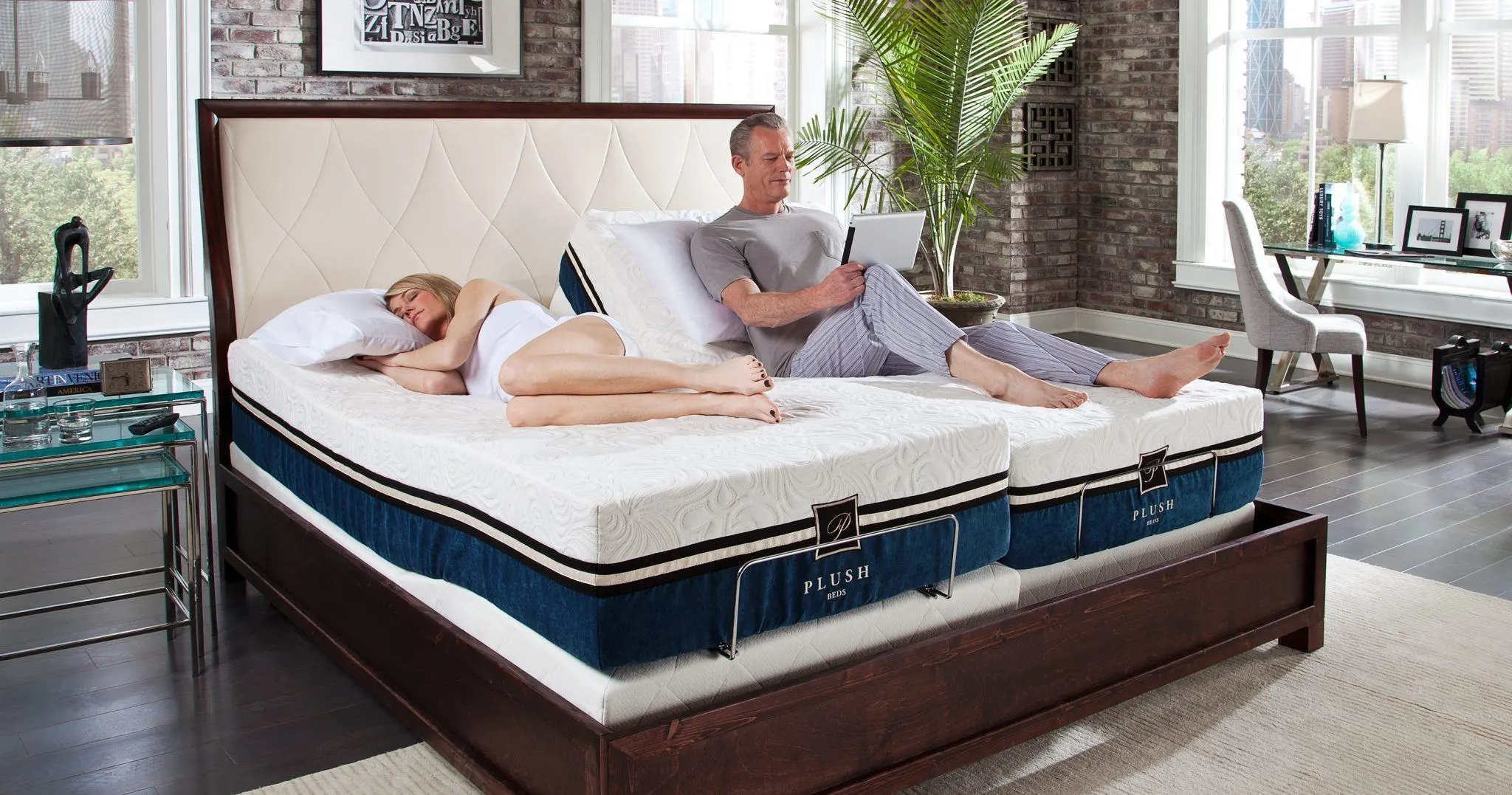
A head-only split is different again. Sleep Number's current specifications describe a FlexTop King as allowing separate head elevation while the lower half moves as one piece. Its Split King allows each side to move independently when paired with a compatible adjustable base 2. The exact product name and instructions control because other manufacturers may use different terminology.
Verify every component's measurements
Measure width, length, and height for each mattress piece. Then calculate and confirm the complete assembled width and length. Do not divide a familiar size name in half and assume the result is sold.
Current official examples show why:
- Saatva listed its split king as two 38 by 80-inch twin XL mattresses. It listed a split California king as two 36 by 84-inch pieces, but only for named mattress models and heights 3.
- Tempur-Pedic's current split-system guide listed each split-king piece at 37.5 by 79.5 inches and each split-California-king piece at 35.5 by 83.5 inches 4.
These specifications were checked July 26, 2026. They demonstrate product variation, not competing universal standards. Use the current product page, order confirmation, and dimensional drawing for the exact model and configuration in your cart.
Record:
- each mattress's finished width, length, height, weight, and stated tolerance
- the combined mattress footprint
- each base section's width, length, height, weight, and leg position
- the frame's inside opening and complete outside footprint
- the headboard, footboard, side rail, bracket, storage, and clearance dimensions
- the total bed height in flat and raised positions
Two halves with different heights create an uneven surface and may fit sheets, protectors, retainers, and headboards differently. Rounded corners, quilted borders, flexible sidewalls, and different edge constructions can also change the center seam even when the nominal measurements match.
Decide what should move separately
A full split mattress on paired adjustable bases can allow separate head and foot movement. It does so only when the bases are the correct configuration, the mattress is approved for articulation, the retainers are installed, and the controls are set for independent operation.
Some paired bases can also move in tandem. Tempur-Pedic currently states that its Split King and Split California King power bases come with two remotes and can operate independently or together 5. That is a feature of the named system, not every pair of twin XL bases.
A base can be split for delivery without providing independent left-and-right movement. Tempur-Pedic distinguishes horizontally divided king and California king bases, which support a one-piece mattress and move together, from vertically divided Split King and Split California King bases positioned side by side 4.
Before ordering, ask:
- Does each side raise its head and foot independently?
- Can the two sides be synchronized, and how is tandem mode configured?
- Does a flex-head mattress permit separate head movement but shared foot movement?
- Are two remotes included, and can either remote control both sides?
- What happens after a power outage, remote replacement, base reset, or software change?
- Can each side return to flat without colliding with the other mattress, frame, headboard, or bedding?
Do not infer movement from the number of shipping cartons or foundation sections.
Match the mattresses to each other
A coordinated split set usually simplifies matching. Combining two separately selected mattresses requires more checks.
Confirm that the manufacturer permits the pairing and compare:
- exact width, length, and height
- edge shape and perimeter firmness
- articulation approval and minimum bending requirements
- required foundation or adjustable base
- mattress weight and base capacity
- cover, fire-label, retainer, and warranty requirements
- trial length, return process, and exchange rules for each side
Choosing different firmness labels does not remove the need to match height. Tempur-Pedic's current ordering instructions allow two separate Twin Long mattress feels for a split king only when they are the same height, and route mixed-feel Split California King orders through its sales team 5. Apply the compatibility rule from the manufacturer you are actually buying from.
Do not assume that two mattress models from the same brand may be mixed, or that matching heights make different brands compatible. If one side is later replaced, the available version may have a different height, cover, edge, support requirement, or model code. Ask before purchase whether:
- either side can be exchanged or returned without the other
- a warranty claim on one mattress affects the set
- one replacement component can be ordered later
- the maker will match a discontinued or revised model
- a replacement must have the same feel, height, or production version
Keep both law tags, serial numbers, receipts, order configurations, and photographs of the original labels.
Check the center seam and edge geometry
Every fully split system has a boundary between the mattress pieces. Its practical effect depends on how closely the pieces align, whether they shift, each mattress's edge construction, the fitted bedding, and whether the bases are flat or articulated.
Test the exact arrangement if possible:
- lie on each side and across the center
- sit near the inside edges
- raise one side while the other remains flat
- raise both sides together
- make the bed with the intended sheets, protector, topper, and blankets
- check the gap at the head, middle, and foot after repeated movement
Do not assume the seam will be invisible, uncomfortable, safer, or less disruptive for everyone. Separate mattresses also do not guarantee a particular degree of motion isolation, temperature control, pain relief, or sleep improvement.
Use only the connectors, straps, retainers, bridge pads, or gap accessories permitted for the exact mattresses and bases. A shared topper or tight connector can reduce visible separation while also changing edge feel or restricting independent movement. It may also affect the mattress or base warranty. Get written compatibility information before adding one.
If a gap grows, first check alignment, retainer installation, frame width, base spacing, and damaged or missing hardware. Do not pull heavy mattresses together by their covers or improvise straps around moving base sections.
Match the support system and frame
“King frame” is not enough information. Verify the frame's inside opening, center support, legs, slats, side rails, headboard hardware, under-bed clearance, and total load capacity against the mattress and base instructions.
A split mattress may use:
- one stationary king foundation made in two delivery sections
- two compatible stationary foundations
- two independently moving adjustable bases
- a paired base synchronized as one unit
- a manufacturer-approved platform or slatted frame
The correct option is product-specific. Sleep Number currently tells buyers to measure the inside of an existing frame because slats, rails, storage, and headboard or footboard hardware can affect adjustable-base fit. Its mattresses require a solid surface or slats no more than two inches apart 2. Saatva's current adjustable-base page excludes named mattress heights and certain storage bed frames even though other mattresses and frames from the same company are compatible 6.
Retainers also differ. A system may use foot bars, corner bars, straps, clips, magnets, textured panels, or a manufacturer-specific cover attachment. Install every required part in its specified position. Generic non-slip material, homemade rails, or straps routed around moving parts can obstruct articulation or damage a cover, hose, wire, or mechanism.

Interpret load limits correctly
Find out whether a published limit applies:
- to one mattress, one side of a base, or the complete system
- per sleeper or to all people and objects on that side
- with or without the mattress, foundation, bedding, and accessories
- in flat and articulated positions
- as a working load or another type of rating
One current example shows why the wording matters. Sleep Number lists a 600-pound-per-side limit for its king adjustable base and states that the limit includes the mattress 2. Do not transfer that number or interpretation to another base.
Include the mattress and any item the manufacturer names when calculating the load. Do not divide a total-system rating in half, add two per-side ratings into a new whole-bed promise, or use frame material and motor count to estimate a missing limit.
Choose bedding for the actual split
For two fully separate mattresses, a typical starting arrangement is one fitted sheet and one protector per mattress. The top layer may be one shared flat sheet and comforter, separate top sheets and blankets, or another arrangement that fits the people using the bed.
Check the exact dimensions and pocket depth. Tempur-Pedic's current split guide says its Split King and Split California King sheet sets include two fitted sheets and one flat sheet for the complete bed 4. That does not make the same sheet set suitable for another brand's measurements or mattress height.
A flex-head or split-top mattress needs bedding made for its split length and shape. Two twin XL fitted sheets are not a substitute for a connected lower section, and a flex-head fitted sheet is not a substitute for two completely separate mattresses.
Also verify:
- whether the protector is full split, flex-head, or one piece
- whether a topper may bridge the center or bend with the base
- whether fitted sheets stay secure at the inside corners
- whether shared bedding pulls when only one side rises
- whether the comforter reaches both outer edges when the sides are at different heights
- whether pillows or bedding can fall behind an elevated head section
Make the base travel through its full approved range with the intended bedding before routine use. Stop if fabric enters a hinge, retainer, rail, or other moving part.
Plan the headboard and room behavior
The mattress footprint is not the assembled bed footprint. Measure the outer frame, headboard, footboard, brackets, base legs, cords, control boxes, and the space required for articulation.
Confirm whether the headboard attaches to the wall, decorative frame, or adjustable base. Check whether separate base sections need one shared bracket set or two, whether a center bracket or leg conflicts with the split, and whether the headboard remains stationary as the mattress rises.
In the room, mark:
- the complete flat footprint
- the highest and farthest position of each moving section
- clearance from the wall, headboard, nightstands, lamps, windows, and outlets
- access to emergency lowering, reset, pairing, and power components
- a path around either side when one half is raised
Do not rely on a “wall-hugging” or “zero-clearance” label without the exact dimensional drawing and installation rules.
Plan delivery, setup, and future moves
Separate pieces can change a delivery plan, but they are not automatically light or easy to move. Check the dimensions and weight of every carton and expanded mattress component. Measure doors, elevators, stairs, landings, ceilings, turns, and the final assembly area.
Ask whether delivery includes:
- placement in the room
- assembly and control pairing
- frame or headboard installation
- retainer and mattress attachment
- removal of packaging and the old mattress
- a demonstration of independent and synchronized movement
Photograph labels and cable routing after setup. Save the disassembly and moving instructions. Before a move, return adjustable sections to the required position, disconnect power, secure or remove allowed components, and use enough capable helpers or professional movers for each listed weight. Do not lift a base by its moving deck, motor, cord, retainer, or upholstery.
Use adjustable sections safely
Keep people, pets, bedding, cords, and objects clear of every moving section. The current Tempur-Pedic Ease 4.0 manual warns that children and pets can be crushed or killed if trapped in moving parts, tells users to check beneath the base before repositioning it, and provides a child-lock function 7.
Follow the exact manual for the installed model. In general:
- operate the base only from the instructed position
- keep hands, feet, hair, clothing, and cords away from hinges, links, legs, retainers, and pinch or crush zones
- do not let children operate the controls or play on or under the base
- use the child lock when the model provides one
- stop if the sides collide, move unevenly, drift out of alignment, or fail to respond normally
- unplug or isolate power before service only as the manual directs
Do not synchronize bases with an unofficial cable, pair incompatible controls, modify retainers, or route cords through moving parts.
Compare trials, returns, warranties, and total cost
A split system can place different parts of one order under different terms. The mattresses may have an in-home trial while foundations, adjustable bases, bedding, brackets, and accessories are nonreturnable.
As checked July 26, 2026, Saatva described its adjustable base as final sale with no returns or exchanges 6. That bounded example is a reason to read every line item, not a statement about all adjustable bases.
Before paying, get written answers to these questions:
- Does the mattress trial apply separately to each side or only to the complete set?
- Can one feel or model be exchanged without returning both?
- Are pickup, processing, delivery, installation, or restocking fees deducted?
- Are opened sheets, protectors, brackets, bases, or remotes returnable?
- Is a promotional bundle repriced if one component is returned?
- Which seller handles mattress, base, motor, remote, frame, and bedding claims?
- Does an unapproved frame, mixed mattress pair, connector, or topper affect coverage?
- Who pays for disassembly, access, labor, shipping, or removal during service?
Compare the complete cart:
- both mattress components
- both base sections or foundations
- frame, legs, center support, headboard, and brackets
- approved retainers or connectors
- fitted sheets, protectors, top bedding, and any permitted topper
- delivery, stairs, setup, electrical work, old-bed removal, and return transport
- future remotes, service, replacement parts, and one-side replacement
A split system is not always more expensive or less expensive than a one-piece bed. The answer depends on the complete configuration and which parts must be replaced together.
A final compatibility check
Before ordering:
- Identify the exact physical split and the movement you need.
- Record each mattress, base, frame, and bedding measurement instead of relying on the size name.
- Confirm mattress-to-mattress height and edge compatibility.
- Confirm support, articulation, retainers, headboard, load, power, and control compatibility in writing.
- Test the center, edges, separate movement, tandem movement, and bedding when possible.
- Measure the room, delivery path, setup area, and future return route.
- Read the trial, return, warranty, bundle, and one-side replacement terms for every line item.
A split mattress is the right configuration only when the complete system solves a defined fit or movement need and its seam, setup, purchase terms, and ownership requirements are acceptable. The label alone cannot make that decision.