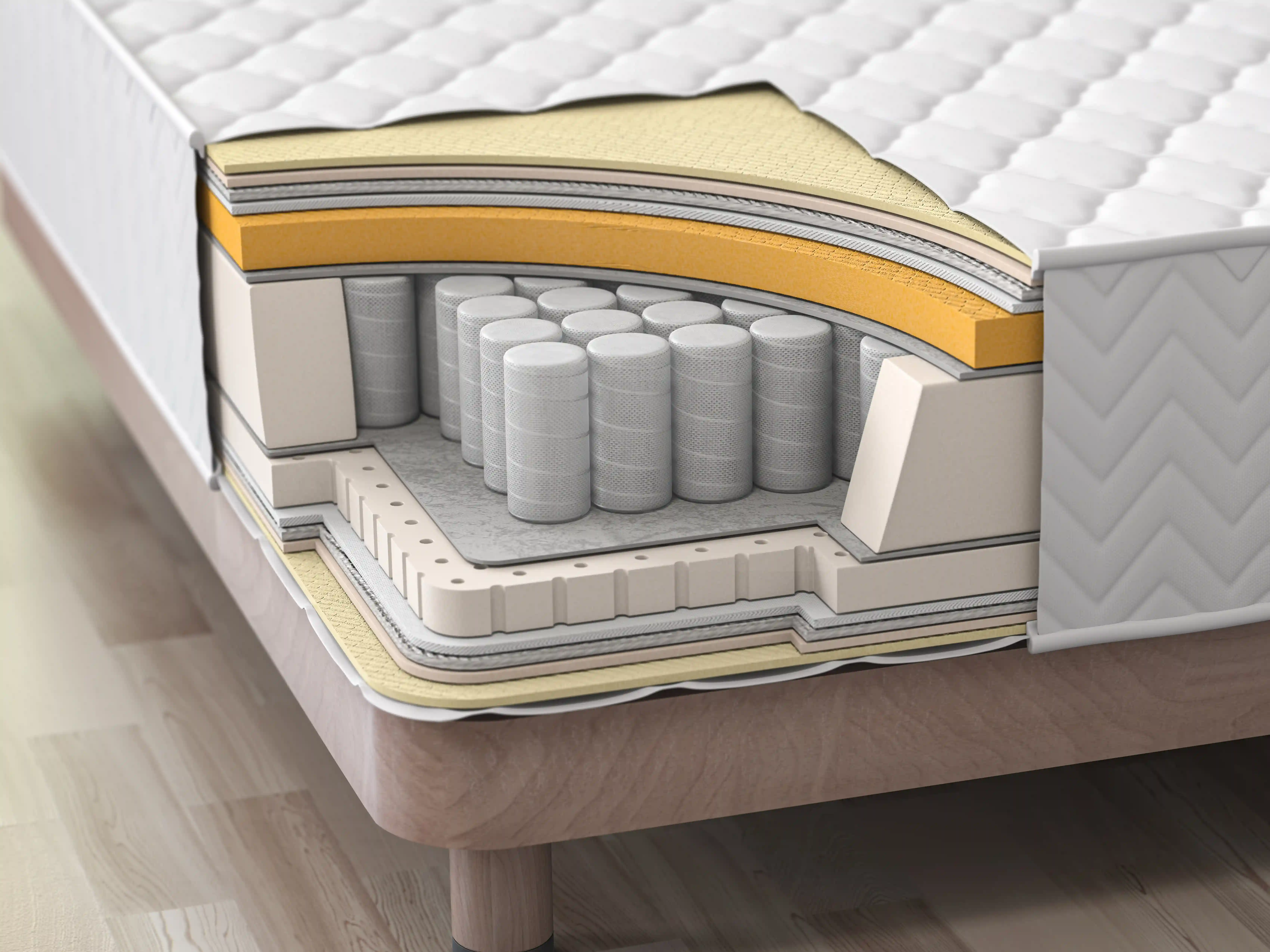
A latex mattress uses latex foam as a substantial comfort or support material. It may be made almost entirely from latex foam, place latex over a coil unit, or combine latex with polyurethane foam, fibers, and other layers.
The word "latex" does not identify one construction. It also does not tell you whether the foam is natural, synthetic, blended, organic, firm, durable, cooling, or suitable for someone with a latex allergy. Those questions require a layer map, material disclosure, and model-specific evidence.
Natural, synthetic, and blended latex describe the material
| Label | What it means | What it does not establish |
|---|---|---|
| Natural rubber latex | The rubber polymer begins with latex collected from the Hevea brasiliensis rubber tree. Commercial foam is compounded and cured with processing ingredients, so "natural" does not mean chemical-free 1. | Organic certification, purity percentage, firmness, or finished-mattress construction |
| Synthetic latex | The foam uses a manufactured rubber latex rather than natural rubber latex. Synthetic rubber latex does not release the natural-rubber proteins associated with immediate latex allergy, but the finished product can still contain other ingredients and materials 1. | A zero-irritation promise, low emissions, or a particular feel |
| Blended latex | The rubber portion combines natural and synthetic rubber. | The proportion of each material, unless the manufacturer discloses it clearly |
If a seller gives a percentage such as "95% natural," ask what the denominator is. It might refer to the rubber polymer, the latex compound, one foam layer, or the entire mattress. These are not interchangeable claims.
Dunlop and Talalay describe manufacturing routes
Dunlop and Talalay are methods for turning liquid latex compound into foam. Research literature describes Dunlop production as foaming, gelling, and curing the compound, while the Talalay route adds vacuum and freezing steps before curing 2.
Neither process name is a universal firmness or quality grade. Dunlop is not automatically 100% natural, and Talalay is not automatically synthetic or blended. The formula, foam density, layer thickness, perforation pattern, zoning, and placement in the mattress all affect the result. Compare the actual model instead of translating "Dunlop" into firm or "Talalay" into soft.
The layer map matters more than the category name
Common constructions include:
- All-latex: Latex foam provides both the upper comfort layers and the deeper support core. A cover and fire-resistant components are still part of the finished mattress.
- Latex hybrid: Latex sits above a steel coil support unit. Other foams or fibers may also be present.
- Mixed-foam mattress: One or more latex layers sit above polyurethane foam or another foam core.
These retail names have no single recipe. Ask for every layer in order, its thickness, and its material. A mattress with a thin latex layer and a thick polyurethane core is a different product from a mattress made from several latex layers, even if both are marketed as latex mattresses.
Firmness numbers need test context
Latex sellers may report density and indentation load deflection, often shortened to ILD. Density describes mass per unit volume. Indentation hardness describes how much force is needed to compress foam under specified conditions. They are related to different properties and should not be treated as the same number.
ISO 2439 includes several indentation methods for flexible foams, and the standard cautions that results relate to the specified test conditions 3. Before comparing ILD figures, ask for the test method, sample thickness, indentation percentage, conditioning, and units. A brand's "soft," "medium," or "firm" scale cannot be converted reliably to another brand's scale without comparable test data.
The rest of the mattress changes the experience
| Question | Details that can change the answer |
|---|---|
| Responsiveness and ease of movement | Latex formulation, layer firmness and thickness, quilting, and the support core |
| Pressure distribution | Surface firmness, depth of softer layers, zoning, body size, sleep position, and the layers below the latex |
| Motion between partners | Layer thickness and softness, coil design if present, edge construction, and the bed frame |
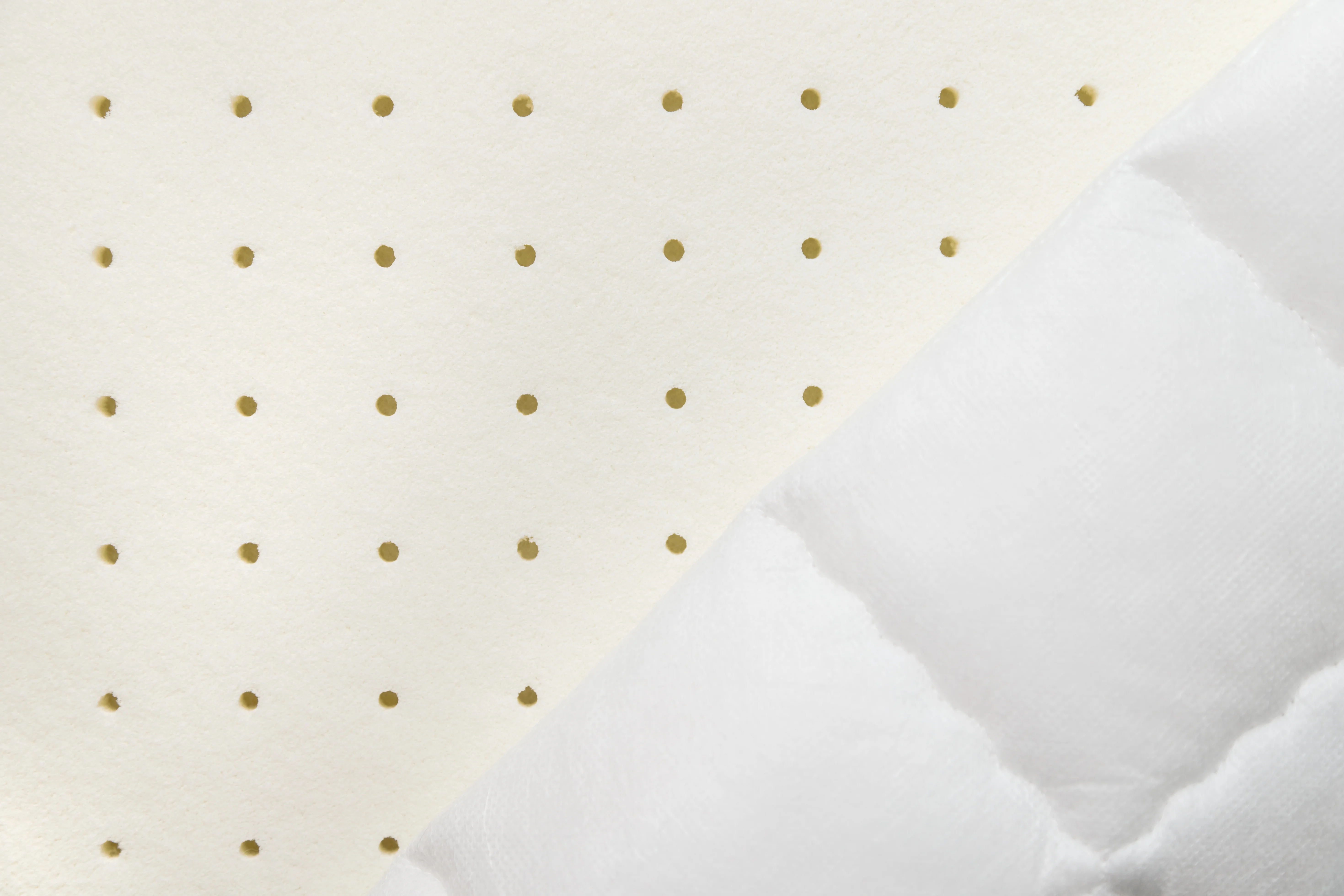
| Temperature | Cover and protector, quilting, foam depth, perforations, airflow around the bed, room conditions, and the sleeper |
| Edge use | Perimeter construction, layer firmness, coil reinforcement if present, and mattress height |
| Odor | Foam formulation, washing and curing, adhesives, cover materials, packaging, storage, and individual sensitivity |
| Weight and handling | Mattress size, latex thickness and density, coils, and whether layers can be moved separately |
| Adjustable-base use | The exact construction and the mattress maker's compatibility instructions |
| Durability | Foam formulation, layer design, sleeper load, foundation, care, and the failure being measured |
A quick-rebounding sample may still allow substantial sink if the upper layers are thick and soft. Perforations can create airflow paths, but they do not prove that the finished mattress will sleep cool. Motion at the surface can also change with the coil unit, frame, and layers around the latex. Try the exact mattress whenever possible.
There is no defensible universal lifespan for every latex mattress. A long warranty is a contract with definitions and exclusions, not a prediction that comfort will remain unchanged for that many years.
Read certification claims by scope
A certification is useful only for the product or component named on its certificate. Ask for the certificate number, certifier, current scope, product appendix when applicable, and the exact model or component covered.
| Claim | What it can tell you | Boundary to check |
|---|---|---|
| GOLS | The Global Organic Latex Standard addresses latex products made from organic raw material and sets requirements for processing, manufacturing, packing, labeling, trading, and distribution 4. | Check whether the scope names latex foam, a mattress, or another product. A certified foam component does not by itself certify every other mattress component. |
| GOTS | The Global Organic Textile Standard covers textiles made from at least 70% certified organic natural fibers. Its "organic" label grade requires at least 95% certified organic fiber content, and mattresses can be within its product scope 5. | GOTS is a textile standard, not evidence that latex foam is organic. For a retail GOTS claim, verify the final product, label grade, certifier, and certification number rather than relying on a supplier's component certificate. |
| OEKO-TEX STANDARD 100 | The named article or component has been tested against the standard's harmful-substance limits for its product class 6. | Read the certificate scope. A certified cover does not mean the whole mattress was tested, and the standard does not certify organic content or prove that a product is chemical-free. |
Certification also does not establish comfort, support, durability, allergy safety, or a medical benefit.
Broad claims such as "eco-friendly," "non-toxic," or "biodegradable" need their own evidence. The Federal Trade Commission advises marketers against unqualified general environmental claims and requires substantiation for non-toxic and free-of claims 7. Natural rubber content alone cannot establish the environmental impact or end-of-life behavior of an entire mattress.
Ask what provides fire resistance
U.S. mattresses are subject to federal smoldering and open-flame performance standards 8. Those tests do not identify the fire-resistant material used in a particular model.
Ask the manufacturer for the cover, fire barrier, adhesives, and other materials in writing. Do not remove a cover merely because it has a zipper. A zipper does not establish that the cover is removable for cleaning. Follow the exact model's care instructions.
Latex allergy requires a more careful decision
Immediate natural-rubber-latex allergy is an immune reaction to proteins in natural rubber latex. Processing chemicals can also cause skin reactions through a different mechanism 1. A latex mattress should not be described as naturally hypoallergenic, antimicrobial, dust-mite-proof, or beneficial for health based only on its foam material.
Clinical latex-allergy guidance focuses heavily on direct skin or mucosal contact and exposure to airborne protein carried by powdered gloves. Mattress foam enclosed inside ticking is a different exposure situation, but that difference is not proof of zero risk 9.
If you have a diagnosed or suspected latex allergy:
- Do not unzip the mattress or handle exposed foam as a home test.
- Ask the manufacturer whether any layer, adhesive, elastic, or other component contains natural rubber latex.
- Discuss the purchase with an allergist, particularly if you have had breathing symptoms, widespread hives, or anaphylaxis around latex.
- For a severe known allergy, a mattress confirmed to contain no natural rubber latex may be the more cautious option.
Synthetic rubber latex does not release the Hevea proteins responsible for immediate natural-rubber-latex allergy, but that fact does not make every synthetic-latex mattress irritation-proof. Verify the entire construction, not only the main foam.
A practical buying checklist
- Get the full specification. Request the ordered layer map, thickness of every layer, natural or synthetic content, Dunlop or Talalay process if claimed, density and test basis for firmness figures, cover, fire-resistant components, adhesives, and support core.
- Verify the certification. Match the certificate number and scope to the exact model or named component. Do not let a certified cover stand in for an uncertified mattress.
- Try the exact design. In a showroom, use your normal sleep positions and include the edge if you sit or sleep there. For an online purchase, treat the home trial as the real fit test.
- Read the return terms before ordering. Check the minimum and maximum trial periods, pickup or donation procedure, return fees, required condition, and whether opened or exchanged products qualify.
- Plan the setup. Confirm total and boxed weight, room-of-choice delivery, foundation type, maximum slat spacing, center-support requirements, and adjustable-base approval.
- Follow model-specific care. Check whether rotation is allowed, whether the cover is removable, how spills should be cleaned, and what protector the maker recommends.
- Read the warranty definition of a defect. Note the indentation threshold, measurement method, required base, exclusions for softness or comfort preference, and who pays transport costs.
A latex mattress can be a good fit when you like the exact model's response, pressure distribution, and construction. The useful comparison is not latex versus non-latex in the abstract. It is one disclosed mattress against another, with its full materials, evidence, purchase terms, and fit for your body and bedroom.