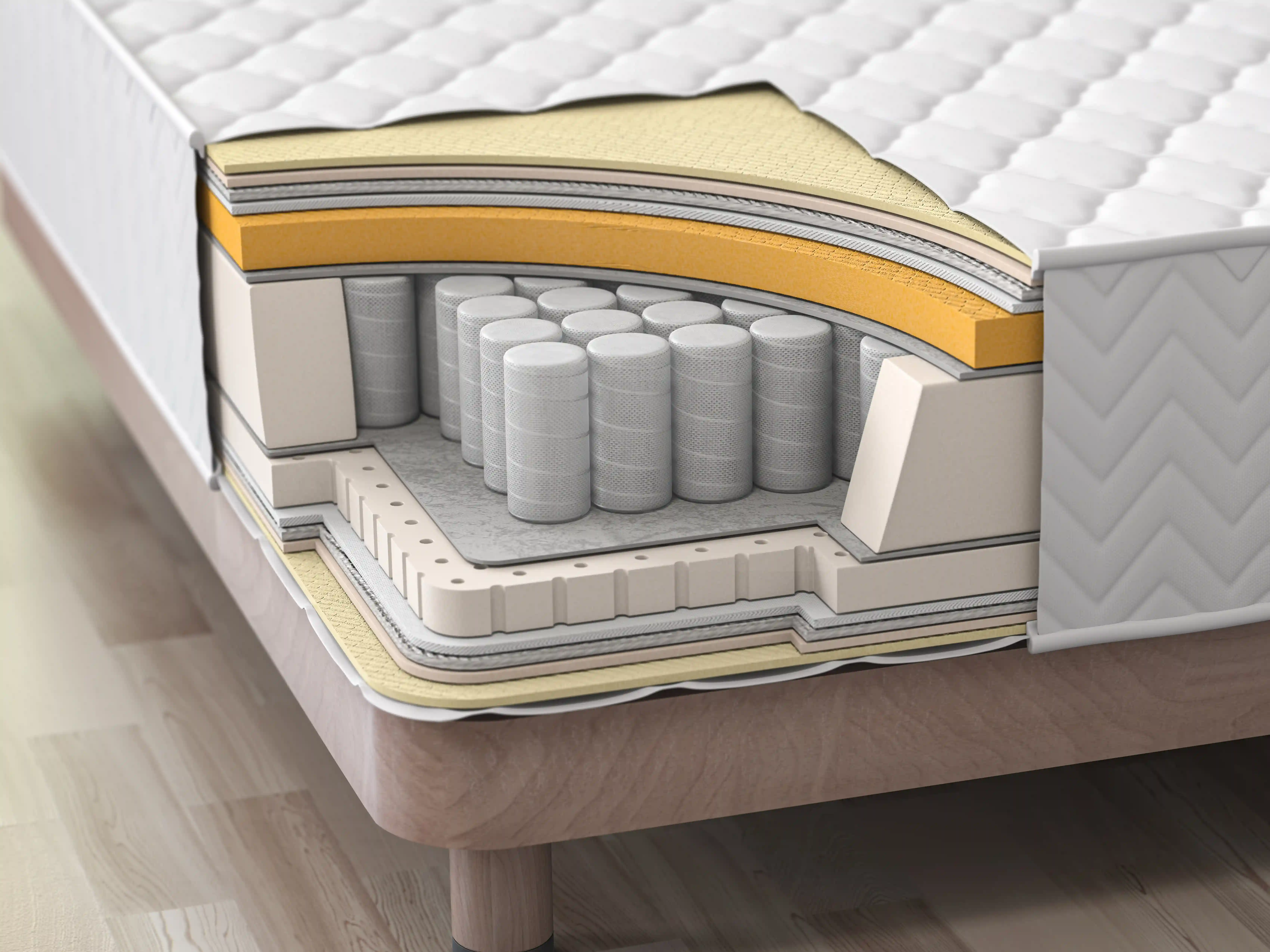

An innerspring mattress uses a steel spring unit as its main support core, with insulation, padding, or other upholstery between the coils and the sleeper. The springs may be linked together or individually enclosed in fabric pockets 12.
Traditional innersprings usually have a shallower comfort system than mattresses sold as hybrids. That boundary is not standardized, however. A plush innerspring can contain foam, fibers, latex, or small comfort coils, while a seller may call a similarly layered product a hybrid 1. Read the full construction instead of treating either name as a fixed recipe. The separate hybrid mattress guide explains that overlapping category in more detail.
What is inside an innerspring mattress?
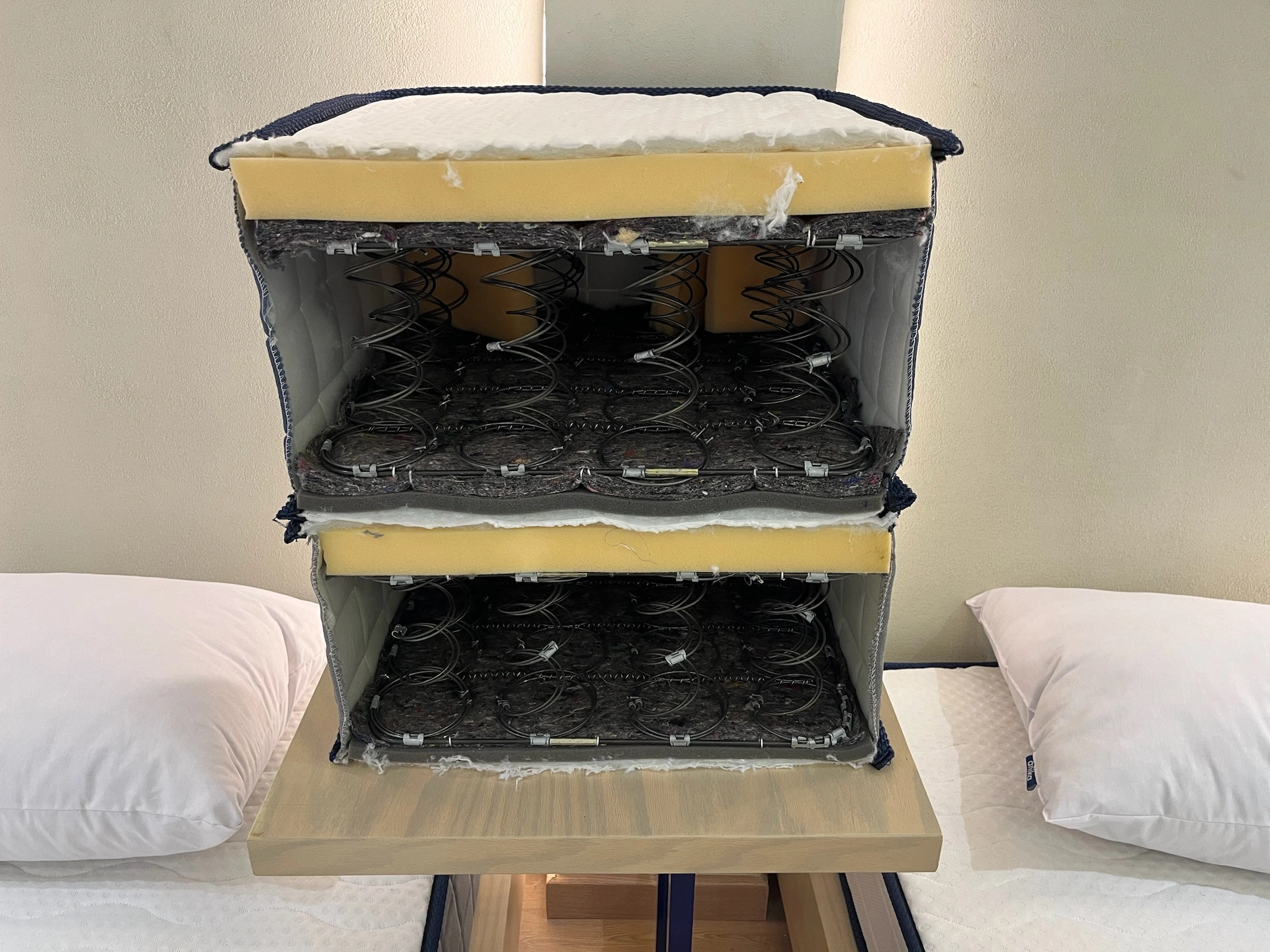
A finished mattress is more than a bare spring unit. From the surface down, it may contain:
- a woven or knit cover, sometimes quilted with foam or fiber
- a fire-barrier system beneath or integrated with the cover
- comfort upholstery made from foam, latex, cotton, wool, other fibers, or small coils
- an insulator that helps keep softer upholstery from pressing into the main springs
- the steel innerspring unit
- perimeter components such as a border wire, edge springs, firmer outer coils, or foam rails
- a bottom panel and, in a one-sided model, a stabilizing layer beneath the springs
This layer sequence matters. The upholstery shapes the immediate cushioning and can damp movement or sound from below. The spring unit supplies the main deeper resistance. Two mattresses with the same coil family can therefore feel and perform differently.
Four common innerspring units
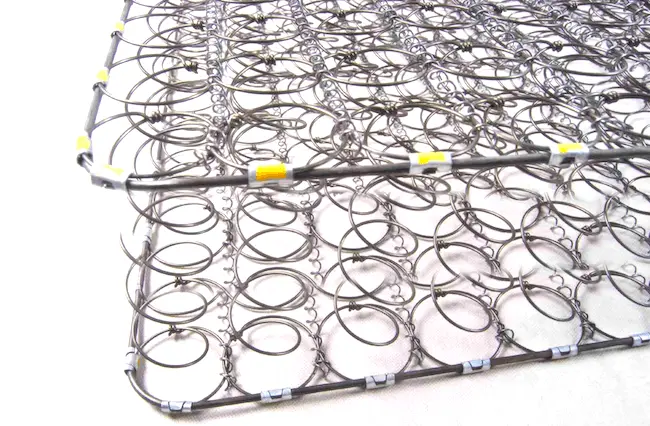
U.S. and Canadian government descriptions of the bedding trade identify four broad coil styles 23.
| Coil family | How it is built | What the construction suggests | What it cannot tell you |
|---|---|---|---|
| Bonnell or open coil | Individual hourglass-shaped coils are joined to adjacent coils with spiral helical wires | Load and movement can engage a wider connected area | Finished firmness, comfort, noise, or useful life |
| Offset coil | Individual coils have flatter or squared upper and lower portions and are joined with helicals | The hinge-like connection changes how the linked unit responds | That it will isolate motion or feel better than another design |
| Continuous-wire coil | One piece of wire forms a row or lattice of springs, with rows commonly linked by helicals | The unit behaves as an interconnected system | How much steel it contains or how the complete mattress will feel |
| Pocketed, encased, or Marshall coil | Each coil sits in a fabric pocket, and the pockets are joined by stitching, welding, or adhesive | Coils have less direct wire-to-wire linkage and can respond more locally | Perfect motion isolation, quietness, durability, or hybrid status |
Pocketed coils do not automatically make a mattress a hybrid. They are one kind of innerspring unit and can appear beneath a shallow or deep comfort system.
Coil specifications are context, not report cards
A coil count or gauge can help describe a spring unit, but neither is a quality score.
Coil gauge is a wire-thickness convention. In the gauge system commonly used for bedding wire, a lower number generally indicates thicker wire. The effect of that wire depends on coil height, diameter, shape, turns, spacing, steel treatment, connection method, and the upholstery above it 34.
Coil count must name the mattress size and what was counted. A queen and king using the same unit design will have different totals. A number may count only the main support unit or may combine support coils with microcoils, edge coils, or a second spring layer. More coils do not by themselves prove greater comfort, stability, or durability. Government industry descriptions likewise show that manufacturers use different count and gauge combinations to reach different responses 3.
Working turns describe how many active windings a coil has. Turns interact with wire thickness, coil diameter, height, and shape, so a higher number is not automatically better 4.
Preload or precompression means a spring has already been compressed before anyone lies on it. For example, a pocketed unit may place a taller coil inside a shorter fabric pocket. This changes the spring's starting response, but the word alone does not predict the feel of the completed mattress 5.
Zoning means selected areas use a different coil, spacing, connection, or neighboring material. Ask where each zone is, how it differs, and whether you can feel the transition. A zone name is not evidence of better alignment or pain relief.
Edge systems may use a border rod, clip-on edge springs, firmer or more densely arranged perimeter coils, foam rails, or no distinct reinforcement. These designs can change sitting feel, usable surface, and bending in different ways. Test the edge rather than judging it from the phrase "edge support."
How construction can affect everyday use
Innersprings are often described with simple promises such as bouncy, cool, firm, or durable. The complete model determines whether those descriptions fit.
| Question | Parts that may matter | Why the category cannot answer it |
|---|---|---|
| Surface cushioning | Upholstery material, thickness, firmness, quilting, and insulator | Traditional designs are often shallow, but some innersprings have substantial pillow or Euro tops |
| Responsiveness and movement | Coil connection, preload, upholstery recovery, and depth of sink | Linked and pocketed units can both feel quick or muted once the upper layers are included |
| Motion across the bed | Coil linkage, pocket construction, foam or fiber layers, base, and bed size | Pocketing may reduce direct mechanical linkage, but it does not eliminate all movement |
| Temperature | Cover, upholstery, protector, bedding, room, and air spaces in the unit | Open space around coils may permit airflow without guaranteeing a cool surface |
| Noise | Spring contacts, pockets, adhesives, frame, foundation, fasteners, and wear | A sound that seems to come from the mattress may come from the base or frame |
| Edge use | Perimeter design, upper layers, base, and how the edge is loaded | Reinforcement can feel stable, abrupt, soft, or restrictive depending on the model |
| Bed height | Mattress profile plus foundation, frame, and bedding | A taller mattress is not necessarily more supportive and may make transfers or fitted-sheet use harder |
| Weight and handling | Steel quantity, upholstery volume, size, compression, and handles | Category names cannot replace the listed product and package weights |
| Adjustable-base use | Coil unit, border, perimeter, profile, and manufacturer approval | Some innersprings can flex on an adjustable base; others are approved only for a flat support |
| Durability | Upholstery fatigue, coils, seams, edges, base, moisture, use, and care | Coil count, price, thickness, and warranty length do not establish a lifespan |
Mattress coils are not a box spring
The innerspring is inside the mattress. A box spring is a separate flexible base that contains springs or other yielding components. A foundation is the broader term for a structure that supports the mattress and can contain a frame, foam, box springs, or other materials. A platform or slatted frame may provide support without being a box spring 6.
Do not assume an innerspring mattress needs a box spring, or that any flat-looking base will work. The approved base may be a matching foundation, rigid platform, slats with a stated maximum gap, or a compatible adjustable base. Center-support and load requirements can also vary by mattress size. Follow the instructions for the exact model because the base can change feel, noise, apparent sagging, and warranty eligibility.
A focused buying checklist
Read the specification sheet
Record the exact model, size, firmness version, stock-keeping unit, and construction revision. Then look for:
- every layer in order, including upholstery materials and thicknesses
- whether the main coil unit is Bonnell, offset, continuous wire, or pocketed
- coil count for the chosen size and whether the total includes microcoils or edge coils
- gauge or gauges, coil height, turns, preload, tempering, and connection method when disclosed
- the location and construction of any zones and perimeter reinforcement
- total dimensions, product weight, package size, and package weight
- whether the mattress is one-sided or designed for flipping
- the approved foundation types, slat spacing, center support, load limits, and adjustable-base compatibility
- cover composition, whether it is intended to be removed, and exact cleaning instructions
A missing specification is an unknown. Do not infer it from the price, total height, coil count, firmness label, or a word such as premium.
Try the exact model
In a store, confirm that the display is the same model, size, firmness, and revision you can buy. Lie down long enough to notice the surface cushioning and whether the firmer layers become obvious. Turn over, sit up, get out of bed, and use the edge as you would at home. If the bed will be shared, have one person move while the other remains still. Listen for the mattress, base, and frame separately.
A short visit cannot establish long-term comfort, temperature, or durability. Use it to reject clear mismatches and decide what to examine during a home trial.
At home, use the approved base and your normal protector, sheets, and room conditions. Keep brief notes on comfort, movement, edge use, temperature, noise, and any visible slope or failed expansion. Change only one removable factor at a time when practical, and do not cut, unzip, or otherwise modify the mattress during the return window.
Plan delivery and setup
Check the packaged dimensions, route through doors and stairs, lifting responsibility, room-of-choice service, old-mattress removal, and disposal terms. Confirm whether the mattress arrives flat or compressed, how it should be opened, how long expansion may take, and when the maker permits first use. Photograph shipping damage, a wrong model label, or a failure to reach stated dimensions before contacting the seller.
Follow the model's care rules
Rotate only as directed. Flip only when the construction and instructions explicitly permit it. A one-sided mattress turned upside down places the designed sleep surface against the base.
Follow the maker's stain and cleaning instructions. A zipper does not prove that the cover is removable or machine washable. U.S. federal standards evaluate smoldering and open-flame performance of the mattress or mattress set as manufactured, and the certified prototype is defined by its materials, components, design, and assembly. Those rules do not identify the internal barrier material for shoppers or authorize removal of a cover. Do not disturb the cover, fire barrier, or internal layers unless the exact model instructions explicitly allow it 6.
Separate the trial, return policy, and warranty
A comfort trial is a period for deciding whether to keep the mattress. The return policy controls notice deadlines, minimum-use periods, eligible condition, pickup or shipping, fees, exchanges, and refunds. The warranty covers only the defects and remedies written in its terms.
Read the warranty before buying. The FTC advises checking duration, covered and excluded parts or repairs, required care, the claims process, available remedy, and who pays shipping or other service costs. Save the warranty and receipt 7.
For a mattress, also note:
- how a qualifying indentation is measured and whether the threshold differs by model
- whether comfort softening, body impressions, stains, burns, tears, or bent border components are excluded
- which base and center support are required
- whether coverage is prorated or limited to the original purchaser
- whether transportation, inspection, replacement, or disposal costs are yours
A long warranty does not promise that the feel will remain unchanged for that many years, and a warranty claim is not the same process as a trial return.
The bottom line
An innerspring mattress is defined by a steel spring unit serving as its main support core beneath upholstery. Bonnell, offset, continuous-wire, and pocketed coils describe different ways to form and connect that unit. None is automatically the best construction.
Compare the complete layer stack and the exact coil details, then test the model under realistic conditions. Verify the approved base, delivery, care, return, and warranty terms before buying. Those facts are more useful than a high coil count, a category label, or a universal sleeper recommendation.