

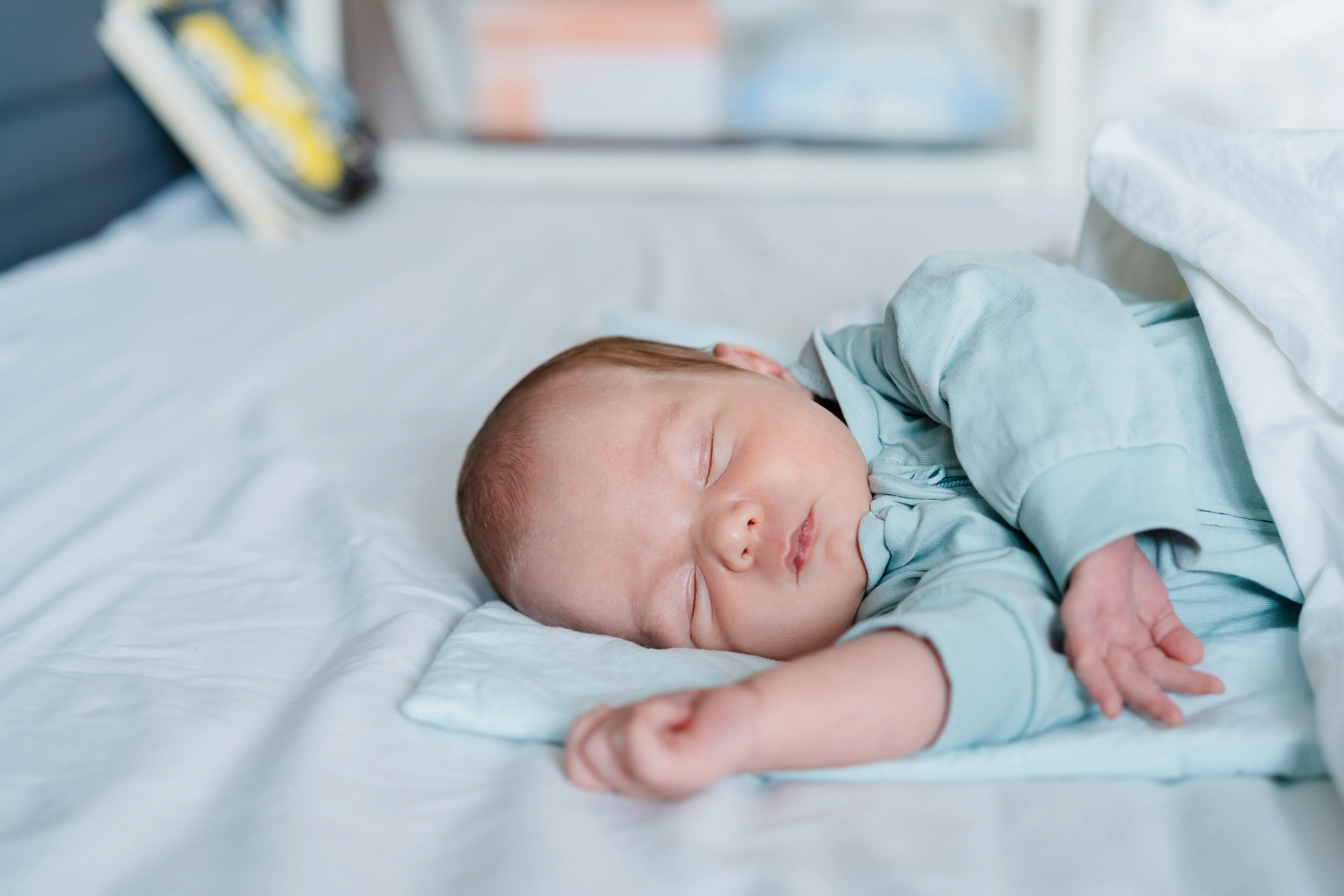
Benign neonatal sleep myoclonus is a non-epileptic movement pattern in which a young infant has repetitive jerks during sleep, the movements stop with arousal, and the baby is otherwise well. It usually starts in the first days or weeks after birth and settles without treatment over the following months 1.
Those features can point a clinician toward the diagnosis, but they do not let a caregiver prove at home that an event is harmless. Seizures, low blood glucose, infection, and other newborn conditions can also cause unusual movements. A newborn with a first episode of repetitive jerking should be assessed promptly, and breathing or color change, unresponsiveness, fever, or movements while awake require urgent help 2.
What benign neonatal sleep myoclonus looks like
Myoclonus means a sudden, brief muscle jerk. In benign neonatal sleep myoclonus, the jerks may repeat rhythmically or in bursts. They commonly involve the arms or legs and may involve several limbs at once. The pattern can be bilateral, one-sided, or move between body parts, so symmetry alone cannot identify it 3.
Clinicians look for a combination of features:
-
onset during the neonatal period, usually within the first few weeks;
-
jerks that occur only while the infant is asleep or drowsy and end when the infant becomes awake;
-
normal breathing, color, feeding, alertness, and behavior around the episodes; and
Episodes may last seconds or minutes and can recur during the same sleep period. Some reports describe much longer clusters. Duration by itself therefore cannot confirm either benign sleep myoclonus or a seizure 1.
In a 38-infant case series, the movements began between the first and sixteenth day of life. Most were bilateral and symmetric, but that series also found mild neurological examination or imaging findings in some infants. This is one reason the diagnosis should rest on the baby's complete clinical picture, not a checklist viewed in isolation 3.
What “stops with arousal” means
In reported cases, the jerking ends when the infant becomes awake. That relationship to sleep is a major diagnostic clue. It is not a home seizure test, and caregivers should not shake a baby, repeatedly provoke an episode, or try to wake a baby who is having trouble breathing, looks unwell, or is difficult to rouse.
If the baby wakes naturally or during ordinary care, note whether the movements stopped. A clinician can interpret that observation together with the video, examination, birth history, and any other symptoms.
How it differs from seizures and other newborn movements
No single visible feature separates every neonatal seizure from every non-epileptic movement. Neonatal seizures can be motor or nonmotor and may be subtle. EEG is central when a seizure is suspected because the electrical event, not appearance alone, determines whether an observed movement is epileptic 5.
Useful distinctions include:
| Pattern | Features that may point toward it | Why medical assessment still matters |
|---|---|---|
| Benign neonatal sleep myoclonus | Repetitive jerks only in sleep, ending with arousal; infant feeds and behaves normally between events | One-sided or prolonged events can still occur, and the whole pattern must fit |
| Epileptic seizure | May occur while awake or asleep; may include sustained stiffening, abnormal eye or mouth movements, breathing or color change, or impaired responsiveness | Some seizures are subtle or have no obvious outward movement; video-EEG may be needed |
| Jitteriness or tremor | Fine, fast shaking often triggered by crying or stimulation; it may settle with soothing or gentle flexion | Jitteriness can also accompany low glucose, low calcium, withdrawal, infection, or brain injury |
| Hyperekplexia | Exaggerated startle with marked stiffness, often while awake; some infants have pauses in breathing | This rare condition can create airway risk and needs specialist assessment |
| Metabolic or infectious illness | Poor feeding, abnormal temperature, unusual sleepiness, irritability, low tone, vomiting, or movements while awake | A newborn can become seriously ill quickly even when the first sign seems subtle |
Jitteriness usually behaves differently from sleep myoclonus: gentle flexion may stop a tremor, while holding a limb with sleep myoclonus may fail to stop the jerks and can sometimes make them more prominent. Hyperekplexia is distinguished by an excessive startle response and generalized stiffness, with apnea in some infants 2.
These differences are guides for clinicians, not instructions to restrain a newborn or deliberately trigger movements.
How clinicians make the diagnosis
The assessment starts with the event and the infant's health before, during, and after it. The clinician may ask:
-
When did the movements begin, and was the baby asleep, drowsy, or clearly awake?
-
Which body parts moved, how long did the event last, and did the same pattern repeat?
-
Did breathing, skin or lip color, eye position, mouth movements, muscle tone, or responsiveness change?
-
Did the jerking end when the baby became awake?
-
Is the baby feeding normally and producing the usual wet diapers?
-
Was the baby premature, unwell around birth, or exposed to medicines or substances that could cause withdrawal?
-
Is there fever, vomiting, unusual sleepiness, irritability, or another sign of illness?
A physical and neurological examination checks alertness, tone, reflexes, symmetry, feeding, and signs of infection or metabolic illness. A convincing history or video and a normal examination may be enough for an experienced clinician to diagnose a classic presentation. A short home video can be particularly useful because it shows the movement pattern and the baby's state at the same time 4.
When EEG helps
If the event is atypical, the infant is unwell, the examination is abnormal, or seizure remains possible, clinicians may use EEG. Video-EEG is most informative when it captures a typical event and links the movement to the baby's electrical brain activity. A normal routine EEG recorded only between events does not, by itself, prove that a witnessed episode was benign 5.
Blood glucose, electrolytes, infection testing, brain imaging, or other studies are selected when the history or examination points to a particular cause. They are not automatically required after a clinician has established a classic benign pattern. Conversely, avoiding all tests is not appropriate when the baby is ill or the diagnosis is uncertain 2.
Treatment and expected course
Confirmed benign neonatal sleep myoclonus does not require medicine or attempts to suppress the movements.
Anti-seizure medicines do not treat this condition. In a published series of 15 infants initially mistaken for having epilepsy, seven received anti-seizure medicines without benefit. Sedation can extend sleep and make the jerking seem more frequent, while medication effects can further complicate assessment 6. Depending on the drug and dose, acute anti-seizure treatment in a newborn can also depress breathing or blood pressure and obscure the neurological examination 2.
That does not mean suspected neonatal seizures should go untreated. Clinicians may need to treat while urgent evaluation is underway. A caregiver should never start, stop, or change a prescribed anti-seizure medicine without the treating team.
Gentle restraint is not a treatment. A review of 164 reported infants found that holding the limbs sometimes stopped the jerks but sometimes worsened them. Anti-seizure medication was also ineffective or associated with worsening in reports included in that review 1. The reason restraint can intensify the movements is not established.
Most reported cases resolve during early infancy. In the 38-infant case series, the median resolution age was 2 months, with a range from 2 weeks to 10 months 3. A broader literature review found that about one-third of reported infants still had episodes after 3 months 1.
Follow-up in published reports has generally been reassuring, but the evidence base is limited. The literature review included only 164 infants, mostly born at or near term, drawn from small reports that may not represent every baby seen in practice. The exact prevalence, cause, and full range of duration are not established 1.
What to do if you see an episode
-
Keep the baby physically safe. Leave or place the infant on their back on a firm, flat, noninclined sleep surface with no pillows, loose bedding, positioners, or soft objects 7.
-
Watch breathing, color, and responsiveness. Call emergency services immediately if breathing is difficult or stops, the lips or skin turn blue, gray, or markedly pale, or the baby is unresponsive.
-
Time the event. Note when it began, whether the baby was asleep or awake, and whether the baby returned to usual behavior afterward.
-
Record a short video if it is safe. Try to include the face and whole body. Do not delay emergency help, move the baby into an unsafe position, or continue filming if the baby looks ill.
-
Do not shake or pin the baby down. Do not put anything in the baby's mouth and do not deliberately provoke another event 8.
If the infant is in a hospital or neonatal unit, alert the clinical staff rather than manipulating the baby to test the movement.
When a newborn needs urgent care
Call emergency services now if:
-
the baby has trouble breathing, pauses in breathing, choking, or blue, gray, or markedly pale color;
-
the baby is limp, unresponsive, unusually difficult to wake, or does not return to usual behavior after the event;
-
the event is continuing, several concerning events occur close together without normal recovery, or this is a first suspected seizure; or
-
the movements occur with a serious injury.
Emergency guidance recommends immediate help for a first seizure, an event lasting more than 5 minutes, repeated seizures, or trouble breathing or waking afterward 8. For a newborn, do not wait for 5 minutes when breathing, color, or responsiveness is abnormal.
Seek urgent same-day assessment in an emergency department or as directed by the baby's clinician if:
-
jerking occurs while the baby is awake or continues after the baby is clearly awake;
-
events are consistently focal or asymmetric, or include forced eye deviation, repeated mouth movements, or sustained stiffening;
-
feeding drops, vomiting recurs, wet diapers decrease, or the baby seems unusually sleepy, irritable, floppy, or otherwise ill;
-
the movements follow a difficult birth, head injury, or possible medicine or substance exposure; or
-
the baby is 3 months old or younger and has a rectal temperature of 100.4°F (38°C) or higher 9.
Focal or asymmetric jerks have been described in benign neonatal sleep myoclonus, but they also raise concern for a seizure. They should not be dismissed at home. If you are unsure whether an event meets an emergency threshold, seek urgent medical help.