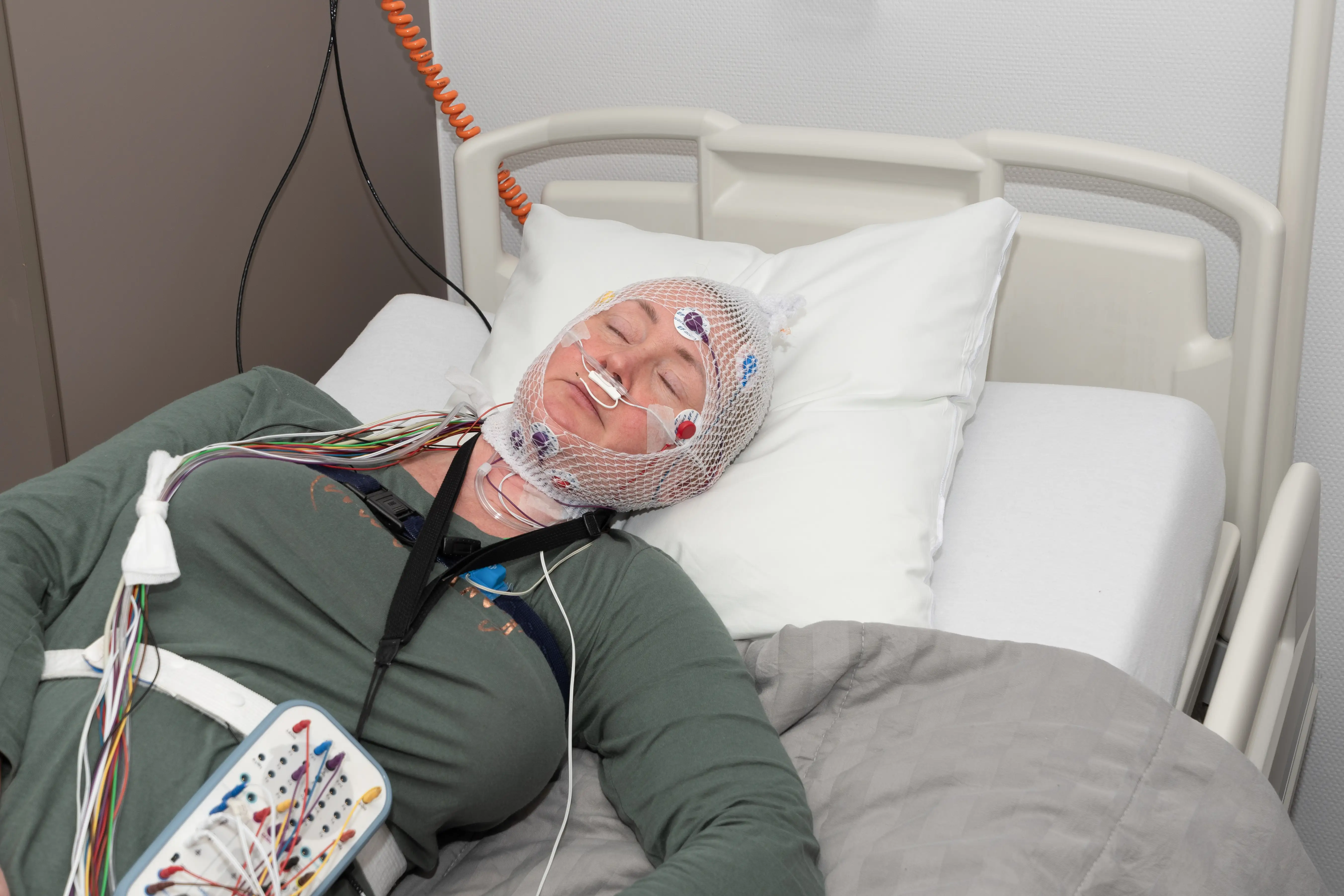
Central sleep apnea (CSA) is a group of sleep-related breathing disorders in which airflow repeatedly stops or becomes very shallow because the effort to breathe temporarily falls or stops. That missing effort is the feature that separates a central event from an obstructive one 1 2.
CSA is not simply a case of the brain “forgetting to breathe,” and the airway is not guaranteed to stay open. In many people, the breathing-control system becomes unstable and repeatedly overshoots and undershoots. Opioids and some neurologic conditions can instead reduce respiratory drive. Obstructive narrowing can coexist with either mechanism, so a person may have central, obstructive, and mixed events in the same night 1 3.
Central, obstructive, and mixed apneas are different events
A sleep study classifies an apnea by comparing airflow with breathing effort from sensors around the chest and abdomen 2.
| Event | Airflow | Breathing effort |
|---|---|---|
| Central apnea | Stops or nearly stops | Absent throughout the event |
| Obstructive apnea | Stops or nearly stops because the upper airway closes | Continues or increases against the blockage |
| Mixed apnea | Stops or nearly stops | Absent at first, then resumes while airflow remains blocked |
The distinction matters because opening an obstructed airway and supporting an absent breathing effort are different treatment jobs. The word “mixed” describes the physiology within an event. It should not be confused with having both central and obstructive events across a night.
Why central breathing pauses happen
Breathing during sleep depends heavily on feedback from carbon dioxide and oxygen levels. In common forms of CSA, a period of deeper or faster breathing lowers carbon dioxide below the level needed to sustain the next breath during sleep. Breathing pauses, carbon dioxide rises again, and the cycle restarts. Heart-failure-related Cheyne-Stokes respiration and high-altitude periodic breathing often follow this unstable pattern 1 3.
Opioid-related CSA can work differently. Opioids may depress respiratory drive and blunt the response to carbon dioxide. They can also produce irregular breathing and sleep-related hypoventilation, which is sustained underbreathing rather than a series of discrete central apneas. A person can have both problems, but the testing and ventilatory support needed may differ 1 3.
Sleep specialists classify adult CSA by its setting because that often points toward the cause and useful treatments 1 3:
- CSA with Cheyne-Stokes respiration: Breathing repeatedly grows deeper, then shallower, around central events. This pattern is strongly associated with heart failure, although it can appear in other medical or neurologic settings.
- CSA due to a medication or substance: Opioids are the best-established cause. A complete review includes prescription medicines, nonprescription substances, alcohol, and combinations that suppress breathing.
- Treatment-emergent CSA: Central events appear or persist as obstructive events are treated, most often during continuous positive airway pressure (CPAP) therapy.
- High-altitude periodic breathing: Lower oxygen pressure after ascent can destabilize breathing, especially during non-rapid eye movement sleep.
- CSA due to another medical or neurologic disorder: Examples include selected brainstem or spinal cord disorders, stroke, and advanced kidney disease. The diagnosis should fit the person's full clinical picture rather than a generic list of associations.
- Primary CSA: No medication, altitude exposure, or medical cause is found after an appropriate evaluation. This is a diagnosis of exclusion 1 3.
Congenital central hypoventilation and other disorders that cause sustained underbreathing are related disorders of respiratory control, but they are not interchangeable with adult CSA. A report that shows high carbon dioxide needs a hypoventilation-focused evaluation, not just a count of apneas 1 2.
Symptoms and bed-partner observations
CSA can cause fragmented sleep, insomnia, daytime sleepiness, fatigue, difficulty concentrating, morning headache, or waking short of breath. Some people have few noticeable symptoms and are tested because of heart failure, opioid treatment, neurologic disease, or an unexpected pattern on another sleep study 1 3.
A bed partner may notice quiet pauses followed by deeper breathing, a waxing-and-waning breathing pattern, or occasional gasps. Loud snoring and repeated choking point more strongly toward obstruction, but they do not rule central events in or out. People often have both mechanisms.
None of these symptoms identifies CSA by itself. Heart failure, lung disease, medication effects, insomnia, insufficient sleep, and other sleep disorders can cause similar complaints. New breathlessness while awake, chest pain, fainting, or neurologic symptoms should not be attributed to sleep apnea without medical assessment.
How central sleep apnea is diagnosed
Polysomnography shows whether effort disappears
An attended overnight polysomnogram records sleep stages, airflow, chest and abdominal effort, oxygen saturation, heart rhythm, and other signals. In adults, an apnea is generally scored when airflow falls by at least 90% for at least 10 seconds. It is central only when inspiratory effort is absent throughout the event 2.
Diagnosis is not based on one pause. A sleep specialist considers the number and proportion of central events, whether they occur during sleep rather than wakefulness, the breathing pattern around them, symptoms, and the criteria for the suspected CSA category. Classifying hypopneas as central or obstructive can be less reliable than classifying complete apneas, which is one reason the entire study and clinical context matter 1 2.
Oxygen saturation shows the gas-exchange effect of disturbed breathing, but a drop in oxygen does not reveal the mechanism. End-tidal or transcutaneous carbon dioxide monitoring may be added when opioid-related respiratory depression, neuromuscular weakness, or sleep-related hypoventilation is possible 2.
A home test may miss the question
Home sleep apnea testing is designed primarily for diagnosing obstructive sleep apnea in uncomplicated adults. The American Academy of Sleep Medicine recommends in-lab polysomnography instead when central apnea, significant heart or lung disease, respiratory muscle weakness, hypoventilation, chronic opioid use, or a history of stroke is a concern 4.
Some medical home tests record airflow, oxygen, and breathing effort, but they usually do not measure sleep stages and are not interchangeable with a full study for every patient. A negative or automatically scored home result does not settle suspected CSA 4.
A watch, ring, phone app, or consumer pulse oximeter may reveal a pattern worth discussing, but it cannot show whether respiratory effort stopped. Consumer sleep technology should not replace validated diagnostic testing 5. Bring the original data or report to the appointment rather than treating an oxygen graph as a diagnosis.
The next step is finding the setting and cause
The workup should be guided by the history and sleep-study pattern. It commonly includes 3:
- A complete list of medicines and substances, with special attention to opioids and combinations that depress breathing
- Assessment for heart-failure symptoms and review of cardiac testing, including left ventricular ejection fraction when ASV might be considered
- The timing and elevation of recent travel
- A neurologic examination when there are focal symptoms, a relevant injury, or signs of a brainstem, spinal cord, or neuromuscular disorder
- Selected blood tests or carbon dioxide measurements when kidney disease, a metabolic problem, or hypoventilation is plausible
Brain imaging, echocardiography, and extensive laboratory testing are not automatic for every central event. The clinician chooses them when the history, examination, or breathing pattern gives a reason 3.
Treatment starts with the cause and the outcome that matters
Treatment is individualized around the CSA category, coexisting obstruction, symptoms, oxygen and carbon dioxide findings, heart function, and the person's priorities. The 2025 AASM guideline makes only conditional recommendations because the evidence is generally low or very low certainty. It advises clinicians to optimize contributing conditions and improve symptoms and quality of life, not simply drive the event count toward zero 1.
That distinction prevents two common mistakes. A device can suppress events without curing heart failure, medication-related respiratory depression, or a neurologic disorder. Conversely, improving the underlying condition does not guarantee that every central event will disappear. Follow-up checks both the breathing data and how the person is functioning.
Treat contributing conditions safely
Heart-failure-related CSA is managed alongside current heart-failure care. A cardiology and sleep team may review fluid status, heart rhythm, medicines, and left ventricular function before adding a breathing treatment 1. Do not stop or alter a heart medicine because of a sleep-study result without the prescriber.
If an opioid or another respiratory depressant may be contributing, the sleep clinician should coordinate with the prescriber, pain team, or addiction specialist. A gradual, individualized reduction or substitution may help some people, but it is not always feasible and does not guarantee resolution. The US Food and Drug Administration warns against rapidly reducing or abruptly stopping opioids in a physically dependent person because withdrawal, uncontrolled pain, and other serious harms can result 6.
For high-altitude periodic breathing, acclimatization may reduce symptoms for some people, and descent is the definitive response to altitude-related CSA. Low-flow oxygen or acetazolamide may be considered for symptomatic adults, but evidence is based mainly on short studies and improvements in breathing indices do not always translate into better daytime symptoms 1. Confusion, inability to walk straight, breathlessness at rest, or worsening illness at altitude can signal cerebral or pulmonary edema and calls for urgent descent and emergency care, not a sleep-apnea remedy 7.
Breathing treatments are not interchangeable
The available options differ in what they support and in the CSA categories for which evidence exists 1.
| Treatment | Where it may fit | Main limits |
|---|---|---|
| CPAP | Often a practical first consideration, especially when obstruction coexists or in treatment-emergent CSA | It does not consistently suppress central events, so response should be confirmed with sleep testing and device data |
| Bilevel PAP with a backup rate | Can deliver a timed breath when effort is absent in selected primary, medication-related, treatment-emergent, or medical-condition CSA | Evidence is very limited; the current AASM guideline does not make a recommendation for this mode in heart-failure-related CSA |
| Bilevel PAP without a backup rate | Not recommended as a CSA treatment | Pressure support without timed breaths can trigger or worsen central apnea and periodic breathing |
| Adaptive servo-ventilation (ASV) | Adjusts support from breath to breath and can control several forms of CSA and mixed central-obstructive breathing | Heart-failure status, left ventricular ejection fraction, the exact device, its labeling, and specialist monitoring are essential |
| Low-flow oxygen | A possible option for CSA related to heart failure or high altitude | It treats oxygen and breathing instability in selected settings, not every cause of CSA; long-term symptom benefit is uncertain |
| Acetazolamide | A possible short-term or adjunct option across several adult CSA categories, including altitude | Evidence is short-term; tingling, altered taste, increased urination, low potassium, acid-base effects, and kidney-stone risk require clinician review and sometimes laboratory monitoring |
| Transvenous phrenic nerve stimulation | An implanted system considered for selected adults with primary CSA or heart-failure-related CSA | It is invasive, costly, and less suitable when obstructive events are prominent; implant infection and lead problems can occur |
These are options, not a universal ladder. Mask fit, comfort, leak, obstructive events, carbon dioxide, oxygen, adherence, and the cause of CSA can all change the choice. CPAP, ASV, oxygen, acetazolamide, and phrenic nerve stimulation have not all been tested equally in every CSA category 1.
ASV and heart failure need a separate safety decision
ASV is effective at suppressing central breathing events, but heart-failure outcome data have conflicted.
In SERVE-HF, 1,325 people with symptomatic systolic heart failure, a left ventricular ejection fraction of 45% or less, and predominantly central sleep apnea were randomized to guideline-based care with or without one ASV device. ASV reduced the apnea-hypopnea index but did not improve the primary cardiovascular outcome. All-cause and cardiovascular mortality were higher in the ASV group 8.
ADVENT-HF later studied a different, peak-flow-triggered ASV device in 731 people with heart failure and an ejection fraction of 45% or less who had central or obstructive sleep apnea. It was stopped early because of pandemic restrictions and a device recall unrelated to the trial's clinical outcomes. ASV suppressed sleep-disordered breathing, but it did not improve the main cardiovascular outcome or mortality; the investigators did not identify an ASV safety signal 9.
The later result does not erase SERVE-HF or prove that every ASV algorithm has the same safety profile. The 2025 AASM guideline conditionally supports ASV for several forms of CSA, including heart-failure-related CSA, but says use in heart failure with reduced ejection fraction should be limited to experienced centers with close monitoring and shared decision-making 1.
Product labeling still matters. For example, the current AirCurve 10 ASV user guide lists ASV as contraindicated in chronic symptomatic heart failure with New York Heart Association class 2 to 4 symptoms, an ejection fraction of 45% or less, and moderate to severe predominantly central sleep apnea 10. A guideline does not override a device-specific contraindication.
Anyone with heart failure who is considering ASV needs a current cardiac assessment and a review of the exact device and label. Do not start, stop, or replace an ASV device based on an old ejection-fraction result or an online comparison.
Treatment-emergent CSA may change with time
Treatment-emergent CSA occurs when central events appear or persist after a treatment opens the upper airway and controls obstructive events. It can happen during CPAP titration and, less commonly, after other effective OSA treatments 11.
For a person who is tolerating CPAP and has mild residual central events, the clinician may continue CPAP and reassess because many cases resolve over several weeks to months. Persistent events, air hunger, repeated awakenings, poor adherence, or worsening oxygen levels justify earlier review. The team may check pressure, mask leak, sleep-wake transitions, opioids, heart failure, altitude exposure, and whether another PAP mode is appropriate 11 1.
Do not raise or lower PAP pressure to chase a machine-generated “central” number without clinical guidance. PAP-device flags do not establish a sleep-study diagnosis because a PAP machine does not record the full set of sleep and respiratory-effort signals used during polysomnography 2.
Central apneas in children need pediatric interpretation
Adult thresholds and treatment recommendations should not be applied to infants or children. Pediatric scoring uses age-specific event-duration and physiologic criteria, and some central pauses can occur during normal development or sleep transitions. Clinically significant CSA is more common in children with an underlying condition, such as prematurity, a brainstem or craniovertebral abnormality, a neuromuscular disorder, a medication effect, or a disorder of central breathing control 2 12.
A child with repeated witnessed pauses, color change, poor growth, unusual daytime sleepiness, morning headaches, or neurologic symptoms should be evaluated by a pediatric sleep or respiratory specialist. Treatment may involve observation, oxygen, noninvasive ventilation, medication, or treatment of the underlying condition, but the choice is diagnosis-specific 12.
When to seek care
Arrange a medical evaluation for repeated witnessed breathing pauses, persistent daytime sleepiness, unexplained waking breathlessness, a new periodic breathing pattern, or central events reported by a PAP device. Mention heart disease, stroke, neurologic symptoms, high-altitude exposure, and every medication or substance that could affect breathing.
Do not drive or operate hazardous equipment when sleepy. Pull over safely if sleepiness develops while driving 13.
Call emergency services for:
- Severe or new shortness of breath while awake
- Blue or gray lips, confusion, fainting, chest pain, or new one-sided weakness
- Slow or shallow breathing, inability to wake, or suspected opioid overdose 6
- Severe headache, confusion, poor coordination, or breathlessness at rest after ascent to high altitude 7
A PAP device is not emergency treatment for opioid overdose, acute heart failure, stroke, or high-altitude cerebral or pulmonary edema.
Bottom line
Central sleep apnea is defined by what the breathing muscles are doing when airflow stops. That makes respiratory-effort measurement, not snoring, oxygen alone, or a wearable score, central to diagnosis.
The useful treatment question is not “Which machine is strongest?” It is “Why are central events happening in this person, what outcome needs to improve, and which option fits the heart, medication, oxygen, carbon dioxide, and obstructive-breathing findings?” A sleep specialist can answer those questions with the full study and appropriate medical evaluation, then verify whether treatment improves both breathing and daily life.