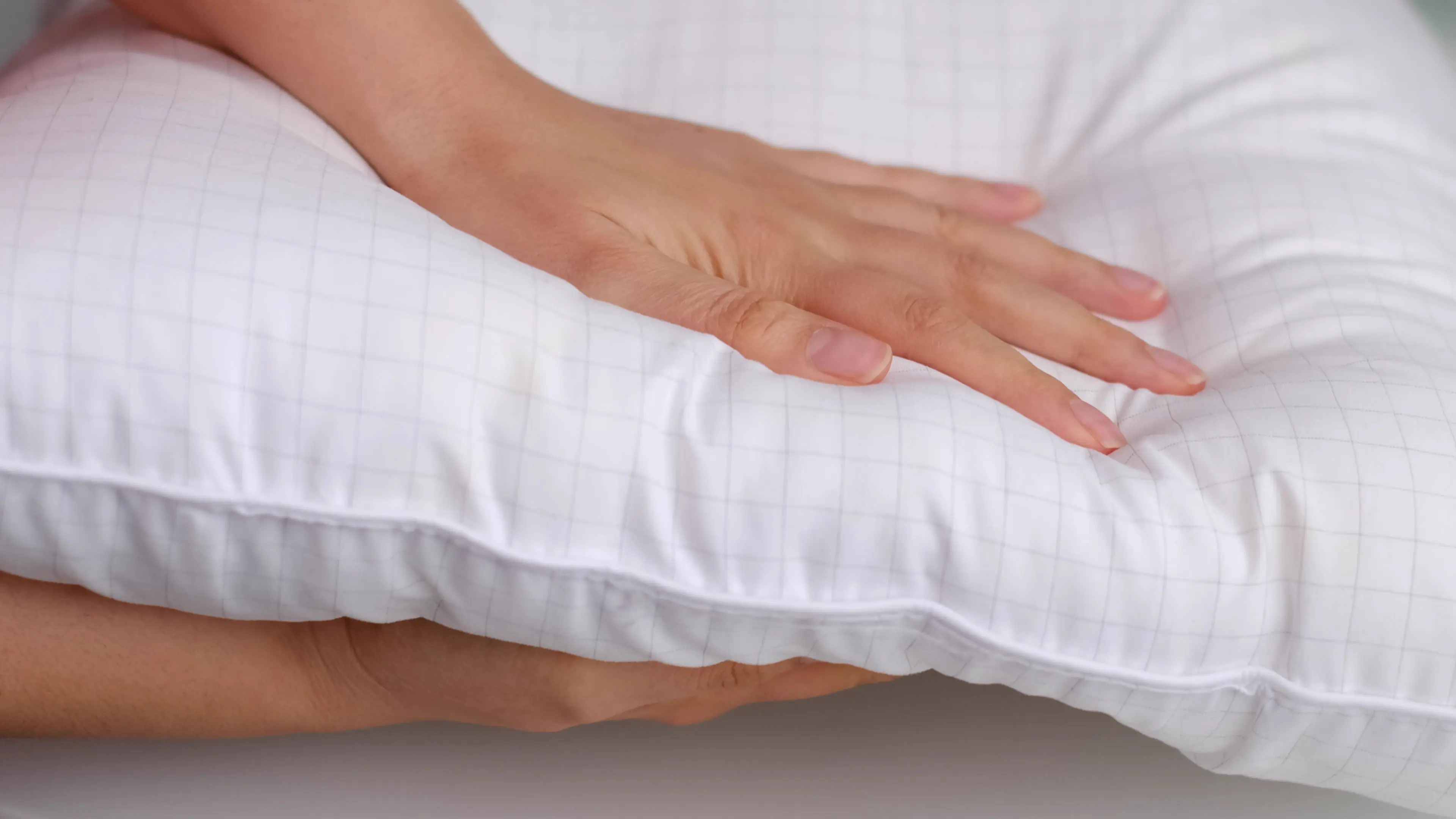


The right pillow is the one that feels comfortable and keeps your head from being pushed into an obvious bend once the pillow is compressed. Sleep position helps narrow the options, but it cannot tell you an exact height or firmness.
Your body and mattress change the answer. A broad-shouldered side sleeper on a firm mattress may need more working loft than a smaller side sleeper whose shoulder sinks deeply into a soft mattress. The same pillow can therefore fit one person and feel far too tall or flat to another.
Start with fit, then compare materials, care, and price. This order is more reliable than choosing a popular fill and hoping its advertised loft will work.
Start with working loft
Loft is a pillow's height. The number printed on a product page is usually measured without a head on the pillow. Working loft is the height that remains after the pillow compresses under you, and that is what affects how it feels in bed.
Research has not established one optimal pillow height for back or side sleeping. Studies have used body measurements, spinal images, pressure, and muscle activity, but a review found too little consistent evidence to define a reliable height range 1. This is why a body-measurement formula or a universal loft chart should be treated as a starting guess, not a prescription.
These factors change the working loft you need:
- Sleep position: Side sleeping usually leaves the largest space between the head and mattress. Stomach sleeping usually leaves the least.
- Mattress sink: When your shoulder and torso sink farther into a softer mattress, the gap under your head often becomes smaller. A firmer surface can leave a larger gap.
- Body proportions: Shoulder width, head shape, upper-back shape, and how weight is distributed all matter. Height or clothing size alone cannot predict pillow fit.
- Compression: A soft, fluffy pillow may begin tall and collapse low. Dense foam may stay closer to its unloaded height.
- Position changes: A pillow that fits on your side may feel tall on your back. Combination sleepers need a workable compromise or a shape they can reposition easily.
A practical starting point for each position
The goal is not a photographically perfect spine. It is a comfortable position that does not force your head sharply toward the mattress, ceiling, or chest.
| Main position | Useful starting point | Signs to adjust |
|---|---|---|
| Side | Enough compressed height to fill the space above the mattress without putting the shoulder on the pillow | Add loft if the head drops toward the mattress; remove loft if it tilts away or the upper shoulder and neck feel crowded |
| Back | Moderate support under the neck with room for the back of the head to settle | Reduce loft if the chin is pushed toward the chest; add a little support if the head tips far back or the neck feels unsupported |
| Stomach | A thin, compressible pillow, or sometimes no head pillow | Reduce loft if the head is pushed backward or neck rotation feels worse |
| Combination | A responsive or adjustable pillow that works in the two positions used most | Test each main position separately and prioritize the one in which you spend the most time |
These are directions, not fixed categories. “Medium” and “firm” are not standardized across brands, and two pillows with the same stated loft can compress very differently.
Side sleepers
Begin with the space created by your shoulder, body, and mattress. Keep the shoulder on the mattress unless the pillow is specifically designed to support more of the upper body. Putting a conventional head pillow under the shoulder changes the height you are trying to fit.
A wider pillow can help if you move forward and backward during the night. Firmness only needs to be high enough to maintain a comfortable working loft. A very firm pillow is not automatically better, and a lofty down or shredded-fill pillow may still work if it holds enough height under load.
Back sleepers
Look for enough support to avoid the sensation that the neck is hanging, but not so much height that the chin is crowded toward the chest. Some people prefer a lower area for the head and a fuller edge under the neck. Others are more comfortable on a simple, evenly filled pillow.
A pronounced contour is useful only when its heights match your body and mattress. If the ridge is too tall or the head well is too deep, the shape can be less forgiving than a conventional pillow.
Stomach sleepers
Stomach sleeping turns the head to one side and can extend the neck. A thin, compressible pillow usually adds less height than a dense one. Some people are more comfortable without a head pillow, although that does not remove the rotation.
If pressure through the lower back or pelvis is the main discomfort, a thin pillow under the hips may feel better for some people. Stop experimenting if a position increases pain, tingling, numbness, or weakness.
Combination sleepers
Choose for your two most common positions rather than trying to optimize every possible posture. Adjustable fill can make this easier. A springier construction may also recover its shape faster after a turn, while a highly molded contour can restrict where the head rests.
If side and stomach sleeping are both common, no single height may feel ideal. One practical option is a moldable pillow that can be gathered on the side and flattened on the stomach.
Test pillow height at home
You can learn more from a short fit test than from comparing marketing labels.
- Test on your own mattress. A showroom mattress changes how far your shoulder and torso sink.
- Recreate your usual position. Use the pillowcase and any mattress topper you normally sleep with.
- Make one small change. Add or remove a little fill, or use a folded towel to explore a slightly different height before buying another pillow.
- Check comfort, not just appearance. Notice pressure around the ear, jaw, neck, and upper shoulder, whether the chin feels crowded, and whether you keep repositioning to escape the pillow.
- Repeat in every position you use often. A photo taken from behind can reveal an obvious side bend, but it cannot prove ideal alignment or predict pain relief.
- Try it for several nights if symptoms are mild. First-night sleep can be affected by novelty. Stop sooner if pain or neurologic symptoms clearly worsen.
Keep removed fill in a sealed bag until the trial period ends. If you use towels to simulate more height, do not place loose folds where they could shift over the face during sleep.
Adjustable, contour, and conventional pillows
An adjustable-fill pillow lets you change working loft without replacing the whole product. It is a strong practical choice when you are unsure of the height, alternate between positions, or expect the mattress feel to change. Check whether the seller includes extra fill and whether the inner zipper is secure.
A contour or cervical pillow has raised and recessed areas intended to support different parts of the head and neck. It may feel comfortable when its geometry fits. It can also be difficult to use if you turn often, have a short or long neck relative to the design, or need a height between its preset edges.
“Cervical” and “orthopedic” do not mean a pillow has been proven to correct posture or treat pain. Clinical pillow trials are small and varied. A systematic review found some benefit from rubber and spring pillows in people with chronic neck pain, but the designs, comparisons, and outcomes differed, and pillows did not improve sleep quality in the pooled analysis 2. That result does not establish latex, memory foam, or any contour as the best choice for an individual.
A conventional rectangular pillow is easier to turn, scrunch, or layer, and often has more standard pillowcase options. Size mainly affects usable surface area and fit with the bed. See our pillow size guide for common dimensions.
Compare fills by what they do
Fill matters when it changes compression, responsiveness, heat, noise, care, or durability. It does not decide the fit by itself.
| Construction | Typical behavior | Practical checks |
|---|---|---|
| Down or feather | Soft, moldable, and highly compressible; may need regular fluffing | Check fill percentages, quill feel, laundering instructions, and whether it keeps enough working loft |
| Polyester or down alternative | Often soft and relatively light; some models can flatten or clump with use | Check whether the whole pillow is washable and how it recovers after drying |
| Solid memory foam | Slow response and a more fixed shape; usually less adjustable | Check the actual contour dimensions, odor return policy, and whether only the cover can be washed |
| Shredded foam | Moldable and often height-adjustable; pieces can shift or feel uneven | Check fill access, loose-fill containment, and care instructions |
| Latex foam | Springier and quicker to rebound than slow-response foam; can be heavy | Check whether the core is solid or shredded, the care label, and any relevant latex allergy |
| Buckwheat hulls | Firm, granular, and usually adjustable; can be heavy and audible when moved | Check shell strength, fill containment, noise tolerance, and whether the hulls must be removed for cleaning |
| Wool or cotton | Dense and less springy than many foams or clusters; can compress with use | Check washability and whether the fill can be redistributed |
| Air or water chamber | Height or resistance may be adjustable; movement can feel unfamiliar | Check leak protection, noise, setup instructions, and warranty terms |
Material names do not guarantee temperature. A perforated foam, ventilated shell, phase-change cover, and loose fill may change initial heat transfer or airflow, but the whole pillow also interacts with the pillowcase, room, bedding, and sleeper. “Cooling” should mean a stated construction or test result, not a promise that the pillow will keep every sleeper cool all night.
Care rules vary even within one fill category. Follow the product label for washing, drying, spot cleaning, and whether the core can get wet. A washable cover is useful, but it is not evidence that the entire pillow can go in a machine.
Treat the trial and return policy as part of the product
A pillow that looks suitable on paper can still fail after it compresses on your bed. Before buying, check:
- whether the policy is a true sleep trial or accepts only unopened bedding
- the number of nights and the deadline for starting a return
- whether stains, odors, removed tags, or fill adjustments void eligibility
- who pays return shipping and whether there is a restocking fee
- whether refunds go to the original payment method or store credit
- whether the warranty covers defects only, rather than comfort or normal softening
Use a clean pillowcase or protector during the trial and follow the seller's rules. Give a new pillow several ordinary nights when it is merely unfamiliar, but do not keep forcing an obviously poor fit to reach a suggested break-in period.
If you have neck pain
A pillow may change comfort and morning symptoms, but it cannot diagnose the cause of neck pain or reliably correct it. Do not choose by a claim that one material “supports the spine” or prevents pain. Start with an adjustable fit, track whether symptoms improve or worsen, and change one variable at a time.
Seek medical advice if pain is persistent, progressively worsening, or interfering with normal activities. Urgent assessment is more important than a new pillow after significant trauma, or when neck pain occurs with fever or feeling seriously unwell, new or rapidly worsening weakness or numbness, hand clumsiness, trouble walking or balancing, or new bladder or bowel changes 3.
Special situations
CPAP masks
Pillow height and edge shape can affect how a mask rests against the face, especially during side sleeping. Test the pillow while wearing the mask and hose in the setup you use at night. A side cutout may create space for some masks, but it does not guarantee a lower leak rate.
If leak, pressure marks, or treatment data change after switching pillows, check the mask fit using the manufacturer's instructions and contact the sleep clinic or equipment provider when needed. Do not tighten straps excessively, change PAP pressure, or use pillow elevation as a substitute for prescribed sleep apnea treatment.
Reflux and upper-body elevation
The American College of Gastroenterology suggests head-of-bed elevation for people with nighttime gastroesophageal reflux disease symptoms, but the recommendation is conditional and based on limited evidence 4. This means elevating the upper body may be one part of a clinician-guided plan. It does not mean a taller head pillow treats reflux.
Stacking pillows can bend the neck or let the body slide while leaving much of the torso flat. A wedge that supports the upper torso or elevation of the bed head is closer to the setup studied. New, frequent, severe, or swallowing-related symptoms need medical assessment rather than repeated pillow changes.
Pregnancy and body support
During the second and third trimesters, side sleeping may be more comfortable, and the American College of Obstetricians and Gynecologists suggests trying a pillow between the knees, under the abdomen, or a full-length body pillow for support 5. A pregnancy-shaped pillow is not required if ordinary pillows provide comfortable support.
Keep the head pillow fitted to the mattress and position as the body changes. Ask the obstetric clinician about persistent dizziness, breathing difficulty, severe pain, or any pregnancy-specific concern rather than trying to solve it with extra elevation.
Allergies and asthma
“Hypoallergenic” has no single performance standard that guarantees a pillow will not trigger symptoms. A synthetic or foam fill can still collect dust-mite allergen in its cover and surrounding bedding, while a natural fill is not automatically a problem for every person.
For someone with confirmed dust-mite allergy or dust-mite-triggered asthma, the CDC recommends an allergen-proof pillow cover, weekly bedding washing with complete drying, and keeping indoor relative humidity around 30% to 50% 6. Choose a pillow and encasement that can be cared for consistently. These measures reduce exposure but do not replace an asthma action plan, prescribed medication, or allergy care.
Infants and children
Do not put a pillow, wedge, positioner, or other soft object in an infant's sleep space. NIH safe-sleep guidance says babies should be placed on their backs on a firm, flat, level surface covered only by a fitted sheet, with pillows and other soft or weighted objects kept out through the first birthday 7.
After the infant safe-sleep period, a pillow is optional rather than a developmental requirement. If an older child wants one, choose a proportionate, washable design and inspect seams, zippers, and fill containment. Do not use a weighted pillow or an adult medical-positioning product for a child unless the child's clinician specifically directs it.
Read marketing claims literally
Look for the measurable feature behind a label:
- Orthopedic or cervical: Describes a shape or intended use, not proven treatment or posture correction.
- Cooling: Ask whether the claim refers to a cool-to-touch cover, laboratory heat transfer, airflow, or whole-night user experience.
- Hypoallergenic: Check the exact materials, washability, and encasement compatibility instead of assuming zero allergy risk.
- Antimicrobial: Determine whether the treatment protects the pillow from odor or material deterioration. The EPA explains that qualifying treated-article claims protect the product itself and do not establish protection for the user against disease-causing organisms 8.
- Beauty or anti-wrinkle: A fabric or shape may change facial contact, but that is not evidence that the pillow prevents wrinkles or improves skin health.
Do not treat a pillow as care for sleep apnea, reflux, neck disease, allergy, asthma, or insomnia. A useful pillow can support comfort while the underlying condition receives appropriate care.
Replace a pillow when its condition changes
A fixed one- or two-year replacement date does not account for material, use, care, or condition. Replace or retire a pillow when:
- it no longer returns to a usable shape or holds the needed working loft
- fill has formed persistent lumps, shifted beyond redistribution, or escaped the shell
- foam is cracked, crumbling, or permanently deformed
- the zipper, seam, or chamber is damaged
- odor, moisture, mold, pest contamination, or a spill cannot be safely removed according to the care instructions
- a change in body, mattress, sleep position, mask, or symptoms makes the fit consistently unsuitable
A protector and correct care may keep a serviceable pillow cleaner, but they cannot restore failed support. Judge condition and fit rather than the calendar.
Bottom line
Choose a pillow by the height and feel it has under your head on your own mattress. Use sleep position to set a starting range, then account for body proportions, mattress sink, compression, and movement. Adjustable fill and a usable return trial make that process easier.
Once the fit is plausible, compare fills for responsiveness, heat, noise, care, allergy needs, and durability. Treat cooling, orthopedic, and health claims as questions to verify, not shortcuts to the right pillow.