

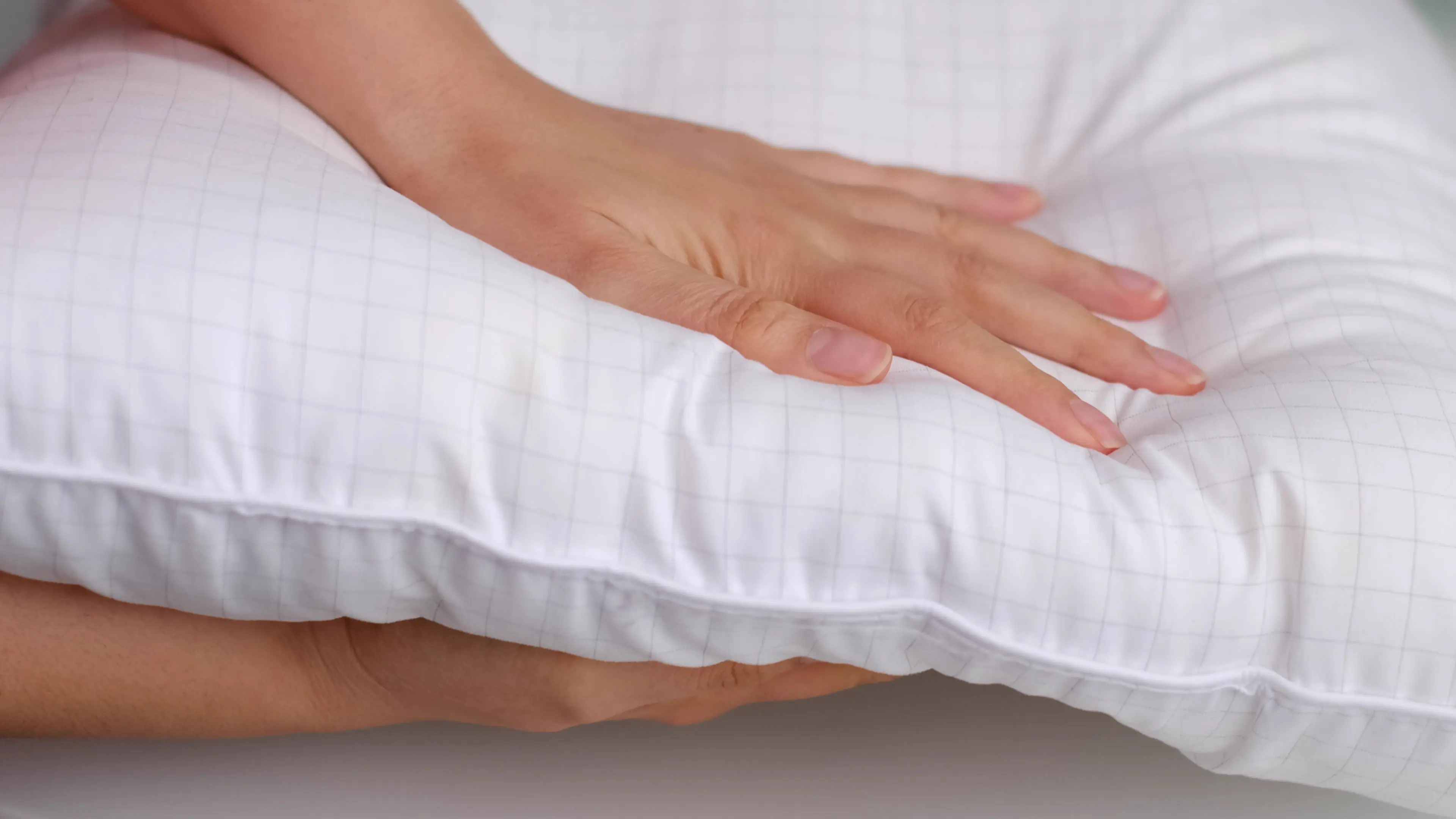
Pillow firmness is the resistance you feel as your head compresses the pillow. A firmer pillow resists the load more, while a softer pillow gives way more easily. That description is useful within one product line, but “soft,” “medium,” and “firm” are not standardized scores that can be compared reliably from one brand to another.
Laboratory standards can measure the indentation hardness of certain flexible latex, polyurethane, and PVC foams under controlled conditions. The relevant ISO standard includes several test methods and warns that the results apply to the stated test conditions and generally cannot be used directly for design. A finished pillow may also contain loose fill, chambers, contours, covers, or layers that change what a sleeper feels. Unless two brands publish results from the same method and conditions, treat their firmness labels as product-specific descriptions. 1
Firmness is only one part of pillow fit
Firmness is often used as shorthand for several different properties. Separating them makes comparison easier:
- Firmness is resistance to compression. It describes how readily the pillow gives under the weight of your head.
- Loft is the pillow’s height before and during use. A tall, soft pillow may compress to a low working height, while a low, firm pillow may retain most of its original height.
- Support is the pillow’s ability to hold the head and neck in a tolerable position through the night. A hard surface is not automatically more supportive, and a soft pillow is not automatically unsupportive.
- Pressure relief describes how contact pressure is distributed at the ear, cheek, head, and neck. A pillow can resist compression yet feel harsh at the ear, or feel plush while allowing the head to sink farther than is comfortable.
- Shape controls where the material sits. A contour, cervical roll, shoulder cutout, gusset, or chamber can change local support even if the overall feel is unchanged.
- Fill behavior includes how quickly the material compresses and rebounds, whether it shifts, and whether it can be fluffed or adjusted.
- Durability is how the pillow changes with use. Initial firmness does not prove that a pillow will resist permanent compression, clumping, or changes in feel.
Rather than treating a generic replacement interval as medical guidance, reassess a pillow when it no longer returns to its intended shape, needs constant folding or fluffing, cannot be cleaned as directed, or produces a repeatable comfort problem.
What changes the firmness and loft you need
Sleep position and body proportions
Sleep position changes the space a pillow has to fill. In side sleeping, shoulder width, head width, and how deeply the shoulder sinks affect the distance between the mattress and the head. In back sleeping, the shape of the upper back, head, and neck affects whether a pillow pushes the chin toward the chest or lets the head tip too far back. Stomach sleeping often leaves less space beneath the head, but head rotation and individual proportions still matter.
These patterns can guide a trial, but they do not justify a universal rule that every side sleeper needs a firm pillow or every stomach sleeper needs a soft one. A review of pillow-height ergonomics found that body dimensions, cervical position, contact pressure, and muscle activity all matter, while the evidence was insufficient to define one optimal height range for either side or back sleeping. 2
Combination sleepers have an added tradeoff. A pillow that fills the shoulder gap on the side may feel too tall on the back. Adjustable fill or a shaped pillow with different zones can make comparison easier, but neither design guarantees that every position will feel equally good.
Mattress sink
Test a pillow on the mattress where it will be used. A mattress that lets the shoulder and torso sink deeply changes the gap the pillow must fill. A firmer mattress may leave more of the shoulder above the surface. A pillow that works in a showroom, hotel, or old bed can therefore feel effectively taller or lower after a mattress change.
Mattress sink does not dictate one firmness category. It changes the geometry of the setup, while the pillow’s own compression determines its working height. Judge the two surfaces together.
Symptoms and pressure sensitivity
A sensitive ear, jaw, shoulder, or scalp may make surface cushioning more important. Someone who wakes because the pillow collapses may care more about retained working height. Neck pain can also change which position feels tolerable, but pain does not identify one correct material or firmness by itself.
New numbness, tingling, weakness, or pain spreading into an arm is not a signal to keep buying firmer pillows. Those symptoms can involve a nerve and warrant clinical assessment. 3
Temperature and changing material response
Some viscoelastic polyurethane foams, commonly called memory foams, have slow recovery after compression and respond to temperature. Depending on the formulation, they may feel firmer in a cool room and become more pliable with warmth. Recovery speed, humidity, cover construction, and foam formulation can also affect the result. “Memory foam” therefore does not describe one fixed firmness or temperature experience. 4
A pillow marketed as cooling still needs a real-world trial. The cover, protector, pillowcase, contact area, room conditions, and fill structure all affect the experience. A cool-to-the-touch fabric does not prove that the pillow will stay comfortable all night.
How common pillow constructions behave
Fill names are starting points, not firmness grades. Look at the complete construction:
- A solid foam core has a fixed profile and cannot be fluffed. Its firmness depends on the exact foam formula, core thickness, contour, and perforations. Slow-recovery foam and faster-rebounding foam can feel very different even when both are called polyurethane.
- A molded latex or polyurethane core usually returns toward one set shape rather than allowing fill to be moved from one area to another. Latex, polyurethane, and memory foam are each produced in multiple firmnesses, so the material name alone does not settle the feel.
- Shredded foam or mixed loose fill can be redistributed. If the cover opens, adding or removing fill usually changes both loft and resistance, so it is not a way to adjust firmness while keeping every other variable constant.
- Fiber, down, and feather fills depend on fill amount, cluster or feather structure, and compartment design. A lightly filled pillow may compress readily, while a densely filled or chambered model made with a similar material may resist much more.
- Layered and chambered pillows can place a more resistant core inside softer outer layers or provide removable inserts. Check which component is adjustable instead of assuming that “adjustable” means independent control of firmness and loft.
For any product, read the fill composition, finished height, removable layers, fill weight if supplied, care instructions, and return terms. Compare those details before comparing the brand’s soft or firm label.
A neutral home trial
A home trial does not need a formula or a posture app. Use it to find a repeatable comfort problem and change one variable at a time.
- Start on your own mattress. Use the pillowcase or protector you normally intend to keep on the pillow. Record the starting fill or layer setup so you can return to it.
- Try your usual positions. On your side, notice whether your head feels tipped toward the mattress or pushed away from it and whether the ear develops pressure. On your back, notice whether the chin is forced toward the chest or the head drops backward. These are comfort screens, not medical measurements of spinal alignment.
- Notice what happens after settling. A pillow that feels fine for a few minutes may continue to compress or warm. Pay attention to repeated folding, bunching, fluffing, heat, ear pressure, headache, or morning neck and shoulder symptoms.
- Change one thing. With removable fill, make a small change and store what you remove. With layered designs, change one insert. Do not change the pillow, mattress topper, and sleep position together if you want to know what helped.
- Use the return window, not a forced adaptation period. Follow the manufacturer’s setup and care directions, but do not keep using a pillow that repeatedly worsens pain, causes numbness, or creates a breathing or allergy concern.
A photo or partner’s observation may help identify an obvious head tilt, but it cannot prove “perfect alignment.” Comfort, morning symptoms, ease of movement, and the pillow’s behavior over the night are more useful than trying to match a single ideal angle.
What the evidence says about neck pain
Pillows have been studied as an adjunct for chronic neck pain, but the evidence does not establish a universally therapeutic firmness. A 2025 systematic review found only five eligible intervention studies with 239 participants. Pain changes were minor, disability results were inconsistent, sleep-quality differences were not statistically significant, and no latex, foam, or standard pillow type showed clear superiority. The studies used different products, methods, and outcomes, which limits broad conclusions. 5
This means a particular pillow may help an individual without proving that its material or firmness will treat everyone. Marketing terms such as “orthopedic” or “cervical” do not guarantee pain relief, and a pillow cannot align every spine in every position.
Arrange medical assessment if neck pain persists or worsens despite reasonable self-care, spreads into an arm or leg, follows an injury, or comes with numbness, tingling, weakness, difficulty walking, loss of balance, fever with a severe headache or stiff neck, or changes in bladder or bowel control. Some of these combinations need urgent care rather than another pillow adjustment. 3
Allergy, asthma, breathing, and infant safety
Firmness does not make a pillow allergy-safe. For people whose asthma is triggered by dust mites, the CDC recommends an allergen-proof pillow cover, weekly bedding washing and complete drying, and following the person’s trigger-control plan. It also advises avoiding down-filled pillows for this group. Check whether the pillow and its cover can be cleaned according to that plan. 6
Natural rubber latex can trigger reactions in people with latex allergy. If you have a known or suspected allergy, ask the manufacturer whether the product contains natural rubber latex and discuss avoidance with an allergist. Wheezing, breathing difficulty, widespread hives, swelling, or lightheadedness after exposure needs urgent medical attention. 7
Pillow firmness is not an established treatment for obstructive sleep apnea. Persistent loud snoring with gasping, witnessed breathing pauses, or excessive daytime sleepiness should prompt sleep-apnea evaluation rather than a pillow-only solution. 89
Adult pillow advice does not apply to infants. The U.S. Consumer Product Safety Commission recommends a bare infant sleep space with a fitted sheet and no pillows, blankets, toys, or sleep positioners. Babies should sleep flat on their backs in a product intended for infant sleep. 10
The useful question is not whether a pillow is labeled soft, medium, or firm. It is whether its working height, resistance, surface feel, and behavior on your mattress remain comfortable in the positions you actually use.