

The right futon mattress is the one designed for the exact support system and job you have. Start with the frame model, its open-bed dimensions, and the way its platform folds. A mattress that fits the room but misses the hinge lines, overhangs the platform, blocks the latch, or cannot bend as required is not compatible.
First clarify which kind of futon you mean:
| Type | How it is used | What the mattress must do |
|---|---|---|
| North American futon sofa | A mattress sits on a convertible wood or metal frame that changes between seating and a flat bed. | Fit the open platform, fold at the frame's hinge lines, stay controlled by the specified retainers, and tolerate sitting as well as sleeping. |
| Japanese-style floor futon or shikibuton | A relatively thin floor mattress is laid out for sleep, then lifted, aired, folded, or stored separately. It is used with a top covering called a kakebuton in a traditional set 1. | Suit the floor, tatami, or approved platform; remain manageable enough to lift and air; and follow its own cleaning and storage instructions. |
These products can share flexible materials, but they are not interchangeable by name. A shikibuton may be the wrong shape or construction for a sofa frame. A thick North American futon mattress may be too bulky to fold and store as Japanese floor bedding.
Begin with the exact frame
If you already own a convertible frame, find its model number, assembly manual, original mattress specification, and warranty before shopping. If the manual is missing, ask the manufacturer for the current document using the model and production label. Similar-looking frames may use different platforms, hinge locations, retainers, and load limits.
Record:
- open platform width and length, measured inside any arms or end stops
- seat, back, and foot-section lengths
- whether it is a bi-fold, tri-fold, lounger, loveseat, or another mechanism
- allowed mattress thickness, construction, and weight
- slat or bar width and spacing
- location of retaining bars, clips, straps, or ties
- total frame weight limit and any separate seat or bed-mode limits
- required wall, floor, and operating clearance
- replacement-mattress part number or compatibility list
Do not apply a universal slat-gap, thickness, or weight recommendation. A support gap that works for one flexible fiber mattress may allow another mattress to sag or catch. An extra-thick mattress can prevent the back from locking or make the seat unstable. A thin mattress may let the frame be felt through widely spaced support bars.
Bi-fold and tri-fold geometry
A bi-fold platform has two main sections and asks the mattress to make one primary bend between the seat and back. A tri-fold platform has three sections and two bend zones, often including a section that becomes a footrest or folds under the seat.
The category does not tell you the finished bed size or acceptable thickness. Match the mattress to the actual panel lengths and hinge positions. Its sewn tufts, quilting channels, coil layout, or foam cuts should not fight the bend. A mattress designed to fold once may buckle, bridge, or slide on a frame that folds twice.
The basic tradeoff is simple: a mattress that bends readily usually converts and sits more predictably, while a mattress built mainly to remain flat may resist the frame or develop a forced crease. Do not assume more thickness, more coils, or a heavier fill is an upgrade for a convertible frame.
Product examples are model-specific
Manufacturer documents show why copying another futon's numbers is risky. One Dorel Home metal-futon manual lists a 600-pound total limit, requires the section with mattress retainers to remain the seat, warns users to keep hands clear of the arm mechanisms, and gives frame-specific advice about edge loading and hardware checks 2. Those instructions belong to the models in that manual, not every futon.
As another example, IKEA lists the NYHAMN frame's open bed surface as 55 1/8 by 78 inches and pairs the system with named NYHAMN mattress components 3. Those dimensions should not be rounded into a universal “full futon” rule. Check whether the replacement is approved for your exact product and whether using another mattress changes the warranty.
Measure the room in both modes
Measure more than the wall width. Mark the frame's full depth as a sofa and as an open bed, plus the path the mechanism travels during conversion. Leave usable access to doors, drawers, outlets, radiators, vents, and a walking route. Include bedding overhang instead of measuring only the bare frame.
Check delivery before ordering:
- packaged mattress and frame dimensions
- package and component weights
- door, stair, elevator, and corner clearance
- whether assembly or moving requires two people
- whether the mattress arrives rolled or compressed and needs a stated setup period
A mattress may fit the assembled frame but fail to turn through a stair landing. A rigid coil unit or dense latex core may be harder to move than a flexible fiber mattress of the same nominal size.
Match the mattress to the way it will be used
Daily bed, daily sofa, or occasional guest bed
For daily conversion, prioritize clean folding, manageable weight, secure retention, and a cover that tolerates frequent contact. Watch whether the seat creeps forward, the fold creates a ridge, or the back fails to settle against the frame.
For a mattress that stays flat most of the time, flat-use performance and ease of rotating may matter more than repeated folding. Still confirm that the frame can lock and the mattress can convert when needed.
For occasional guests, consider storage, setup, cleaning after spills, and whether the open size genuinely fits the expected sleeper count. A label such as full or queen does not establish how much usable surface remains between arms, retainers, or sloped edges.
Do not promise that one construction is better for posture, pain, spinal alignment, cooling, or allergies. Comfort and access are individual, while compatibility and safe operation are product-specific.
Sleeper count and weight
Use the open sleeping width and the manufacturer's load limit, not the size name alone. Calculate the load exactly as the manual defines it, combining all sleepers and any mattress, bedding, or other items the manufacturer says count. Confirm whether a published limit applies to seating, sleeping, one position, or the entire unit.
A wider surface may still be intended for one sleeper. A frame that physically accommodates two people may not support their combined load. Do not infer capacity from arm width or from another model in the same brand.
Sitting behavior
In sofa mode, the mattress becomes both seat and back cushion. Check whether it stays against the back, whether the front edge is retained, and whether the fold sits where knees and hips naturally meet. Deep mattresses can raise the seat and shorten the effective back. Thin mattresses can make support bars more noticeable.
Test ordinary movements if a floor model is available: sitting near the center, standing up, leaning back, and converting the frame. Do not jump, stand on the mattress, perch on an unsupported edge, or use the back as a step. Follow any model-specific edge-load warning.
Total bed height and accessibility
Measure the top of the mattress from the floor in sofa and bed modes. A low surface may be difficult for someone with limited leg strength, balance, joint movement, or transfer needs. A thick replacement may raise the seat but also obstruct folding or reduce the useful backrest.
Try the complete height and conversion force rather than treating a low futon as automatically accessible. Include the ability to reach the latch, keep balance during conversion, get up from bed, and move the mattress for care.
Futon mattress constructions
Construction affects weight, flexibility, sitting behavior, care, and price, but the category alone cannot establish quality or comfort.
| Construction | Possible fit for a convertible frame | Tradeoffs to inspect |
|---|---|---|
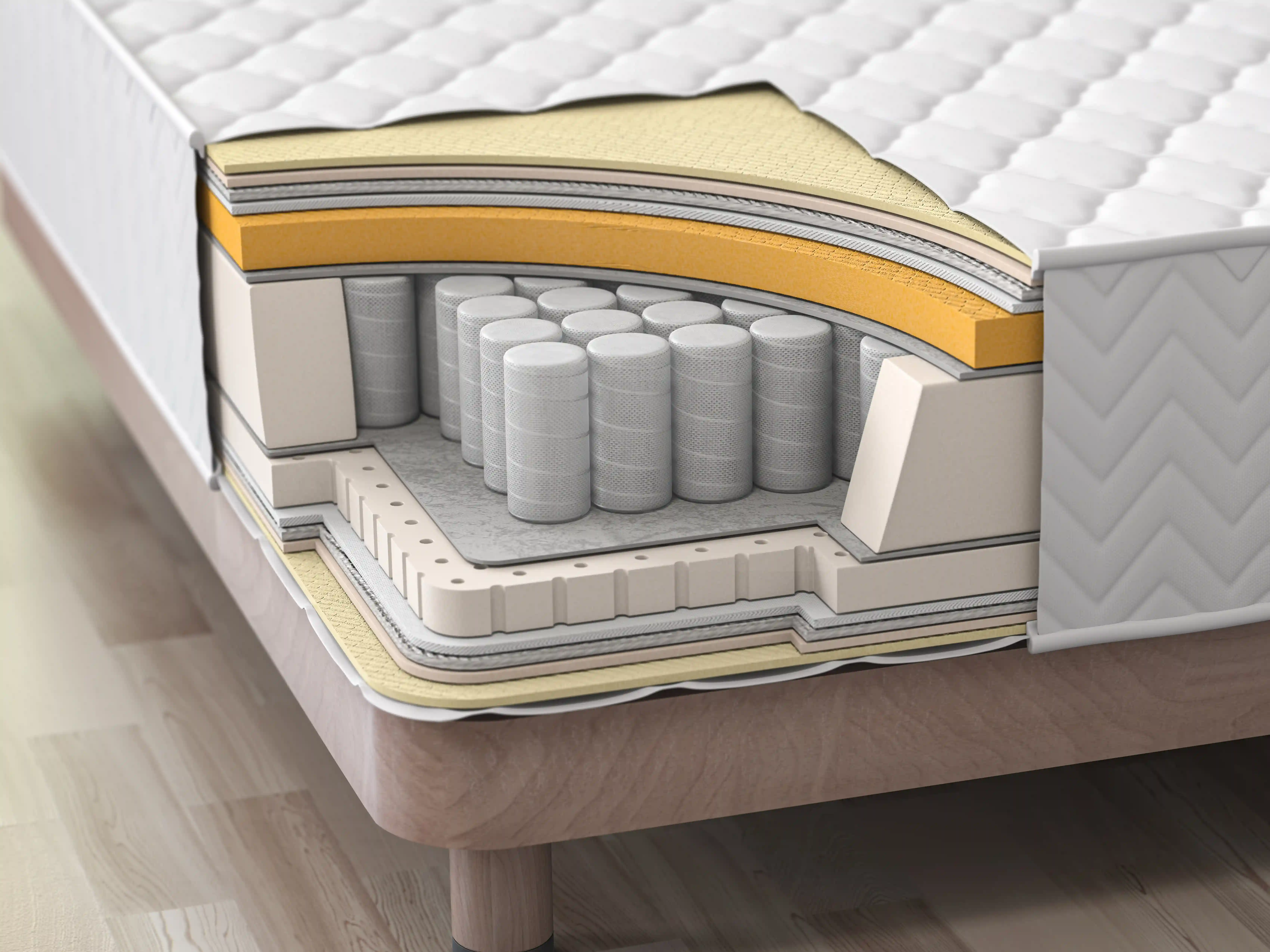
| Foam | Can flex when the foam type, thickness, layers, and cuts are designed for the frame. | May develop a persistent seat crease or compressed edge. Dense or thick foam can be heavy and resist a sharp fold. |
| Cotton or other fiber batting | Common in flexible futon mattresses and can conform to fold zones. | Can compress, shift, or become lumpy. It may be heavy when wet and may need specialist cleaning or renovation. |
| Innerspring | Some futon-specific coil units are engineered to bend. A conventional flat mattress is not automatically suitable. | Coil layout can resist the hinge, create a ridge, or be damaged by repeated folding if the product is not designed for it. |
| Latex | Can be flexible, but weight, thickness, layer bonding, and repeated-bend approval matter. | Dense latex can be difficult to convert or move. Do not sharply fold a product whose instructions require flat support. |
| Hybrid | May combine foam, fibers, latex, or futon-specific coils. | The word hybrid reveals too little to confirm compatibility. Pocketed coils do not by themselves make a mattress safe for a futon frame. |
Ask for a cross-section or written construction rather than relying on “natural,” “orthopedic,” “firm,” or “premium.” Confirm whether the model is one-sided or two-sided and whether any tufting, zipper, fire barrier, or removable cover changes the care method.
A compatibility checklist before buying
Dimensions and support
Compare the seller's finished width and length with the frame's open platform, not a generic mattress-size chart. Ask what manufacturing tolerance is allowed. Check that the mattress sits fully on the support without interfering with hinges, arms, locks, or retainers.
Compare the mattress maker's foundation requirements with the frame's slat or bar spacing. If either company cannot confirm the combination, do not assume a flexible mattress can bridge the gaps safely.
Thickness and flexibility
Ask whether the stated thickness is measured before or after expansion and whether tufted high points are included. Confirm the minimum and maximum thickness the frame accepts, if specified, and whether the mattress is approved for the number and direction of bends.
A showroom mattress that has already been repeatedly folded may feel more flexible than a new one. A compressed product may need to finish expanding before the first conversion. Follow its setup instructions rather than forcing it into sofa mode.
Retainers and hardware
Use the specified retaining bars, clips, straps, covers, and fasteners. A nonslip pad is not an automatic substitute because it can alter ventilation, interfere with a latch, or violate the frame or mattress instructions. Never drill, tie, or modify the frame without written manufacturer approval.
Fire label, warranty, and product identity
In the United States, a detachable futon or sofa-bed mattress is generally subject to federal mattress flammability standards. The permanent label for a mattress set includes the manufacturer, manufacture date, model and prototype identification, compliance statement, and whether the mattress is intended for sale alone or with a foundation 4. Keep the label accessible for identification, recall checks, and warranty questions.
A compliance label does not make a mattress fireproof. Keep ignition sources away. For a replacement, verify the model identity, intended foundation, warranty, and whether the frame manufacturer approves a separately purchased mattress.
Before buying used, locate labels on both frame and mattress, obtain the manual, and check the CPSC recall database by brand and model 5. Missing hardware, improvised retainers, fire damage, bent hinges, or an unresolved recall are reasons to stop rather than test the unit.
Rotation, covers, spills, and cleaning
Rotate or flip only when the mattress maker permits it. A one-sided mattress may have a designated sleeping face, fire barrier, non-slip panel, or fold orientation. A reversible cotton mattress may allow turning, but the frame's retainers and hinge lines still need to match after the change.
A removable, washable cover can simplify care if it is made for the mattress and does not bunch in the mechanism. Keep the original law label accessible. Confirm whether “washable” refers to the outer cover or the mattress itself.
For a spill:
- Move the frame to a stable, fully open position if the manual permits.
- Blot liquid without driving it deeper.
- Use only the cleaner and moisture level allowed by the mattress instructions.
- Dry the mattress fully before folding, covering, or storing it.
- Inspect the frame, slats, floor, and underside for trapped moisture.
Do not saturate foam, cotton batting, coils, latex, adhesives, or a fire barrier unless the product is expressly washable. Avoid steam, bleach, solvents, machine washing, or dryer heat unless the care label allows that exact method. Professional cleaning is not automatically safe for every futon construction.
Moisture, floor use, and mold
A mattress placed directly on a floor or a poorly ventilated platform can hold moisture where air movement is limited. Condensation, body moisture, spills, a damp floor, and humid storage can all keep the underside wet. Mold needs moisture to grow, and the EPA advises drying damp materials and fixing the moisture source promptly, generally within 24 to 48 hours after a leak or spill 6.
For a Japanese-style shikibuton, lift it from the floor, inspect both sides and the surface below, and air it according to the maker's instructions. The Japan Futon Association recommends using a cover or sheet, drying futons, and avoiding storage while damp; its care guidance also warns against assuming every futon can be washed at home 7.
For any floor setup:
- start with a clean, completely dry surface
- follow any required tatami, mat, underlay, or ventilated-base instruction
- lift the mattress when moisture is present rather than leaving it sealed against the floor
- dry both mattress and floor before remaking the bed
- do not wrap a damp mattress in plastic or place it into closed storage
There is no universal airing calendar. Climate, floor temperature, sleeper moisture, material, and product instructions differ. Inspect often enough to catch dampness, odor, or spotting before storage, and increase ventilation when conditions stay humid.
Visible mold on a porous mattress can extend below the surface. The EPA notes that moldy absorbent materials may need replacement 6. Do not rely on fragrance or a surface wipe to prove the interior is clean. Address leaks, condensation, or room humidity before placing another mattress in the same location.
Safe conversion and use
Read the frame's conversion sequence and practice it without anyone on the unit. Before moving the mechanism:
- remove pillows, sheets, cords, toys, and objects that could enter a hinge or latch
- keep hands, hair, clothing, children, and pets clear of pinch points
- use only the handles, rails, or grasp points shown in the manual
- move slowly and stop if the frame binds, twists, or makes a new sound
- confirm every required lock or support leg is fully engaged
Do not sit, stand, or sleep on a frame that is partly converted. Do not let a child operate or play on the mechanism. Keep the unit on a level surface and do not pull it across the floor while loaded.
Inspect loose fasteners, cracked welds, bent hinges, missing retainers, broken slats, torn mattress seams, and exposed springs or fill. Tighten or replace parts only as the manual directs. Stop using the unit when it no longer locks securely, the mattress prevents full engagement, or the manufacturer or CPSC instructs owners to stop because of a recall.
Special situations
Infant sleep
A convertible futon, sofa mattress, shikibuton, or mattress placed on the floor is not an approved infant sleep space. The CPSC recommends a crib, bassinet, play yard, or bedside sleeper intended for infant sleep, with a firm, flat surface and only a fitted sheet. It advises keeping blankets, pillows, and other soft items out of the sleep space 8.
Do not use a futon for infant naps, even while supervising. Move an infant who falls asleep on a sofa or futon to an appropriate infant sleep product.
Bunk beds and lofts
Do not put a futon mattress on an upper bunk or loft merely because its width and length appear to fit. Bunk-bed labels must state the proper mattress size and thickness, and the upper guardrails must retain the required height above the mattress 9. Use only the mattress and foundation combination allowed by that bed's instructions.
A convertible futon under a loft is a separate piece of furniture. Check clearance in sofa, bed, and moving positions so the frame, sleeper, or bedding cannot contact the upper structure, ladder, or guardrail.
Putting a mattress directly on the floor
Floor placement changes ventilation, bed height, access, and sometimes the mattress feel or warranty. It does not provide a proven posture, pain, alignment, or cooling treatment.
Use floor placement only when the mattress maker permits it. Plan how the mattress will be lifted and dried, keep it out of walking routes, and consider whether the sleeper can safely get down and stand back up. A Japanese-style shikibuton is designed around a different setup and care routine than a Western futon-sofa mattress, so one practice should not be transferred to the other without product approval.
When to replace the mattress or stop using the frame
Replace or professionally assess the mattress when:
- permanent lumps, troughs, tears, or shifted fill prevent it from lying or folding as designed
- springs, hard components, or interior materials become exposed
- the cover, seam, zipper, or fire barrier is damaged beyond an approved repair
- moisture, odor, or visible mold remains after appropriate care
- it no longer fits securely or prevents the frame from locking
Stop using the frame when a hinge, latch, weld, slat, leg, retainer, or load-bearing fastener is broken, missing, bent, or unstable. Follow the manufacturer's repair, part-replacement, and recall instructions. Do not set a universal replacement age for either component. Condition, use, care, and model-specific warranty terms are more useful than a calendar.
The bottom line
Match a futon mattress to the exact frame and use, not to a size name or a general material ranking. Confirm the open platform, fold geometry, thickness, flexibility, support spacing, retainers, load limit, fire label, approved replacement, warranty, room clearance, and total height before buying.
Treat Japanese floor bedding as its own system with its own lifting, ventilation, cleaning, and storage needs. Whichever type you choose, keep the mattress dry, convert the frame only when clear and unloaded, lock it fully before use, and stop when damaged parts or an unresolved recall make the setup uncertain.