
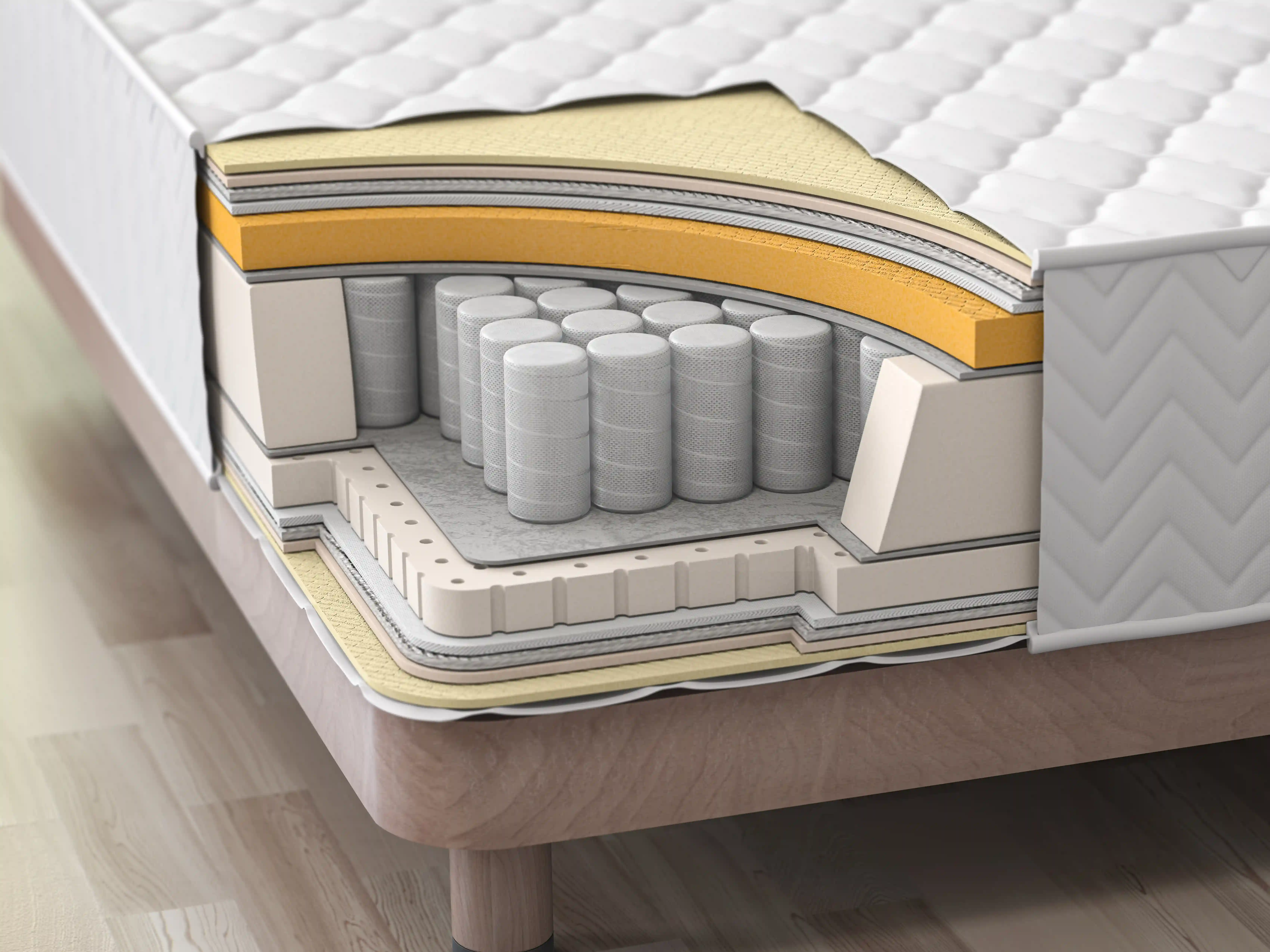
A hybrid mattress combines a steel coil support core with one or more substantial comfort layers, commonly polyurethane foam, memory foam, latex, or a combination. The coils distinguish it from an all-foam mattress. The deeper comfort system distinguishes the usual hybrid concept from a traditional innerspring with relatively little upholstery 12.
"Hybrid" is a retail construction label, not a single universally applied recipe or a quality grade. Industry descriptions agree on coils plus foam or latex, but they do not establish one required coil type, comfort material, layer depth, or total height. U.S. federal mattress rules address matters such as flammability, labeling, and conformity rather than prescribing a hybrid bill of materials 13.
For that reason, the layer-by-layer specifications tell you more than the word hybrid.
Hybrid, innerspring, and all-foam are useful but imperfect categories
| Category | Support core | Material above the core | Main boundary |
|---|---|---|---|
| Hybrid | Steel coils | A substantial comfort system, often foam or latex and sometimes fibers or microcoils | No universal comfort-layer depth separates every hybrid from every innerspring |
| Traditional innerspring | Steel coils | Usually thinner quilting and upholstery | Modern plush innersprings can overlap with products marketed as hybrids |
| All-foam mattress | Polyurethane, memory, or latex foam rather than a coil core | One or more foam comfort layers | Mixing two foam types does not add a coil support core |
| Foam-topped coil mattress marketed as a hybrid | Steel coils | Any amount of foam the seller chooses to describe as hybrid construction | Read the actual layer thicknesses and materials instead of accepting the label |
A pillow top or Euro top describes how the upper upholstery is attached or finished. It does not tell you whether the support core is coils or foam, and it does not establish firmness, quality, or durability.
Read a hybrid from the cover down
Cover and quilting
The outer ticking may be woven or knit and may include quilted foam or fibers. Stretch, thickness, quilting pattern, padding, and any separate cooling treatment can change the first impression of the surface. A removable-looking zipper does not mean the cover is intended to come off.
Fire barrier
U.S. mattresses are subject to federal smoldering and open-flame performance standards. These rules test the finished mattress or mattress set; they do not tell a shopper which material was used as the fire barrier. Ask the maker for the exact barrier construction and whether the cover is designed for removal. Do not open a cover unless the instructions explicitly say it is removable for laundering, because an internal zipper may exist only for factory assembly and opening it can expose or disturb internal materials 34.
Comfort layers
These are the layers that compress most directly under the sleeper. Memory foam, other polyurethane foams, latex, fibers, and microcoils can be used alone or together. Material family suggests some tendencies, but thickness, density, firmness, formulation, temperature, quilting, and neighboring layers change the result. "Gel," "plant-based," "natural," and branded foam names are not measurements of feel or performance.
Transition layers
A transition layer sits between the upper comfort system and the main coils. It may be foam, latex, fiber, or microcoils. It can moderate how quickly the sleeper reaches the firmer support core or reduce direct contact with the springs. Some designs omit a separately named transition layer, so its absence is not automatically a defect.
Coil support core
Pocketed coils are common in hybrids because each spring is enclosed in fabric and can move with less direct mechanical linkage to neighboring coils. Connected Bonnell, offset, or continuous-wire units can also appear in coil mattresses. A layer of short microcoils above the main unit is a comfort or transition feature, not a substitute for identifying the support core 5.
Perimeter and bottom layers
Edge reinforcement may use firmer perimeter coils, smaller coils placed more densely, a steel border, foam rails, or a combination. A thin foam or fiber layer can sit below the coils to stabilize and protect the unit. The label "edge support" does not indicate how firm, wide, durable, or adjustable-base-friendly the perimeter will be.
Overall profile
Total height includes the cover, quilting, comfort, transition, coil, and bottom layers. A taller mattress is not necessarily more supportive or durable. Height matters for fitted-sheet depth, guardrails, transfer height, headboard appearance, bending on an adjustable base, and the finished height of the mattress plus foundation.
Coil numbers need context
Coil type describes how springs are formed and connected. Pocketed coils usually move more independently than a linked unit, but fabric pockets, adhesives, preload, layout, and the layers above still affect motion and feel.
Gauge describes wire thickness. In the wire-gauge convention commonly reported for bedding, a lower number generally means thicker wire. It does not mean better wire or a better mattress. Coil height, diameter, shape, active turns, tempering, preload, and placement also change spring response 5.
Coil count is useful only when the mattress size and counting method are clear. A queen count cannot be compared directly with a king count. A total that combines support coils, microcoils, and multiple spring layers is not equivalent to the count of one support core. More small coils can raise the count without proving greater comfort, edge stability, or useful life.
Zoning means selected areas use a different spring, spacing, foam, or layer arrangement. The purpose may be to vary resistance across the surface. A named "lumbar zone" does not prove spinal alignment, pain relief, or a better fit for every body.
What a hybrid may change, and why the outcome is not guaranteed
| Question | Construction that may matter | Why the hybrid label cannot answer it |
|---|---|---|
| Motion between partners | Pocketed versus linked coils, foam type and thickness, quilting, coil preload, and bed size | Coils can add movement while upper layers can damp it; the complete model must be tested |
| Pressure and surface cushioning | Comfort-layer material, thickness, firmness, density, zoning, and quilting | Coils do not guarantee pressure relief, and deep foam does not guarantee a comfortable fit |
| Ease of changing position | Surface recovery, foam formulation, latex, coil response, and sink depth | Two hybrids can range from slow and enveloping to quick and springy |
| Temperature | Air spaces in the coil unit, cover, quilting, foam, latex, protector, sheets, and room | A coil cavity permits airflow but does not make the sleeping surface automatically cool |
| Edge sitting and lying | Perimeter coils, foam rails, border wire, comfort layers, and base | Reinforcement can feel stable or abrupt, and performance can change with use |
| Noise | Coil design, contact between parts, adhesives, cover, age, and foundation | A quiet new pocketed unit can still develop noise, and the base can be the actual source |
| Mattress weight and handling | Steel quantity, foam or latex volume, total size, and handles | Hybrids are often substantial, but the listed product weight and route matter more than category |
| Adjustable-base use | Coil flexibility, perimeter design, total profile, and maker approval | Some hybrids are compatible and others are not; approval for the exact model controls |
| Durability | Fatigue and bonding of the comfort layers, coils, edges, cover, and base | Coil count, thickness, price, and warranty length are not standalone lifespan scores |
A fast spec-sheet check
Before comparing price or firmness labels, record the exact model, size, stock-keeping unit, and current construction revision. Then look for:
- every layer in order, with material and thickness
- polyurethane-foam density when disclosed, the type or blend of latex, and whether microcoils are included
- the main coil type, gauge or gauges, height, count for the chosen size, and what that count includes
- the location and construction of zones and edge reinforcement
- cover composition, quilting, removable status, and cleaning instructions
- the exact fire-barrier material or system
- finished dimensions, total profile, packaged and unpackaged weight, and handles or grip points
- whether the mattress is one-sided or designed to be flipped
- permitted foundations, maximum slat spacing, center-support rules, adjustable-base approval, and any load limits
- delivery form, expansion instructions, ventilation guidance, and the time allowed before first use
- certification names, certificate or listing details, and which component or finished product each one covers
- trial, return, exchange, warranty, and disposal terms
If a seller will not provide a specification, treat it as unknown. Do not replace the missing fact with an assumption based on price, brand, thickness, or the word premium.
How to test one in a store
Confirm that the display bed is the same model, firmness, size, and revision you can buy. A showroom name may cover several constructions.
Use the positions and movements that matter in your household. Notice whether you reach the firmer layers, feel stuck or unstable while turning, sense a sharp transition at a zone, or slide toward the edge. If two people share the bed, have one change position and get up while the other stays still. Sit and lie near the edge if that is part of normal use.
Temperature and long-term comfort cannot be settled during a brief store visit. The goal is to reject obvious mismatches and form specific questions to test at home, not to prove that a category is right for you.
How to evaluate it during a home trial
Use the approved base and ordinary bedding. For several representative nights, keep brief notes on:
- initial comfort and whether deeper layers become noticeable through the night
- ease of turning, getting in and out, and using the edge
- partner disturbance and whether movement or noise comes from the mattress or base
- heat buildup with the protector, sheets, and room conditions you normally use
- any persistent slope, uneven expansion, unusual sound, loose seam, or visible damage
Change one removable factor at a time when practical. Replacing the pillow, protector, foundation, and room temperature together makes it difficult to tell what changed the result. Do not modify the mattress itself during a return window.
Setup and ownership checks
Base compatibility
Do not assume every platform, box spring, slatted frame, or adjustable base is permitted. Match the instructions for slat spacing, center support, foundation type, adjustable movement, and combined sleeper-plus-mattress load. A noncompliant base can change feel, create apparent sagging, make noise, and affect warranty eligibility.
Delivery and expansion
Some hybrids arrive flat while others are compressed and rolled. Confirm package dimensions, route clearance, total weight, room-of-choice service, removal of the old mattress, and who is expected to lift it. After opening, follow the maker's sequence and timing for removing wrap, positioning, expansion, ventilation, and first use. Photograph shipping damage, a model-label mismatch, or failure to reach the stated dimensions before arranging a return.
Rotation, flipping, and cleaning
Rotate only on the schedule the maker gives, and flip only if the model is explicitly two-sided. Use handles only for the purpose stated in the instructions. Follow the cover and stain-cleaning directions, keep liquids out of internal layers, and do not unzip or machine-wash a cover merely because it has a zipper 4.
Trial, return, and warranty
Read these as three separate documents. A sleep trial covers preference during a defined return window. A return policy explains pickup, shipping, fees, required condition, packaging, refunds, and exchanges. A warranty covers specified defects under specified ownership and support conditions; it is not a comfort guarantee or a promised lifespan.
Check when the trial starts, whether there is a minimum-use period, who pays for pickup, whether an exchange ends or restarts the trial, and which stains or damage make a return ineligible. For the warranty, note the indentation measurement method and threshold, required base, exclusions, remedy, prorating, transportation costs, and whether coverage is limited to the original purchaser. U.S. federal rules require covered written warranty terms for consumer products over $15 to be available before purchase, so read the actual document rather than relying on a duration printed in an advertisement 6.
What certifications do and do not tell you
A certification has a named scope. It does not automatically certify every material in the mattress, establish comfort, prove durability of the complete bed, or demonstrate a health benefit.
CertiPUR-US certifies flexible polyurethane foam against the program's criteria for content, emissions, performance, and durability. It does not certify a mattress, company, product line, latex layer, coil unit, cover, adhesive, or fire barrier. Check that the company is in the current program directory and ask which polyurethane foams in the exact model are covered 4.
UL GREENGUARD or GREENGUARD Gold concerns chemical-emissions limits for the product identified in the UL certification. Gold uses lower emission limits and additional requirements. It does not describe coil quality, foam density, organic content, comfort, or expected lifespan. Confirm that the exact finished mattress or exact component appears in the listing rather than transferring a certificate across a brand 7.
CPSC flammability compliance means the applicable mattress prototype or set meets federal smoldering and open-flame performance requirements. The permanent label includes identifying and compliance information, but it is not a complete ingredient list. Save a photograph of that label with the receipt and written specifications 3.
Is a hybrid the right category?
A hybrid is worth comparing when you want to test a coil-supported bed with a deeper comfort system. That does not make it best for a particular sleep position, body size, couple, pain condition, or temperature preference.
Compare the exact hybrid against at least one plausible alternative under similar conditions. An all-foam model may feel more or less responsive, isolate more or less motion, and sleep warmer or cooler depending on its construction. A traditional innerspring may have thinner upholstery or may overlap substantially with a mattress sold as a hybrid. Choose the model whose tested behavior, dimensions, support requirements, ownership work, and purchase terms fit the household.
The bottom line
A hybrid mattress is a coil-core mattress with a substantial comfort system, usually foam or latex. The name describes a broad construction idea, not a fixed formula or a promise of cooling, pressure relief, edge strength, quietness, adjustability, or durability.
Compare the full layer sequence and coil details, then test the exact model and verify its base, setup, care, certification, return, and warranty terms. Those details determine whether a particular hybrid is a good purchase, not the category label by itself.