
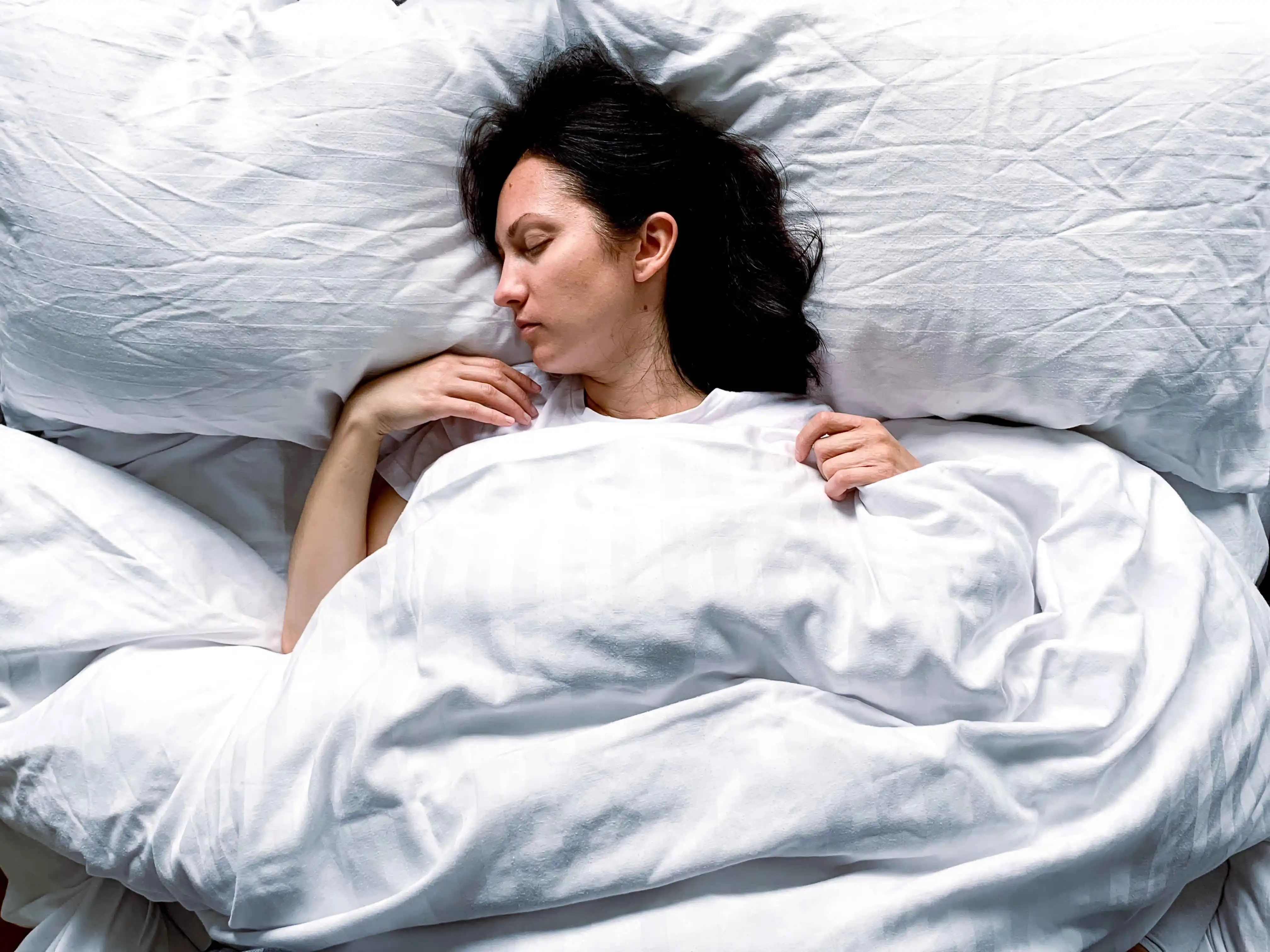
Sleeping on your back is acceptable if it feels comfortable and no medical or recovery instruction tells you to use another position. It is not automatically healthier than side or stomach sleeping, and you do not need to train yourself to stay on your back all night.
Research does not establish one adult sleep position that reliably prevents spinal pain. A scoping review found only four eligible studies on sleep posture and spinal symptoms, with too little high-quality evidence for firm recommendations 1. Conditions such as positional obstructive sleep apnea (OSA), nighttime reflux, breathlessness when flat, and later pregnancy create clearer reasons to reconsider back sleeping.
If you are choosing among several positions, see our broader side, back, and stomach sleep comparison. This guide focuses on deciding whether back sleeping fits your situation.
When a back-sleeping trial is reasonable
Try back sleeping because it is comfortable, not because it is supposed to place every body in perfect alignment. It may suit someone who dislikes pressure on a shoulder or hip. It may also feel better or worse when neck or back pain is present, and that response is individual.
For a simple trial:
- Start in your usual back position without replacing your mattress or buying a special pillow.
- If your lower back feels strained, test a pillow under your knees. Keep it only if it makes you more comfortable. This is not a proven anatomical correction.
- Judge the position by repeated morning pain, awakenings, numbness, and daytime function.
- Stop forcing the position if symptoms become worse.
Persistent pain, progressive numbness, or weakness needs an assessment of the underlying problem rather than a more elaborate sleep setup.
When back sleeping may be the wrong fit
Positional sleep apnea and snoring
Some people with OSA have substantially more breathing events while lying on their backs. A Cochrane review of eight short studies found that positional therapy reduced apnea severity compared with no positional treatment, but continuous positive airway pressure (CPAP) reduced it more. The studies did not establish long-term results 2.
This does not mean every person who snores must avoid back sleeping. A 2024 systematic review found that changing position or elevating the head reduced snoring in some studies, but the evidence was limited and the approaches were not equally tolerable 3. Snoring alone cannot diagnose OSA, and quieter snoring cannot prove that treatment is controlling it. The American Academy of Sleep Medicine recommends diagnosis with a comprehensive sleep evaluation and either polysomnography or an appropriate home sleep apnea test 4.
If you have diagnosed OSA, use sleep-study position data and your clinician's advice to decide whether positional therapy belongs in your treatment. Do not replace CPAP, an oral appliance, or another prescribed treatment with a position change on your own. If you have loud snoring with gasping, witnessed breathing pauses, or marked daytime sleepiness, ask about an OSA evaluation.
Nighttime reflux
Back sleeping does not trigger reflux in everyone. If heartburn or regurgitation repeatedly appears while you are flat, however, position can be one useful part of symptom management. The American College of Gastroenterology guideline supports head-of-bed elevation for nighttime symptoms and advises against sleeping right-side down 5.
A 2023 systematic review found that left-side sleeping reduced nighttime acid exposure and improved acid clearance compared with back or right-side sleeping. Only three studies met the review criteria, so this is a practical option rather than a guaranteed fix 6.
Try the left side if back sleeping predictably worsens your symptoms. If you need elevation, raise the torso with a stable wedge or an adjustable bed rather than stacking pillows only under the head. Repeated nighttime reflux still deserves condition-specific care, especially if it persists despite appropriate treatment.
Breathlessness when lying flat
Needing to sit up or use several pillows because you cannot breathe comfortably while flat is not simply a sleep-position preference. This symptom is called orthopnea and can occur with heart or lung conditions. MedlinePlus advises contacting a health professional about unexplained breathing difficulty when lying down 7.
Arrange medical assessment rather than trying to solve the symptom with bedding. Seek urgent help for sudden or severe breathlessness 8.
Pregnancy after 28 weeks
After 28 weeks of pregnancy, NICE advises going to sleep on your side rather than your back because back going-to-sleep position may be linked with late stillbirth. The evidence has some uncertainty because it comes from observational studies, but the guideline concluded that it was strong enough to support this advice 9.
Either side is acceptable. If you wake on your back, turn onto your side and return to sleep rather than panicking 10. Follow any individualized advice from your maternity team.
Surgery, injury, or another recovery plan
Procedure-specific instructions override general sleep-position advice. Some recovery plans require back sleeping, while others restrict it. Follow the position and duration your care team gave you, and ask that team how to adapt the setup if pain, breathing, or wound concerns make the instructed position difficult.
Babies need a different back-sleeping rule
Adult position advice does not apply to infants. The American Academy of Pediatrics recommends placing babies on their backs for every sleep until age 1, including babies with reflux. Use a firm, flat, noninclined sleep surface with a fitted sheet and no pillows, wedges, positioners, loose bedding, or other soft objects 11.
Once a baby can roll both ways independently, continue placing the baby on their back at the start of sleep. The baby may remain in the position they reach on their own, but the sleep space should stay empty 11.
How to decide whether to keep sleeping on your back
Separate comfort from disease control:
- For general comfort: Keep back sleeping if you fall asleep without strain and do not repeatedly wake with pain, numbness, or poorer sleep.
- For apnea: Use objective testing and your treatment plan. Comfort and quieter snoring do not show that breathing events are controlled.
- For reflux: Notice whether symptoms consistently change with position, but do not use position as a substitute for needed diagnosis or treatment.
- For pregnancy or recovery: Follow the relevant clinical instruction even if another position was previously comfortable.
There is no prize for staying in one position all night. For most adults without a position-specific restriction, the practical answer is to use back sleeping when it feels comfortable and change position when it does not.