

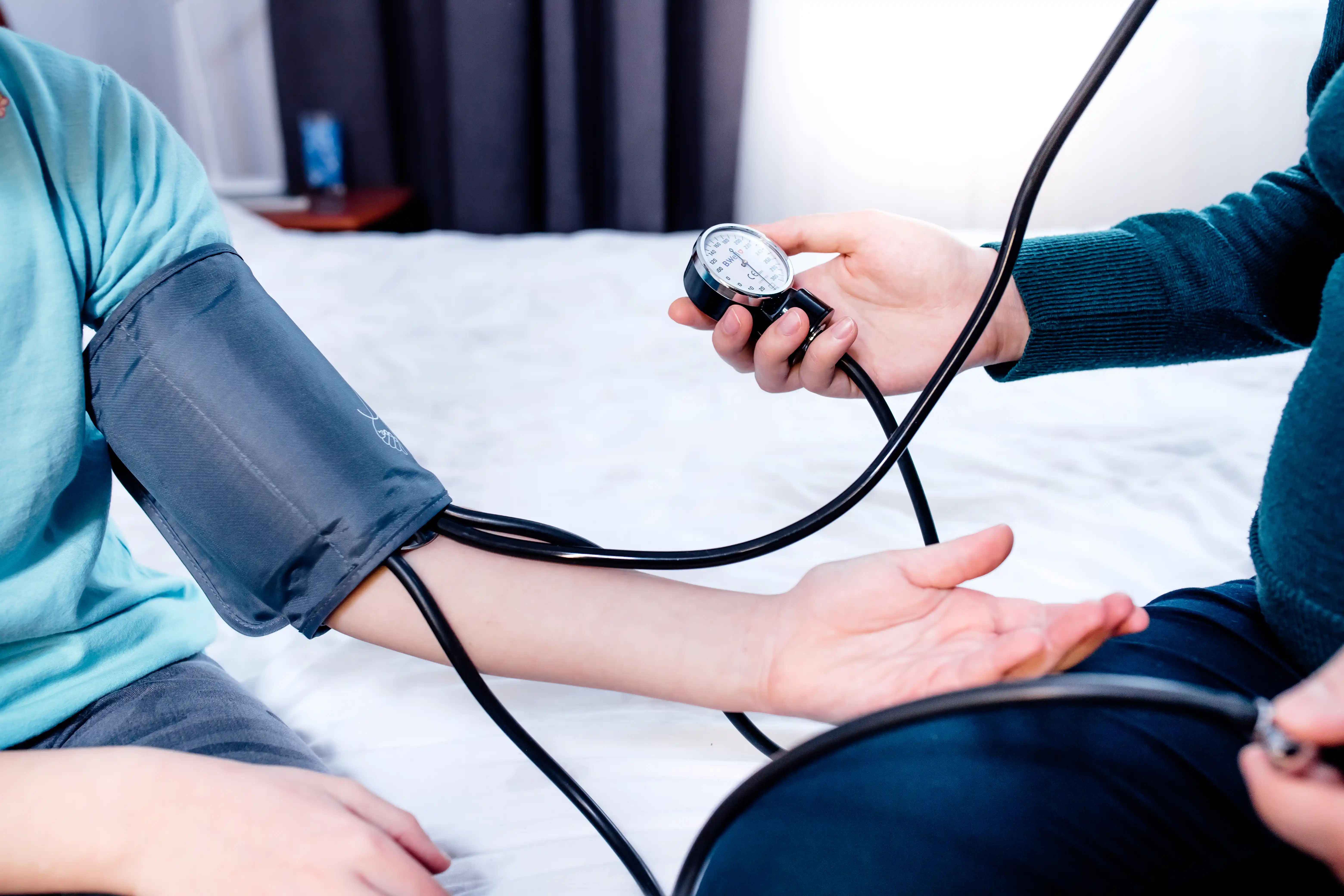
Obstructive sleep apnea (OSA) can contribute to high blood pressure. The connection is especially relevant when pressure stays high at night, looks normal in the clinic but high outside it, or remains above goal despite several medications. OSA is not the only possible cause, however. Not everyone with OSA has hypertension, and not everyone with hypertension has OSA 1.
The useful question is not simply whether the two conditions are linked. It is whether each condition has been measured correctly, whether OSA could be one contributor to the person's blood-pressure pattern, and whether both treatments are working as intended.
This article is about obstructive sleep apnea
OSA occurs when the upper airway repeatedly narrows or closes during sleep even though the body is still trying to breathe. Central sleep apnea is different: breathing pauses because the brain does not consistently send the signals needed to breathe. The causes, testing, and treatment can differ, so evidence about OSA and blood pressure should not automatically be applied to central sleep apnea 2.
If a sleep report lists central or mixed events, ask the treating clinician how those events affect the diagnosis and treatment plan. The rest of this article refers specifically to OSA.
Why OSA can raise blood pressure
Each obstructive event can trigger a pressure surge
During an obstructive event, airflow falls or stops, oxygen may drop, carbon dioxide may rise, and breathing effort creates large pressure swings inside the chest. The brain then briefly arouses enough to reopen the airway. Low oxygen, the arousal, and the effort of breathing activate the sympathetic nervous system, which controls part of the body's short-term alert response. Heart rate and blood pressure can rise sharply as breathing resumes 1.
These surges have been measured directly in people with OSA. In a small laboratory study of 10 patients, blood pressure and sympathetic nerve activity rose during sleep and peaked around obstructive events. The patients also had higher sympathetic activity while awake than matched controls. This study helps explain the mechanism, but its small size means it does not predict how much one person's daytime pressure will change 3.
Repetition may affect daytime regulation
When obstruction, intermittent low oxygen, and arousals recur through the night, the nervous system does not receive the usual quiet period of stable sleep. Persistently increased sympathetic activity and changes in vascular and blood-pressure regulation are plausible pathways from OSA to daytime hypertension 1.
Long-term observational evidence supports a contribution from sleep-disordered breathing. In the Wisconsin Sleep Cohort, 709 adults had objective sleep testing and were followed for four years. More breathing events at baseline were associated with higher odds of hypertension at follow-up, even after adjustment for factors including body size, age, sex, alcohol use, and smoking 4.
This dose-response pattern strengthens the case that OSA can help cause hypertension, but it still does not prove that OSA caused a particular person's high pressure. Obesity, kidney disease, medications, genetics, alcohol, diet, physical activity, and other conditions may contribute at the same time.
The nighttime pattern can be the clue
Blood pressure usually falls during sleep. A drop of less than 10% from daytime pressure is called a non-dipping pattern. When nighttime pressure is higher than daytime pressure, it is called reverse dipping. OSA is associated with both patterns, but neither pattern is specific to OSA.
A meta-analysis of 14 studies found wide variation in non-dipping among people with and without OSA. In the seven studies that directly compared the groups, OSA was associated with about 1.5 times the odds of non-dipping. Differences among the studies and the overlap between groups mean that a non-dipping result is a reason to investigate, not a diagnosis of OSA 5.
A routine home cuff can show whether pressure is high when you check it, but ordinary morning and evening readings do not reveal what happens throughout sleep. A 24-hour ambulatory blood-pressure monitor takes repeated measurements during waking and sleeping hours. It can identify nocturnal hypertension, a non-dipping or reverse-dipping pattern, and masked hypertension, which means pressure is acceptable in the clinic but high outside it 6.
Ask whether ambulatory monitoring would be useful if office and home readings disagree, high morning readings recur, kidney or cardiovascular risk is high, or blood pressure remains difficult to control.
What counts as high blood pressure
For nonpregnant adults, the current US categories are:
-
Normal: below 120 systolic and below 80 diastolic
-
Elevated: 120 to 129 systolic and below 80 diastolic
-
Stage 1 hypertension: 130 to 139 systolic or 80 to 89 diastolic
-
Stage 2 hypertension: 140 systolic or higher, or 90 diastolic or higher 6
The top number is systolic pressure, measured when the heart contracts. The bottom number is diastolic pressure, measured between beats. The 130/80 threshold marks the start of the stage 1 category in this US framework. It does not mean that one reading at or above that level proves chronic hypertension or that everyone with the same reading needs the same treatment.
Diagnosis generally relies on an average from repeated, properly taken readings, often confirmed outside the clinic. Medication decisions also depend on the average pressure, cardiovascular risk, other health conditions, and response to nonmedication measures 6.
Resistant hypertension needs a careful check
Resistant hypertension generally means blood pressure remains above goal despite three complementary medications, including a diuretic, at the highest tolerated doses, or is controlled only with four or more medications. Before applying that label, clinicians look for inaccurate measurements, missed doses, medicines or substances that raise pressure, and a white-coat effect 6.
OSA is common enough in resistant or poorly controlled hypertension that the American Heart Association recommends screening for it in this group 1. Screening is not the same as diagnosis, and finding OSA does not make the rest of a hypertension evaluation unnecessary.
What to do when OSA and high blood pressure may overlap
If OSA is suspected but not diagnosed
Loud habitual snoring, witnessed pauses, gasping or choking during sleep, and excessive daytime sleepiness can justify a sleep evaluation, especially alongside resistant or nighttime hypertension. Symptoms and questionnaires can identify risk, but they cannot diagnose OSA on their own.
The American Academy of Sleep Medicine recommends polysomnography or a technically adequate home sleep apnea test for appropriate uncomplicated adults at increased risk. If a home test is negative, inconclusive, or technically inadequate while suspicion remains, an in-lab study is recommended. In-lab testing is also preferred for certain conditions, including significant heart or lung disease, chronic opioid use, a history of stroke, suspected hypoventilation, and severe insomnia 7.
Do not start borrowed PAP equipment or choose an OSA treatment solely because blood pressure is high. First confirm what type of sleep-related breathing problem is present and establish an appropriate treatment plan.
If OSA is already diagnosed
Continue prescribed OSA treatment and blood-pressure medication unless the clinician managing them advises a change. If pressure remains high, the sleep clinician can review:
-
how often and how long PAP is actually used, including naps
-
mask leak, discomfort, congestion, or other barriers
-
residual breathing events reported by the device
-
whether the prescribed settings are controlling OSA
-
whether weight, medications, symptoms, or health conditions have changed since the last assessment
Device data are useful, but a low machine-reported event count does not answer every clinical question. Adequate follow-up is part of PAP treatment, and persistent symptoms or residual events may require a clinician to check the mask, data, diagnosis, or pressure plan 8.
Do not change pressure settings, stop PAP, or reduce blood-pressure medication based on a few improved readings. Sleep and primary-care or cardiology clinicians may need to coordinate because treating one condition does not replace treating the other.
How much can CPAP lower blood pressure?
CPAP lowers blood pressure modestly on average, with the largest mean effect often seen at night. A 2025 meta-analysis of 75 randomized trials involving 10,025 participants found average systolic reductions of 2.5 mm Hg in office readings, 2.6 mm Hg over 24 hours, 2.2 mm Hg during the day, and 3.5 mm Hg at night 9.
These are pooled study averages, not a forecast for an individual. Some people have little measurable change, while others have a larger response. In study-level analyses, reductions tended to be greater when baseline blood pressure was higher, OSA was more severe, and average CPAP use was longer. The finding that studies averaging at least 5 hours of use per night had larger reductions does not create a personal cutoff at which benefit suddenly begins 9.
The 2025 US hypertension guideline similarly describes short-term reductions of roughly 2 to 5 mm Hg in office and ambulatory pressure, including in resistant hypertension 6. That effect can matter as part of a complete plan, but CPAP is not a substitute for antihypertensive treatment.
There is no fixed timeline in which a person's pressure must improve and no promise that CPAP will allow medication reduction. Review trends measured with the same reliable method and let the prescribing clinician decide whether treatment needs to change.
CPAP treats OSA and can improve sleepiness and other OSA outcomes. It should not be presented as proven protection against heart attack, stroke, or death for every person with OSA. The AASM found the evidence insufficient and inconclusive for using PAP specifically to prevent cardiovascular events or mortality in nonsleepy adults 8.
What about treatments other than CPAP?
The right OSA treatment depends on the diagnosis, severity, anatomy, symptoms, other health conditions, and what the person can use consistently. Blood-pressure evidence differs by treatment.
-
Oral appliance therapy: A custom, adjustable appliance fitted and followed by qualified clinicians is an evidence-based option for some adults who prefer it or cannot tolerate CPAP. Trials suggest a modest average blood-pressure reduction, but the evidence is smaller than the CPAP evidence base. Follow-up sleep testing is used to confirm that the appliance controls OSA 10.
-
Weight management: For people with overweight or obesity, weight management can address a contributor to both OSA and hypertension. In a 24-week randomized trial of 181 adults with obesity and moderate to severe OSA, blood pressure fell in the CPAP, weight-loss, and combined groups. Among participants who met the trial's adherence criteria, the combined approach produced a larger reduction in systolic and mean arterial pressure than either treatment alone 11. Weight change does not justify stopping PAP without reassessment because OSA may persist.
-
Positional therapy: A positional device can reduce breathing events in people whose OSA is demonstrably worse on their back. A systematic review found lower apnea-hypopnea index values and less time spent on the back, but follow-up was generally short and patient-centered outcomes were limited. It did not establish positional therapy as a blood-pressure treatment 12.
-
Surgery: Surgical referral may be considered for selected adults who cannot use PAP, have pressure-related PAP problems, or have relevant anatomy. The decision requires an individualized assessment and discussion of residual OSA risk 13. Current US hypertension guidance notes that large randomized trials have not established a blood-pressure benefit from sleep surgery, so lowering blood pressure alone is not a sound basis for choosing a procedure 6.
These options are not interchangeable home remedies. Treat the diagnosed form of OSA, then measure whether that treatment is actually working.
How to get a reliable home blood-pressure reading
Use a validated automatic upper-arm monitor with the correct cuff size. Wrist and finger devices are less reliable. For each session:
-
Avoid smoking, caffeine, and exercise for 30 minutes, and empty your bladder.
-
Sit quietly for at least 5 minutes without talking or using your phone.
-
Keep your back supported, feet flat, legs uncrossed, and the cuff on bare skin with your arm supported at heart level.
-
Take two readings 1 minute apart and record both.
-
Measure at the times and for the number of days your healthcare professional recommends 14.
Keep the date and time with each result. If you use PAP, noting whether it was used the previous night may help the treating team interpret a pattern, but do not overinterpret one good or bad morning. Home monitoring supports care; it does not replace appointments or justify stopping medication 14.
When high blood pressure or sleepiness needs urgent action
If a reading is higher than 180 systolic and/or higher than 120 diastolic, wait at least 1 minute and measure again. If it remains that high without new concerning symptoms, contact a healthcare professional immediately. If it remains that high with chest pain, shortness of breath, back pain, numbness, weakness, a change in vision, or difficulty speaking, call emergency services. Do not wait to see whether it falls on its own 14.
OSA-related sleepiness can also create an immediate safety risk. If you are struggling to stay awake, do not drive or operate machinery. Stop in a safe place and arrange another way to travel. Do not rely on coffee to make severe drowsiness safe 15.
The bottom line
OSA can contribute to repeated nighttime pressure surges, loss of the usual sleep-time dip, and sustained daytime hypertension. The relationship is real, but it is not universal and does not reveal how much OSA explains one person's pressure.
Confirm hypertension with repeated, correctly taken readings and confirm OSA with appropriate sleep testing. If both are present, keep treating both. Review PAP effectiveness, blood-pressure patterns, medication, and other possible contributors with the relevant clinicians rather than expecting one treatment to solve the entire problem.