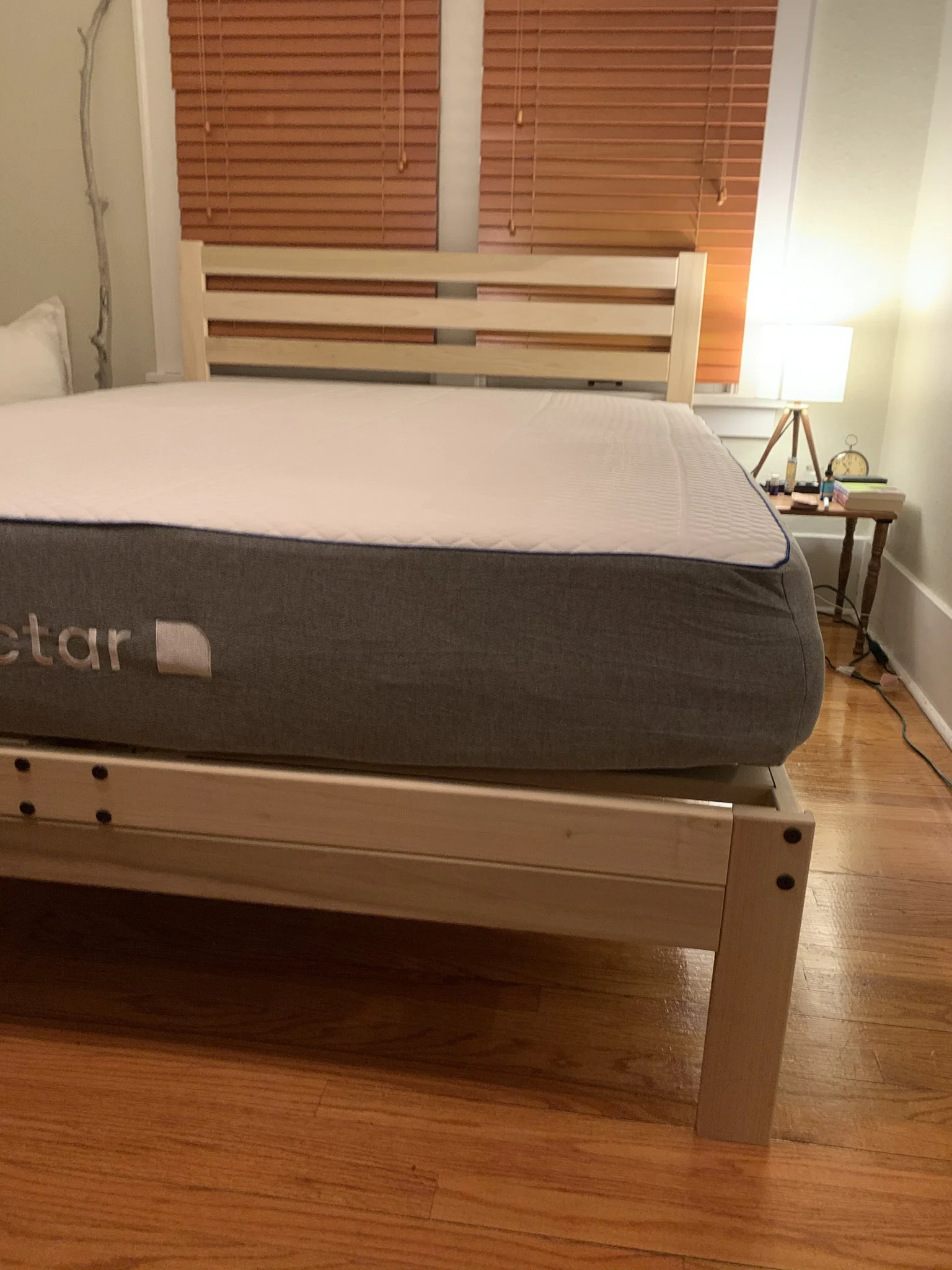


A visible dip can sometimes be fixed when the failed part is below the mattress. A broken slat, loose frame connection, damaged foundation, or incorrectly configured adjustable base may be repairable under the instructions for that product. Permanent deformation inside the mattress is not corrected with a household fix. It usually calls for a warranty claim, a manufacturer-authorized repair, or replacement.
Start by stripping the bed and inspecting the complete support chain. Do this before adding a topper, board, pillow, or extra slat. Those additions can hide the symptom without identifying the failure, change how the bed is supported, damage a component, or complicate a warranty claim.
First, identify the exact products and rules
Find the mattress brand, model, size, and approximate purchase date. The law label, order confirmation, receipt, registration record, or retailer may help. Then find the warranty and care instructions that apply to that exact mattress generation. Also identify the foundation, platform, frame, slats, and adjustable base, if present.
Look for five kinds of model-specific information:
-
the time the mattress should be left unloaded before an indentation is assessed
-
the manufacturer's definition of a covered indentation or defect
-
the required foundation, platform, slat dimensions, center support, load capacity, and adjustable-base compatibility
-
the prescribed way to photograph and measure the problem
-
whether the mattress may be rotated, flipped, unzipped, moved, or repaired
Do not borrow these rules from a different mattress. Warranty definitions are not uniform. Tempur-Pedic, for example, publishes different indentation thresholds for quilted and non-quilted mattresses, while Casper's current mattress warranty uses another threshold and excludes sag associated with an improper or unsupportive base 1 2. These are examples of why the governing instructions matter, not measurements to apply to another model.
Decide which problem you actually have
The word “sag” is often used for three different observations. They do not lead to the same fix.
| What you observe | How to check it | Appropriate route |
|---|---|---|
| A change in feel or an impression that recovers | Remove bedding and occupants, then allow the exact model's stated recovery period before reassessing. | Follow the model's rotation and care instructions. Do not treat ordinary softening as proof of a defect. |
| A visible indentation that remains while the mattress is unloaded | Follow the warranty's waiting, surface, straightedge, and measurement instructions without pressing on the mattress. | Document it and open a warranty claim before altering the mattress. |
| A dip that follows a bowed, broken, loose, or unsupported component below the mattress | Inspect the foundation, slats or platform, center supports, frame connections, and adjustable base against their exact specifications. | Stop using an unstable system. Seek the component maker's approved correction or replacement, then reassess the mattress. |
A mattress that feels softer where someone usually sleeps has not automatically failed. Serta, for example, distinguishes normal softening during use from covered sagging and tells owners to check the foundation when the surface is uneven 3. Likewise, an impression visible only while a person is lying on the bed is not an unloaded indentation. Follow the exact manufacturer's definition instead of diagnosing by feel alone.
Shape can also be intentional. A quilted surface, tufting, zoning, edge profile, or split configuration may not be designed to look uniformly flat. Tempur-Pedic specifically warns that the waterfall edge on some of its models should not be mistaken for sagging 1. Compare the observed area with the model's product information before measuring it as a defect.
Inspect the entire support chain
Remove the mattress only if its handling instructions allow it and you can support its weight and shape safely. Get help with a bulky mattress. Do not fold, drag, bend, or stand it on an edge unless the manufacturer permits that handling.
Work from the floor upward:
-
Floor and feet: Confirm that each intended foot or support point is installed, secure, and making stable contact with the floor. Look for rocking, an uneven surface, damage, or a support that has shifted.
-
Frame and connectors: Check side rails, cross members, brackets, fasteners, and corner connections for bending, separation, looseness, or missing parts. Tighten or replace a component only by the frame manufacturer's instructions.
-
Center support: For a frame designed with a center rail, beam, feet, or other middle supports, confirm that the specified pieces are present, aligned, undamaged, and in contact where intended. There is no universal number of legs that makes every frame adequate.
-
Slats or platform: Look for broken, cracked, warped, displaced, or missing slats and for flexing or damaged platform panels. Measure slat width and spacing only against the exact mattress and frame rules.
-
Foundation: With the mattress removed, look and feel for a local dip, broken part, separated section, or loss of support. A foundation can fail even when its cover looks intact.
-
Adjustable base: Check that the mattress and base are approved for each other and that every section returns to the intended position. Look for an obstruction, displaced deck section, damaged connector, or visible mechanical or electrical damage. Follow the base manual before touching anything below the moving platform.
Support specifications vary enough that generic fixes are risky. Tempur-Pedic currently permits qualifying slatted frames only when the slats meet its width, spacing, strength, and load requirements. Purple publishes a different maximum gap for its mattresses 4 5. Use the requirement for your mattress and base combination rather than whichever number is easier to meet.
If a support component is broken or out of specification, contact its manufacturer or retailer. Repairing the support may remove the dip, but it does not prove the mattress escaped damage. After the approved support is restored, leave the mattress unloaded for the period specified by its manufacturer and inspect it again.
Document the mattress before changing it
If the mattress itself may be defective, preserve the evidence before rotating it, moving it to another base, removing a cover, adding support, or attempting a repair.
Photograph:
-
the whole mattress with all bedding and protectors removed
-
the affected area while the mattress is unloaded
-
the mattress law label and any model label
-
the entire base, foundation, or frame with the mattress removed
-
the slats, platform, center support, frame connections, and any damaged component
Note the date, when the change was first noticed, whether it recovers, and where it appears relative to the support below. Keep the receipt, warranty document, order record, photographs, claim number, and correspondence. The Federal Trade Commission recommends saving both the written warranty and the receipt because coverage, exclusions, claim processes, and remedies vary 6.
Measure only by the method in the governing warranty. One current Tempur-Pedic claim process, for example, requires the mattress to be stripped and unloaded, both ends of a straightedge to rest on the mattress surface, and a ruler to show the deepest point without being pushed into the bed. It also asks for the law label, proof of purchase, and a clear view of the support system 7. Another manufacturer may require different tools or documentation.
Which common “fixes” actually help?
Rotation
Rotation can redistribute where future use occurs, but it cannot mend split foam, broken coils, a collapsed edge, or a failed base. Rotate only when the instructions for the exact model allow it, and preserve your evidence before doing so. There is no reliable universal rotation interval.
Flipping
Flip a mattress only when the manufacturer identifies it as a two-sided model designed for flipping. Layered one-sided mattresses can place their support core on top and their sleep surface against the base when flipped. Tempur-Pedic says not to flip its mattresses because doing so can affect performance, cause damage, and affect warranty coverage 8.
A topper
A topper can change surface feel. It cannot restore failed internal support, straighten a damaged foundation, reconnect a frame, or make a permanent indentation disappear. Adding one before documenting the defect may also make it harder to judge whether the underlying problem is progressing.
Pillows, boards, and extra slats
Do not place pillows or loose objects under a low area. They create concentrated, unstable support and do not repair the failed component. Do not insert plywood, a bunkie board, or random extra slats unless the mattress and frame manufacturers approve the exact change. Added parts can alter spacing, load paths, height, ventilation, and adjustable-base movement.
A board is not a universal cure. Tempur-Pedic advises against plywood for its mattresses because it may trap moisture and affect warranty coverage, and it places similar restrictions on several other bases 4. That rule is specific to its products, but it shows why an improvised board should not be treated as harmless.
Do not move a mattress to the floor as a default test or repair. The mattress maker may prohibit floor use, the surface may not meet its support requirements, and reduced airflow can allow moisture to remain beneath the mattress. If a manufacturer asks for a short diagnostic test, follow its written setup and handling instructions exactly.
Opening or repairing the mattress
Do not cut the cover, open seams, remove foam, tie coils, inject adhesive, or attempt an internal repair. Contact the manufacturer before any alteration. Use only a repair route it authorizes for that model. An unauthorized alteration can expose sharp parts, destabilize the construction, and affect the claim.
Protect the warranty route
Contact the retailer or manufacturer as soon as the unloaded documentation suggests a mattress defect. Ask which warranty edition applies, what the claim covers, how the indentation should be measured, which base evidence is required, and whether any action is permitted before inspection.
Do not remove the law label, discard the support system, or repair the mattress while the claim is being evaluated. If you already changed the setup, be accurate about what changed and when. Keep copies of everything submitted. If the company offers a repair, confirm that the provider and procedure are authorized and ask how the work affects the remaining warranty.
Stop using the bed when it is unsafe
Do not sleep on the bed while springs, wires, sharp frame parts, or internal components are exposed. Stop if an edge or support has collapsed, the frame shifts or rocks, slats fall from their ledges, or a component can no longer carry the intended load. Keep children and pets away from a damaged or partly disassembled bed.
Treat a powered base as electrical and moving equipment, not as ordinary furniture. Unplug it before moving or examining it when its manual requires that step. Keep hands, loose clothing, bedding, children, and pets away from moving sections and pinch areas. Do not disassemble motors, wiring, control boxes, or mechanical assemblies. Purple's adjustable-base manual, for example, says to unplug before servicing, closely supervise use near children and pets, keep them from playing under the bed, and contact qualified service for a damaged cord, malfunction, or water exposure 9. Tempur-Pedic's moving guidance says to disconnect power, use professional help because the base is heavy, and not disassemble its electrical or mechanical parts 10. Use the safety procedure for your exact base and arrange authorized service for a movement, electrical, or mechanical fault.
When replacement is the sensible answer
Mattress age or material alone does not decide this. Consider replacement when:
-
the mattress has an unloaded permanent indentation or structural damage and warranty or authorized repair is unavailable
-
exposed or collapsed components make continued use unsafe
-
the correct support system has been restored, the specified recovery time has passed, and the mattress still does not recover
-
a manufacturer-authorized repair cannot restore safe, even support
-
the model no longer meets the sleeper's needs and the issue is comfort rather than a covered defect
If the base failed, replace or repair that component before placing a new mattress on it. Confirm the new mattress's support requirements first so the same setup does not damage the replacement.
What if the bed seems to cause pain?
A pattern can provide a clue, but it cannot prove that a mattress caused back, neck, hip, or shoulder pain. Note where and when the pain occurs, whether it changes after sleeping elsewhere, and whether the mattress or base has an observable defect. Persistent or worsening pain deserves assessment rather than repeated changes to the bed.
Contact a health professional promptly for pain after a severe fall or blow, unexplained fever, new weakness or numbness, trouble walking, loss of bladder or bowel control, severe pain that does not allow a comfortable position, or unexplained weight loss. MedlinePlus lists these among signs that back pain needs timely medical attention 11.
The bottom line
Do not try to fill a dip until you know where it comes from. Strip and document the mattress, identify every support component, and compare the whole system with the exact model's instructions. A failed frame, foundation, or slat can have a specific approved fix. A permanently deformed mattress usually needs a warranty claim, authorized repair, or replacement, not a topper or household object hidden underneath it.