

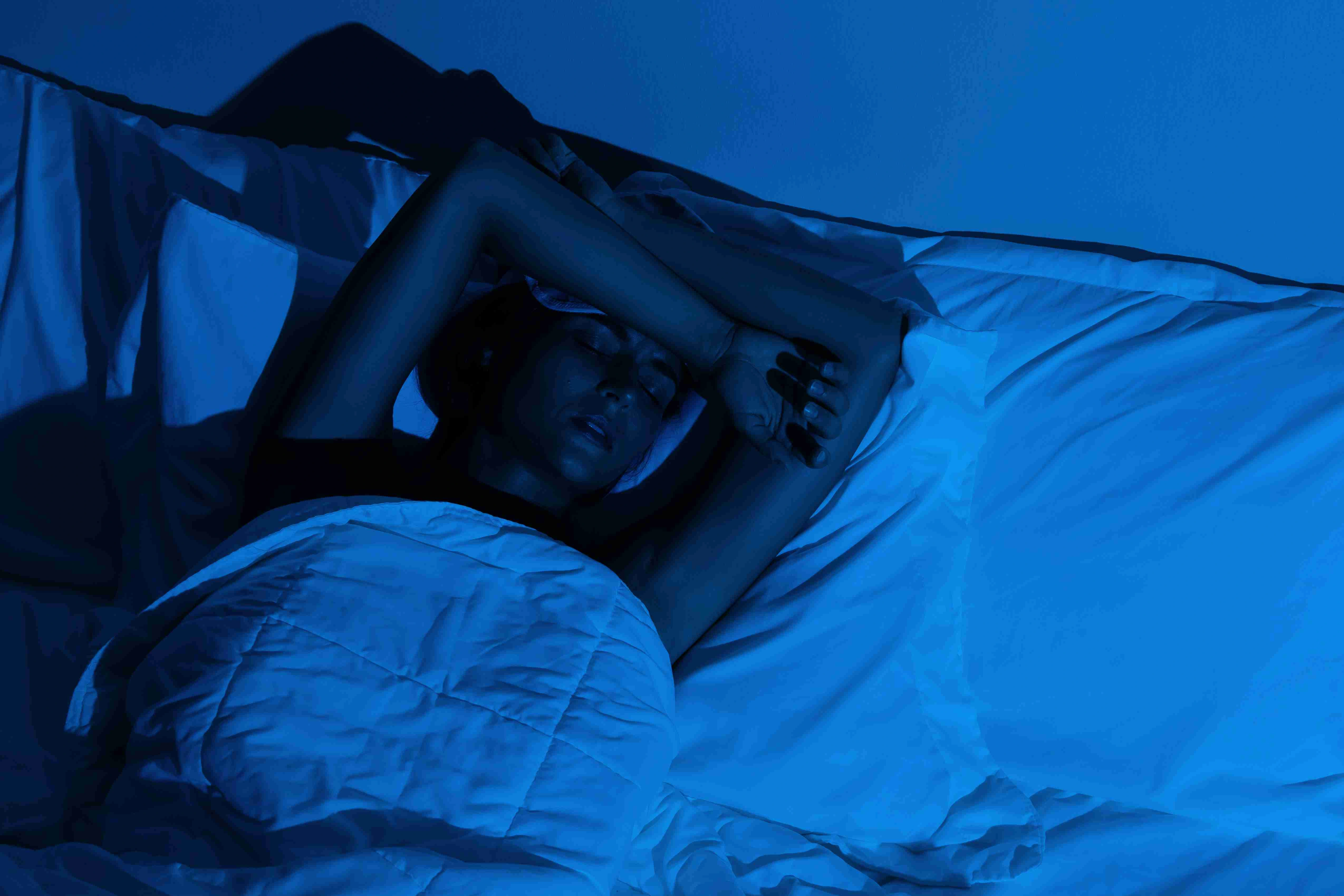
Hypnagogic hallucinations are vivid sights, sounds, or bodily sensations that happen as you are falling asleep. They can feel real for a few moments, but an isolated sleep-onset experience can fall within the normal transition between wakefulness and sleep. By itself, it does not mean that you have psychosis or narcolepsy 12.
Some researchers prefer the less stigmatizing term hypnagogic experience because these perceptions can occur within the normal range of sleep onset. In clinical use, recurrent or distressing events are often discussed under sleep-related hallucinations 31.
What a hypnagogic hallucination can feel like
The experience begins while you are drowsy and drifting into sleep. It may be:
- Visual: flashes, colors, geometric shapes, faces, people, animals, or a scene in the room.
- Auditory: a knock, music, a familiar voice, your name, or a short word or phrase.
- Bodily or movement-related: a sense of falling, floating, being touched, movement in the bed, or a presence nearby.
- Less often, smell or taste-related: an odor or taste with no matching source.
Reviews describe visual experiences most often, followed by auditory and bodily or movement sensations. The content can be simple or detailed, pleasant, neutral, or frightening. It may appear as a disconnected snapshot rather than a long story 31.
Timing is the defining feature
Hypnagogic means that the experience occurs while falling asleep. Hypnopompic means that it occurs while waking up. The content can be similar, so the direction of the transition is what separates the terms 1.
A brief image that appears after you close your eyes but while you are still fully alert is not necessarily hypnagogic. Neither is a perception that continues through ordinary daytime wakefulness. When the boundary is unclear, record whether you were falling asleep, waking, or already awake and active.
How common lookalikes differ
Several nighttime experiences can sound similar in a short description. The complete pattern matters more than whether it involved a voice, image, or sense of presence.
- An ordinary dream or nightmare usually unfolds during established sleep. Hypnagogic imagery belongs to the transition and can extend into early N1 sleep, so the boundary is not always sharp. It is often more snapshot-like than a longer dream. A nightmare is a distressing dream that wakes the person, who is usually oriented and can often recall the dream as a dream 31.
- Sleep paralysis is defined by being conscious but temporarily unable to move or speak while falling asleep or waking. A sensed presence, pressure, or other hallucination can occur at the same time, but a hypnagogic hallucination can also occur without paralysis 1.
- Exploding head syndrome is a sudden imagined bang, crash, or explosion at sleep onset or awakening, sometimes with a flash of light. It is usually painless, lasts only a fraction of a second, and does not usually unfold into a complex scene 14.
- Nocturnal panic wakes a person from sleep in a state of panic, often with a racing heart, breathlessness, sweating, trembling, or fear of catastrophe. It is not simply a sensory image that appears while drifting off 5.
- A sleep-related seizure can include visual, auditory, or bodily sensations. Repeated episodes with a highly similar pattern, loss of awareness, tonic-clonic movements, tongue biting, urinary incontinence, injury, or marked confusion afterward need neurologic assessment 16.
- Medication, intoxication, or withdrawal effects may produce hallucinations, abnormal dreams, confusion, or changes in consciousness. The timing of a new medicine, dose change, substance use, or abrupt reduction can be more informative than the content of the perception 17.
- Hallucinations during full wakefulness are not hypnagogic. They have a broader range of medical, neurologic, sensory, medication, substance, and psychiatric causes and deserve clinical assessment, especially when they are new or insight is reduced 27.
Do not try to diagnose a seizure, panic disorder, psychosis, or another condition from one feature. A brief home recording may help a clinician if there are repeated movements or behaviors, but personal privacy and immediate safety come first.
Does it mean narcolepsy?
Hypnagogic hallucinations are one recognized symptom of narcolepsy, but they are nonspecific. Many people who have a sleep-onset experience do not have narcolepsy. The central symptom that should raise the question is persistent, hard-to-resist daytime sleepiness or unintended sleep 81.
A sleep evaluation is more important when the hallucinations occur with one or more of these features:
- irresistible daytime sleepiness or unintended sleep episodes
- cataplexy, meaning brief muscle weakness triggered by emotion, such as knees buckling with laughter while awareness is preserved
- recurrent sleep paralysis
- disrupted nighttime sleep
Narcolepsy often begins in youth, so the same cluster matters in adolescents. AASM guidance says diagnosis follows a careful sleep history and examination and usually requires an overnight polysomnogram followed by a multiple sleep latency test, or MSLT. Those tests evaluate narcolepsy and competing sleep disorders. They do not prove that a remembered image or voice occurred 8.
What is known about causes and triggers
A simple trigger list overstates the evidence. Reviews report associations between hypnagogic experiences and poorer sleep quality, stress, anxiety, depression, post-traumatic stress, narcolepsy, and some medicines. Much of this evidence comes from questionnaires or observational studies, and medication or other factors were not always controlled 3.
That means an association cannot show that stress, anxiety, an irregular night, or a short period of sleep loss caused a particular episode. Laboratory work has found changes in the dream-like quality of sleep-onset experiences after selective REM sleep deprivation, which is not the same as proving that ordinary sleep loss causes recurrent hallucinations 3.
If episodes seem to cluster with insufficient sleep, changing schedules, stress, or a medicine or substance change, note the pattern rather than assuming the explanation. Restore adequate sleep opportunity for overall health and discuss medication or substance timing with a clinician, but do not promise that these steps will prevent another episode.
How a clinician evaluates the experience
The main evidence is the history and timing. A clinician may ask:
- Were you falling asleep, waking, or fully awake?
- What did you see, hear, feel, smell, or taste, and how long did it seem to last?
- Could you move and speak?
- Did you recognize afterward that the experience was not external?
- Was there loss of awareness, repetitive movement, injury, incontinence, or confusion?
- Are there daytime sleep attacks, cataplexy, sleep paralysis, snoring, or disrupted sleep?
- Did it begin after illness, fever, a medicine change, substance use, or withdrawal?
- Does a witness describe behavior that differs from what you remember?
A short diary can capture the date, sleep transition, estimated duration, sensory content, movement, daytime sleepiness, medicine or substance changes, and recovery. This is more useful than trying to interpret the experience's symbolism.
Polysomnography is not routinely used to confirm an isolated hypnagogic hallucination. The 2024 clinical review emphasizes subjective reports and notes that sleep-related hallucinations do not have a distinct established polysomnographic signature. Testing is selected for the suspected condition instead, such as overnight polysomnography and an MSLT for narcolepsy or video EEG when a seizure remains possible 186.
What to do about isolated or recurrent episodes
An isolated, clearly sleep-onset experience with no concerning daytime or neurologic symptoms often needs no treatment. If it is frightening, sit up safely, turn on a light, orient yourself to the room, and allow full wakefulness to return before standing.
For repeated episodes:
- Record the timing and the whole symptom pattern. This helps separate a sleep-onset experience from a waking hallucination, panic, paralysis, or another event.
- Protect adequate sleep opportunity. This is sensible sleep care, but it is not a guaranteed prevention method for hypnagogic hallucinations.
- Review medicines and substances with the prescriber. Do not abruptly stop a psychiatric medicine, sedative, stimulant, alcohol, or another substance that can cause withdrawal.
- Treat the diagnosed problem. Narcolepsy, panic disorder, insomnia, a medication effect, epilepsy, and a psychotic or medical illness require different plans.
- Address persistent fear directly. Explanation and a plan for the next episode may reduce panic. CBT may be appropriate for a diagnosed anxiety or insomnia problem, but it is not an established generic treatment for hypnagogic hallucinations.
Melatonin, antidepressants, stimulants, antipsychotics, supplements, and a particular diet are not routine prevention for an isolated hypnagogic experience. A clinician may use one for a separate diagnosed condition, but do not start one for this purpose without a diagnosis-specific reason. If a prescribed medicine seems connected to new episodes, discuss it promptly rather than changing it on your own 1.
Children and physical safety
A child may describe a person in the room, a voice, a shadow, or a falling sensation while drifting off. Research comparing hypnagogic experiences in children and adults is limited, and early studies in children produced mixed findings. Ask calmly when it happened, whether the child could move, and what they remember, without confirming the perception as real or dismissing the fear 3.
Arrange pediatric assessment when episodes are recurrent or very distressing, occur with fever or illness, follow a medication change, happen during full wakefulness, involve loss of awareness or unusual movements, or accompany marked daytime sleepiness, cataplexy, or sleep paralysis.
The perception itself is usually benign, but a startled reaction can cause a fall or collision. If someone jumps up or reaches toward an image, clear the route beside the bed, move sharp or breakable objects, and consider a lower sleep surface rather than a top bunk. Use calm verbal orientation and do not hold the person down. Get emergency help if the behavior cannot be kept safe.
When to seek prompt or emergency help
Arrange prompt medical assessment when hallucinations:
- happen during full wakefulness or continue well after the person is awake
- become recurrent, distressing, or difficult to distinguish from reality
- begin after a medicine or substance change
- occur with new headaches, weakness, numbness, abnormal movements, loss of awareness, memory change, or other neurologic symptoms
- occur with persistent daytime sleepiness, unintended sleep, cataplexy, sleep paralysis, or major nighttime sleep disruption
- appear with new manic, psychotic, or severe mood symptoms
Seek emergency help for sudden severe confusion, speech that does not make sense, high fever with altered behavior, a seizure, suspected poisoning or overdose, severe intoxication or withdrawal, inability to tell what is real with dangerous behavior, commands to harm yourself or someone else, suicidal intent, extreme agitation, or rapidly worsening hallucinations 79.
Severe alcohol withdrawal can cause hallucinations, confusion, visible shaking, and seizures. It can be dangerous to stop suddenly after dependence, so these symptoms require emergency care rather than a sleep-hallucination explanation 9.