

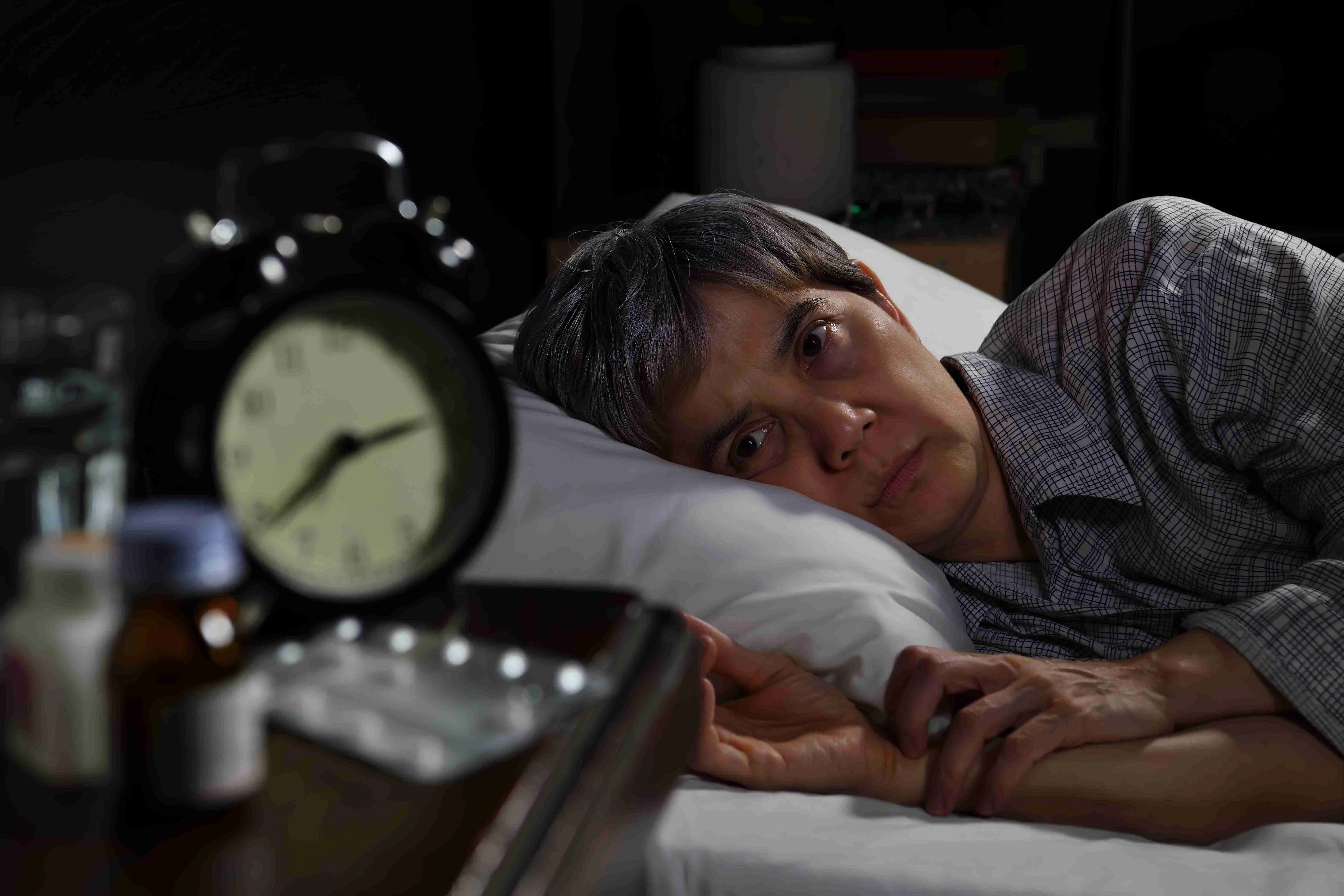
Common insomnia can run in families, but it is not inherited through one deterministic “insomnia gene.” Research points to a highly polygenic susceptibility, meaning that many common genetic differences may each contribute a very small amount of risk. Family history is therefore a clue about vulnerability, not a prediction that insomnia is inevitable.
This distinction matters because insomnia is a clinical sleep problem, not a DNA result. It involves repeated difficulty falling asleep, staying asleep, or returning to sleep after waking early despite adequate opportunity and circumstances for sleep, together with meaningful distress or daytime impairment 1. Many genetic studies measured a broader phenotype such as self-reported insomnia complaints or symptoms rather than formally diagnosed chronic insomnia disorder.
What does insomnia heritability mean?
Twin studies compare how similar insomnia measures are in identical twins, who share nearly all their inherited DNA, and fraternal twins, who share about half on average. A 2021 meta-analysis of 13 independent samples estimated mean insomnia heritability at 39%. The estimates varied greatly among studies 2.
That 39% figure does not mean:
- 39% of one person's insomnia was caused by genes
- a child of someone with insomnia has a 39% chance of developing it
- the remaining 61% can be assigned to a specific set of habits
- an individual's outcome can be calculated from family history
Heritability describes how much of the variation in a measured trait within a particular population, at a particular time, is statistically associated with genetic differences. It can change with the population and environment being studied. Estimates also depend on age, sex, who reports the symptoms, how insomnia is defined, and the statistical method. A symptom questionnaire, a single sleep complaint, and a diagnosed disorder are not interchangeable phenotypes 2.
Twin models are useful, but they estimate rather than directly observe genetic and environmental contributions. They make assumptions about how similarly identical and fraternal twins share relevant environments. Gene-environment correlation, gene-environment interaction, measurement error, and differences in participation can also blur a clean separation between “genes” and “environment” 3.
Why can insomnia cluster in a family?
Family resemblance may reflect several pathways at once 31:
- many inherited variants with individually small effects
- shared schedules, light exposure, noise, housing, work demands, or caregiving patterns
- common health conditions, medicines, caffeine, alcohol, nicotine, or other substances
- shared stressors and ways of responding to nighttime wakefulness
- learned sleep behaviors that persist after an original trigger has passed
These influences are not independent boxes. A predisposition may affect how someone responds to stress, while a prolonged sleep problem can change routines and expectations around sleep 31. Two relatives can therefore have similar symptoms for different combinations of reasons. Relatives can also share a home and much of their DNA while having very different sleep.
Family history does not show whether a current problem is insomnia, insufficient sleep opportunity, a circadian timing mismatch, sleep apnea, restless legs syndrome, a medicine effect, substance withdrawal, pain, anxiety, depression, or another condition. The present symptom pattern still needs to be assessed 1.
What have large genetic studies found?
Genome-wide association studies, or GWAS, compare genetic variants across very large groups. One study of 1,331,010 people identified 202 genomic regions associated with insomnia complaints. Its meta-analysis explained 2.6% of variation in that study phenotype 4.
Finding many associated regions supports a polygenic model. It does not mean researchers found 202 diagnostic insomnia genes. Most participants were classified through self-reported complaints, and statistical mapping from a region to a possible gene or biological pathway does not establish that the mapped gene causes insomnia in a particular person.
Genetic studies also use several terms that answer different questions:
| Term | What it means | What it does not establish |
|---|---|---|
| Genetic association | A variant or pattern of variants occurs more often with an insomnia phenotype in a study population. | That the variant causes one person's insomnia. |
| Genetic correlation | Two traits share some genome-wide association patterns. | That one trait causes the other, or that everyone with one trait will have the other. |
| Pleiotropy | A variant may be associated with more than one trait or pathway. | A simple one-gene, one-outcome mechanism. |
| Mendelian randomization | Genetic variants are used as statistical instruments to test a possible causal direction at the population level. | A clinical diagnosis or a guaranteed causal answer; results depend on assumptions about confounding, instrument strength, and alternative pathways 5. |
For example, the large GWAS found genetic correlations between insomnia complaints and psychiatric, metabolic, and other sleep-related traits 4. This overlap can guide research, but it cannot tell whether insomnia caused another condition, the other condition caused insomnia, or shared biology influenced both.
Can a genetic test diagnose insomnia?
No current single-variant test, direct-to-consumer sleep report, or polygenic risk score can diagnose common insomnia, predict its course for an individual, or select routine insomnia treatment 461.
A polygenic risk score combines many associated variants to estimate relative genetic risk. It does not provide a diagnosis, an absolute probability, or a timeframe. Scores can also perform differently across populations because much genomic research has used participants of European ancestry. The National Human Genome Research Institute describes these scores as probabilities that are still being improved, not certainties 6.
Consumer tests may examine only some relevant variants, and different companies may test and interpret different sets. A positive result does not mean a condition will develop, and a negative result does not rule it out. The U.S. Food and Drug Administration advises against using a consumer result by itself to make treatment decisions 7.
The same boundary applies to medication claims. A consumer DNA report should not be used to choose, start, stop, or dose an insomnia medicine 7. Current insomnia treatment decisions depend on the actual diagnosis, target symptom, other medicines and substances, health conditions, pregnancy, age, adverse effects, and patient preferences 1.
What about epigenetics?
Epigenetics studies changes in how genes are regulated without changing the DNA sequence. It is a legitimate research area, but the insomnia evidence remains preliminary. A 2023 systematic review found only eight epigenetic studies within a much larger and methodologically varied genetics literature 8.
That evidence does not support claims that stress, diet, screen use, or a poor routine “switches insomnia genes on.” There is no routine epigenetic test that diagnoses insomnia, and no established epigenetic treatment for it.
Rare inherited sleep conditions are different
A rare single-gene sleep phenotype should not be confused with common insomnia:
- Familial advanced sleep phase shifts sleep and wake timing much earlier. A person may sleep normally when allowed to follow that early schedule 9.
- Familial natural short sleep describes people who naturally sleep for a short duration and function well without trying to obtain more sleep. That is different from wanting to sleep but being unable to do so 9.
- Fatal familial insomnia is a phenotype of genetic prion disease, with progressive neurologic and autonomic illness as well as severely disrupted sleep. It is not an extreme subtype of ordinary insomnia 910.
Insomnia alone is not a reason to pursue testing for fatal familial insomnia. Formal genetic counseling becomes relevant when a clinician identifies a compatible progressive neurologic syndrome or when a pathogenic variant has already been confirmed in an affected relative. GeneReviews recommends that predictive testing for an adult at risk for genetic prion disease occur only after the familial variant is known and within formal genetic counseling 10.
Does family history change insomnia treatment?
Family history can help a clinician understand the background, age of onset, persistence, and other sleep or mental health patterns in the family. It does not create a separate diagnosis called “genetic insomnia,” and it does not make established treatment ineffective.
Multicomponent cognitive behavioral therapy for insomnia, or CBT-I, remains first-line treatment for chronic insomnia disorder. It combines sleep-window adjustment, stimulus control, cognitive strategies, and other components tailored to the person. Sleep hygiene can support a treatment plan, but it is not recommended as a standalone treatment for chronic insomnia 111.
Treatment still follows the current phenotype. That may include addressing pain, mood symptoms, hot flashes, reflux, breathing problems, restless legs symptoms, circadian timing, medicines, substances, or environmental disruption alongside CBT-I 1. A regular routine does not “override” genes, but modifiable contributors can still matter greatly.
When to seek care
Consider a clinical evaluation when difficulty falling asleep, staying asleep, or waking too early is persistent, causes distress, or affects concentration, mood, work, school, relationships, or safety. A short sleep diary can help document timing, sleep opportunity, awakenings, naps, substances, medicines, and daytime effects. Genetic testing is not a substitute for this assessment 1.
Mention family history, but also report:
- loud snoring, gasping, breathing pauses, or morning headaches
- an urge to move the legs at rest
- a sleep schedule that works well only at very early or late times
- unplanned dozing or severe daytime sleepiness
- recent medicine or substance changes
- pain, mood, anxiety, trauma, menopause, pregnancy, or other health changes
Very little sleep with unusually high energy, racing thoughts, rapid speech, impulsive behavior, or an inflated sense of ability may be mania or hypomania rather than insomnia alone and needs prompt mental health assessment 12. Seek urgent local help for suicidal intent, psychosis, dangerous behavior, or inability to stay safe 13.
If sleepiness affects driving, stop driving and arrange safe transportation 14. Rapidly progressive problems with thinking, balance, involuntary movements, autonomic symptoms, or weight loss, especially in a family with a confirmed pathogenic prion variant, warrant prompt neurologic and genetics evaluation rather than routine insomnia self-care 10.
Genes help explain why susceptibility differs across people. They do not determine a person's future, replace a careful sleep assessment, or change the central role of evidence-based insomnia care.