
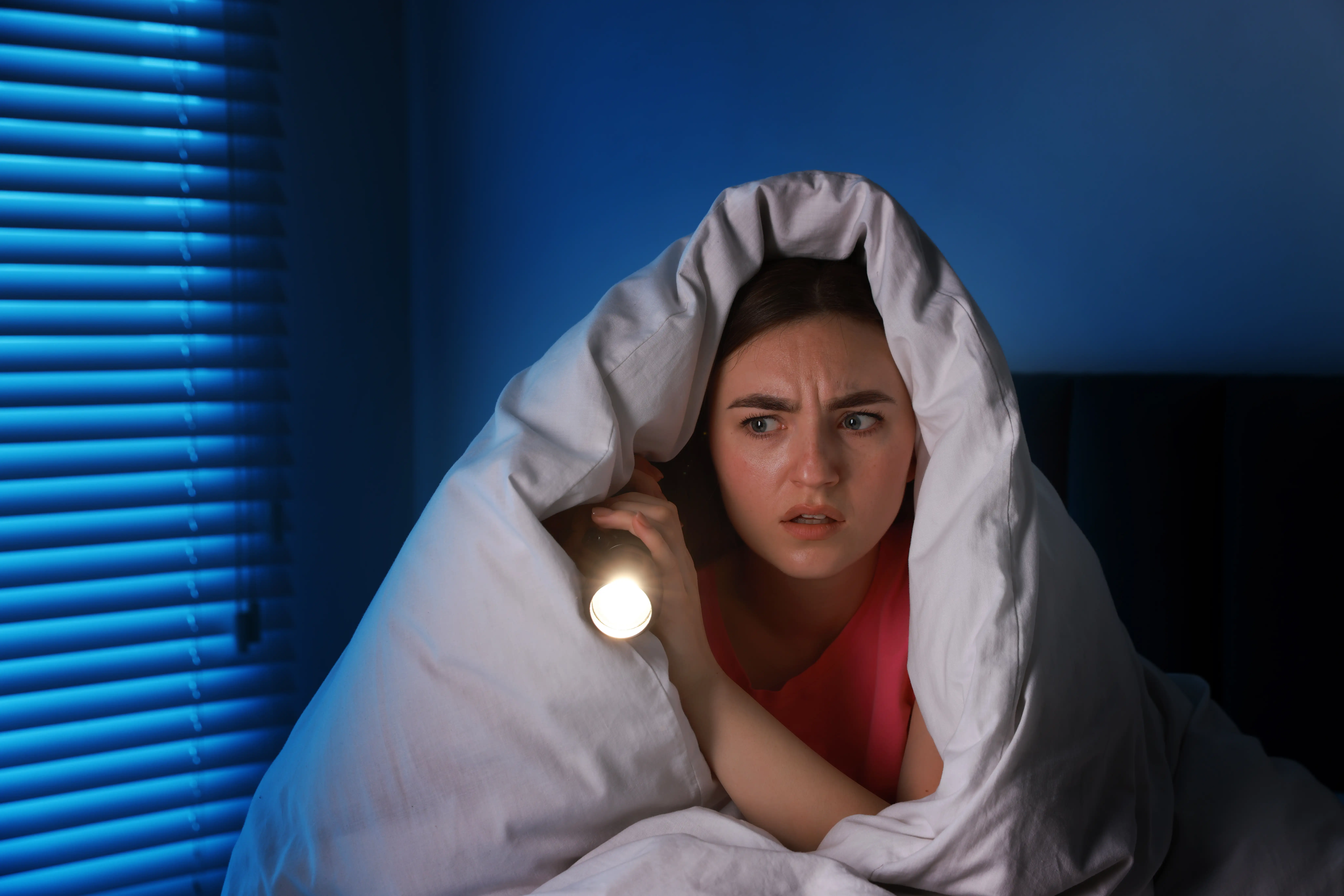
Sleep terrors, often called night terrors, are episodes of partial awakening from non-rapid eye movement (NREM) sleep. A person may suddenly scream, sit up, bolt from bed, breathe quickly, sweat, or look terrified. Their eyes may be open, but they are not fully awake and may respond little or in a confused way to someone trying to help 1.
The event can be frightening to watch, but its appearance does not reveal the cause. Many childhood episodes follow a typical sleep-terror pattern and become less common over time. Other episodes need closer assessment because nightmares, nocturnal panic, REM sleep behavior disorder, seizures, medication effects, and breathing-related arousals can look similar 2.
What a sleep terror usually looks like
Sleep terrors belong to the same family of NREM disorders of arousal as sleepwalking and confusional arousals. These conditions reflect an incomplete transition from sleep toward wakefulness rather than a fully awake fear response. A sleep terror is distinguished by abrupt, intense distress, often with a cry or scream and clear physical signs of arousal such as a fast heartbeat, rapid breathing, sweating, or enlarged pupils 1.
Common clues include:
- a sudden cry, scream, fearful expression, sitting up, or movement out of bed
- open eyes with limited awareness of the room or people nearby
- confused speech, pushing away, or little useful response to comfort or direction
- settling back into sleep without becoming fully alert
- no memory the next day, or only a brief image or fragment rather than a detailed account.
These are patterns, not a checklist that every episode must match. Sleep terrors usually emerge from deep NREM sleep and are therefore more likely in the earlier part of the main sleep period. They can occur at other times, especially when a person's schedule is unusual. Research also shows that complete amnesia is not universal. Some children and adults report fragments of images or thoughts, so limited recall supports the diagnosis but does not settle it by itself 2.
Sleep terrors compared with similar nighttime events
A witness's account of awareness, recall, movement, timing, and recovery is usually more useful than the intensity of the fear alone. No one feature can reliably separate every sleep terror from every mimic 2.
| Event | Clues that may point toward it | What makes assessment important |
|---|---|---|
| Sleep terror | Partial awakening, limited interaction, intense autonomic arousal, and little or fragmentary recall. It often arises from deeper NREM sleep. | Typical episodes may need no testing, but unusual, frequent, or dangerous events deserve a closer look. |
| Nightmare | The person wakes fully, becomes oriented, and can usually describe a frightening dream. Nightmares are associated with REM sleep and often occur later in the sleep period. | Recurrent nightmares may need their own assessment, especially when linked with trauma, medication, or major sleep disruption. |
| REM sleep behavior disorder (RBD) | Speech or movement appears to act out a dream, often later in the night. The person may remember dream content after waking. | Definite RBD requires video polysomnography showing REM sleep without the usual muscle atonia. It has a different clinical meaning and treatment path. |
| Sleep-related seizure | Events may be very brief, highly similar each time, clustered repeatedly, or include focal stiffening, unusual postures, or rhythmic movements. They can occur at different points in the night. | A normal routine EEG does not exclude every sleep-related seizure. Specialist evaluation may require extended video EEG or video polysomnography. |
| Nocturnal panic | The person awakens fully into panic, is aware of the symptoms, and usually remembers the attack. Returning to sleep may be difficult. | Panic attacks, heart or breathing symptoms, and sleep apnea can overlap, so the full clinical history matters. |
| Breathing-related arousal | Loud snoring, choking, gasping, witnessed pauses in breathing, restless sleep, or marked daytime sleepiness may accompany the event. | Sleep apnea can fragment sleep and may coexist with or help precipitate NREM arousals. |
RBD and sleep-related seizures deserve particular care because complex movement and vocalization can overlap with NREM parasomnias. RBD is linked to dream enactment during REM sleep and requires polysomnographic evidence of REM sleep without atonia for a definite diagnosis 3. Sleep-related seizures are more likely to be brief, stereotyped, repetitive, or focal, but their appearance can still be difficult to distinguish from a parasomnia without video and EEG information 4.
Children and adults can have different clinical questions
Sleep terrors are most common in childhood. An occasional, recognizable, noninjurious episode in a child who is otherwise well often does not indicate a dangerous neurological or psychiatric condition. Episodes commonly diminish as children get older, but there is no single age at which every child must stop having them 2.
Childhood sleep terrors should not automatically be dismissed as harmless. Injury, frequent disruption, breathing symptoms, pronounced daytime sleepiness, a new unusual movement pattern, or events that do not fit the usual partial-arousal picture are reasons to speak with a clinician.
Sleep terrors can persist into adulthood or begin for the first time in an adult. Adult episodes are not proof of trauma, anxiety, or neurological disease. However, first adult onset deserves a more careful history because medication or substance effects, another sleep disorder, seizures, RBD, and other mimics need to be considered. Adults may also be capable of more forceful movement, so the practical risk of falls, leaving the home, or injuring a bed partner can be greater 2.
What can bring on an episode?
Sleep terrors rarely have one simple cause. A person may be predisposed to NREM disorders of arousal, while short-term conditions make an episode more likely. Sleep loss and an irregular schedule can increase the pressure for deep sleep. Noise, pain, fever, stress, obstructive sleep apnea, and periodic limb movements can create arousals that interrupt sleep. Alcohol and some medicines may also alter sleep or arousal 12.
These are associations and possible precipitating factors, not proof that any one item caused an episode. Stress is especially easy to overinterpret. It may coincide with worse sleep and more episodes in some people, but a sleep terror does not by itself show that a child is emotionally distressed or that an adult has a mental health condition.
Look for a time-linked change rather than assuming a cause. Useful questions include:
- Was the person sleeping less, traveling, working shifts, or keeping a different schedule?
- Was there a fever, pain, acute illness, or unusually noisy sleep environment?
- Did snoring, gasping, breathing pauses, restless legs, or repeated kicking become noticeable?
- Did episodes begin after starting, stopping, or changing a prescription medicine, over-the-counter product, alcohol pattern, cannabis, or another substance?
Do not stop a prescribed medicine abruptly because an episode occurred. Record the timing and discuss it with the prescriber, who can weigh the suspected link against the reason the medicine is needed.
How sleep terrors are diagnosed
Diagnosis usually starts with a clinical interview, not a sleep study. Because the person may remember little, a caregiver's or bed partner's description is often central. A short home video can be useful when it can be recorded without delaying help, approaching a dangerous person, or compromising privacy 2.
A clinician may ask about:
- what the eyes, face, breathing, speech, and movements looked like
- whether the person responded, recognized anyone, or became fully awake
- what they remembered immediately afterward and the next day
- where the event fell within the sleep period and whether several occurred together
- whether each episode looked nearly identical or varied from one event to another
- injuries, leaving bed or home, daytime sleepiness, and effects on the household
- snoring, gasping, limb movements, dream enactment, panic symptoms, and seizure history
- recent sleep loss, illness, stress, schedule changes, medicines, and substances.
A simple log can help if episodes recur. Record sleep and wake times, an approximate event time, what a witness saw, possible short-term triggers, and next-day effects. There is no required number of days and no frequency cutoff that diagnoses a sleep terror.
When a sleep study or video EEG helps
Polysomnography is not routinely needed for a typical, uncomplicated childhood parasomnia. The American Academy of Sleep Medicine recommends considering video polysomnography with expanded EEG channels when a child's event is atypical or potentially injurious, or when history and a routine EEG have not distinguished a parasomnia from sleep-related epilepsy. Testing is also appropriate when symptoms raise concern for sleep-disordered breathing or periodic limb movements 4.
Similar reasoning applies to adults. Video polysomnography can help when events begin in adulthood, are unusually brief or stereotyped, occur throughout the sleep period, cause injury, or raise concern for RBD, seizures, sleep apnea, or another disorder. A laboratory night may not capture the person's usual event, so a normal study must be interpreted alongside the history and home observations 2.
What to do during a sleep terror
Stay calm and focus on immediate safety:
- Clear hard, sharp, hot, or breakable objects from the person's path.
- Keep stairs, windows, exterior doors, and other hazards between you and the person when possible.
- Use a quiet voice and minimal interaction. Do not shout, shake, argue with, or routinely try to force the person awake.
- Do not hold the person down as a routine response. If they are moving toward immediate danger, use the least force needed to block the hazard or guide them away if you can do so safely.
- Stay nearby until the person settles or becomes fully oriented.
Attempts to wake or restrain someone can increase confusion or defensive movement, but this is not an absolute rule against intervening. Preventing an imminent fall, exit, burn, or injury takes priority. Public health guidance similarly recommends allowing the event to settle while stepping in when there is a risk of harm 5.
Reducing risk and managing recurrent episodes
Make the sleep environment safer
Safety changes should match what the person actually does during an episode. Remove weapons and bedside hazards, keep the floor clear, secure accessible windows and exterior doors, use stair gates when developmentally appropriate, and avoid a top bunk if a child may get out of bed. Choose alarms or locks that do not block emergency exit. Bed partners may need temporary distance if kicking, striking, or sudden movement is possible 1.
Protect adequate, regular sleep
Address obvious sleep loss and large schedule swings. The goal is enough sleep for the individual's age and needs, not one rigid number for everyone. A steady wake time and a realistic bedtime can be more useful than an elaborate bedtime routine. If insomnia, shift work, caregiving, pain, or another problem is preventing adequate sleep, that problem may need its own plan.
Address contributing conditions
A clinician can assess and treat sleep apnea, periodic limb movements, restless legs, insomnia, or another condition when symptoms point that way. Medication and substance review should focus on timing, dose changes, and alternatives rather than assuming every medicine in a broad class is responsible 2.
Scheduled awakenings have a narrow role
Scheduled awakening may be considered for a child with frequent episodes that occur at a reliably predictable point in the sleep period. A caregiver uses the observed pattern to wake the child enough for a brief, clear arousal before the usual event time, then lets the child return to sleep. It is not a good fit for sporadic or unpredictable episodes, and there is no universal number of minutes that works for everyone.
Evidence is limited. A 2023 systematic review found that most research on behavioral treatments for NREM parasomnias consisted of case reports or case series, with inconsistent outcome measurement. Scheduled awakenings appeared in only a small part of that literature 6. A pediatrician or sleep clinician can help decide whether the approach is sensible and how to stop it if it disrupts sleep without helping.
Medication is not routine first-line treatment
Medication may be considered by a sleep specialist for selected severe, dangerous, or persistently impairing cases after safety, sleep opportunity, contributing conditions, and medication triggers have been addressed. Clonazepam is sometimes used, particularly in adults, but the supporting evidence is largely observational case series rather than strong randomized trials. Sedation, falls, dependence, interactions, and effects on breathing must be considered for the individual 2.
Psychological treatment may be useful when insomnia, anxiety, trauma symptoms, or stress independently needs care. It should not be presented as a guaranteed treatment for sleep terrors. The same systematic review found promising reports for multicomponent cognitive behavioral approaches and hypnosis, but the overall evidence remains limited by small and uncontrolled studies 6.
When to seek medical care
Arrange a medical appointment when the pattern, consequences, or accompanying symptoms raise concern 24:
- episodes first begin in adulthood or change noticeably from a long-standing pattern
- events are frequent, increasingly disruptive, or causing major fear of sleep
- there is an injury, a near miss, leaving the home, or danger to another person
- sleep is not restorative or there is marked daytime sleepiness, impaired attention, or difficulty functioning
- loud snoring, gasping, breathing pauses, restless legs, or repeated limb movements occur
- the event began after a medicine or substance change
- the movements are brief, highly stereotyped, clustered, focal, rhythmic, or accompanied by stiffening, drooling, loss of bladder control, or daytime spells
- the person acts out remembered dreams, especially later in the sleep period
- the person wakes fully aware with panic, chest symptoms, or persistent difficulty breathing
- a child has an unusual pattern, frequent disruption, injury risk, or any symptom that concerns the caregiver.
Seek emergency help for a serious injury, blue or abnormal breathing, or an event in which the person cannot be kept safe. If the event may be a seizure, emergency help is warranted for a first seizure, a convulsion lasting more than five minutes, repeated seizures without recovery, serious injury, or difficulty breathing afterward 7.
An occasional classic childhood episode may need only safety measures and discussion at a routine visit. The purpose of the care boundaries is not to label every dramatic event as dangerous. It is to avoid missing a different disorder when the pattern, consequences, or accompanying symptoms do not fit a straightforward sleep terror.