Obstructive sleep apnea, or OSA, is repeated narrowing or collapse of the upper airway during sleep. Airflow falls or stops, but the chest and breathing muscles continue trying to pull air through the blockage. The brain may briefly arouse to reopen the airway, and oxygen can fall. This cycle can fragment sleep even when the person remembers no awakenings 12.
OSA is not the same as central sleep apnea. In central apnea, breathing effort falls because the brain's drive to breathe is interrupted. A person can also have mixed or treatment-emergent events. Symptoms cannot reliably separate these patterns, which is one reason objective testing matters 2.
Snoring, gasping, and witnessed pauses raise suspicion for OSA, but none confirms it. Likewise, quiet sleep does not rule it out. Diagnosis requires a sleep study selected and interpreted in the context of a clinical evaluation.
Signs that should prompt an OSA evaluation
A bed partner may notice frequent loud snoring, pauses followed by gasping or choking, labored breathing, or repeated brief awakenings. The person being evaluated may notice:
- unrefreshing sleep despite enough opportunity to sleep
- excessive daytime sleepiness or dozing unintentionally
- morning dry mouth or headache
- frequent nighttime urination
- trouble concentrating, slower reactions, irritability, or low mood
- insomnia symptoms or repeated awakenings without an obvious reason
OSA can be present without dramatic snoring or obvious daytime sleepiness. Symptoms also overlap with insufficient sleep, insomnia, circadian disruption, restless legs, medicines, alcohol, pain, depression, and other medical conditions. A questionnaire can estimate risk, but the American Academy of Sleep Medicine advises against using a questionnaire, clinical prediction rule, or symptoms alone to diagnose adult OSA 2.
Seek an evaluation sooner if sleepiness affects driving or safety, breathing pauses are witnessed repeatedly, or symptoms occur alongside resistant hypertension, atrial fibrillation, stroke, heart failure, type 2 diabetes, or pregnancy. These conditions do not prove that OSA is present, but they can change the reason for testing and the urgency of treatment 34.
Why the airway collapses
The sleeping airway is affected by anatomy, muscle responsiveness, breathing control, sleep stage, body position, and the pressure around the airway. OSA usually reflects a combination, not one universally visible defect.
Factors that can raise risk include:
- higher body weight or recent weight gain
- enlarged tonsils or adenoids, a relatively narrow jaw or airway, or a larger tongue
- older age, male sex, and the years during or after menopause
- pregnancy
- family history and inherited craniofacial traits
- nasal obstruction
- alcohol, smoking, and some sedating medicines
- conditions such as hypothyroidism, acromegaly, polycystic ovary syndrome, and heart or kidney failure
These are risk factors, not destiny. OSA occurs in people across the weight spectrum, and many people with obesity, large tonsils, or a small jaw do not have OSA. A body mass index, neck measurement, airway photograph, or Mallampati score cannot diagnose the condition or determine the treatment on its own 53.
Alcohol can make upper-airway collapse more likely. If a prescribed sedating medicine appears to worsen snoring, gasping, or sleepiness, ask the prescriber to review it. Do not change a prescribed medicine without speaking with its prescriber, and do not use another sedative to sleep through breathing symptoms.
OSA looks different in children
Children may snore, breathe through the mouth, pause or work hard to breathe, sleep restlessly, or wet the bed. During the day they may be overactive rather than visibly sleepy, have trouble paying attention or learning, or show mood, behavior, or growth concerns. Enlarged tonsils or adenoids are common contributors, but weight, craniofacial differences, neuromuscular conditions, prematurity, and other factors can matter 6.
Adult AHI thresholds should not be applied to a child. Pediatric respiratory events and severity are interpreted with age-specific rules, symptoms, oxygen findings, growth, and health context. Suspected childhood OSA belongs with a pediatric clinician or sleep team, usually with polysomnography rather than an adult consumer screening pathway 6.
How clinicians evaluate possible OSA
A comprehensive evaluation is more useful than starting with a device score. It may cover:
- the snoring, pause, gasping, awakening, and sleepiness pattern
- usual sleep opportunity, schedule, insomnia, shift work, and other sleep disorders
- driving, work, school, and near-miss safety events
- blood pressure and cardiovascular, lung, neurologic, endocrine, and metabolic history
- alcohol, opioids, sedating medicines, and other substances
- nasal symptoms, tonsils, jaw and dental health, and prior airway or facial surgery
- weight history without assuming weight is the sole cause
- pregnancy and planned surgery or sedation
A physical examination can identify factors that affect test selection or treatment, but it cannot show what the airway does during sleep.
Polysomnography
Attended polysomnography records sleep stages, airflow, breathing effort, oxygen, heart rhythm, and other signals. It can determine whether events are obstructive or central and can identify arousal-linked events and competing sleep problems.
Children with suspected OSA are generally evaluated with pediatric polysomnography 6. In adults, polysomnography rather than HSAT is recommended with significant heart or lung disease, possible neuromuscular breathing weakness, awake or sleep-related hypoventilation, chronic opioid use, a history of stroke, or severe insomnia. It is also useful when another sleep disorder or a non-obstructive breathing problem is plausible 2.
Home sleep apnea testing
A medically ordered home sleep apnea test can be an appropriate first test for an uncomplicated adult whose evaluation suggests a higher likelihood of moderate or severe OSA. Convenience or inability to attend a laboratory is not the only selection criterion.
Most home tests record fewer signals and do not directly measure sleep stages or electroencephalographic arousals. They often divide events by monitoring time rather than confirmed sleep time, producing a respiratory event index, or REI. If the person lies awake for part of the recording, this can underestimate event frequency. A home test can also miss arousal-based disease or fail because a sensor did not record well 2.
A negative, inconclusive, or technically inadequate home test does not close the case when OSA is still suspected. The AASM recommends polysomnography after that result. If an initial polysomnogram is negative but clinical suspicion remains high, a second study may sometimes be appropriate 2.
A smartwatch, phone app, ring, home oximeter, or snoring recording may capture a useful pattern to discuss with a clinician. It is not interchangeable with a prescribed HSAT or polysomnogram and cannot establish the diagnosis, event type, or treatment setting 7.
What AHI means, and what it misses
The apnea-hypopnea index, or AHI, is the average number of scored apneas and hypopneas per hour of sleep on polysomnography. Adult categories commonly describe 5 to fewer than 15 events per hour as mild, 15 to fewer than 30 as moderate, and 30 or more as severe. Adult OSA can generally be diagnosed at 5 or more predominantly obstructive events per hour when relevant symptoms or associated health conditions are present, or at 15 or more even without reported symptoms 3.
These categories are useful, but AHI is not a complete measure of how OSA affects a person. Two people with the same AHI may have different:
- oxygen depth and duration
- event length and breathing effort
- arousal and sleep-fragmentation burden
- REM-related or back-sleeping concentration of events
- daytime sleepiness and functional risk
- cardiovascular, respiratory, neurologic, or pregnancy context
Scoring rules and whether a test measures sleep or recording time can also change the number. A treatment decision should therefore use the study's full pattern, symptoms, comorbidities, safety risks, and patient goals rather than the AHI label alone 3.
Health effects without overpromising causation
OSA is associated in observational research with hypertension, atrial fibrillation, coronary disease, stroke, heart failure, insulin resistance, and type 2 diabetes. Repeated oxygen changes, sleep fragmentation, and autonomic activation offer plausible pathways, but OSA also shares risk factors with these conditions. An association does not prove that OSA alone caused an individual's heart or metabolic disease 3.
The AASM evidence review found average improvements in breathing-event frequency, sleepiness, sleep-related quality of life, and blood pressure, along with fewer motor-vehicle crashes. Randomized trials have not established that PAP prevents death or major cardiovascular events in every adult with OSA. Treat OSA for its established symptoms, functional risks, objective breathing disorder, and individualized health goals without promising that one therapy will prevent a heart attack, stroke, or diabetes 8.
Treatment is matched, not ranked for everyone
The treatment discussion should consider event pattern, symptoms, oxygen findings, comorbidities, anatomy, dental health, sleep position, pregnancy, access, and what the person can use consistently. More than one approach may be combined.
Positive airway pressure
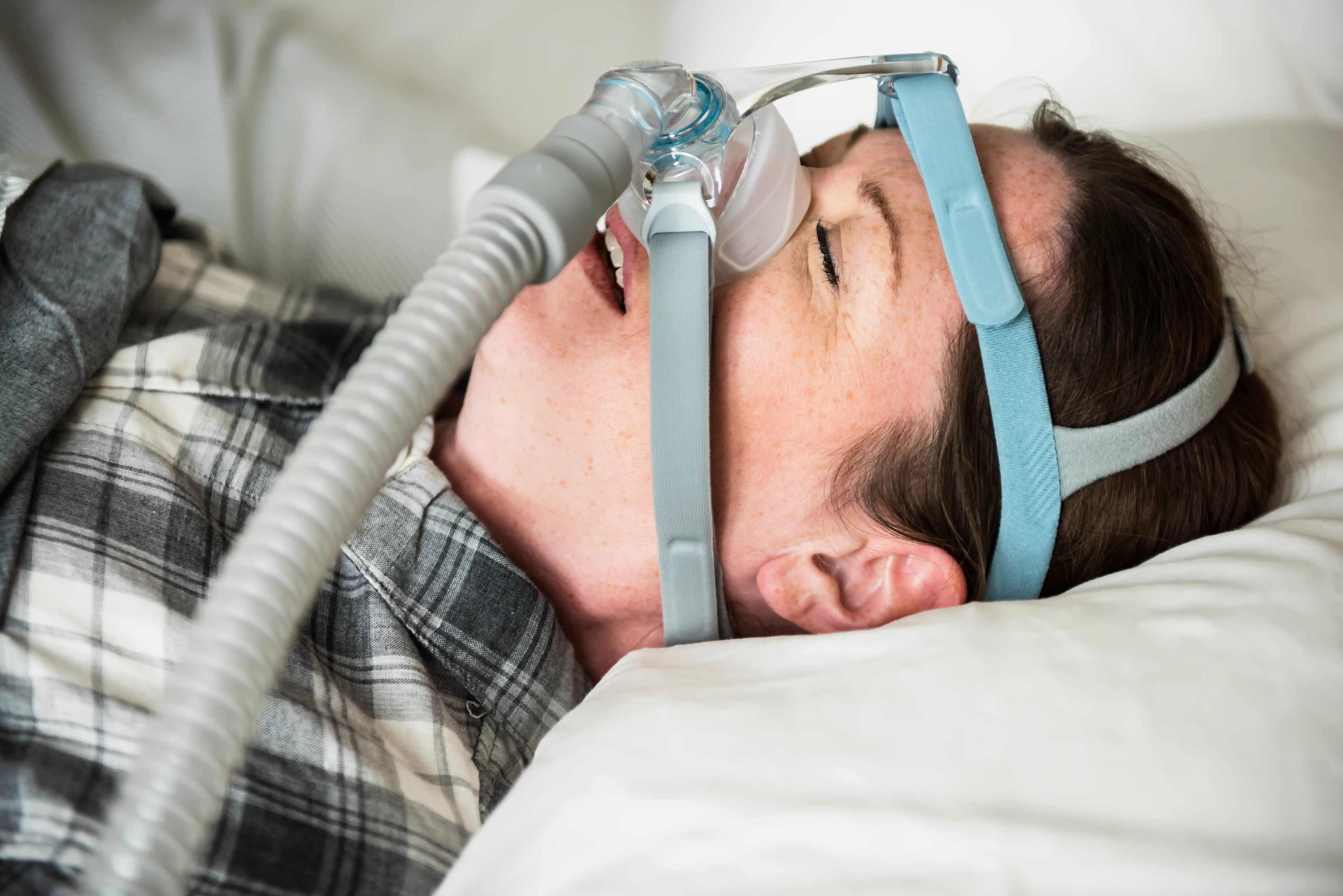
Positive airway pressure, or PAP, sends air through a mask to hold the upper airway open during sleep. Fixed CPAP and auto-adjusting PAP are common options. PAP has the most consistent ability to reduce obstructive events across adult OSA severities, but the best real-world treatment is one that is both effective and usable 98.
PAP should be used for all sleep, including naps, according to the prescribed plan. Mask leak, dry nose or mouth, pressure discomfort, claustrophobia, skin irritation, and aerophagia are reasons for troubleshooting, not proof that PAP is impossible. Early education, mask or humidification adjustments, and review of objective efficacy and usage data can improve treatment 9.
Do not change pressure ranges or switch to bilevel or advanced modes on your own. Those modes are not simply stronger CPAP and may be chosen for different breathing physiology or tolerance needs.
Custom oral appliances
A custom, adjustable mandibular advancement appliance can be considered for an adult who prefers it or cannot tolerate PAP. It moves the lower jaw forward during sleep to make collapse less likely. A sleep clinician should confirm OSA and prescribe the approach, and a qualified dentist should fit and monitor the device for jaw, tooth, bite, and gum effects. A follow-up sleep test is recommended to confirm that it controls OSA 10.
An over-the-counter anti-snoring mouthpiece is not equivalent to a custom, titratable appliance. Quieter snoring alone does not prove that oxygen and obstructive events are controlled.
Positional therapy
Positional therapy is reasonable only when the diagnostic study shows that OSA is meaningfully worse on the back and adequately controlled in other positions. A side-sleeping pillow or app cannot establish that pattern. Comfort, ability to stay off the back, remaining non-supine events, and follow-up data determine whether the approach is sufficient 3.
Weight management as an adjunct
When excess weight contributes and the person wants support, sustainable nutrition, physical activity, behavioral care, anti-obesity medicine, or metabolic surgery may reduce OSA severity. Weight management should be offered without blame and should not be a prerequisite for receiving another effective treatment. People without obesity can have clinically important OSA too 5.
In the United States, Zepbound (tirzepatide) is approved for moderate to severe OSA in adults with obesity, alongside reduced-calorie eating and increased physical activity. That narrow indication does not make it a general sleep-apnea medicine, and prescribing must account for contraindications, adverse effects, pregnancy plans, access, and the person's broader weight and metabolic care 11.
Weight change can alter OSA but does not prove cure. Continue the current OSA treatment until the care team advises otherwise and use objective reassessment before stopping it.
Surgery and implanted therapy
Surgery may address enlarged tonsils, jaw position, or another specific site of airway obstruction. Options can include adenotonsillectomy, selected upper-airway procedures, maxillomandibular advancement, or hypoglossal nerve stimulation. Candidacy depends on the sleep study, anatomy, health, prior treatment, and procedure-specific criteria rather than one visible feature or universal weight cutoff.
The AASM recommends discussing sleep-surgeon referral as one option when an adult cannot use or does not accept PAP, or has persistent problems that may be related to an operable obstruction. A discussion does not commit someone to surgery, and surgery does not guarantee permanent cure 12.
Treatment in children
A pediatric plan follows the cause and severity. Removal of enlarged tonsils and adenoids is a common treatment when they are obstructing the airway. PAP, anti-inflammatory nasal treatment, orthodontic or other surgery, and weight-management support may fit selected children. Because OSA can persist after an intervention, continuing symptoms need pediatric follow-up rather than an assumption that quieter snoring means resolution 6.
What is not a do-it-yourself OSA treatment
Do not replace diagnostic and prescribed care with mouth tape, a chin strap, a product sold as "micro-CPAP," an uncustomized mouthpiece, or a consumer oxygen product. Supplemental oxygen may be prescribed for a separate indication or occasionally alongside another therapy, but it does not hold the upper airway open and is not recommended as the primary treatment for OSA 13.
Do not self-adjust PAP settings, borrow another person's machine, or use alcohol or sedatives to suppress awakenings. If treatment feels unusable, the next step is troubleshooting or a matched alternative, not silently abandoning therapy.
Follow-up proves whether treatment is working
Follow-up should ask both how the person functions and whether breathing is objectively controlled. For PAP, clinicians can review usage, leak, pressure, and device-estimated events while remembering that machine data are not identical to a diagnostic sleep study. Persistent sleepiness despite effective OSA treatment should prompt a review of sleep duration, medicines, circadian timing, depression, narcolepsy, and other causes.
Routine repeat testing is not needed for every asymptomatic adult doing well on PAP. A follow-up PSG or HSAT can be useful when symptoms persist or recur, after a major weight change, when cardiovascular disease changes, or when device data are unexplained. Follow-up testing is recommended to assess non-PAP treatments such as an oral appliance, positional therapy, surgery, or weight-related intervention 14.
Do not stop PAP or another established therapy because snoring became quieter, a wearable shows better oxygen, or weight changed. Confirm the plan and, when indicated, confirm control objectively.
Pregnancy and surgery need specific planning
Pregnancy can reveal OSA or change the severity of preexisting OSA. OSA in pregnancy is associated with hypertensive and metabolic complications, but current evidence does not prove that CPAP prevents maternal, fetal, or neonatal complications. Expert guidance recommends CPAP to reduce OSA symptoms and AHI and advises continuing established treatment during pregnancy, with pressure and data review as the body changes. OSA diagnosed during pregnancy may improve after delivery but can persist, so postpartum reassessment matters 4.
Tell the obstetric and anesthesia teams about diagnosed or suspected OSA before labor, delivery, or another procedure.
Before any surgery or sedation, tell the surgeon, anesthesiologist, and recovery team about OSA and the treatment you use. Bring the PAP device, mask, and settings information if the facility asks. Perioperative guidance supports continuing previously used PAP when feasible unless the procedure makes it unsuitable, with an individualized plan for anesthesia, opioids, airway support, and postoperative monitoring 15.
Driving and emergency safety
Do not drive or operate dangerous equipment when you are fighting sleep, nodding off, or unable to stay alert. A sleepiness-related crash or near miss is a high-risk sign. Arrange another way home and seek prompt clinical help rather than relying on caffeine, an open window, or loud music. Effective OSA treatment can reduce driving risk, but the person should not assume they are safe from an AHI value alone 168.
OSA causes recurrent events during sleep and usually belongs in a prompt outpatient sleep evaluation. It does not explain every breathing emergency. Call emergency services if someone has severe difficulty breathing while awake, is gasping or choking and cannot get words out, or develops very pale, blue, or gray lips or skin 17.
For suspected OSA without an acute emergency, the next step is a comprehensive sleep evaluation and an appropriate sleep study. The goal is not merely quieter snoring. It is reliable control of obstructive breathing, safer daytime function, and a treatment the person can sustain.