

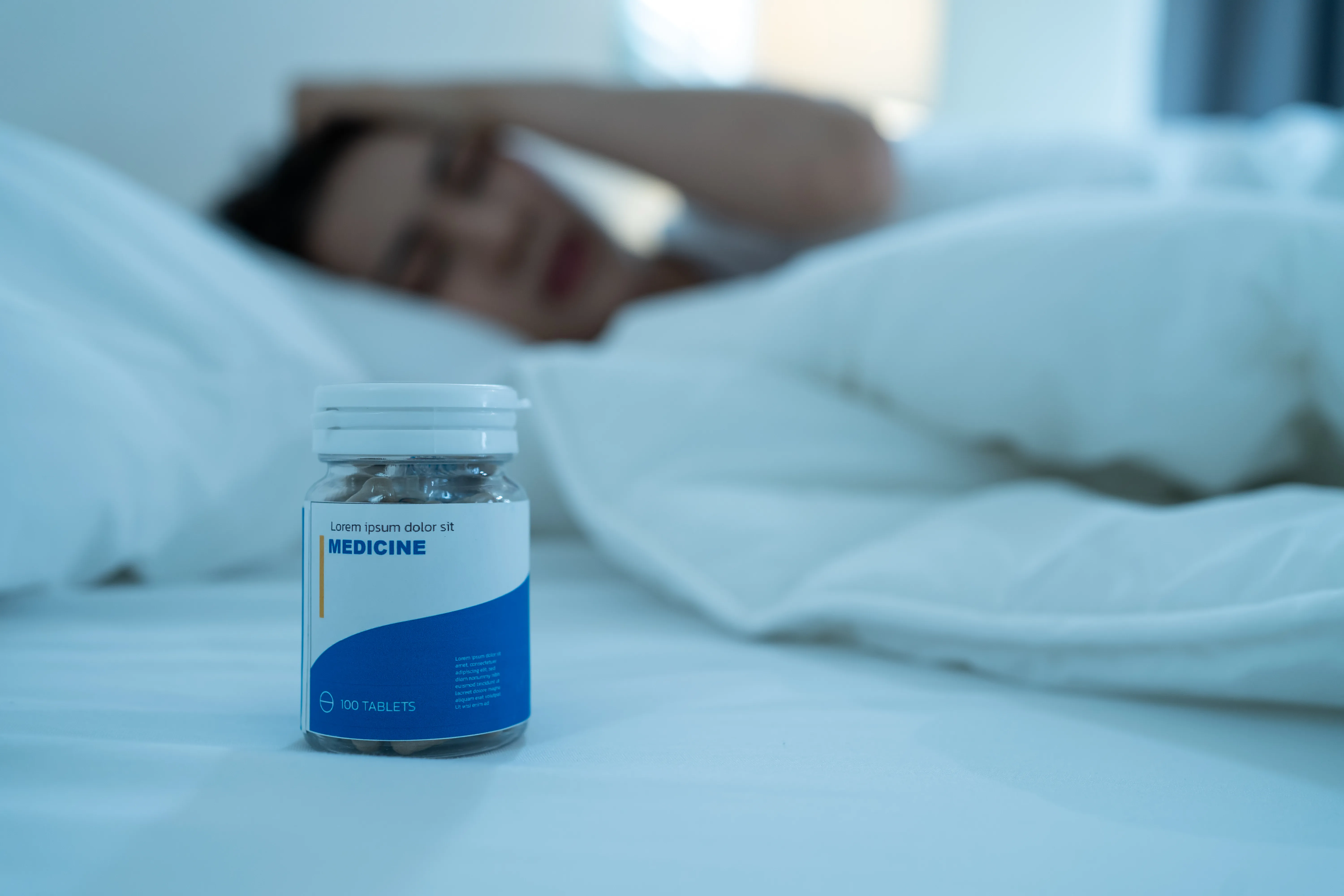
Over-the-counter sleep aids can make some people drowsy, but they are not one type of treatment and they are not a good default for every sleep problem. In the United States, a true OTC drug is a medicine that can be bought without a prescription. It is intended to be safe and effective when the Drug Facts directions and warnings are followed 1.
Most products sold specifically as OTC nighttime sleep-aid drugs contain a sedating antihistamine, usually diphenhydramine or doxylamine. Their labels are for occasional sleeplessness or difficulty falling asleep, not nightly treatment of chronic insomnia 23.
Melatonin, valerian, magnesium blends, and other products sold in the same aisle may be dietary supplements rather than OTC drugs. Prescription insomnia medicines are a separate category that requires a clinician. The distinction matters because each category has different evidence, oversight, labeling, and risks.
What “over the counter” does and does not mean
OTC describes access, not strength or suitability for a particular person. The Drug Facts panel identifies the active ingredient, its amount, what the medicine is for, who should not use it, interactions, directions, and situations that require medical advice. Similar brand names can contain different ingredients, and formulas can change, so read the panel each time rather than relying on the front of the box 4.
A dietary supplement uses a Supplement Facts panel instead. FDA does not approve dietary supplements for safety or effectiveness before they are sold. Manufacturers are responsible for meeting the applicable safety, quality, and labeling rules, while much of FDA's oversight begins after products reach the market 5.
A prescription medicine has been selected for a diagnosed or evaluated problem and comes with a treatment plan. Do not treat a relative's prescription, an online sedative, or a medicine left from an earlier illness as an OTC option.
Sedating antihistamines: diphenhydramine and doxylamine
Diphenhydramine and doxylamine are first-generation antihistamines. They block histamine signaling involved in wakefulness, which is why they cause drowsiness. Diphenhydramine also appears in allergy and multi-symptom products. The active ingredient, not the brand name or the word “PM,” tells you whether you are taking one 673.
The benefit is limited to occasional use
An FDA nighttime sleep-aid monograph describes diphenhydramine products as relieving occasional sleeplessness in people who have trouble falling asleep. Current doxylamine labeling uses a similar limited indication 23.
That is different from treating chronic insomnia. The American Academy of Sleep Medicine guideline suggests that clinicians not use diphenhydramine for sleep-onset or sleep-maintenance insomnia in adults because the available evidence did not show a favorable enough balance of benefit and harm. The recommendation is weak because the evidence base itself is limited, but it does not support turning an occasional-use product into a nightly routine 6.
Drowsiness can continue into the next day
A bedtime label does not guarantee normal alertness the next morning. Doxylamine labeling warns users to take it only at bedtime, allow time for a full night's sleep, avoid alcohol, and not drive or operate machinery. FDA diphenhydramine labeling also requires warnings against alcohol and taking the product with sedatives or tranquilizers without first consulting a doctor 32.
Do not drive or operate machinery if you feel groggy, slowed, dizzy, confused, or unable to focus. A fixed promise such as “cleared by morning” is not reliable because the product, dose, other medicines, sleep opportunity, age, and individual response all matter 3.
Anticholinergic effects add to the risk
These antihistamines also block acetylcholine, a chemical involved in memory, alertness, digestion, bladder function, and other body processes. Effects can include dry mouth, constipation, blurred vision, difficulty urinating, dizziness, and confusion. Product labels direct people with glaucoma, certain breathing problems, or difficulty urinating due to an enlarged prostate to ask a clinician before use 823.
The total anticholinergic burden matters. Other antihistamines, bladder medicines, antidepressants, and additional drugs can contribute even when their brand names look unrelated. A pharmacist can check the complete list rather than evaluating one box in isolation 8.
Older adults face greater harm
The 2023 American Geriatrics Society Beers Criteria recommends avoiding oral diphenhydramine and doxylamine in most older adults. It cites reduced clearance with age, tolerance when these drugs are used as hypnotics, and greater risk of confusion, dry mouth, constipation, and anticholinergic toxicity. The criteria also note that greater cumulative anticholinergic exposure is associated with falls, delirium, and dementia, including in younger adults. That association does not mean one correctly used dose causes dementia, but it is a strong reason not to normalize regular use 8.
Melatonin is a supplement, not an OTC drug
In the United States, melatonin sold without a prescription is regulated as a dietary supplement. Melatonin helps signal biological night, so its most plausible uses involve sleep timing, such as jet lag or certain circadian problems. It is not simply a gentler version of an antihistamine 9.
Evidence and timing depend on the actual problem. NCCIH reports that melatonin may help some problems related to jet lag or shift work, but major guidelines have recommended against using it for chronic insomnia because the evidence is not strong enough. Short-term use appears safe for most adults, while long-term safety remains uncertain. Reported effects include sleepiness, headache, dizziness, and nausea 9.
Product quality is another limitation. Testing has found that some supplements contain substantially different amounts of melatonin than their labels state, and some tested products contained serotonin. A larger number on the front of the bottle is therefore not a promise of a stronger, more predictable, or safer result 9.
Melatonin can interact with medicines. NCCIH specifically advises medical supervision for people with epilepsy and those taking blood thinners. There is also too little research to establish safety during pregnancy or breastfeeding 9.
Valerian and multi-ingredient “natural” sleep products
Supplements marketed for sleep may contain valerian, magnesium, chamomile, L-tryptophan, 5-HTP, cannabinoids, or several ingredients in one blend. These are different substances, not interchangeable versions of one natural sleep aid.
Evidence for valerian in chronic insomnia is inconsistent, and the AASM guideline suggests not using it for sleep-onset or sleep-maintenance insomnia. Evidence for many other complementary sleep products is limited or specific to a narrow population. A blend is not proven effective merely because each ingredient has a plausible calming mechanism 6.
“Natural” does not mean harmless. Supplements can have biological effects, interact with medicines, duplicate ingredients in other products, interfere with laboratory tests, or pose risks around surgery. Multi-ingredient formulas also make it harder to identify which substance helped or caused an adverse effect 5.
Nighttime cold and pain products are not simple sleep aids
A “PM” pain reliever may combine a sedating antihistamine with acetaminophen or an anti-inflammatory drug. A nighttime cold product may add a cough suppressant, pain reliever, or decongestant. Those extra active ingredients treat other symptoms and bring their own warnings. Taking a multi-symptom product only to become sleepy exposes you to ingredients you may not need.
Duplicate ingredients are the main practical danger. Diphenhydramine can appear in allergy, sleep, cold, and pain products. FDA labeling says not to use a nighttime sleep aid with another diphenhydramine product, including a skin product 2.
Acetaminophen is found in hundreds of prescription and nonprescription medicines. FDA says not to take more than one acetaminophen-containing product at a time and not to exceed the directions on any label. The agency's maximum total for adults and children age 12 and older is 4,000 milligrams from all products in 24 hours, but this is a safety ceiling, not a target, and a product label or clinician may set a lower limit. Too much can cause liver failure and death, sometimes before obvious symptoms appear 10.
Before combining anything, compare every active ingredient and amount across prescription medicines, OTC drugs, topical products, and supplements. Ask a pharmacist when two names or abbreviations are unclear.
A quick safety check before taking any product
1. Identify the sleep problem
An occasional difficult night is different from persistent insomnia, a shifted body clock, inadequate sleep time, or daytime sleepiness caused by another disorder. A sedating product may mask a symptom without addressing its cause.
2. Read the active ingredients and purpose
Use the Drug Facts or Supplement Facts panel, not a color, brand family, gummy format, or “natural” claim. Check whether the product contains one ingredient or several and whether each active ingredient treats a symptom you actually have 45.
3. Check conditions, medicines, and substances
Ask a pharmacist or clinician before use if you take other sedatives, tranquilizers, antihistamines, sleep medicines, blood thinners, or multiple medicines with anticholinergic effects. Do the same if you have glaucoma, urinary difficulty, a breathing disorder, liver disease, epilepsy, or another condition named in the label. Share supplements as well as prescription and OTC medicines.
Do not mix a sleep aid with alcohol. Do not stack products because the first one did not produce sleep quickly, and do not take another dose sooner than the label directs 23.
4. Protect the next day
Use a sedating product only when the label's required sleep opportunity is possible. If you must drive early, care for someone overnight, respond to emergencies, or perform safety-sensitive work, next-day or overnight impairment may make the product unsuitable. Do not drive while the label warning applies or while you feel impaired 3.
5. Store drugs and supplements securely
Keep every medicine and supplement out of children's reach and sight, preferably in its original child-resistant container. Gummies still require medication-level storage. CDC estimated about 11,000 U.S. emergency department visits for unsupervised melatonin ingestion among children age 5 and younger during 2019 through 2022, with flavored products involved in many cases 11.
Children, pregnancy, and breastfeeding
Do not use an adult antihistamine sleep aid to make a child sleepy. FDA diphenhydramine nighttime labeling and the current doxylamine label say not to use these products in children under 12. Older children and teenagers still need the exact age, ingredient, dose, and warnings checked rather than receiving an adult product by assumption 23.
Parents should speak with a pediatric healthcare professional before giving melatonin or another sleep supplement. A clinician can first determine whether schedule or behavioral changes are more appropriate. Supplement content can vary, and long-term pediatric safety is not well established 9.
If you are pregnant, trying to conceive, or breastfeeding, ask the obstetric or prescribing clinician and a pharmacist before using a sleep product. An ingredient used for another pregnancy-related purpose is not automatically an appropriate self-treatment for insomnia. The current doxylamine label directs pregnant or breastfeeding users to seek professional advice, and melatonin lacks adequate safety research in these groups 39.
Overdose and severe reactions need prompt help
Do not wait for sleepiness to wear off if someone may have taken too much or combined duplicate ingredients. FDA warns that high doses of diphenhydramine can cause serious heart problems, seizures, coma, and death. Hallucinations, inability to wake, seizure, breathing trouble, or collapse require immediate emergency help 7.
Suspected excess acetaminophen also needs immediate medical or poison-control advice, even if the person feels well. Early symptoms may be absent, while delayed treatment can allow severe liver injury to develop 10.
Seek urgent care for trouble breathing, collapse, severe confusion, a seizure, a serious heart problem, or inability to wake normally 7.
When a sleep problem needs evaluation
The label for an OTC antihistamine sleep aid says to consult a clinician when sleeplessness persists continuously for more than two weeks because insomnia can signal an underlying illness 2.
Seek evaluation sooner when sleepiness makes driving or work unsafe, or when poor sleep comes with loud snoring, gasping, breathing pauses, unexpected sleep episodes, significant mood change, pain, or a new medicine. A clinician may review sleep timing, substances, medicines, pregnancy or menopause, medical conditions, and symptoms of sleep apnea, circadian disorders, or narcolepsy 12.
For long-term insomnia, cognitive behavioral therapy for insomnia (CBT-I) is usually the first treatment. It addresses the patterns that keep insomnia going rather than relying on sedation, and it can be delivered in person, by telephone, or online 13.
The practical takeaway
OTC availability can be useful for limited self-care, but it is not a judgment that a product fits your sleep problem. Diphenhydramine and doxylamine are occasional-use antihistamine sleep aids with next-day and anticholinergic risks. Melatonin and herbal products are supplements with different evidence and oversight. Combination nighttime products require special attention to every active ingredient.
Start with the problem, not the product. Read the full label, avoid duplicate or interacting ingredients, protect next-day alertness, and bring persistent insomnia or excessive sleepiness to a clinician instead of escalating self-treatment.