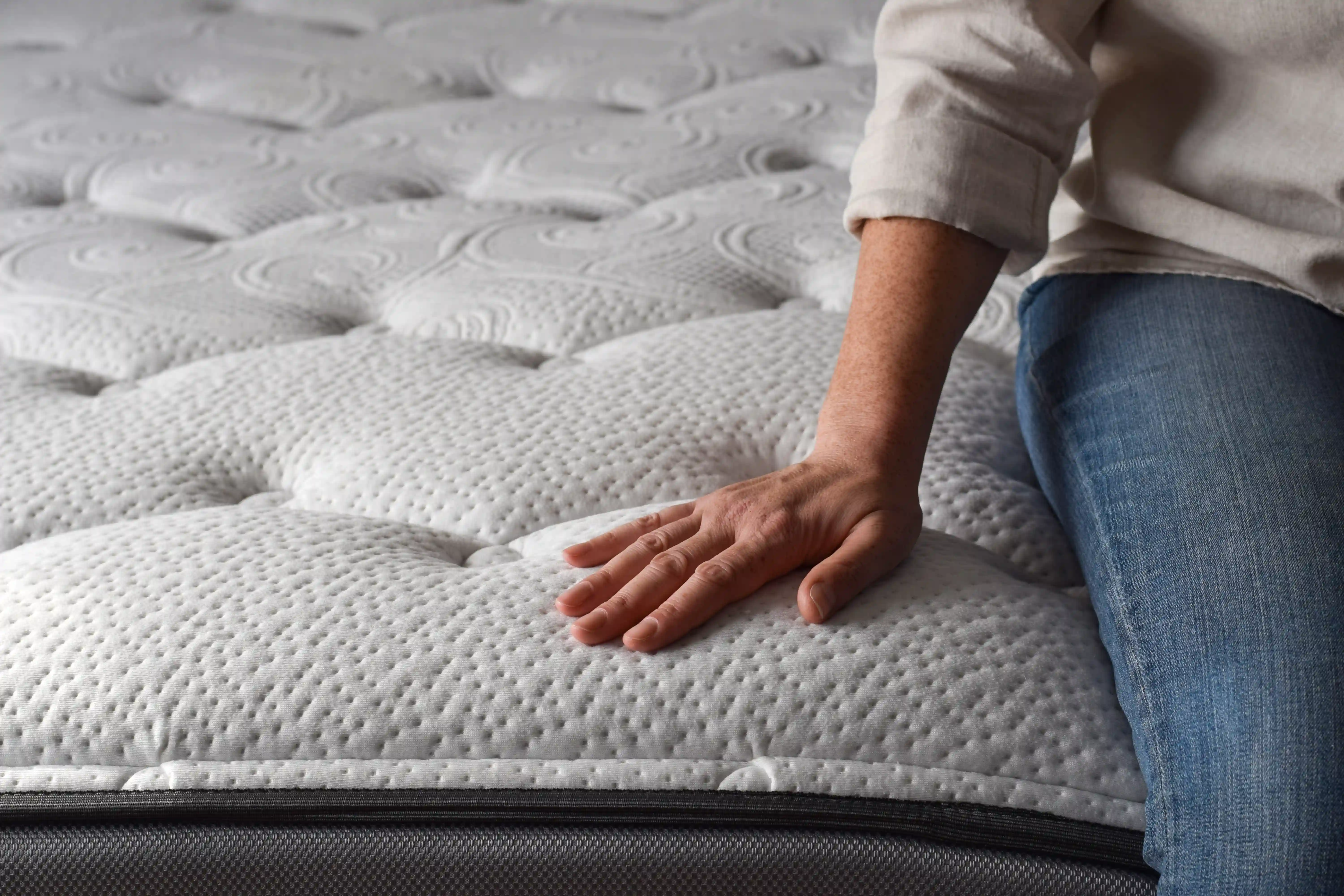

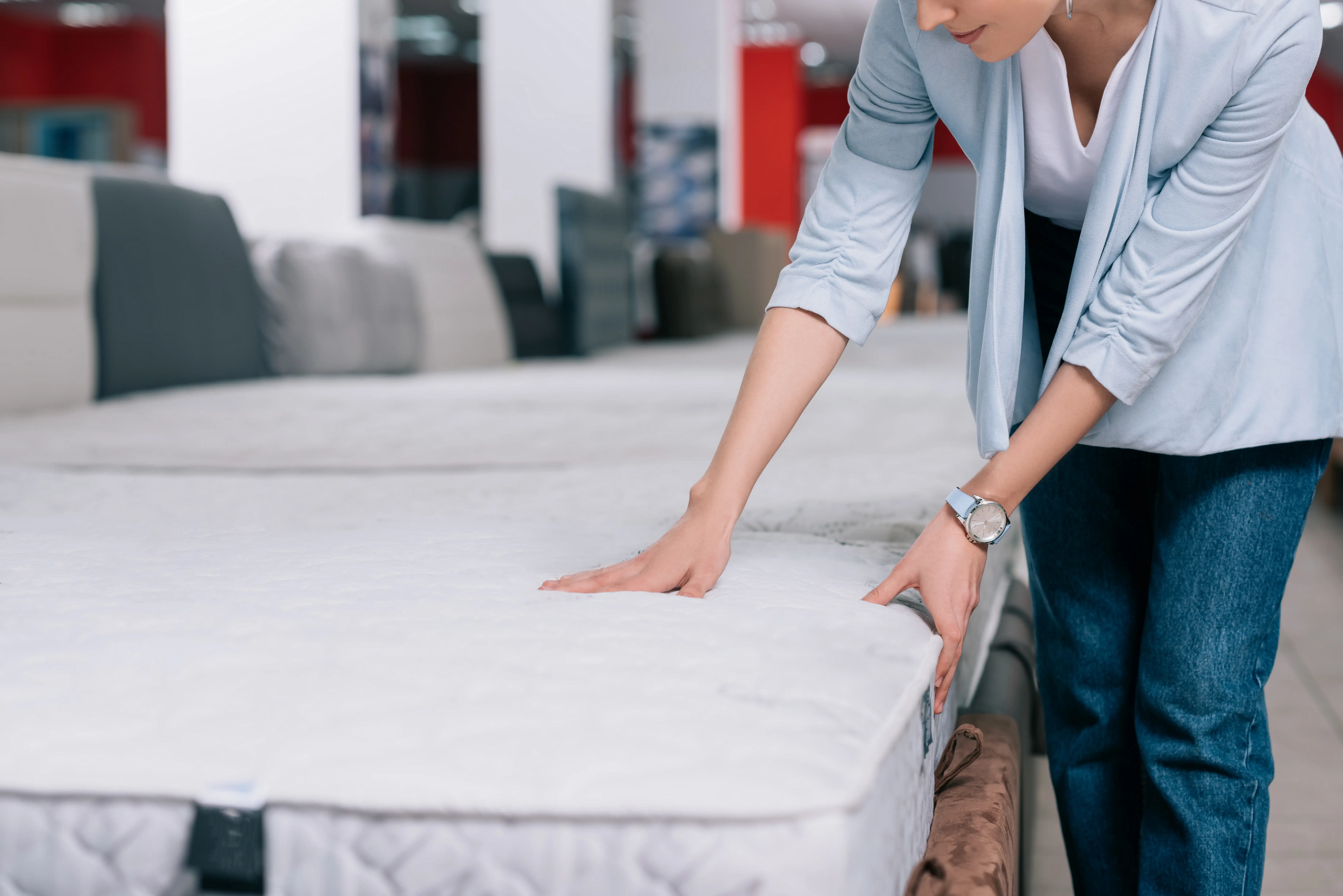
Neither a soft mattress nor a firm mattress is better for everyone. Choose the exact mattress that feels comfortable at the surface, remains stable as your body settles into deeper layers, and lets you move and use the bed safely.
A softer option generally yields more readily under load. A firmer option generally resists that load more. Those descriptions do not tell you which mattress offers better pressure relief, support, motion isolation, edge stability, cooling, or durability. They also do not show how either mattress will feel under your body.
This guide answers the focused question of how to compare a softer and firmer choice. Our mattress firmness guide explains retail scales in more detail, while the mattress buying guide covers the complete purchase.
Soft and firm are not standardized categories
Terms such as "plush," "medium-firm," and "firm" are labels chosen by manufacturers, sellers, or reviewers. Retail 1-to-10 scales do not share one required calibration. A 6 from one brand may feel softer than a 5 from another, and even mattresses carrying the same label can use very different constructions.
A biomechanical review found wide variation in the way mattress studies measured stiffness, pressure, posture, and comfort and concluded that standardized evaluation protocols were still needed 1. In a study of four mattresses and older adults, objective firmness and pressure related to perception, but full-body lying and partial-body pressing produced different information 2. A hand pressed into a showroom mattress cannot replace lying on it.
Compare labels most cautiously across brands. If one product family offers soft, medium, and firm versions, ask exactly what changes between them. The maker may change the quilting, comfort-layer material, layer thickness, zoning, coil system, or several features at once. The options are not necessarily the same mattress with one layer made stiffer.
What the firmness label leaves out
| Feature | What a softer option may do | What a firmer option may do | What to check |
|---|---|---|---|
| Surface firmness | Yield more at first contact | Resist more at first contact | Whether the surface feels welcoming, neutral, or uncomfortably hard |
| Pressure relief | Let more of the body contact the surface, which may spread load | Allow less local compression, which may feel better or sharper depending on the person | Shoulder, hip, rib, heel, and other contact areas after lying still |
| Deep compression and support | Let the body reach deeper layers sooner | Limit deep compression, depending on the complete construction | Continued sinking, a hard layer beneath, rolling together, or uneven collapse |
| Zoning | Use firmer or softer sections within the overall feel | Use firmer or softer sections within the overall feel | Whether each zone meets your body in the intended place |
| Movement | Feel enveloping or slow to some sleepers | Feel easier to push against in some constructions | Turning, sitting up, and getting out rather than the label alone |
| Motion between partners | Absorb or transmit movement depending on the materials and structure | Absorb or transmit movement depending on the materials and structure | Ordinary turning and getting in or out while both people are on the bed |
| Edge behavior | Have a stable or unstable perimeter | Have a stable or unstable perimeter | The usable sleeping edge, sitting, and transfers |
| Durability | Wear well or poorly depending on materials, construction, load, base, and care | Wear well or poorly for the same reasons | Exact layer specifications, warranty definitions, and repeated performance over time |
Surface firmness is the immediate resistance you feel. Pressure relief describes whether contact load is spread comfortably rather than concentrated at one area. Support is the mattress and base remaining stable enough for the positions and movements you use. Deep compression is what happens after your body has moved through the upper layers. A mattress can feel plush on top and still have a stable core, or feel firm at first and then collapse unevenly.
Zoning, motion isolation, and edge reinforcement are separate design choices. A firmness word cannot establish their performance. The same is true of durability. A firmer label does not prove stronger materials or a longer useful life.
What a softer mattress can feel like
A softer version may allow the shoulder, hip, or another prominent area to settle farther into the comfort layers. That can reduce uncomfortable surface pressure for one person. Another person may dislike the depth of contouring, encounter a hard layer below, or find turning more difficult.
Soft does not automatically mean:
- better for every side sleeper;
- less supportive;
- better motion isolation;
- warmer;
- less durable; or
- suitable below a particular body weight.
The complete construction determines those features. A soft quilt over responsive latex and coils will behave differently from a thick, slow-responding foam top, even if both sellers use the same firmness word.
What a firmer mattress can feel like
A firmer version may keep the body closer to the surface and provide more resistance when turning or getting up. For one sleeper that may feel stable and easy to use. For another it may create uncomfortable contact at the shoulder, hip, ribs, or heels.
Firm does not automatically mean:
- more supportive;
- medically better for the back;
- cooler;
- better for every back or stomach sleeper;
- easier for every older adult or person with limited mobility; or
- more durable.
Ease of movement depends on surface resistance, contouring depth, material response, bed height, edge behavior, the base, and the person's abilities. A firm mattress with a weak edge may be harder to leave than a softer mattress with a stable perimeter.
Use sleep position and body size as test conditions, not prescriptions
Your usual positions change where the mattress receives load. Body size and proportions change how deeply its layers compress. These facts help you test a mattress, but they do not assign a universal firmness.
When lying on your side, notice the shoulder and hip, the waist, any numbness or tingling, and whether you can turn comfortably. When lying on your back, notice surface pressure, stability beneath the pelvis and torso, and whether you can relax. When lying on your front, notice pressure and whether the middle of the body continues to descend uncomfortably. Test every position you actually use.
More total load may engage deeper layers sooner, while less load may leave a person feeling mostly the upper layer. Height, body proportions, mobility, pain, and the layer sequence can change that pattern. There is no evidence-based body-weight cutoff at which everyone should cross from soft to firm.
Age also does not choose the mattress. An older adult may need easier turning, a stable edge, and a safe transfer height, but those features must be tested directly. A firm label guarantees none of them.
The back-pain evidence does not create a universal answer
The best-known firmness trial enrolled 313 adults with chronic nonspecific low-back pain, no referred leg pain, and pain while lying in bed or on rising. Researchers replaced their mattresses with one of two spring mattresses, described as firm or medium-firm on the European Hs laboratory scale, and followed participants for 90 days 3.
Both groups improved. The medium-firm group had greater improvement in disability and pain while lying in bed than the firm group, while the adjusted result for pain on rising was less certain. The Hs scale ran from 1 as firmest to 10 as softest, the reverse of many retail graphics. The trial therefore does not identify a current retailer score, material, brand, or mattress for a person with back pain.
A 2015 systematic review of 24 controlled trials found generally favorable patterns for surfaces described as medium-firm and for self-adjusted mattresses 4. The included studies used different products, populations, firmness definitions, and outcomes. The evidence is useful for rejecting the claim that the firmest mattress is always best. It is not strong enough to prescribe "medium-firm" to everyone or to treat a mattress as care for the cause of pain.
New, severe, worsening, or persistent pain needs assessment based on its symptoms and cause. Mattress shopping should not delay care. Our guide to sleeping with lower-back pain covers positioning, symptom management, and urgent warning signs without assigning one mattress to every painful back.
Compare soft and firm in a store
Whenever possible, compare adjacent firmness options from the same model family. That reduces the number of differences, although you still need to confirm whether their layers or construction change.
Before lying down, record:
- the brand, exact model, size, firmness option, height, and stock-keeping unit;
- the layer-by-layer specifications available for each option;
- the foundation or adjustable-base setting beneath the display;
- whether the floor sample differs from the product currently delivered; and
- the written trial, exchange, return, and warranty terms for the seller you will use.
Then use a full-body test:
- Use your usual pillow if practical.
- Lie in every position in which you commonly sleep.
- Stay long enough to notice how the deeper layers respond after the first impression.
- Turn in both directions, sit up, get out of bed, and test the edge as you use it at home.
- If you share the mattress, test together. Reproduce ordinary turning and getting in or out.
- Write down the same observations for each option before trying another model.
Do not judge the choice by whether someone thinks your spine looks straight in a photograph. Notice what you can feel and do: surface pressure, continued sinking, bottoming out, numbness, ease of movement, edge stability, rolling together, and partner disturbance.
Let the problem point to the next comparison
- Sharp or building surface pressure: Compare the adjacent softer option or a construction with a different comfort layer.
- Comfortable at first, then meeting a hard layer: Compare comfort-layer depth and deep compression. A softer label alone may not solve bottoming out.
- Continued sinking or rolling toward one area: Check the base and construction, then compare a more resistant option if the surface is sound.
- Difficulty turning: Compare responsiveness and contouring depth, not only the firmness word.
- Unstable edge: Compare edge design and the base. Overall firmness may not change the perimeter.
- Partner movement: Test movement with both people. Softness does not guarantee isolation.
These are comparison steps, not medical tests. One observation helps you choose what to try next; it does not diagnose a posture or health problem.
Use the home trial as a controlled comparison
Set the mattress on the exact foundation or frame the manufacturer requires. A bowed base, wide slat gaps, missing center support, or a different adjustable-base position can make the same mattress behave differently.
Keep the pillow, protector, bedding, room conditions, and base reasonably consistent at first. Change one variable at a time. Make brief notes about:
- pressure or discomfort and where it occurs;
- whether you keep sinking or contact a firmer layer;
- turning, sitting up, and getting out;
- edge use and partner disturbance;
- morning comfort and daytime function; and
- any change made to the sleep setup.
Look for a repeated pattern, but do not let the return date pass while waiting for a promised transformation. There is no universal break-in period that proves an uncomfortable mattress will become suitable.
Read the exact trial and exchange terms
A trial length does not reveal its minimum-use period, pickup fee, exchange limit, eligible seller, location restrictions, or which bundled items are excluded. Current direct-purchase terms illustrate the variation. As checked on July 25, 2026, Saatva listed a 365-night mattress trial with no mandatory minimum and a pickup processing fee 5. Helix listed a 120-night mattress trial, requested at least 30 nights before return, and limited households to two returns 6.
These examples are not recommendations, and the terms can change. A third-party retailer may use different rules from the manufacturer. Save the policy that applies to the exact seller and purchase date.
Separate a comfort mismatch from a warranty defect
A sleep trial or comfort exchange is the route for a mattress that is intact but feels too soft, too firm, or otherwise unsuitable. A warranty covers only the defects and remedies written in its terms. The Federal Trade Commission advises reading the warranty before purchase, saving it with the receipt, and getting spoken promises in writing 7.
Normal settling, a body impression, and a covered indentation are not interchangeable terms. Warranty thresholds and measurement methods vary by manufacturer and model. As checked on July 25, 2026, Tempur-Pedic's current guidance listed different unloaded indentation thresholds for quilted and non-quilted mattresses and required measurement with a straightedge and no pressure on the bed 8. That rule applies to the products covered by those terms, not to every mattress.
If a dip develops:
- Remove the bedding and inspect the mattress unloaded.
- Inspect the foundation, frame, center support, and floor contact.
- Photograph the full mattress, affected area, law tag, and base.
- Measure only as the current warranty instructs.
- Report the problem before the claim or trial deadline.
A mattress that feels much softer only under a person may be uncomfortable without meeting a written indentation threshold. That difference is another reason to keep the comfort-return deadline separate from the warranty.
When partners prefer different firmnesses
Do not assume every couple needs a medium compromise. Test these options:
- One shared firmness: Simplest construction, but both sleepers need to find it acceptable.
- Split king or split California king: Two separate mattresses can use different feels, with a center seam, separate sheets, and possible height or edge differences.
- One-piece split-firmness mattress: Different comfort layers may be fitted on the left and right inside one cover. Check the center transition, usable width, layer-swap terms, and whether both sides share an unsuitable support core.
- Dual-chamber adjustable-air mattress: Each side can change air pressure, but the comfort layers, edge, chamber behavior, pump, power, noise, and maintenance still affect the experience.
Current Naturepedic EOS specifications provide one example of a modular mattress with separate left and right comfort selections 9. This confirms that the format exists; it does not establish that the model or its materials suit a particular couple.
Test both sides together and read what can be exchanged or returned. A split option is useful only if its seam, heights, base requirements, sheets, and terms also work for the household.
A topper can soften a stable mattress, but it has limits
A topper can add cushioning to an otherwise stable mattress. Its material and thickness can also change contouring, responsiveness, movement, edge use, and temperature comfort.
A topper cannot:
- repair a sagging support core, broken coil, unstable edge, or failed base;
- remove an unloaded dip;
- reliably turn a deeply yielding mattress into a firm, stable one; or
- prove that an unsuitable mattress will work after its return period.
A firm topper still follows the mattress beneath it. If the support core or base collapses, the added layer does not correct that structure. During an active trial, ask whether exchanging the mattress is more sensible than masking the problem and whether a topper affects the return terms.
Make the final choice
Choose the softer or firmer option only after checking the exact construction, compatible base, and purchase terms. The better option is the one that:
- remains comfortable after the first impression;
- does not create persistent pressure, numbness, or bottoming out;
- stays stable in every position you use;
- allows safe turning, sitting, and transfers;
- provides enough usable edge and partner space;
- keeps movement acceptable for both sleepers; and
- can be returned or exchanged on terms you understand.
Firmness is one part of the comparison. It is not a health grade, a durability rating, or a rule about who should sleep on the mattress.