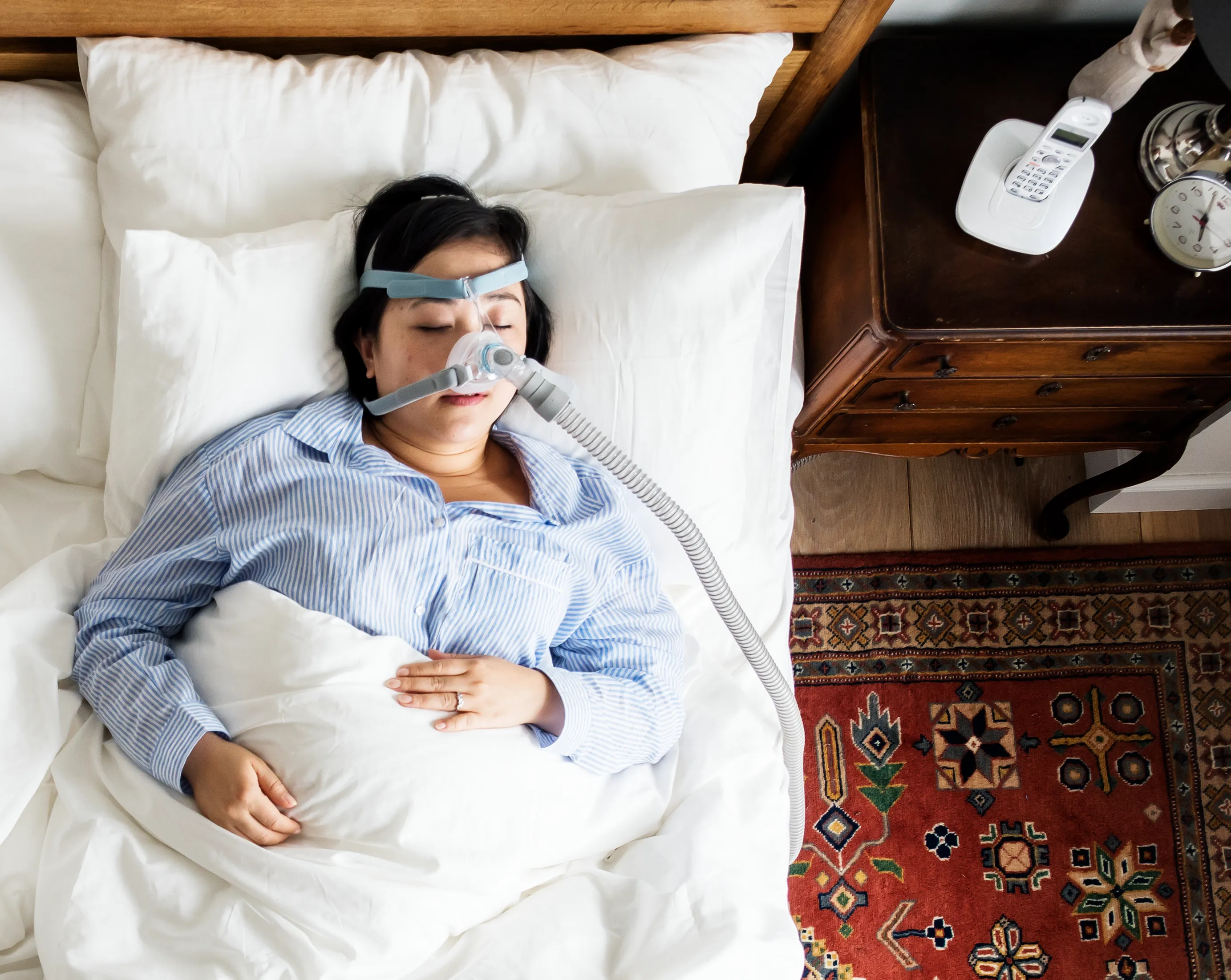
Adaptive servo-ventilation (ASV) is a prescription form of positive airway pressure therapy used for selected patterns of central sleep apnea and mixed central-obstructive breathing. It tracks recent breathing and changes inspiratory support from one breath to the next. It can provide more help when breathing weakens or pauses, then reduce that help when breathing becomes stronger.
ASV is not simply a more advanced CPAP machine or a device to choose from a feature list. The cause of the central events, the presence of obstructive events, medications, oxygen and carbon dioxide findings, and current heart function all affect whether it is appropriate.
A practical safety rule: known or possible heart failure and left ventricular ejection fraction (LVEF) need clinician review before ASV starts. If you already use ASV and have heart failure, an unknown LVEF, or a major change in cardiac symptoms, contact the prescribing sleep clinician rather than changing or stopping therapy on your own.
What an ASV machine changes breath by breath
An ASV device delivers air through a mask and uses the airflow signal to follow the shape, timing, and size of recent breaths. Its two main jobs are:
- Keep the upper airway open. Expiratory positive airway pressure (EPAP) acts as a pneumatic splint. Some ASV modes hold EPAP at a set level, while others adjust it within a prescribed range to respond to obstruction.
- Stabilize ventilation. Pressure support is the difference between inspiratory pressure and expiratory pressure. ASV raises or lowers this support rapidly as breathing falls below or rises above the device's recent target. An automatic backup function can deliver support when a spontaneous breath is late or absent 1.
The target and response are not identical across brands or generations. Some algorithms track recent minute ventilation, while others use peak airflow. They can also differ in minimum pressure support, backup timing, and how EPAP responds to obstruction. Studies comparing ASV devices have found meaningful differences in the ventilation and pressure they deliver 2.
This variability is one reason a prescription should identify the device and mode, not only say "ASV." It also means results from one algorithm cannot automatically be transferred to every ASV machine.
How ASV differs from CPAP and bilevel PAP
These modes can look similar at the bedside because each uses a mask, tubing, and positive pressure. Their response to a missing or unstable breath is different.
| Mode | Pressure pattern | What happens if breathing effort pauses? | Typical role |
|---|---|---|---|
| CPAP or APAP | One pressure, fixed or automatically adjusted mainly to keep the airway open | It does not supply a separate timed inspiratory breath | Usually first-line therapy for obstructive sleep apnea and sometimes an initial trial for CSA |
| Bilevel PAP without a backup rate | Lower EPAP and higher inspiratory pressure, usually with a set amount of pressure support | The device follows spontaneous effort and does not guarantee a timed breath | Can support ventilation in selected conditions, but is not recommended as treatment for CSA because excessive pressure support can worsen central instability |
| Bilevel PAP with a backup rate, often called BPAP-ST | Separate expiratory and inspiratory pressures plus a minimum respiratory rate | It supplies a timed breath when the rate falls below the set backup | One option for some forms of CSA or hypoventilation, depending on the cause |
| ASV | EPAP treats obstruction while inspiratory pressure support changes continually around a recent breathing target | An adaptive backup function supports late, shallow, or absent breaths | Selected central, periodic, or mixed breathing patterns |
The 2025 American Academy of Sleep Medicine guideline suggests against bilevel PAP without a backup rate for CSA. It conditionally suggests bilevel PAP with a backup rate for primary, medication-related, treatment-emergent, and some medical-condition-related CSA, although the evidence is very limited. The guideline did not make the same recommendation for heart-failure-related CSA because evidence was insufficient 3.
ASV also differs from volume-assured ventilation. ASV tries to smooth an unstable breathing pattern around the person's recent ventilation. It is not designed to guarantee a fixed tidal volume for chronic hypoventilation. A high carbon dioxide level or suspected hypoventilation changes the evaluation and may call for a different ventilatory mode.
Central breathing patterns for which ASV may be considered
Central sleep apnea is not one disease. A central event occurs when airflow falls because breathing effort temporarily falls or stops. Finding why that happens is part of choosing a treatment.
Treatment-emergent central sleep apnea
Treatment-emergent central sleep apnea (TECSA), previously called complex sleep apnea, describes central events that appear or become prominent when PAP opens an obstructed airway. The original study usually shows obstructive sleep apnea, then central apneas emerge during CPAP or another PAP treatment.
TECSA is dynamic. It resolves with continued CPAP in many people, persists in some, and appears later in a smaller group. If symptoms are manageable and oxygenation is acceptable, a clinician may first optimize CPAP, correct leak, avoid unnecessarily high pressure, and observe the pattern. Persistent central events, poor sleep, symptoms, or oxygen concerns can lead to another titration and consideration of ASV or a different treatment 4.
A PAP machine labeling a few events as "central" does not establish TECSA. Wakeful breath-holding, leak, and the limits of device algorithms can affect event labels. The diagnosis depends on the sleep study and clinical context.
CSA related to opioids or another substance
Opioids can depress respiratory drive and produce central apneas, irregular breathing, or hypoventilation. The medication, dose, timing, other sedating substances, lung health, and carbon dioxide level all matter. A supervised reduction or change in the contributing medication may be part of treatment when it is medically feasible. Any medication change needs the prescriber's guidance.
The AASM conditionally suggests ASV as one option for medication- or substance-related CSA, but the evidence is low certainty. CPAP, bilevel PAP with a backup rate, and acetazolamide are other options considered in the guideline. Suspected hypoventilation requires a separate assessment because the guideline's CSA recommendations do not cover hypoventilation disorders 3.
Primary or idiopathic CSA
Primary CSA means recurrent central events remain after evaluation does not identify another cause. "Idiopathic" has the same practical meaning. ASV may be considered when the events are clinically important, but the diagnosis should prompt a review for cardiac, neurologic, medication, altitude, and other contributors before it is treated as unexplained.
Cheyne-Stokes breathing and heart failure
Cheyne-Stokes breathing is a form of periodic breathing in which breaths gradually grow deeper, then become shallower, followed by a central pause. It is often associated with heart failure and can also occur with neurologic disease. Treating the underlying condition is a central part of the plan.
ASV can suppress this breathing pattern, but lowering the event count is not the same as improving survival. Heart-failure symptoms, current LVEF, the type of sleep apnea, the exact ASV device, and the expected effect on symptoms or quality of life must be reviewed before treatment.
CSA due to another medical condition
Central events may occur with stroke, kidney disease, and other medical or neurologic conditions. ASV is conditionally suggested as one possible treatment in the current AASM guideline, but care begins with the underlying condition and the full sleep-study pattern 3.
High-altitude periodic breathing is usually approached differently because it may improve with acclimatization or descent. Low-flow oxygen or acetazolamide may be considered in selected cases. ASV is not the default conclusion for every central event.
What current guidance says about ASV
The 2025 AASM guideline conditionally suggests ASV over no ASV for adults with primary CSA, heart-failure-related CSA, medication- or substance-related CSA, treatment-emergent CSA, and CSA due to a medical condition. "Conditional" means different choices can be appropriate for different people. The certainty of evidence was low 3.
The guideline emphasizes shared decision-making and a realistic expectation of symptom or quality-of-life improvement. It advises clinicians to treat contributing conditions and not focus only on eliminating events. For people with heart failure with reduced ejection fraction, ASV should be managed in experienced centers with close monitoring and follow-up 3.
This updated posture reflects evidence from more than one device and trial. It does not mean every ASV machine is appropriate for every type of CSA, and it does not cancel a specific product contraindication.
The SERVE-HF safety signal
SERVE-HF was a randomized trial of 1,325 adults with symptomatic chronic heart failure, LVEF of 45% or less, and predominantly central sleep apnea. Participants received guideline-based heart-failure care alone or the same care plus a first-generation, minute-ventilation-targeted ResMed ASV device.
ASV lowered the apnea-hypopnea index but did not improve the trial's main combined cardiovascular outcome. All-cause mortality was higher in the ASV group, with a hazard ratio of 1.28. Cardiovascular mortality was also higher, with a hazard ratio of 1.34 5.
The device tested in SERVE-HF is no longer manufactured. It used an older algorithm and required a minimum level of pressure support that newer designs may not use. Those differences are plausible reasons to study devices separately, but they have not proved why mortality increased 6.
The finding applies most directly to the population that was studied: symptomatic chronic heart failure with reduced LVEF and moderate to severe, predominantly central sleep apnea. It did not test people without heart failure, those with preserved ejection fraction, or every ASV algorithm.
The warning remains clinically active. Current labeling for the ResMed AirCurve 10 ASV states that ASV is contraindicated in people with chronic symptomatic heart failure, New York Heart Association class II to IV, LVEF of 45% or less, and moderate to severe predominantly central sleep apnea 7.
What ADVENT-HF added
ADVENT-HF later studied a different, peak-flow-triggered Philips ASV algorithm in 731 people with heart failure and LVEF of 45% or less. The trial included both predominantly central and predominantly obstructive sleep apnea.
Over an average 3.6 years, ASV greatly reduced sleep-disordered breathing but did not improve the main combined cardiovascular outcome or all-cause mortality. The investigators did not identify an ASV-related safety signal. The trial ended early because of pandemic restrictions and a recall of the study device, which limits how confidently it can settle long-term questions 8.
Taken together, SERVE-HF and ADVENT-HF do not show that ASV improves survival. They also do not support assuming that the SERVE-HF mortality signal applies equally to every algorithm. The AASM evidence review did not find a class-wide mortality effect, but it could not recommend one specific ASV device over another 3.
What should be checked before ASV starts
A sleep specialist usually needs more than a central apnea index. The pre-treatment review may include:
- The diagnostic pattern: central, obstructive, and mixed event counts; whether events cluster in a particular sleep stage or position; oxygen levels; arousals; and whether hypoventilation is present.
- The likely cause: heart failure, stroke or another medical condition, opioid or sedative exposure, recent altitude, or treatment-emergent events.
- Current cardiac status: symptoms, heart-failure diagnosis and treatment, and a recent measure of LVEF when heart failure is known or suspected. An echocardiogram is commonly used to measure LVEF 3.
- The treatment goal: fewer disruptive events, better sleep, improved daytime function, or better oxygenation. A lower machine AHI alone may not deliver a meaningful benefit.
- The exact device: its manufacturer, model, algorithm, labeling, and available settings.
New breathlessness, ankle or abdominal swelling, rapid unexplained weight gain, difficulty breathing when lying flat, or reduced exercise tolerance should be reported because they can signal a change in heart failure. Severe or sudden breathlessness, chest pain, or fainting needs urgent medical evaluation 9.
How ASV is titrated
ASV is commonly set during an attended sleep-lab titration. The technologist and sleep clinician watch airflow, breathing effort, sleep stage, oxygen level, heart rhythm, arousals, body position, and leak while the device responds 10.
Titration tries to find enough EPAP to control obstruction and appropriate pressure-support limits to stabilize central breathing without causing unnecessary pressure, leak, arousals, or overventilation. Carbon dioxide monitoring may be added when hypoventilation or unstable ventilatory control is a concern. Device-specific protocols matter because the same numerical settings do not produce identical behavior across algorithms 2.
Pressure changes can be large and rapid during a central pause. Adjusting clinical settings without the prescribing team can worsen sleep, obstruction, central instability, or ventilation. Comfort controls such as humidity may be user-adjustable, but treatment pressures and mode should follow the prescription.
How treatment response is followed
The device download can show hours of use, leak, estimated residual events, periodic breathing, pressure patterns, and how often support changed. These are useful trends, not a replacement for symptoms, oxygen assessment, or a sleep study.
Follow-up should ask:
- Are awakenings, sleepiness, breathlessness, and daytime function improving?
- Is the mask comfortable enough for the device to be used through the sleep period?
- Are leak and residual obstructive or central events controlled?
- Is oxygenation adequate, and is carbon dioxide monitoring needed?
- Have cardiac symptoms, LVEF, medications, opioid exposure, weight, or another medical condition changed?
- Does the device's response match the original treatment goal?
Persistent central events should lead to a review of the underlying risk factors and other treatment options, not just repeated pressure increases. The current AASM guideline gives priority to patient-reported outcomes and recommends close follow-up when ASV is used in reduced-EF heart failure 3.
A repeat titration or sleep study may be useful when symptoms persist, device data are unexplained, oxygen remains low, or health status changes. A stable device AHI with worsening breathlessness or fatigue still deserves clinical review.
Alternatives to ASV
The appropriate alternative depends on why central breathing is unstable. Options in the AASM guideline include:
- optimizing treatment of heart failure or another underlying condition
- continuing or refining CPAP when central events may resolve or respond
- bilevel PAP with a backup rate for selected non-heart-failure forms of CSA
- low-flow oxygen for selected people with heart-failure-related or high-altitude CSA
- acetazolamide for selected CSA causes
- transvenous phrenic nerve stimulation for selected primary or heart-failure-related CSA
- carefully reducing a contributing opioid or sedative with the prescriber when feasible
These are not interchangeable treatments. Oxygen has its own safety requirements, acetazolamide can affect electrolytes and kidney-stone risk, and phrenic nerve stimulation requires an implanted system. The evidence behind the AASM options is generally low or very low certainty 3.
Questions to ask before using ASV
- What type of central sleep apnea does my study show, and what is the likely cause?
- Do I have heart failure, and is my LVEF current?
- Does this specific ASV device have a contraindication that applies to me?
- Why is ASV being considered instead of continued CPAP, bilevel with a backup rate, oxygen, medication, or phrenic nerve stimulation?
- Will the device be titrated in a sleep lab?
- Which outcomes will we follow besides the event index?
- When will device data, symptoms, oxygenation, and cardiac status be reviewed?
ASV can reduce central breathing events in selected people. Its value depends on using the right algorithm for the right breathing pattern, with a clear clinical goal and ongoing review of heart and respiratory health.