
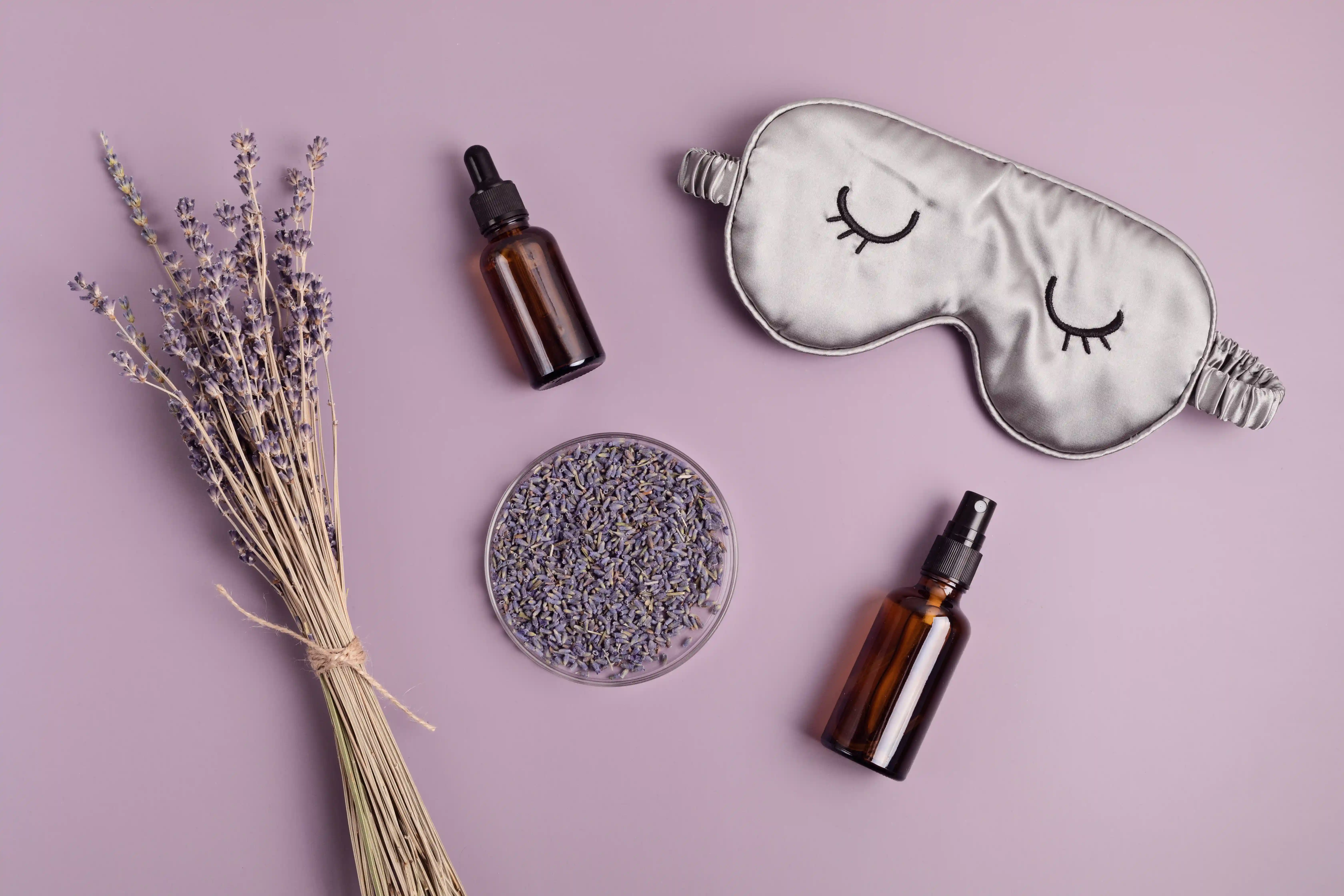
Lavender has the most human research of any essential oil used for sleep. It may modestly improve how some adults rate their sleep, but it has not been shown reliably to increase total sleep, change sleep stages, or treat insomnia. No essential oil has enough evidence to be called the best sleep aid.
Chamomile and bergamot each have limited single-oil research. Evidence for cedarwood is indirect, while studies involving sandalwood or ylang-ylang used blends that make the individual oil's effect impossible to identify. Valerian essential oil should not be confused with oral valerian root extracts.
If you enjoy a scent and can use it safely, an essential oil can be an optional wind-down cue. It should not replace treatment for persistent insomnia, obstructive sleep apnea, an anxiety disorder, or another cause of poor sleep.
How strong is the evidence for lavender?
A 2025 systematic review combined 11 randomized trials involving 628 adults. Lavender was associated with a moderate improvement in sleep-quality ratings, but the studies differed substantially in their participants, products, exposure methods, and results. Most measured sleep with questionnaires, nine used inhalation, and two involved topical application or massage. The reviewers rated the overall risk of bias as moderate 1.
That finding supports a cautious statement: lavender may help some people feel that they slept better. It does not prove that lavender changes sleep itself. Scent studies are hard to blind because participants can often recognize the aroma, and expectations can influence questionnaire scores.
Objective findings are mixed. Small studies using polysomnography or activity trackers have not produced a consistent change in total sleep or sleep stages. In one 2025 placebo-controlled study of 59 college students, a single nighttime exposure to lavender reduced tracker-estimated sleep time and sleep efficiency rather than improving them 2. These short studies do not settle the question, but they are a reason not to turn a subjective benefit into a claim about deep or longer sleep.
How do other essential oils compare?
The comparison below follows the product that was actually tested. It does not rank oils by popularity or infer that an unstudied oil works like lavender.
| Oil | What human sleep research has tested | What the result does not show |
|---|---|---|
| Lavender | Eleven randomized trials in a recent review, mainly using inhalation and subjective sleep scales, produced a modest pooled improvement with substantial variation between studies 1. | It is not proven to increase total sleep, improve deep sleep, or treat insomnia. Results from one species, product, or route do not validate every lavender oil, lotion, spray, or capsule. |
| Chamomile | One trial randomized 80 adults ages 18 to 35 with insomnia symptoms to inhale chamomile oil before bed or continue their usual routine for 15 days. Questionnaire scores improved more with chamomile 3. | There was no active scented placebo, no objective sleep measurement, and only one short trial. Chamomile tea and oral extracts are different products. |
| Bergamot | An open-label crossover study in 48 university students found improvements in some self-rated sleep dimensions after a bergamot spray was used before bed and after waking 4. A separate randomized trial in 60 postpartum women found no between-group sleep-quality benefit 5. | The evidence is conflicting and based on subjective outcomes in specific groups. It does not establish bergamot as a general sleep aid. |
| Cedarwood or cedrol | A laboratory study exposed 26 healthy adults to isolated cedrol through a face mask and measured short-term cardiovascular and breathing responses 6. It did not measure overnight sleep. | A relaxation-related body response is not evidence of falling asleep faster, sleeping longer, or sleeping better. There is no basis for a required number of nights or a sleep dose. |
| Sandalwood | A seven-day trial in 54 adults with perennial allergic rhinitis used a blend of sandalwood, geranium, and Ravensara. Sleep was one of several self-rated outcomes 7. | Because the intervention was a blend and the participants had rhinitis, the study cannot identify a sandalwood effect or support a recommendation for the general population. |
| Ylang-ylang | A crossover trial in 42 cardiac rehabilitation patients tested a blend of lavandin, bergamot, and ylang-ylang for five nights 8. | A positive result for a three-oil blend cannot show that ylang-ylang worked on its own or that the same blend helps people outside cardiac rehabilitation. |
| Valerian essential oil | The European Medicines Agency describes traditional use of valerian essential oil to aid sleep but notes that clinical studies of valerian essential-oil medicines were lacking 9. | Findings and milligram doses for swallowed valerian root extracts do not apply to volatile oil. Do not ingest an essential oil because a valerian supplement has a similar name. |
Some human trials have studied other oils or multi-oil mixtures in narrowly defined groups. That does not create a reliable top-10 list. An oil with no suitable trial should be described as unproven, not as ineffective, and an oil that appears in a blend should not receive credit for the blend's result.
For a broader look at scent studies and objective sleep measurements, see Aromatherapy and Scents for Sleep.
Choose a product you can evaluate
There is no clinical standard that makes one retail essential oil effective for sleep. A useful label should let you identify what you are buying and how the maker intends it to be used.
Look for:
- a complete ingredient list and, for a single oil, the botanical name and plant part
- a clearly labeled route, such as inhalation or pre-diluted topical use
- directions, warnings, lot information, and a manufacturer contact
- disclosure of every oil in a blend rather than only a proprietary blend name
A single-oil product is easier to evaluate than a blend because you can stop it or compare it without guessing which ingredient mattered. That does not make it more effective.
Terms such as “pure,” “therapeutic grade,” and “sleep blend” are not proof of clinical benefit. Testing or certification may help verify identity or manufacturing practices, but it cannot show that the product improves sleep. In the United States, whether an aromatherapy product is treated as a cosmetic, drug, or another product category depends partly on its intended use and claims. A promise to treat insomnia or another disease is a drug claim, not evidence that the product works 10.
A lower-exposure way to try inhalation
No drop count, diffuser setting, or exposure schedule has been proven best for sleep. Devices and concentrations vary, so a research dose or social-media recipe should not be copied into a different product.
- Start with one product labeled for inhalation. Do not begin with a homemade blend. Use the lowest label-directed amount or setting.
- Test it while awake. Try a brief exposure in a ventilated room where you can turn it off and leave. A faint scent is enough to judge tolerability.
- If tolerated, use it during a short wind-down period. Turn the diffuser off before you fall asleep. There is no evidence that all-night exposure works better.
- Limit device contamination. For a water-reservoir diffuser, follow its cleaning schedule, empty and dry it after use, and do not let water or oily residue sit between sessions. Do not put essential oil into a humidifier unless the device instructions explicitly allow it.
- Stop if symptoms appear. Headache, nausea, coughing, wheezing, chest tightness, eye irritation, dizziness, or a rash means the exposure is not a useful bedtime routine.
A pleasant aroma is not the same as a measurable sleep benefit. If you want to test whether it helps, keep the rest of your routine stable and note sleep onset, awakenings, wake time, and next-day functioning for several nights. Stop if there is no clear benefit.
Inhaled, topical, and oral products are not interchangeable
Inhalation exposes the nose, eyes, and airways to volatile compounds. Ventilation and shorter exposure reduce the amount in the room, but they do not make an oil risk-free. People with asthma, fragrance sensitivity, migraines triggered by odor, or another respiratory condition should avoid experimenting during a flare and ask a clinician whether fragrance exposure is appropriate. The American Academy of Allergy, Asthma & Immunology notes that direct studies in people with asthma are lacking and that diffuser emissions may act as irritants 11.
Topical use adds the risk of skin irritation or allergic contact dermatitis. Use only a product labeled and pre-diluted for skin, follow its directions, and keep it away from eyes, lips, and damaged skin. Do not apply undiluted oil. Testing a small amount on intact skin may reveal an immediate reaction, but a clear patch does not guarantee that later use will be safe, and it says nothing about inhalation tolerance. Lavender can cause allergic skin reactions in some people 12.
Oral use is a separate exposure. Never swallow diffuser oil or any product labeled for external use. Essential oils can cause serious poisoning when misused 13. Oral products may also interact with medicines or other sedating substances 12. If you are considering a product made to be swallowed, discuss that specific product with a clinician or pharmacist rather than converting drops from a topical or diffuser recipe.
Who should take extra care?
- Pregnancy and breastfeeding: Safety information is limited for lavender and many other oils. Avoid casual use or ask the obstetric clinician or pediatric clinician about the exact product, route, and exposure 12.
- Babies and children: Do not apply adult essential-oil products to a child or run a diffuser in a child's room without guidance from the child's clinician. Small amounts can be dangerous if swallowed. Keep bottles, soaked pads, and diffuser water locked away.
- Pets: Never apply a human essential oil to a pet. Keep diffusers secure, ventilate the room, and let the animal leave. Avoid diffusion around pets with breathing problems and in homes with birds. Contact a veterinarian or animal poison service after a suspected exposure 14.
- People taking medicines: A product that is inhaled, placed on skin, or swallowed has different interaction potential. Ask a pharmacist about the exact product, especially if it is oral or used with sleep medicines, sedatives, alcohol, or other supplements.
Prevent spills, poisoning, and fire
Store essential oils in their original labeled containers, tightly closed and out of sight and reach of children and pets. Do not reuse food or drink containers. Clean spills promptly without bare-skin contact, and wash exposed skin with soap and water. If oil enters an eye, rinse with running water and contact a poison service for case-specific advice.
Do not use a candle, oil burner, or other open flame while drowsy or in a sleeping area. Blow out candles before leaving the room or going to bed 15. Keep oil bottles and fragranced products away from heat, sparks, and device openings not designed for them.
In the United States, use webPOISONCONTROL or call Poison Control at 1-800-222-1222 after a suspected swallow, eye exposure, or concerning skin exposure. Do not induce vomiting. Outside the United States, contact the local poison service. Call emergency services for trouble breathing, a seizure, collapse, or inability to wake 13.
When poor sleep needs more than a scent
Speak with a healthcare professional if sleep difficulty happens at least several nights a week, lasts for months, or affects safety and daytime functioning. Loud snoring, gasping, witnessed breathing pauses, morning headaches, or severe daytime sleepiness may point to obstructive sleep apnea and need assessment.
Essential oils do not address the causes of chronic insomnia. Cognitive behavioral therapy for insomnia is the recommended first-line treatment for adults with chronic insomnia 16. A scent can remain part of a quiet bedtime routine if you like it and tolerate it, but it should not delay care that targets the sleep problem itself.