
A Chiari malformation is a structural finding at the point where the brain meets the spinal canal. In the most common form, Chiari I, the lowest parts of the cerebellum, called the cerebellar tonsils, extend through the opening at the base of the skull.
The finding can be important, but the MRI measurement is not the whole diagnosis. Many people have low-lying tonsils without symptoms. Others have a pattern of headaches, neurologic changes, or a fluid cavity in the spinal cord that makes the finding more clinically meaningful. Current guidelines emphasize matching the history and neurologic examination to the complete imaging picture rather than deciding from a millimeter cutoff alone 1 2.
What Chiari I means
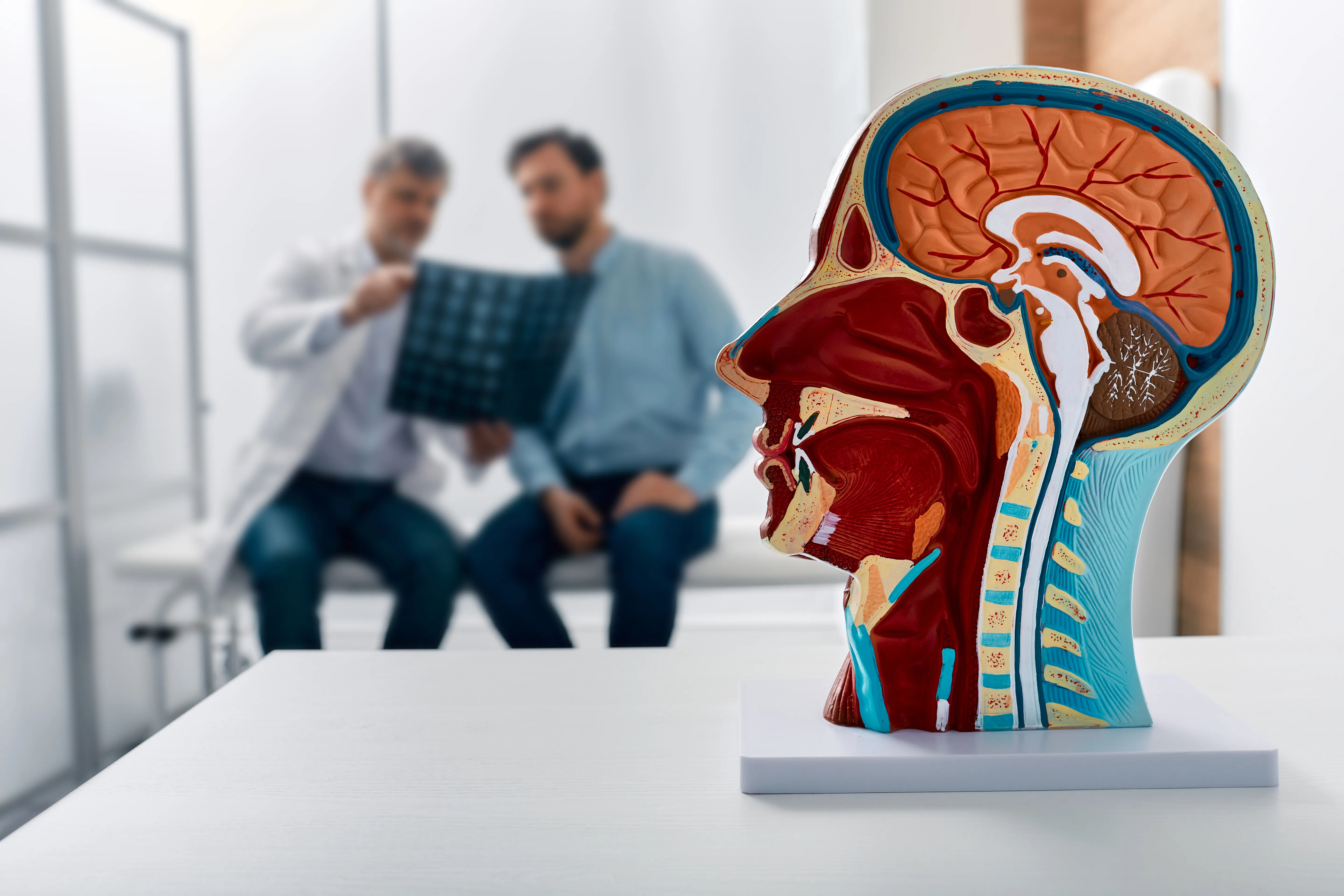
The foramen magnum is the opening at the base of the skull through which the brainstem continues into the spinal cord. Cerebrospinal fluid, or CSF, also moves between the skull and spinal canal through this area.
In Chiari I, one or both cerebellar tonsils sit below the foramen magnum. A commonly used radiologic definition is at least 5 millimeters of descent. Some expert groups also include 3 to 5 millimeters when there is a spinal cord syrinx or a pointed, crowded appearance of the tonsils 2. These measurements help radiologists describe anatomy. They do not prove that a headache, dizziness, fatigue, or another common symptom comes from Chiari.
A more useful interpretation considers:
- the shape of the tonsils and how crowded the junction looks
- whether normal CSF spaces appear narrowed or blocked
- whether the brainstem or lower cranial nerves may be affected
- whether a syrinx or hydrocephalus is present
- whether the symptoms and neurologic examination fit the anatomy
- whether symptoms or associated findings are changing over time
Low tonsils can also occur for reasons other than a developmental Chiari I. Intracranial hypotension from a CSF leak, raised pressure inside the skull, hydrocephalus, and a mass can push or pull the tonsils downward. These are sometimes called acquired tonsillar ectopia or Chiari-like changes, and treating them as ordinary Chiari I could miss the underlying problem 2 3.
The Chiari types are not stages of one disease
The numbered types describe different anatomy. They should not be read as a scale on which type I inevitably progresses to type II.
- Chiari I mainly involves downward position of the cerebellar tonsils. It is often found in older children or adults, including people who had an MRI for an unrelated reason.
- Chiari II includes descent of more hindbrain structures and occurs almost exclusively with myelomeningocele, an open form of spina bifida. Hydrocephalus and shunt-related problems are often part of the clinical picture. The name Arnold-Chiari is most appropriately used for type II.
- Chiari III is a rare congenital condition in which cerebellar or brainstem tissue extends through a skull or upper-spine defect. It usually causes serious problems in infancy.
- Chiari IV is an older label for severe underdevelopment of the cerebellum without the characteristic downward herniation. Modern reviews question whether it belongs in the Chiari group at all 3.
This article focuses on Chiari I. Types II and III require different pediatric and neurosurgical care 4.
Symptoms that fit Chiari I, and symptoms that do not prove it
Chiari I does not have a single universal symptom list. The same MRI finding may be incidental in one person and clinically relevant in another.
The characteristic headache pattern
The headache most closely associated with Chiari I is pain at the back of the head or upper neck that starts or becomes sharply worse with coughing, sneezing, laughing, or straining. These pressure-triggered attacks are often brief. They are sometimes called cough headaches or Valsalva headaches.
Migraine and tension-type headache can occur in someone who also has Chiari I. A constant headache, light sensitivity, nausea, dizziness, or pain elsewhere in the head does not become a Chiari symptom simply because an MRI shows low tonsils. In a small retrospective study, decompression improved classic cough headache more reliably than migraine-like or tension-type headache, and the authors recommended treating the established headache disorder before considering decompression for an atypical headache alone 5. The Congress of Neurological Surgeons similarly concludes that strain-related headache is the pain symptom most likely to respond, while other symptoms have more variable outcomes 6.
Neurologic and swallowing symptoms
Symptoms that can raise concern for involvement of the cerebellum, brainstem, lower cranial nerves, or spinal cord include 4 2:
- worsening balance, an unsteady walk, or loss of coordination
- abnormal eye movements or double vision
- difficulty swallowing, repeated choking, hoarseness, or a weak gag
- new weakness, clumsiness, numbness, or altered sensation in an arm or leg
- loss of pain and temperature sensation, particularly across the shoulders, arms, or hands
These findings deserve medical assessment, but none is unique to Chiari. Inner-ear disorders, migraine, peripheral nerve problems, cervical spine disease, medication effects, and other neurologic conditions can produce overlapping symptoms. A specialist should identify the pattern and examine the person rather than assigning every unexplained symptom to the scan.
Associated conditions that can change the plan
Syringomyelia
A syrinx is a fluid-filled cavity inside the spinal cord. When it enlarges or damages nearby pathways, it can cause weakness, muscle wasting, stiffness, neuropathic pain, or an unusual loss of pain and temperature sensation. In a child, a new or worsening spinal curve can be one sign that prompts evaluation for a syrinx 2.
A narrow central canal on MRI is not always the same as clinically important syringomyelia. Specialists consider the cavity's shape, width, extent, symptoms, and change over time. When Chiari I has been seen only on a brain or cervical MRI, guidelines say further brain and spine imaging may help assess for a syrinx and hydrocephalus 1. Pediatric consensus specifically recommends imaging the whole spinal cord to rule out syringomyelia in children with Chiari I 2.
Hydrocephalus and pressure disorders
Hydrocephalus is a buildup of CSF in the brain's ventricles. It can coexist with a Chiari malformation or cause secondary tonsillar descent. In children with both hydrocephalus and Chiari I, expert consensus recommends addressing the hydrocephalus first and reserving posterior fossa decompression for symptoms that persist 2.
The clinical pattern can also lead a specialist to investigate low CSF pressure from a leak or raised intracranial pressure. This distinction matters because decompression is not the standard treatment for every cause of low-lying tonsils.
Tethered cord
A tethered spinal cord is a separate condition in which tissue limits normal movement of the spinal cord within the spinal canal. It should not be assumed from a Chiari I finding or from nonspecific back, leg, or bladder symptoms. Pediatric consensus describes the association as rare and sporadic and recommends treating a clearly symptomatic tethered cord on its own merits, without expecting detethering to correct Chiari I 2.
How Chiari I is evaluated
The goal is not merely to confirm that the tonsils cross a line. It is to determine whether the anatomy explains the clinical problem and whether another condition needs attention.
A useful evaluation may include:
- A detailed history. The clinician asks when symptoms began, what triggers them, whether they are progressing, and how they affect walking, hand function, swallowing, breathing, school, work, and daily life.
- A neurologic examination. Strength, sensation, reflexes, coordination, gait, eye movements, speech, and lower cranial nerve function can help localize a problem.
- MRI review. MRI of the brain and craniocervical junction shows tonsil position, crowding, the brainstem, ventricles, and nearby CSF spaces. Brain and spine imaging may be added when the first study does not cover the areas needed to assess a syrinx, hydrocephalus, or another cause 1.
- Targeted testing for a specific symptom. A sleep study can identify obstructive, central, or mixed sleep apnea. A swallowing evaluation can assess choking or suspected aspiration. Guidelines do not support routinely ordering either test in a person without sleep or swallowing symptoms 6.
Cine phase-contrast MRI shows CSF movement across the craniocervical junction. It can add context in selected cases, but it is not a pass-fail test for symptomatic Chiari. The evidence is mixed on whether cine MRI predicts who will benefit from decompression 1.
A neurologist may be especially helpful when headache, dizziness, or sensory symptoms have plausible alternatives. A neurosurgeon with Chiari experience can explain whether the clinical and imaging findings support observation, surgery, or further evaluation.
Questions worth asking at a specialist visit include:
- Which of my symptoms do you think Chiari explains, and which may have another cause?
- Is there a syrinx, hydrocephalus, marked crowding, or another structural finding?
- Would another brain or spine MRI change the decision?
- If you recommend surgery, what specific problem is it intended to improve or prevent?
- Which symptoms are less likely to improve after surgery?
Chiari I and sleep-disordered breathing
Chiari I can occur with obstructive sleep apnea, central sleep apnea, or a mixture of both. In a prospective study of 90 adults seen in a specialist setting, sleep-related breathing disorders were common, but central events above the study threshold occurred in only a small minority 7. That selected clinic population does not establish how often apnea occurs in everyone with an incidental Chiari finding.
Snoring, witnessed pauses, gasping, morning headaches, restless sleep, and daytime sleepiness are reasons to discuss testing. They do not reveal whether an event is obstructive or central, and an MRI cannot diagnose sleep apnea. Polysomnography provides that information 6.
Decompression can reduce breathing events in some patients, but it is not a guaranteed cure. In a small pediatric series, sleep-disordered breathing improved overall after surgery, yet many children still needed positive airway pressure 8. Sleep medicine follow-up remains important even when Chiari is treated.
See our dedicated guide to Chiari malformations and sleep apnea for a closer look at testing and the difference between obstructive and central events.
Observation and symptom care
Many people with an incidental Chiari I and no syrinx do not need surgery. The Congress of Neurological Surgeons recommends against prophylactic decompression for an asymptomatic person without a syrinx, while acknowledging that a small proportion develop new or worsening symptoms later 6.
Observation may involve clinical follow-up and repeat imaging chosen for the person's age, symptoms, and associated findings. There is no single MRI schedule for every adult. Children who are still growing may need longer clinical and imaging follow-up, with the interval individualized 2.
Medicines can treat a coexisting migraine or another source of pain, but they do not change the Chiari anatomy. Treatment should target the diagnosed headache or pain condition rather than assume that every symptom requires decompression 5.
When decompression surgery may be considered
Surgery is considered when the team has evidence that Chiari is causing a meaningful problem. Examples include progressive neurologic deficits, symptoms that closely fit Chiari and substantially affect daily life, or a significant or enlarging syrinx 6 9. In an asymptomatic child, the presence and progression of a syrinx may affect the decision even when symptoms are limited 2.
The usual operation is posterior fossa decompression. The surgeon removes a small amount of bone at the back of the skull and sometimes part of the first cervical vertebra to make more room at the foramen magnum. The dura, the covering around the brain and spinal cord, may be left closed or opened and enlarged with a patch. In selected cases with a syrinx, the surgeon may reduce part of the tonsillar tissue.
Current guidelines do not identify one operation as best for every patient. Bone-only decompression and decompression with duraplasty can both be first-line options. Opening the dura may improve CSF space and syrinx resolution in some situations, but it also increases the chance of CSF-related complications. The choice depends on age, symptoms, syrinx, anatomy, prior surgery, and the surgeon's judgment 9 2.
The aim is to restore room and CSF flow and to prevent further neurologic injury. It is not a promise that all symptoms will disappear. Strain-triggered headache is more likely to improve than a migraine-like headache or a symptom with another cause. Longstanding spinal cord damage may not fully reverse 6 4.
Risks vary with the operation and the person's anatomy. They can include infection, bleeding, CSF leakage, a fluid collection under the skin called a pseudomeningocele, meningitis, new neurologic injury, persistent symptoms, or another operation. A surgeon should explain the expected benefit and the risks for the exact proposed technique 9 2.
Recovery and follow-up after surgery
Recovery does not follow one reliable timetable. The operation performed, complications, symptoms before surgery, work or school demands, and the surgeon's restrictions all matter. The surgical team should provide individualized instructions for wound care, pain control, lifting, driving, work, school, and return to exercise.
Follow-up usually considers both symptoms and imaging. A syrinx may take months to shrink, and symptom improvement does not always track its size. Current guidelines note that some people improve and later develop recurrent symptoms or imaging changes, so new problems after a successful recovery still deserve reassessment 9.
Persistent symptoms do not automatically mean that more decompression is needed. The team may reconsider whether the original symptom was caused by Chiari, whether CSF flow remains restricted, whether the syrinx has changed, or whether hydrocephalus, instability, scar tissue, migraine, sleep apnea, or another condition is contributing 9 2.
Children with Chiari I
Children can have the same cough-triggered headache and neurologic signs as adults, but younger children may not be able to describe them. Feeding or swallowing problems, repeated choking, abnormal breathing, low muscle tone, delayed motor development, or poor growth may prompt assessment in a baby or young child. Older children may present with headaches, balance problems, weakness, sensory changes, or scoliosis associated with a syrinx 4 2.
Marked tonsillar descent by itself is not a reason for preventive surgery in a child who has no symptoms and no syrinx. International pediatric consensus supports observation in that situation and follow-up through growth based on the child's individual findings 2.
Activity, sports, and pregnancy
An asymptomatic Chiari I without a syrinx does not automatically require activity restrictions. The Congress of Neurological Surgeons found no evidence that blanket restrictions prevent future harm in this group 6. This does not provide personal clearance for every sport. Symptoms, a syrinx, neurologic findings, other skull-base anatomy, and previous surgery can change the advice, so discuss high-impact or collision activities with the treating clinician.
Pregnancy does not automatically require decompression, general anesthesia, or cesarean delivery. A systematic review found only 35 reported deliveries, so the evidence was limited, but it found no reported brain herniation and included both vaginal and cesarean births with neuraxial and general anesthesia 10. Planning should be individualized with the obstetric, anesthesia, and neurosurgical teams, particularly when there are significant neurologic symptoms, a syrinx, hydrocephalus, or previous decompression.
When to seek medical care
Arrange prompt medical review for a new or worsening pattern of:
- weakness, numbness, loss of hand function, or difficulty walking
- choking, trouble swallowing, hoarseness, or coughing with food or drink
- headaches reliably triggered by cough or strain, especially when they are new
- witnessed breathing pauses, gasping, or marked daytime sleepiness
- loss of pain or temperature sensation, or a changing spinal curve in a child
Seek emergency care for severe trouble breathing, blue or gray lips, inability to swallow secretions, sudden loss of consciousness, a sudden severe headache unlike the usual pattern, or rapidly developing weakness or difficulty walking. These symptoms can have causes other than Chiari and should not wait for a routine neurosurgical appointment.
The practical question after a Chiari finding is not, “How many millimeters is it?” It is, “Do the symptoms, examination, and full imaging picture point to a problem that observation or treatment can meaningfully address?”