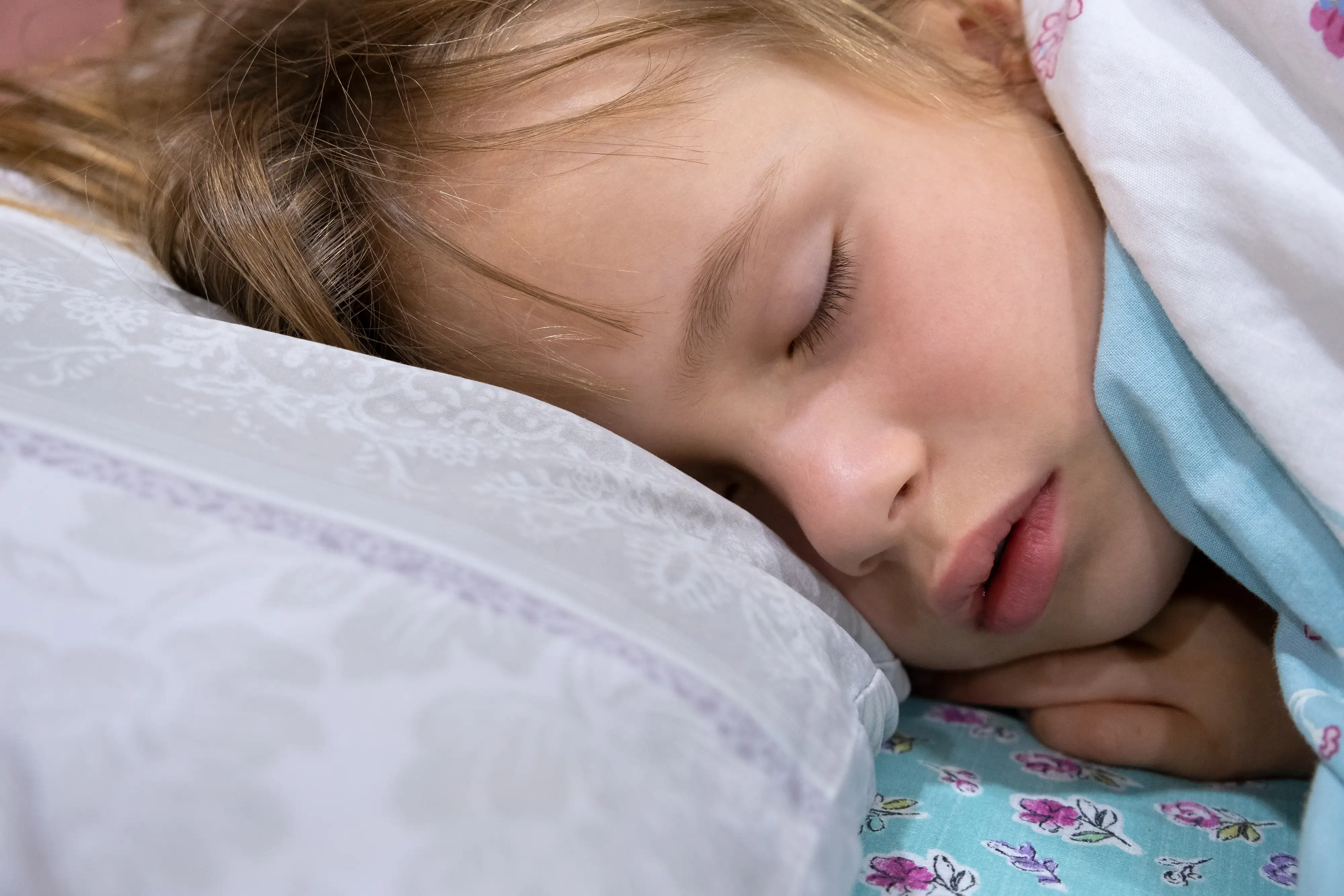
A child who snores often, works hard to breathe during sleep, or has repeated pauses or gasps should be evaluated for sleep apnea. Children do not always look sleepy during the day. Irritability, hyperactivity, attention problems, difficult mornings, or declining school performance may be the more visible clues.
These signs do not prove sleep apnea. A cold can cause temporary snoring, and behavior or learning changes have many possible explanations. The concern rises when symptoms are frequent, occur together, persist after an illness clears, or affect growth, daytime function, or safety.
What sleep apnea means in a child
Sleep apnea is repeated abnormal reduction or stopping of breathing during sleep. The main pediatric forms are:
- Obstructive sleep apnea (OSA): The upper airway narrows or closes while the child continues trying to breathe. Enlarged tonsils and adenoids are common contributors, but obstruction can involve several parts of the airway.
- Central sleep apnea (CSA): Airflow stops because breathing effort also stops. Central events can occur with neurologic, genetic, neuromuscular, or other medical conditions. Some brief central pauses can be physiologic in infants, so age, event length, oxygen and carbon dioxide changes, and the rest of the sleep study matter.
- Mixed apnea: An event has both central and obstructive features.
OSA is the usual focus when a child habitually snores or has labored breathing. CSA is less common and more often found in children with an underlying condition. The two can also occur together 1. A caregiver cannot reliably tell which mechanism is present by listening for a pause.
Infant apnea, apnea of prematurity, brief resolved unexplained events, congenital hypoventilation, and sudden infant death syndrome are not interchangeable with routine childhood OSA. A baby with pauses, color change, poor responsiveness, feeding difficulty, or breathing effort needs age-specific medical assessment.
Signs that deserve attention
No single symptom can separate primary snoring from OSA. Look for a pattern across the night, morning, and day.
During sleep
Common reasons to discuss pediatric sleep-disordered breathing with a clinician include:
- snoring on many nights, especially when loud or present outside colds
- labored breathing, chest or belly movement that looks unusually forceful, or inward movement between or below the ribs
- witnessed pauses, gasps, choking sounds, or repeated snorts
- mouth breathing, a blocked-sounding nose, or sleeping with the neck extended
- restless sleep or unusual positions, such as propping upright or sleeping with the knees tucked under the body
- frequent sweating without an obvious room-temperature explanation
- repeated awakenings
- bedwetting, especially if it begins again after a sustained dry period
Snoring is common enough that it is not a diagnosis. It is still worth reporting when it is habitual because pediatric guidelines recommend asking about snoring and evaluating children who snore and have other symptoms or findings 2.
In the morning and daytime
A child may have:
- dry mouth, morning headache, or difficulty waking
- irritability, emotional outbursts, impulsivity, or hyperactive behavior
- trouble sustaining attention, remembering instructions, or completing schoolwork
- a change in grades, classroom participation, or peer relationships
- unplanned naps, falling asleep in class or during rides, or obvious daytime sleepiness
- poor appetite, slow growth, or concern that height or weight is not following the expected pattern
Sleepiness is not absent in children, but it can be less obvious than in adults. Behavior and attention changes should not automatically be labeled as sleep apnea or ADHD. They are reasons to ask whether sleep and breathing are part of the picture.
How presentation can vary with age
- Infants and toddlers: Noisy or effortful breathing, feeding and growth concerns, unusual positioning, color change, and pauses may be more noticeable than classic loud snoring. Evaluation should be prompt because both the possible causes and normal breathing patterns differ from those of older children.
- Preschool and school-age children: Habitual snoring, mouth breathing, restless sleep, bedwetting, hyperactivity, and attention or school concerns are common referral clues.
- Adolescents: Snoring, morning headaches, difficult waking, mood or attention changes, and daytime sleepiness may look more adult-like. Obesity becomes a more prominent risk factor, but thin adolescents can also have OSA.
Who is more likely to develop OSA?
Pediatric OSA usually reflects more than one factor. Important contributors include:
- Enlarged tonsils or adenoids: These tissues can take up a large share of a child's smaller airway. Their size while awake does not, by itself, predict whether OSA is present or how severe it is.
- Obesity: Fat distribution, airway mechanics, lung volume, and inflammation may all contribute. Weight is a health factor, not a parenting failure or a reason to withhold other treatment.
- Craniofacial anatomy: A small or set-back jaw, midface differences, cleft-related anatomy, or another structural condition can reduce airway space.
- Low muscle tone or neuromuscular disease: These conditions can affect airway stability and, in some cases, nighttime ventilation.
- Down syndrome and other genetic conditions: Several anatomic and neuromuscular features can overlap. A quiet sleeper can still have clinically important disease.
- A history of prematurity: Earlier birth is associated with later sleep-disordered breathing in some children.
- Nasal obstruction or allergic rhinitis: Persistent congestion can add resistance and worsen mouth breathing, although treating the nose does not rule out obstruction elsewhere.
Pediatric guidelines also identify young age and medical complexity as factors that can change testing, surgical planning, and postoperative monitoring 3. Risk factors should lower the threshold for evaluation, not be used to diagnose a child without testing.
Why evaluation matters
Pediatric OSA is associated with poorer quality of life, behavior and attention concerns, learning difficulties, altered blood pressure, and other cardiovascular or metabolic findings. Growth can be affected in some children. These outcomes vary widely, and much of the evidence is observational, so OSA should not be presented as the proven cause of every difficulty 4.
Treatment studies show the same need for balance. In a randomized trial of 459 children with habitual snoring and very mild obstructive sleep-disordered breathing, adenotonsillectomy did not improve the two primary measures of attention and executive function more than watchful waiting at 12 months. It did improve several secondary outcomes, including caregiver-reported behavior, symptoms, quality of life, and blood pressure 5. The result supports individualized decisions rather than a promise that one treatment will correct school performance or behavior.
How pediatric sleep apnea is diagnosed
Start with the child's pediatrician or primary care clinician. Depending on the pattern, the child may be referred to pediatric sleep medicine, pediatric pulmonology, or an ear, nose, and throat specialist. Children with craniofacial, neurologic, neuromuscular, cardiac, or genetic conditions may need their established specialty team involved.
History and examination are the screening step
A clinician may ask about snoring frequency, visible breathing effort, pauses, sleep position, bedwetting, morning symptoms, behavior, school function, sleep schedule, medicines, and family observations. The examination may cover growth, blood pressure, nasal airflow, tonsils, palate, jaw and facial structure, and signs of neuromuscular or cardiopulmonary disease.
This information helps estimate risk and choose the next test. It cannot reliably distinguish primary snoring from OSA or determine severity. Large tonsils do not prove OSA, and small tonsils do not exclude obstruction lower in the airway 2.
An attended sleep study gives the clearest answer
Overnight polysomnography records actual sleep as well as:
- airflow through the nose and mouth
- chest and abdominal breathing effort
- oxygen saturation
- carbon dioxide, when included in the pediatric setup
- brain, eye, and muscle signals used to identify sleep stages and arousals
- heart rhythm, body position, sound, and video
Together, these signals show whether events are obstructive, central, or mixed; whether oxygen or carbon dioxide changes; and whether events cluster in REM sleep or a particular position. Pediatric guidelines recommend polysomnography when symptoms and findings suggest OSA, although access and the exact testing pathway can vary 2.
Pediatric results are not adult results in smaller numbers
Adult AHI cutoffs should not be copied into a child's report. Pediatric respiratory events use age-specific scoring rules, and clinicians interpret even relatively infrequent events in the context of symptoms, oxygen and carbon dioxide, arousals, event type, age, growth, and medical conditions.
The event index is not the only result that matters. A child with a low obstructive event count may still have important gas-exchange changes or symptoms. Another child may have an abnormal number but little measured oxygen disturbance. The pediatric sleep clinician should explain what the full pattern means for that child.
When testing is especially useful before surgery
The ear, nose, and throat guideline recommends preoperative polysomnography for children with obstructive sleep-disordered breathing who are younger than 2 years or have obesity, Down syndrome, craniofacial abnormalities, neuromuscular disorders, sickle cell disease, or mucopolysaccharidoses. It also recommends advocating for a study when the need for surgery is uncertain or the examination does not match the reported severity 3.
Those recommendations help identify perioperative risk and avoid assuming that tonsil size answers the diagnostic question.
What home devices can and cannot tell you
A recording can help a clinician understand what concerned you. Note whether the child was ill, which position they were in, how often the pattern occurred, and what the next day was like. Do not delay care to make a video.
Consumer and limited-channel tools have important limits:
- A phone recording can capture snoring, gasps, position, and visible effort but not sleep stage, airflow, carbon dioxide, or event type.
- A pulse oximeter can show possible oxygen drops. Motion, poor contact, circulation, and device limitations can create false readings. A normal tracing does not rule out pediatric OSA.
- A wearable, smart bed, or app may estimate breathing or oxygen from indirect signals. It cannot replace pediatric respiratory-effort and sleep-stage channels.
- A consumer baby monitor is not a diagnostic sleep study and should not be used to decide that a baby is safe or that a witnessed pause is harmless.
The American Academy of Sleep Medicine position paper does not recommend a standard home sleep apnea test for diagnosing OSA in children from birth through age 18 6. A specialist may use home oximetry, respiratory polygraphy, or another limited study in a particular health system or clinical situation. Ask what the test can miss and what happens if the result is negative or technically incomplete.
How treatment is chosen
Treatment should match the type of apnea, the site or cause, the sleep-study findings, symptoms, age, other health conditions, and family priorities. Sleep hygiene can support adequate sleep, but a bedtime routine does not open an obstructed airway.
Adenotonsillectomy
Removing the tonsils and adenoids is a common first treatment when a child has OSA and adenotonsillar enlargement. Pediatric and ear, nose, and throat guidelines support it in appropriately selected children 2 3.
Surgery can improve breathing, symptoms, and quality of life, but it is not a guaranteed cure. The decision should cover:
- what the sleep study and airway examination show
- expected benefits for this child's pattern
- pain, bleeding, dehydration, anesthesia, and breathing risks
- whether overnight hospital monitoring is recommended
- when symptoms and, if needed, objective testing will be reassessed
Children younger than 3 years and those with severe OSA need particular postoperative monitoring under the ear, nose, and throat guideline 3. Other medical conditions can also change the plan.
Monitored watchful waiting
Some otherwise healthy children with very mild disease and no urgent features may be offered observation with supportive care. This is an active plan, not permission to ignore witnessed pauses. It should specify what contributors will be addressed, when the child will be reviewed, and which changes should trigger earlier reassessment.
The PATS trial shows why families may reasonably make different choices for mild sleep-disordered breathing. Surgery improved several symptoms and quality-of-life outcomes, but it did not outperform watchful waiting on the primary attention and executive-function tests and caused serious adverse events in a small number of participants 5. Those findings apply to the study's selected mild population, not to a child with substantial oxygen changes, severe symptoms, growth problems, or complex disease.
Positive airway pressure
CPAP holds the upper airway open and may be used when surgery is not appropriate, when OSA persists after surgery, or when the obstruction is not mainly from the tonsils and adenoids. Some children with hypoventilation, neuromuscular disease, or central events need bilevel support or a backup breathing rate instead of ordinary CPAP.
Pediatric PAP care includes a correctly sized mask, child-specific pressure selection or titration, attention to skin and nasal symptoms, equipment adjustment as the face grows, and practical support for the child and caregivers. Families should not copy an adult's settings or change pressure because of a wearable reading.
Weight and activity support
For a child with overweight or obesity, family-centered nutrition, activity, and medical support may improve health and can be one part of OSA treatment. It should be respectful, developmentally appropriate, and focused on sustainable health rather than blame.
Weight support should not delay treatment that is needed now. The 2024 American Thoracic Society guideline suggests a weight-loss intervention for children with persistent OSA and overweight or obesity, but rates the certainty of evidence as very low 7.
Nasal anti-inflammatory treatment
A clinician may consider an intranasal corticosteroid for selected mild OSA or persistent OSA, especially when nasal inflammation is part of the picture. Evidence is limited and often short term. The exact medicine, approved age, technique, duration, side effects, and follow-up should be reviewed rather than treating it as an over-the-counter cure.
Montelukast is sometimes considered alongside an intranasal steroid for persistent pediatric OSA, but the supporting evidence is low certainty 7. The FDA requires a boxed warning about serious mental health side effects and advises reserving it for allergic rhinitis when alternatives have not worked or cannot be tolerated 8. It needs a clinician-led benefit and risk discussion, not routine use for snoring.
Orthodontic and targeted surgical care
Dentofacial orthopedic treatment, such as expansion for a selected child with a narrow maxilla and a compatible growth pattern, may be considered with pediatric sleep, orthodontic, and dental expertise. Evidence for persistent OSA is low certainty, and the treatment is not equivalent to buying an adult-style anti-snoring mouthpiece 7.
A child with persistent obstruction may need additional airway evaluation. Site-specific options can include treatment of lingual tonsil tissue, sleep-dependent laryngomalacia, or a craniofacial problem. These are not standard next steps for every child. Anatomy, medical complexity, sleep-study findings, and procedural risks determine whether they fit.
Central sleep apnea
Adenotonsillectomy is not the default treatment for a primarily central disorder. The team looks for the reason breathing effort is stopping, which may involve neurologic or brainstem anatomy, a genetic or neuromuscular condition, medication, altitude, cardiac disease, or no identified cause. Treatment may involve the underlying condition, oxygen, positive airway pressure with an appropriate mode, or ventilatory support. Pediatric CSA evidence is limited, so specialist selection and objective follow-up are important 1.
Symptoms can persist or return after treatment
Less snoring does not always mean OSA has resolved. The 2024 American Thoracic Society guideline estimates that up to 40 percent of children can have persistent OSA after adenotonsillectomy, with higher concern in children with obesity, severe preoperative OSA, Down syndrome, craniofacial conditions, neuromuscular disease, or other medical complexity 7.
Follow-up should ask about breathing, sleep, morning symptoms, behavior, school function, growth, PAP use when relevant, and treatment side effects. Repeat polysomnography is especially important when symptoms continue, the original disease was severe, the child has a higher-risk condition, or the clinician needs objective confirmation before stopping or changing treatment.
OSA can also recur as a child grows, gains weight, or develops a new airway or medical issue. New habitual snoring, witnessed pauses, gasps, daytime impairment, or sleepiness deserves reassessment even after an earlier treatment seemed successful.
What parents can do while waiting for evaluation
- Keep a short record of snoring nights, pauses or gasps, sleep position, bedwetting, morning symptoms, daytime behavior, and illness or medicine changes.
- Ask another caregiver or teacher whether they have noticed sleepiness, attention changes, or altered performance.
- Bring a brief recording of concerning breathing if it was safe to make one.
- List every prescription medicine, over-the-counter product, and supplement.
- Protect adequate sleep opportunity and keep smoke and vaping aerosols away from the child.
- Do not give a child an adult anti-snoring device, sedating sleep aid, oxygen, or someone else's PAP machine.
Positioning a child on their side or elevating an older child's head may change snoring on a particular night, but it should not be presented as proof of safety or a substitute for diagnosis and prescribed treatment.
Infant safe sleep remains separate
Do not place an infant prone, on an incline, in a positioner, or among pillows to try to treat snoring or suspected apnea. The American Academy of Pediatrics recommends placing infants on their back for every sleep on a firm, flat, noninclined surface with no soft bedding, while room sharing without bed sharing 9.
If a pediatric specialist prescribes monitoring, oxygen, ventilation, or a different setup for a specific medical condition, follow that individualized plan. A commercial monitor does not prevent sleep-related infant death and does not replace safe-sleep practices 9.
When to seek urgent help
Call emergency services if a child:
- has blue, gray, or very pale lips or skin
- is struggling to breathe, has severe chest retractions, or cannot speak or cry normally because of breathing
- has a prolonged pause and does not promptly resume normal breathing
- is limp, unresponsive, difficult to awaken, or has a seizure-like event
Follow emergency-dispatch instructions. If the child is unresponsive and not breathing normally, begin age-appropriate CPR and use an automated external defibrillator if one is available 10.
Contact the child's clinician promptly for recurrent witnessed pauses, worsening labored breathing, falling asleep unexpectedly, morning headaches with other breathing signs, poor growth, or a meaningful decline in behavior or school function.
A teenager who is struggling to stay awake should not drive. The National Highway Traffic Safety Administration advises teens to delay driving until well rested because sleepiness impairs attention, reaction time, judgment, and decision-making 11. Arrange a ride and seek timely medical review for severe or unexplained sleepiness.
The bottom line
Pediatric sleep apnea is not simply adult apnea in a smaller body. Children may show habitual snoring and labored breathing at night, then hyperactivity, irritability, attention problems, growth concerns, or school difficulties during the day.
History, a recording, tonsil size, oximetry, and wearables can raise concern but cannot reliably diagnose the type or severity. An attended pediatric sleep study and a cause-focused evaluation guide the choice among adenotonsillectomy, monitored observation, PAP, medical treatment, weight support, or targeted specialty care. Reassessment matters because improvement is not always complete and sleep apnea can recur.