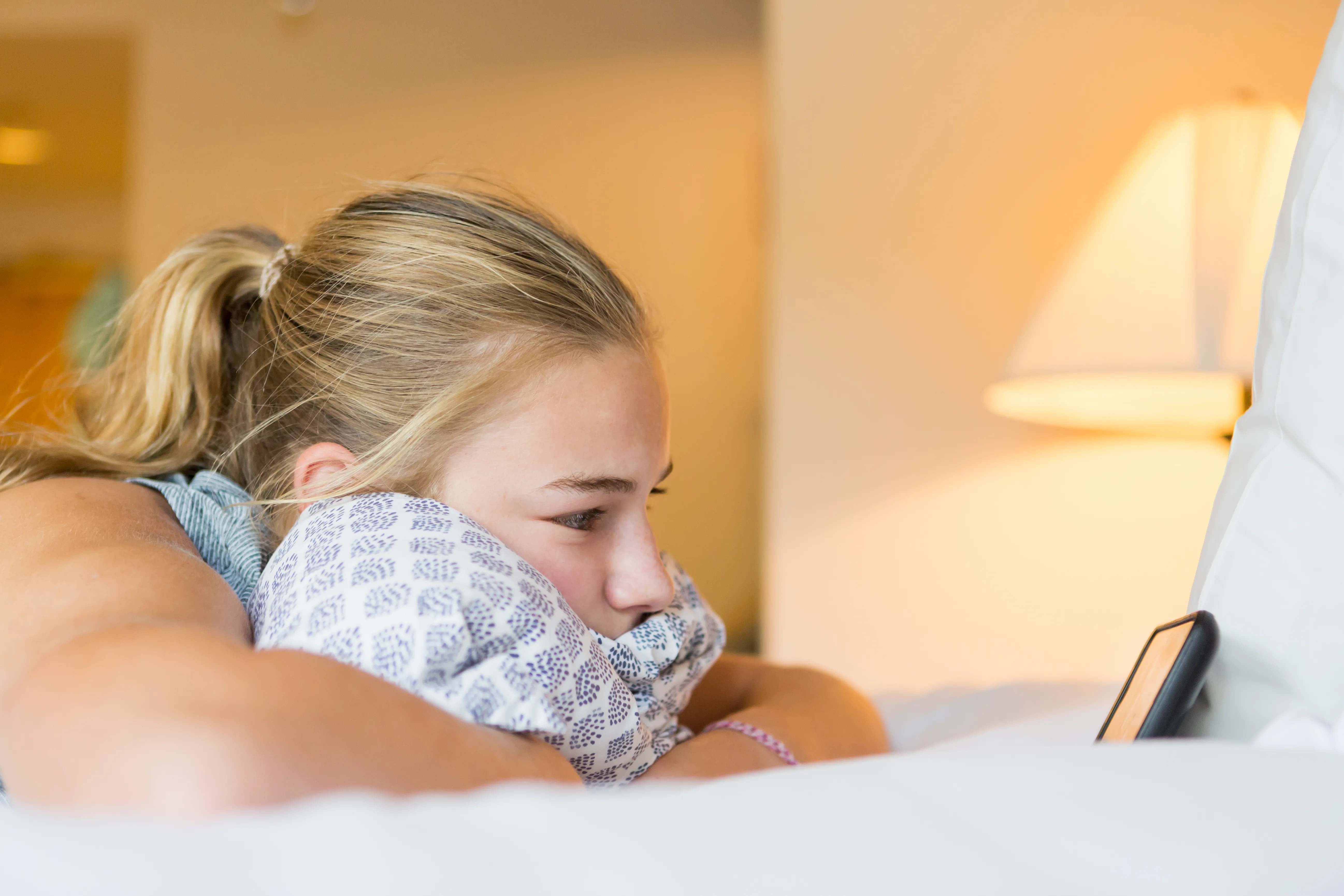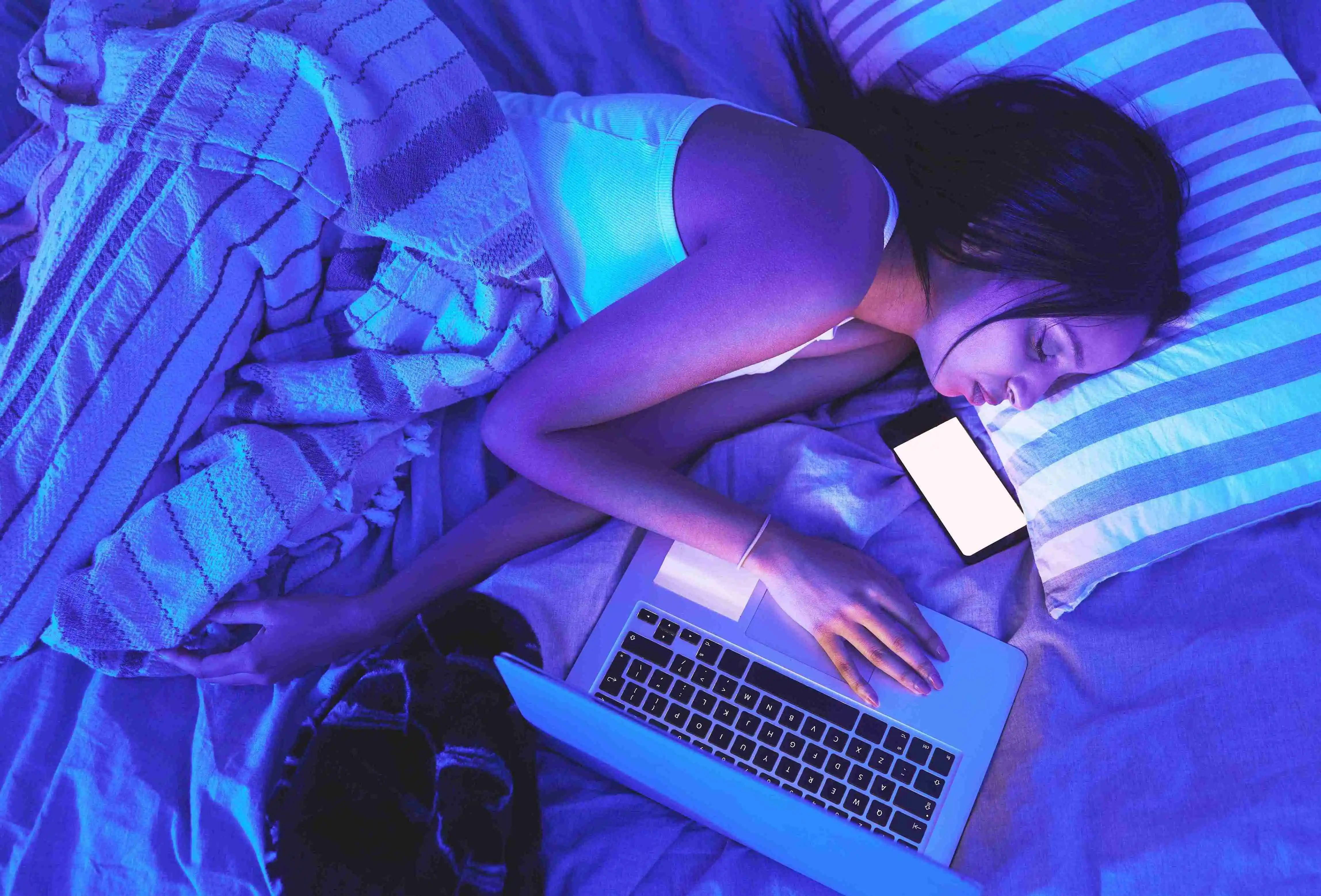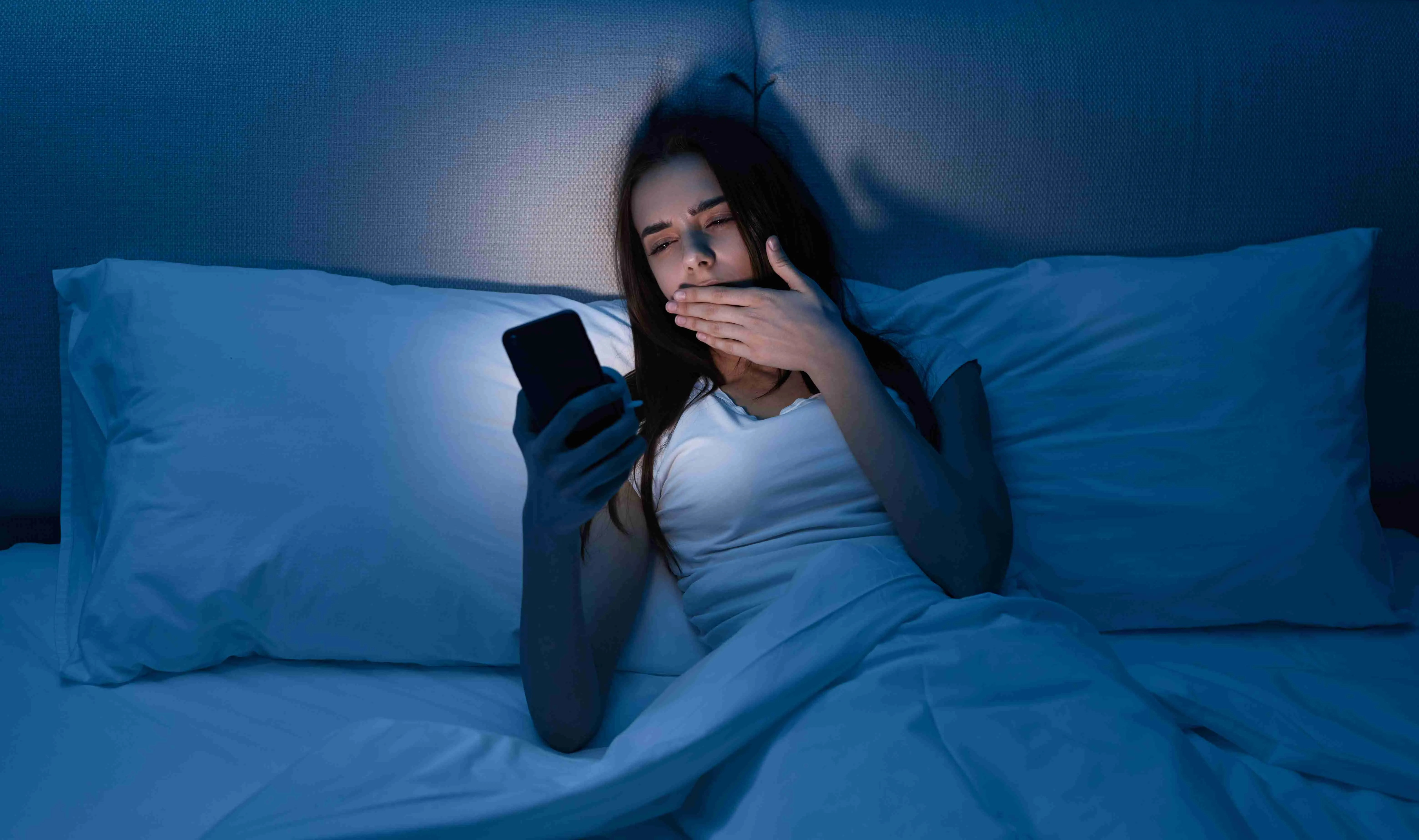

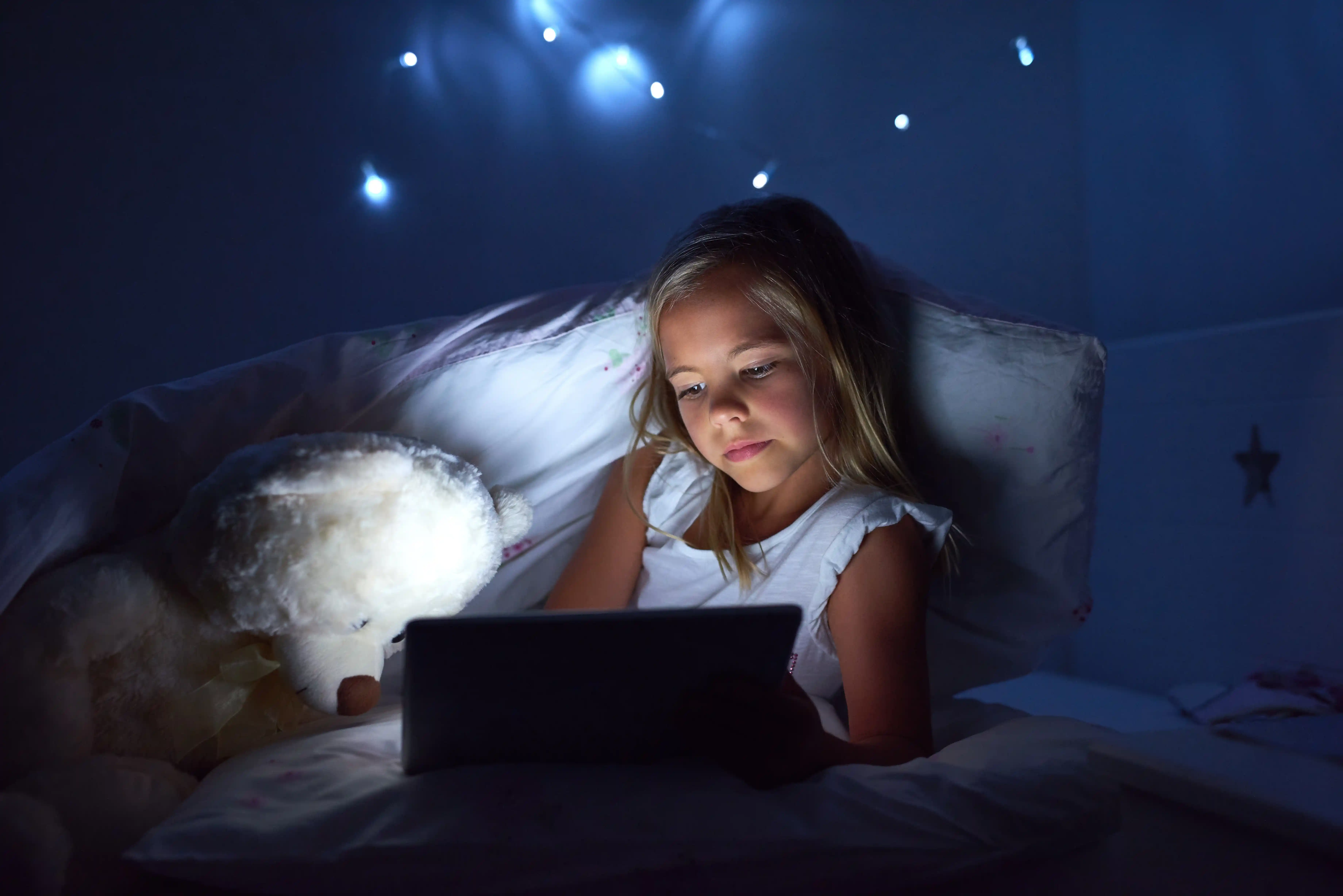
Blue light can affect a child’s sleep, but the familiar warning that screens simply “trick the brain into thinking it is daytime” leaves out most of the useful story.
Light reaching the eyes in the evening can reduce melatonin and influence circadian timing. Short wavelengths, which include blue light, can contribute strongly to that signal. Yet a screen also has a brightness, a duration, a distance from the eyes, and a time of use. What a child is doing on it matters too. A quiet video with a caregiver, an urgent group chat, homework, and a competitive game are not equivalent bedtime experiences.
Current research supports protecting children’s sleep from bright or prolonged evening light and from screen use that pushes bedtime later. It does not support blaming every sleep problem, night waking, or long-term health concern on blue light alone 1 2.
Blue light is one part of the evening light signal
Blue light is a range within visible light, not a special form of radiation created by phones. Daylight contains far more light than a typical screen and includes blue wavelengths. That daytime signal is useful because light and darkness help synchronize the body’s roughly 24-hour rhythm 3.
In the evening, the same light-sensitive system is preparing for darkness. Light reaching the retina can reduce or delay melatonin secretion 4 5. Melatonin is one signal of biological night, but it is not a sedative switch. Suppressing it does not prove that a child will develop insomnia, lose a particular sleep stage, or wake repeatedly.
The biological response depends on more than the color of the light:
- Timing: Light close to a child’s biological night may matter more than the same exposure earlier in the day.
- Brightness at the eyes: Screen settings, room lighting, viewing distance, screen size, and the image on display all affect the light that reaches the eyes.
- Duration: A brief task and hours of use are different exposures.
- Spectrum: A warmer display can reduce some short-wavelength light, but it still produces light.
- The child: Age, usual schedule, individual light sensitivity, and existing sleep problems can change the response.
This is why there is no universal number of “safe blue-light minutes” for children.
What controlled pediatric light studies show
Controlled light experiments can isolate part of the biological mechanism. They are more informative about melatonin than about what happens during ordinary family screen use.
Preschool-age children
In a controlled study of 36 healthy children ages 3 to 4, researchers exposed each child to one of several levels of whole-room light during the hour before usual bedtime. Melatonin fell substantially across the tested range, including among children assigned to the dimmest levels. The children were selected as healthy good sleepers, and each light level included very few participants, so the findings do not provide a household cutoff or show that a particular tablet causes sleep problems 4.
The practical lesson is broader: for a preschooler, the whole evening lighting environment may matter. Turning a tablet orange while leaving the room brightly lit does not remove the light signal.
School-age children
A small laboratory study compared primary-school children with adults under dim light and moderately bright room light. The children showed greater melatonin suppression under the brighter condition. Some participants could not be included in the suppression calculation because their melatonin had not yet risen, so the percentages should not be treated as a precise estimate for all children 6.
This study supports age sensitivity to evening light under its experimental conditions. It did not compare phones with televisions, measure a normal school night, or prove that every child is more affected than every adult.
Adolescents
A controlled study of 12 adolescents and 12 adults tested four hours of evening light with warmer and cooler spectra. Both spectrum and exposure duration affected melatonin suppression, and the adolescent response differed from the adult response under some conditions 5.
Again, this was a small light experiment, not a trial of social media, gaming, or homework. It shows why wavelength and duration deserve attention. It does not show that blue light is the only reason a teenager stays awake.
What screen-use studies show
Screen research asks a different question. Most studies observe how children already use devices, then compare that use with sleep. Such studies repeatedly find links between more bedtime media use and later, shorter, or poorer sleep, but they cannot always separate cause from context. A child may stay awake because of a device, reach for a device because sleep is difficult, or experience both in a feedback loop 1.
A 2026 systematic review examined daily within-person studies, which compare a young person with their own usual pattern rather than comparing high-use and low-use people. Across 25 studies, more screen use on a given day had a small association with later sleep onset. It was not significantly associated with total sleep time, sleep efficiency, time awake after sleep onset, or subjective sleep quality. The review included ages 3 to 25, so its pooled result should not be read as an age-specific effect for every child 2.
One detailed study recorded screen use and sleep across 323 nights in 79 young people ages 11 to 14. Screen use during the two hours before bed was not associated with most sleep measures. Use after getting into bed was more important, especially interactive use and multitasking, and was associated with later sleep and less total sleep. This was an observational study, so it could not isolate the effect of blue light or prove that the activity caused the sleep change 7.
A randomized pilot trial provides a different kind of evidence for toddlers. Researchers assigned 105 families with children ages 16 to 30 months to remove screens during the hour before bed, use matched non-screen activities without a screen-removal instruction, or continue as usual. The screen-removal program was feasible and showed preliminary small to moderate improvements in some objectively measured sleep outcomes, but not all comparisons were conclusive. The trial tested a seven-week behavior change, not a blue-light filter 8.
Together, these studies support a more useful conclusion than “all screens are bad.” Timing, in-bed use, and the kind of activity may matter, while the average effect of one day’s extra screen time can be modest.
Why content and interaction matter
A screen can delay sleep without producing a large circadian light effect.
- Time displacement: Watching, scrolling, or gaming can simply continue past the planned bedtime.
- Interaction: Messaging, gaming, and switching among apps require decisions and invite another response.
- Emotional arousal: Conflict, frightening content, exciting competition, or upsetting news may make settling harder.
- Engagement design: Autoplay, endless feeds, rewards, and algorithmic recommendations make stopping less natural.
- Notifications: A sound, vibration, or illuminated lock screen can restart attention after the child has settled.
- Bedroom access: A portable device can remain available after caregivers think screen use has ended.
Current American Academy of Pediatrics guidance therefore emphasizes quality, context, and family conversation, not only a daily minute limit. It recommends making room for sleep, using screen-free times or zones where helpful, turning off autoplay and notifications, and including caregivers in the plan 9 10.
Phones and tablets are often associated with worse sleep than television in observational research, but proximity to the face is only one possible explanation. Portability, private bedroom use, messaging, gaming, and difficulty disengaging can also differ. A television is not automatically harmless, and a handheld device is not automatically more disruptive on every occasion 1.
Match the plan to the child’s age
Toddlers and preschoolers
Young children depend on caregivers to shape the environment. Keep the last part of the evening predictable and low conflict. If a screen is part of the current routine, replace it with a specific activity such as reading together, quiet play, a bath, or familiar audio. Simply removing a device without a workable substitute may turn bedtime into a struggle.
Dim bright overhead lighting as bedtime approaches. Do not rely on the device’s night mode while the rest of the room stays bright. If a screen is needed for communication, accessibility, or calming during a difficult period, keep it brief, reduce brightness to a comfortable level, and choose slow, familiar content rather than an endless feed.
School-age children
Schoolwork, reading, and social activities may require a device. Separate required use from open-ended use. Finish the most interactive work earlier when possible, mute nonessential notifications, and move optional videos or games out of the sleep space.
Invite the child to help choose the boundary. A charging spot outside the bedroom may work for one family. Another may need the device nearby for diabetes technology, hearing access, communication, or another health need. In that case, use scheduled focus settings, allow only necessary contacts, and keep the screen face down or out of reach.
Adolescents
Teenagers often have a naturally later circadian preference while school still demands an early wake time. Social connection, homework, jobs, sports, and household responsibilities can also compress the night. A rule that focuses only on blue light may miss the main problem.
Agree on a protected sleep window first. Then identify which late activity is taking it away. A teen may benefit more from silencing a group chat, moving gaming earlier, or keeping the phone off the bed than from wearing tinted glasses while continuing to scroll.
Use collaboration rather than surprise confiscation when safety allows. Decide which contacts must remain available, how an alarm will work, and what changes on weekends. Caregivers should follow the shared rule where practical.
Protect sleep opportunity before perfecting screen settings
A screen strategy cannot compensate for a schedule that leaves too little time for sleep. The American Academy of Sleep Medicine recommends the following total sleep in 24 hours, including naps for the younger groups 11:
- ages 1 to 2: 11 to 14 hours
- ages 3 to 5: 10 to 13 hours
- ages 6 to 12: 9 to 12 hours
- ages 13 to 18: 8 to 10 hours
Infants need separate safe-sleep and age-specific guidance. Individual needs also vary within these ranges. Work backward from the required wake time and allow for the child’s usual settling time. If the planned sleep window is already too short, changing the screen color will not fix the shortage.
A realistic family plan
1. Set the sleep window
Choose a reasonably consistent wake time and a bedtime that creates enough sleep opportunity. Protect the final part of that window from activities that commonly run over.
2. Build a clear day-night contrast
Encourage outdoor light and activity during the morning or daytime when practical. As bedtime approaches, reduce unnecessary overhead brightness and use the lowest comfortable lighting for routine tasks. Bright morning light and a darker sleep environment support the light-dark cues involved in sleep timing 3.
3. Target the most disruptive use
Start with the activity most likely to delay sleep: gaming that is hard to stop, social messaging, short-form video, upsetting content, or homework that regularly extends into bed. The goal is not to declare every pixel equally harmful.
4. Remove prompts to continue
Turn off nonessential notifications, autoplay, and app reminders. Schedule focus or do-not-disturb settings. If the device remains in the room for a legitimate reason, restrict which alerts can break through 10.
5. Give devices a night location
A shared charging station outside bedrooms is simple when it suits the household. If it does not, choose a shelf, desk, or drawer away from the bed. Keep the sleep surface for sleep rather than homework, gaming, or scrolling.
6. Plan for schoolwork and accessibility
Do not remove an assistive tool, medical connection, translation aid, or required school resource to satisfy a generic rule. Instead, keep the necessary function and reduce optional light and engagement around it. Options include lower brightness, a warmer display, a larger screen farther away, printed material when available, notification controls, and a clear stopping point.
7. Model the boundary
Children notice when adults answer messages through bedtime. A shared family wind-down is often easier to sustain than a child-only restriction. The AAP specifically encourages caregivers to model putting phones down and to make media rules a family plan 9.
8. Test one change
If the main problem is unclear, change one variable for one or two weeks. For example, stop in-bed use, mute notifications, move gaming earlier, or dim the room. Track lights-out time, estimated sleep onset, wake time, night waking, and daytime alertness.
This is a practical household experiment, not a diagnostic test. It can show whether a change is useful without demanding instant perfection or changing five things at once.
Do night mode, filters, or blue-light glasses work?
A warmer night-mode setting can reduce the short-wavelength contribution from a display. Dimming the screen can reduce total light. These are reasonable secondary controls when evening use is necessary.
They do not remove the other pathways that affect sleep. The child can still stay online too long, react to emotional content, receive alerts, multitask, or use the device after bedtime. A warm screen at high brightness can also continue to deliver a meaningful light signal.
Blue-light filtering glasses are not an established pediatric insomnia treatment. A Cochrane review of 17 randomized trials in adults found uncertain effects on sleep and no high-certainty evidence across its outcomes. Those adult findings cannot establish effectiveness for children 12.
Use night mode if it makes the screen more comfortable or supports a dimmer routine, but do not let it become permission for unlimited bedtime use. Do not buy nonprescription tinted glasses for a child as a substitute for evaluating persistent sleep trouble.
Screen light is not known to damage children’s eyes
Sleep timing and eye injury are different questions. Normal screen use has not been shown to damage children’s eyes through blue light. The AAP notes that blue-light filtering glasses are not required for eye protection 13.
Long periods of close work can still contribute to dry, tired, or uncomfortable eyes, and spending too little time outdoors is relevant to childhood myopia risk. Comfortable brightness, regular distance breaks, blinking, an appropriate viewing setup, outdoor time, routine vision screening, and assessment of persistent visual symptoms are more useful than eye-damage warnings 13.
When a sleep problem needs medical care
Arrange a pediatric visit when trouble falling asleep or staying asleep persists despite a workable routine, or when it regularly affects attendance, learning, mood, behavior, or daytime alertness. Bring a one to two-week sleep and screen log if possible. It can help the clinician distinguish too little sleep opportunity from insomnia, a delayed body clock, anxiety, medicine effects, or another sleep disorder.
Tell the pediatrician about frequent snoring, gasping, labored breathing, or witnessed breathing pauses. These can point to pediatric sleep apnea rather than a screen problem. Marked daytime sleepiness and attention or behavior changes can also occur 14.
Seek urgent help if a child has prolonged breathing pauses, blue or gray skin color, or is unusually difficult to wake. A dangerously sleepy teen should not drive, bike in traffic, operate equipment, or do another safety-sensitive task until alert.
The useful question is not whether blue light is good or bad. It is which part of the evening is delaying this child’s sleep, and what realistic change protects enough rest without removing something the child genuinely needs.