
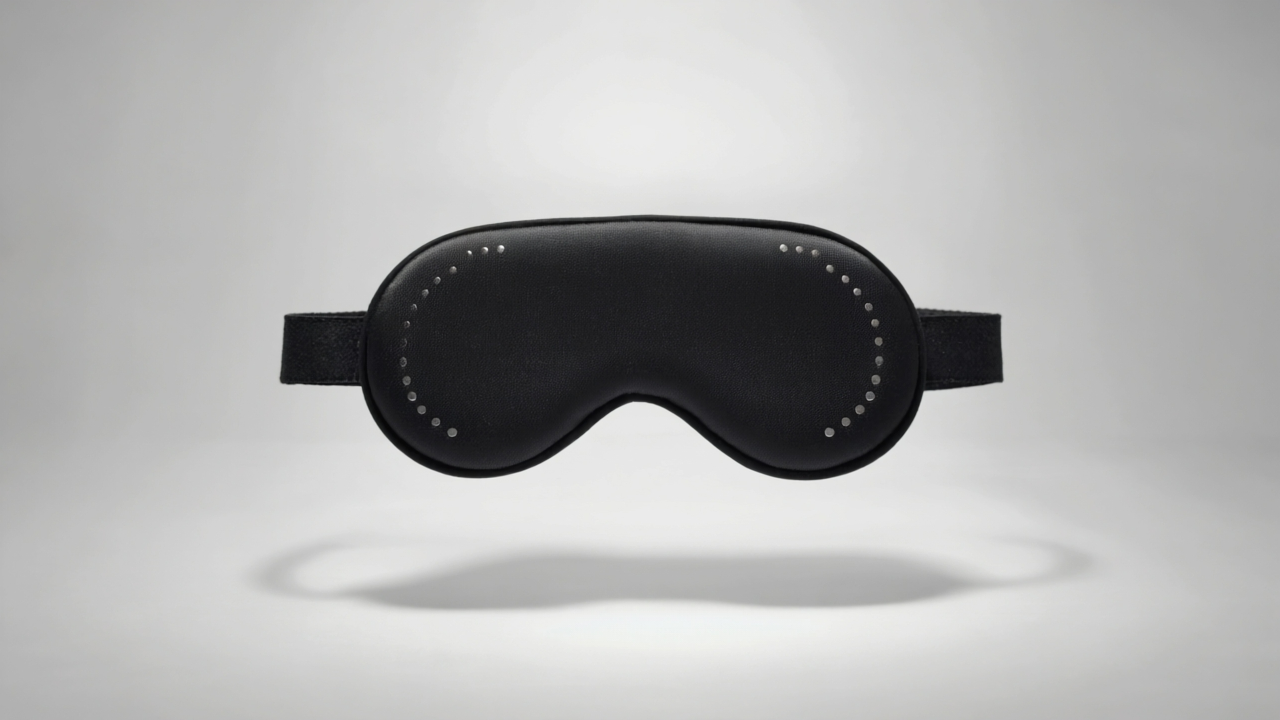
Lucid dream masks may help some people notice that they are dreaming, but they are not a reliable switch for lucid dreams. Laboratory and home studies show that light or sound cues can sometimes enter a dream and support lucidity when the cue is paired with training 12. Evidence for retail masks themselves is much thinner 3. A result obtained with one research device or smartphone protocol does not establish that another mask detects REM sleep accurately or improves lucid dreaming.
A lucid dream is a dream in which you become aware that you are dreaming while the dream continues. Dream control is separate. You may know you are dreaming yet be unable to change the setting, characters, or events. Systematic reviews use awareness as the defining feature and describe control as something that may accompany it, not something required for the dream to count as lucid 45.
What a lucid dream mask is trying to do
A cue-based device usually has two jobs:
- Choose when to give a cue. A simple mask may present cues on a timer. A more complex mask or headband may claim to estimate REM sleep from eye movement, movement, heart rate, or EEG signals.
- Deliver a cue without fully waking you. Depending on the product, the cue may be flashing light through closed eyelids, sound, vibration, or a combination.
The intended sequence is that the cue reaches the sleeper, appears in the dream, and reminds the dreamer to ask, "Am I dreaming?" That sequence can fail at several points. The device can give a cue at the wrong time. The cue can go unnoticed, enter the dream without prompting awareness, or wake the sleeper. A person can also become lucid spontaneously and credit the device afterward.
Four different outcomes that should not be confused
Product pages and customer reviews often use "worked" without defining what happened. Evidence is easier to interpret when the outcome is separated into four levels:
- Cue delivery or detection: The mask reports that it found REM sleep and presented a cue. This tests the device or its algorithm, not lucid dreaming.
- Dream incorporation: The sleeper later recalls the light, sound, or vibration appearing in the dream. Incorporation shows that some sensory information reached the dream, but the person may never have realized they were dreaming.
- Self-reported lucidity: After waking, the person reports awareness of dreaming during the dream. This is the usual outcome in home studies.
- Signal-verified lucidity: In a sleep laboratory, a participant makes a prearranged left-right eye-movement signal after becoming lucid. Researchers confirm that the signal occurred during polysomnography-recorded REM sleep. This is a stronger outcome than recall alone 6.
An app badge, a REM graph, or a customer testimonial is not signal verification. Even a sincere report cannot show whether a mask's REM algorithm was accurate unless the exact device was compared with an appropriate reference.
What the mask research actually found
The classic DreamLight study was small and product-specific
A 1995 home study tested the DreamLight, an early light-cue mask, in 14 volunteers who already had lucid-dream experience and strong interest in the subject. Each person first adjusted the device until cues had appeared in at least two dreams, then used it for 4 to 24 nights while cue-enabled and cue-disabled conditions alternated without their knowledge.
Eleven participants reported 32 lucid dreams. Twenty-two occurred on cue-enabled nights and 10 on cue-disabled nights. Reports of light appearing in dreams were also much more common when cues were enabled 1. This supports the idea that calibrated light cues can help some selected users. It does not show that most beginners will respond, that the device identified every REM period correctly, or that a current product will reproduce the result. The lucid dreams were reported at home rather than confirmed by polysomnography and eye signals.
A 2019 review examined 10 portable lucid-dream devices and found that DreamLight was the only one in that group with published empirical testing at the time. The authors also found limited access to REM-detection algorithms and concluded that better controlled, device-specific validation was needed 3. Products have changed since that review, so it cannot be used as a current shopping list. Its central lesson still applies: evaluate evidence for the exact model and software version, not for the general idea of a "smart" sleep mask.
Newer cue research is promising, but it was not a retail mask test
A 2024 study tested targeted lucidity reactivation at home. Participants completed pre-sleep training that paired a sound with a lucid mindset, then an Android phone replayed the sound later in the night. Nineteen people completed the first experiment. A second experiment used blinded cue conditions and included 112 participants in its first two-night comparison. On the second night, the trained-cue group had higher odds of a lucid dream than the two control groups combined. Comparisons with each control group separately did not establish a clear difference 2.
This result matters because it suggests that a cue's learned meaning, not just the noise or awakening it creates, can support lucidity. It was still a smartphone sound protocol, not proof that a retail mask works. The phone used movement as a sign of possible sleep disruption; it did not identify REM sleep. Lucidity was reported after awakening rather than verified with laboratory eye signals, and many people did not complete the full week.
Stronger verification has come from combined laboratory protocols
In a 2020 laboratory study, 20 people without lucid-dream experience were awakened from REM sleep after about six hours, completed a series of cognitive tasks, and returned to bed. Ten reported a lucid dream on one of the study nights, and eight produced the prearranged eye signal during REM sleep 6.
That is useful evidence that carefully timed, combined induction methods can produce verified lucidity in some novices. It is not a mask trial. The protocol included polysomnography, a researcher-controlled awakening, cognitive training, and up to two laboratory nights. A retail device cannot inherit that success rate by using a sensor or cue that sounds similar.
The practical conclusion
Sensory cueing is plausible and has produced positive results in specific protocols. Current consumer masks should still be treated as experiments with uncertain personal benefit. There is no evidence-based number of nights by which a mask should work, and research has not established that regular use "trains the brain" to respond. Customer reviews may reveal comfort, app, battery, and return problems, but they cannot establish efficacy.
Do REM sensors make a mask more effective?
Not automatically. Infrared eye sensors, accelerometers, heart-rate sensors, and wearable EEG electrodes measure different signals. The presence of a sensor says nothing about the accuracy of the algorithm that turns those signals into a REM label.
The American Academy of Sleep Medicine has cautioned that consumer sleep technologies should not be used to diagnose or treat sleep disorders without appropriate validation and clinical evaluation 7. For a lucid-dream mask, the relevant questions are narrower but similar:
- Was the exact model tested against simultaneously recorded polysomnography?
- Was performance reported for REM detection itself, not only total sleep time?
- Were the participants similar to the people expected to use it?
- Was the current algorithm tested, or an older version?
- Did the study measure cue delivery, dream incorporation, self-reported lucidity, or signal-verified lucidity?
- Was there a sham or cue-disabled condition that accounted for expectation and spontaneous lucid dreams?
A companion app is not a sleep study. Its graph can help you compare the app with itself over time, but it cannot confirm REM accuracy, diagnose a sleep disorder, or prove that an uncued lucid dream was caused by the product.
How to evaluate a mask before buying
Start by identifying what the product actually does. A timed light mask, an app-controlled audio device, and an EEG headband are not interchangeable.
Check the evidence claim. Look for a peer-reviewed study naming the exact device and software. Read what outcome was measured and whether there was a control condition. Phrases such as "science-backed," "uses EEG," or "based on REM research" are not product validation.
Check whether cueing can be adjusted. Useful controls include cue type, intensity, duration, delay, and a way to disable individual channels. A device that repeatedly wakes you but offers no meaningful adjustment is unlikely to be a good sleep tool.
Check the ordinary product details. Confirm the return window after opening, warranty, replacement parts, battery and charging instructions, cleaning method, materials touching the face, heat management, strap fit, and whether the device remains functional without an active subscription.
Review privacy before pairing an app. Find out what sleep, microphone, account, or health data are collected; whether raw data can be exported; how long records are retained; whether data are shared; and how to delete the account and stored data.
Protect equipment you already need. If you use CPAP or another prescribed sleep device, make sure the mask and straps do not lift the cushion, obstruct tubing, cover vents, or make you remove treatment. Ask the therapy-device manufacturer or clinician about compatibility when the fit is uncertain.
A low-disruption way to test one
A home trial cannot prove efficacy, but it can show whether the product is tolerable and whether your experience changes.
- Establish a simple baseline. For several nights, record bedtime, wake time, recalled dreams, spontaneous lucid dreams, awakenings, and next-day alertness without the device. Keep the record brief enough to sustain.
- Protect a full sleep opportunity. Do not test cueing on a short night, before a long drive, during an illness, or when alertness is safety-critical the next day.
- Use the device exactly as intended. Learn the cue while awake. If the method includes pre-sleep conditioning, pair the cue with a concrete intention such as recognizing that you are dreaming, rather than assuming any flash or tone automatically creates lucidity.
- Change one setting at a time. A few nights at one setting are easier to interpret than changing brightness, sound, timing, and vibration together.
- Find the weakest useful cue. The goal is the lowest setting that can sometimes be noticed or incorporated in a dream without repeated awakenings. If a cue only wakes you, reduce it or stop. Do not keep escalating indefinitely in pursuit of a response.
- Record the correct outcome. Note whether the cue appeared in the dream, whether you became aware you were dreaming, whether you had any control, and whether the night felt more fragmented. Do not count the app's REM label as a lucid dream.
- Stop when sleep or daytime function worsens. More awakenings, reduced total sleep, persistent eye or skin irritation, headache, anxiety, poorer concentration, or sleepiness are reasons to pause rather than push through.
Mask-free methods have evidence too
Mnemonic induction of lucid dreams
Mnemonic induction of lucid dreams, or MILD, involves recalling a recent dream, identifying something that could reveal it as a dream, imagining becoming lucid at that point, and setting an intention to recognize the next dream. A 2023 systematic review of 19 studies and 14 induction techniques judged MILD the most effective method in the evidence it reviewed, although no technique guarantees a lucid dream 4.
Reality testing
Reality testing means regularly checking whether the present experience is a dream, often while reflecting on how you arrived in the situation. It may be included in a broader protocol, but daily checks alone are not well established as an effective induction method. In a 2025 four-week diary study of 81 people, neither reality testing nor autosuggestion significantly increased lucid-dream frequency; prior lucid-dream frequency was the strongest predictor of having one during the study 8.
Wake-back-to-bed
Wake-back-to-bed, or WBTB, intentionally interrupts sleep and is commonly combined with MILD or another cognitive method. The signal-verified laboratory result described above used an awakening after about six hours plus cognitive tasks, not a single alarm formula for home use 6. If you try WBTB, reserve it for a night with enough remaining sleep opportunity and no next-day driving or safety-sensitive work. Stop if it leaves you short on sleep.
Safety and reasons to be cautious
Lucid dream masks have not been studied well enough to call every cue pattern, device, population, or nightly schedule safe. The most immediate concerns are sleep disruption, sensory triggers, poor fit, and interference with other needs.
- Flashing light: Flashing or flickering light can trigger seizures in some people with photosensitive epilepsy, and risk depends partly on the stimulus pattern and the individual 9. If you have photosensitive epilepsy, have had a seizure triggered by light, or have been told to avoid flashing stimuli, do not experiment with a light-cue mask unless your neurologist has reviewed the exact device and cue.
- Migraine and light sensitivity: Light sensitivity is common with migraine, and bright or flickering light can aggravate symptoms for some people 10. Choose a non-light method or stop if cueing provokes a headache, visual symptoms, nausea, or persistent discomfort.
- Sound and vibration: Keep sound low enough to avoid pain or ringing, and do not use a setup that prevents you from hearing a smoke alarm, medical alarm, child, caregiver, or other safety signal. Stop if vibration causes numbness, pain, or repeated awakenings.
- Eyes, skin, heat, and batteries: Stop for eye pain, visual changes after the device is removed, rash, swelling, pressure injury, unusual heat, odor, swelling battery, or damaged charging hardware. Follow the manufacturer's cleaning and charging instructions.
- Nightmares, trauma, and PTSD: A lucid-dream mask is not a treatment for nightmare disorder or PTSD. The American Academy of Sleep Medicine recommends imagery rehearsal therapy for nightmare disorder and PTSD-associated nightmares, while placing lucid-dream therapy among options that may be used in selected adults 11. Frequent or trauma-related nightmares deserve assessment and evidence-based care rather than unsupervised cue escalation.
- Bipolar disorder, psychosis, or dissociation: Research does not establish that consumer masks worsen these conditions, but sleep disruption and repeated reality-testing exercises can be poor experiments during unstable symptoms. Decreased need for sleep can be a feature of mania 12. Discuss lucid-dream induction with your mental health clinician first, and stop for unusual energy with less sleep, worsening hallucinations or paranoia, confusion between dreams and waking events, or increased derealization.
- Children and pregnancy: The central trials discussed here studied adults and do not establish a benefit for children or a pregnancy-specific safety routine. A parent, pregnant person, or anyone with a high-risk pregnancy should ask the relevant clinician before using a device that flashes, vibrates, plays sound, heats, or interrupts sleep.
- Sleep disorders and treatment: A mask does not screen for sleep apnea, parasomnias, seizures, or other sleep disorders. Do not delay evaluation for loud snoring with breathing pauses, dangerous dream enactment, unexplained injuries, seizure-like events, or severe daytime sleepiness. Do not reduce or remove prescribed sleep treatment to make room for the mask.
If the device or an accompanying WBTB routine makes you sleepy the next day, do not drive or perform safety-critical work. Adequate sleep is the main protection against drowsy driving, and a short-term alertness trick does not replace it 13.
Frequently asked questions
Do lucid dream masks work for beginners?
There is no good evidence that masks are especially effective for beginners. The classic mask study recruited people with prior lucid-dream experience and calibrated cues for each person 1. A novice may benefit from a combined cognitive protocol, but a current retail mask needs its own evidence.
How long should a lucid dream mask take to work?
There is no validated timeline. A promise that results should appear within days or weeks is not supported by the mask literature. Judge a trial by cue incorporation, self-reported lucidity, sleep continuity, and next-day function, then stop if there is no useful signal or the cost to sleep is too high.
Is a lucid dream mask safe to use every night?
Nightly use has not been established as a universal safe schedule. Device materials, cue pattern, intensity, battery design, sleep disruption, medical history, and other sleep equipment all matter. Follow product instructions, start conservatively, and let sleep quality and daytime alertness set the boundary.
Can a mask treat recurring nightmares?
No consumer lucid-dream mask is an established treatment for recurring nightmares, nightmare disorder, or PTSD. A clinician can help distinguish occasional bad dreams from a condition that merits treatment and discuss options such as imagery rehearsal therapy 11.