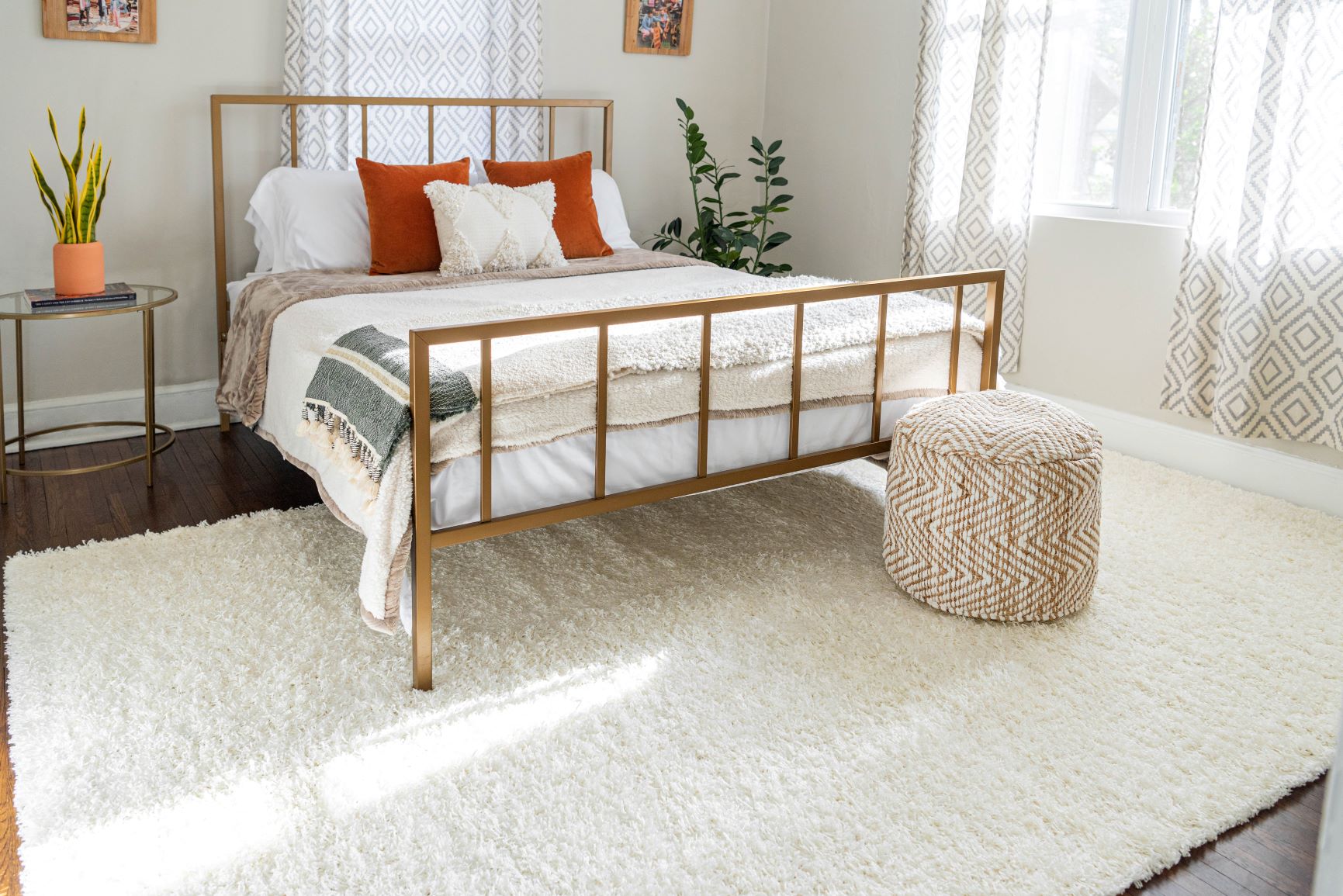

A platform bed is a bed frame with a built-in surface intended to support a mattress, an approved foundation, or an adjustable base. That surface may be a solid deck, closely spaced slats, a metal grid, or a model-specific combination of rails and panels.
The name alone does not prove that a frame can support every mattress directly. The mattress manufacturer's base requirements and the frame's instructions control the setup. Check both before buying or removing an existing foundation.
What makes a frame a platform bed?
A platform frame distributes the bed's load through a support surface and into its side rails, center structure, legs, or plinth. A conventional open frame may instead have only a perimeter and a few crossbars intended to hold a separate foundation. Product listings sometimes use the terms loosely, so inspect the support structure rather than relying on the title.
Four details determine what the frame can support:
- Support geometry: whether the surface is solid, slatted, or a grid, including the clear gaps between supports.
- Load path: how the surface connects to the side rails, center rail, legs, plinth, and floor.
- Approved configuration: whether the maker permits a mattress, foundation, or adjustable base on that structure.
- Specified load: what the capacity includes, which size it applies to, and how it was tested.
A headboard, upholstery, drawers, or a low profile can change the appearance and function, but none of them establishes mattress compatibility.
Platform support surfaces and designs
| Type | What to inspect | Common fit questions |
|---|---|---|
| Solid deck | Panel joints, fasteners, center support, and whether the surface is approved for the mattress | Does the mattress maker permit a closed deck, and how should moisture be managed? |
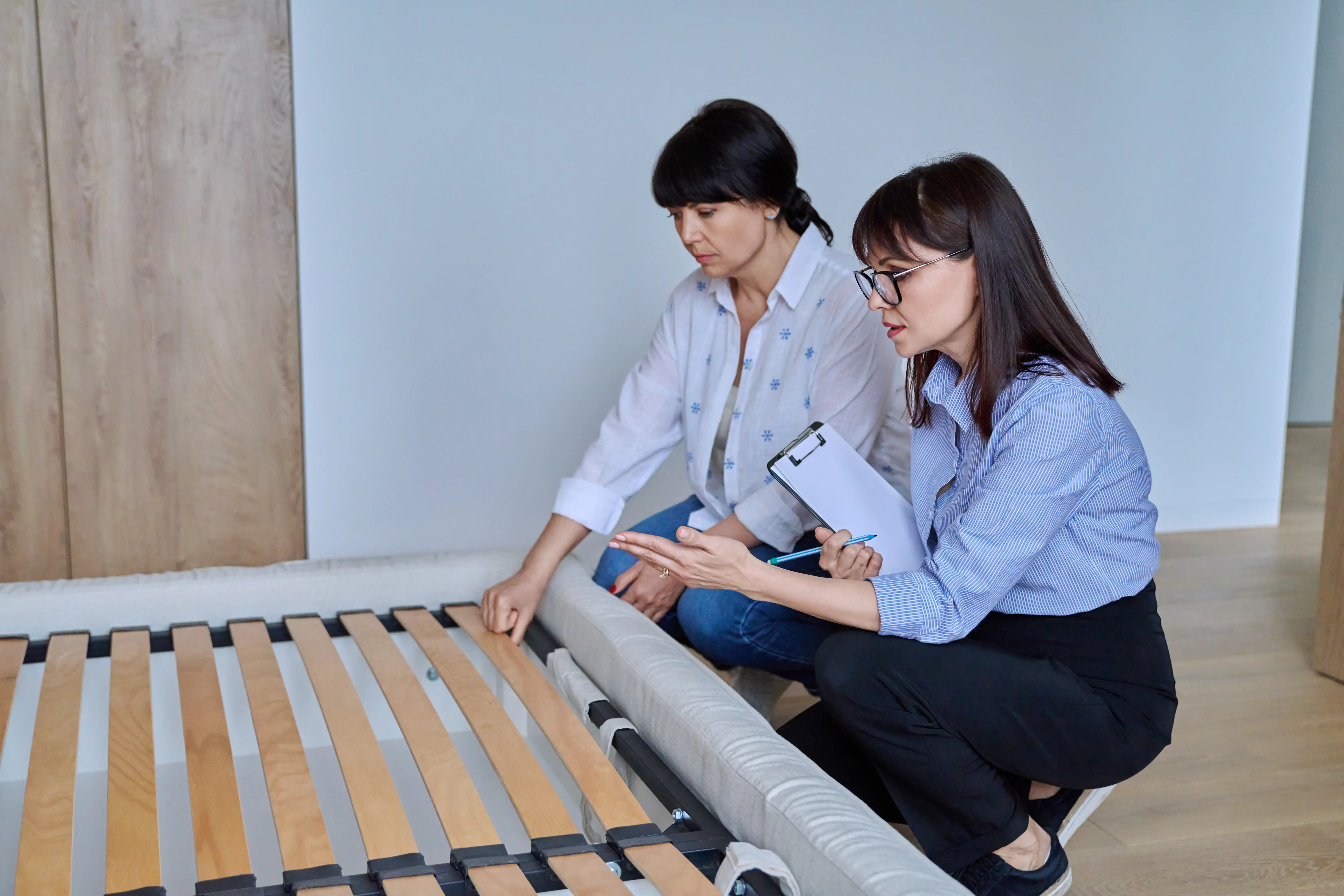
| Wood slats | Slat width, clear spacing, attachment, flex, center rail, and center legs | Do the slats meet the mattress warranty, and can they shift or bow? |
| Metal slats or grid | Bar spacing, cross rails, welds, rounded contact points, center support, and retainers | Does the mattress or foundation maker approve this support shape? |
| Upholstered platform | The wood or metal structure hidden beneath the fabric, not just the finish | Can the support parts be inspected and tightened after assembly? |
| Drawer storage | Drawer travel, floor clearance, rail location, drawer load, and access to fasteners | Will drawers open fully without blocking a walkway or nightstand? |
| Lift-up storage | Lift hardware, stops, mattress limits, pinch points, and interior load rules | Can the deck be raised and lowered safely with the intended mattress? |
| Floating style | Whether the bed uses a recessed floor plinth, hidden legs, or actual wall attachment | What carries the load, and does the model require anchoring? |
Wood, metal, and upholstery are finish or construction categories, not quality rankings. A well-specified frame in any of them can be suitable for its intended setup. Compare joint design, support layout, hardware access, instructions, warranty, and replacement-part availability rather than treating one material as universally stronger, quieter, or longer lasting.
Match the platform to the mattress
Start with the mattress maker's current support and warranty instructions. Look for:
- the permitted support types
- minimum slat width and maximum clear spacing
- center-rail and center-leg requirements by mattress size
- whether a box spring, rigid foundation, bunkie board, solid deck, or plywood panel is allowed
- whether placing the mattress on the floor is excluded
- inspection, proof-of-purchase, and warranty conditions
These numbers are model-specific. Tempur-Pedic currently permits a structurally sound slatted frame when the slats are at least 3 inches wide and no more than 4 inches apart. Its guidance rejects traditional box springs and bunkie boards and warns that plywood or floor placement can trap moisture and affect warranty coverage 1.
Purple's current mattress warranty uses a different rule: slats without an additional foundation must be no more than 3.5 inches apart, and larger sizes require suitable center support 2. Neither manufacturer's rule should be transferred to a mattress from another brand.
How to measure slats
Measure the clear opening from the inside edge of one slat to the inside edge of the next. Do not measure from center to center. Check several places because spacing can change near the head, foot, or center rail.
Also record each slat's width and thickness, whether it is flat or bowed, and how it is retained. A roll of slats connected by fabric can still need screws or other retainers specified in the frame manual. Do not add, remove, reverse, drill, or reposition slats unless both the frame and mattress instructions allow the change.
Center support and total load
A center rail is useful only when its connections and legs are installed as directed and the legs contact a suitable floor. Some sizes use a different support layout, so inspect the instructions for the exact size instead of copying the twin or full configuration.
When comparing capacity, determine:
- whether the number is a tested load, recommended limit, or marketing statement
- whether it applies to one size or every size
- whether it is static, dynamic, evenly distributed, or concentrated
- whether it includes the mattress, foundation or adjustable base, bedding, sleepers, and pets
- whether drawers, shelves, or a headboard have separate limits
Purple, for example, says the queen size of its Metal Platform was tested to support up to 2,000 pounds. That product uses 16 slats and two center rails 3. This is a bounded specification for that frame and test context, not a default capacity for metal platforms.
Storage components can have much lower limits than the sleep surface. IKEA lists a 44-pound maximum load for each drawer on its queen BRIMNES storage bed 4. Do not treat a drawer rating as the capacity of the assembled bed or vice versa.
Does a platform bed need a box spring?
A platform bed often replaces a separate foundation because its deck or slats provide the approved support. It does not follow that every platform should be used without one or that a box spring can safely be added for height.
A foundation changes the total load, height, headboard exposure, footboard clearance, and the way the mattress is supported. It may also place weight on parts of the platform that were designed for direct mattress contact. Before adding one, confirm that:
- the mattress maker permits that foundation type
- the frame maker permits the combined configuration
- the foundation fits inside the frame without bridging the lip or rails
- the total load remains within the applicable limit
An innerspring mattress does not automatically require a box spring. Follow the instructions for the exact mattress. As the Tempur-Pedic example shows, some manufacturers specifically reject traditional box springs 1.
Avoid adding a loose plywood sheet as a universal fix for wide slat gaps. A panel can change ventilation, load distribution, height, and warranty compliance. Use only a support change approved by the relevant manufacturers.
Ventilation and moisture
Open slats allow air to move beneath a mattress more freely than a closed panel in the same room. That does not prove the sleeper will feel cooler, and it does not make every slatted base compatible.
Moisture also depends on room humidity, spills, mattress construction, bedding, and how the bed is used. Follow the mattress maker's care instructions, keep the underside accessible for inspection when possible, and address dampness rather than covering it. Tempur-Pedic's warning about plywood and floor placement is one example of a manufacturer linking restricted airflow and trapped moisture to its warranty conditions 1.
Do not drill ventilation holes or cut a deck without written approval. Modifying a structural panel can weaken it and may affect the frame warranty.
Measure the complete bed, not just the mattress
A queen mattress label does not tell you how much room a queen platform uses. Record the assembled frame's outside width and length, then measure:
- the internal opening for the mattress or foundation
- the height from floor to the support deck
- the lip or recess around the mattress
- the top of the mattress after all approved layers are installed
- the lowest under-bed obstruction, including center rails and legs
- drawer travel or the arc of a lift-up deck
- headboard height visible above the mattress
- the route through doors, stairs, elevators, and turns
Bed height is a practical transfer and room-layout decision, not a universal comfort standard. Test whether the completed height works for the intended sleeper without assuming all platforms are low. The Purple Metal Platform, for example, lists 9 inches of under-bed clearance and includes felt pads intended to level the frame and protect the floor 3. Another frame may have a lower crossbar than its side rail or require a different floor-protection method.
For drawers, measure to the fully open position and preserve the walkway required to use them. For lift storage, include ceiling, headboard, wall, light, and nearby furniture clearance.
Using an adjustable base with a platform frame
Adjustable-base compatibility is model-specific. The word platform does not mean that a powered base can sit on top, fit inside, or replace the existing support.
Check:
- whether the adjustable base is approved for zero-clearance use
- whether its legs must contact the floor
- whether the platform's deck, slats, or crossbars must be removed
- the frame's internal dimensions and support lip
- the adjustable base's load and mattress limits
- clearance for the moving sections, wiring, controls, and retaining bars
- whether drawers, lift hardware, or a thick upholstered headboard obstruct movement
Saatva says its current zero-clearance adjustable base can work with some platform frames without its legs. The same guidance excludes Saatva's Sydney solid platform and storage frames, warns that drawer platforms and thick upholstered headboards can interfere, and instructs owners of some open frames to remove the slats or platform so the base legs reach the floor 5. This is why compatibility needs confirmation for the exact base and frame, even within one brand.
Assembly, noise, floors, and moving
Inventory the packages, hardware, and support parts before assembly. Follow the sequence in the manual, use the specified fasteners, and confirm that the frame is square and stable on the intended floor. Do not substitute a similar-looking bolt or leave out a center leg because the frame appears steady without a mattress.
Some manuals call for connections to be checked again during use. IKEA tells owners of the BRIMNES bed to retighten screws and other connectors when necessary, and West Elm gives similar periodic hardware guidance for its Haven storage bed 46.
A new squeak is not proof of one particular defect. With the bed unloaded and safe to inspect, check for loose approved fasteners, a shifted slat, contact between the headboard and wall, an uneven foot, or damage around a joint. Follow the maker's troubleshooting steps and stop using the bed if a structural part is cracked, bent, detached, or unstable.
Use floor pads, glides, or anchors only as specified for the model and floor. Dragging an assembled frame can damage flooring, loosen joints, or load the structure in a direction it was not designed to handle. For a move, follow any disassembly instructions, label the hardware, support large panels during handling, and inspect all connections after reassembly. A storage platform may arrive in several heavy packages even when its assembled dimensions look manageable; the BRIMNES queen, for example, is supplied in three packages 4.
Safety checks for special designs
Lift-up storage and pinch points
A lifting deck stores energy in its hinges, springs, or gas struts. Keep hands, clothing, children, and pets out of the mechanism's path. West Elm's Haven instructions identify pinch points and warn users to keep hands and fingers clear to avoid pinching or crushing 6. Use the stops, mattress range, opening procedure, and service instructions for the exact model.
Children, rails, and entrapment gaps
A low platform or floor bed is not automatically safe for a young child. Openings between rails, spindles, walls, and the mattress can create entrapment or strangulation hazards. A 2023 CPSC recall of children's house and floor beds involved spindle spacing that could allow a child's torso through while trapping the head 7.
Use a product intended for the child's age and follow its mattress-size, rail, wall-clearance, and assembly requirements. Do not add improvised rails or place a mattress in a frame with unexplained gaps.
Bunk and loft beds are a separate category
A tall platform is not a substitute for a compliant bunk or loft bed. Under U.S. federal bunk-bed rules, a bed with the bottom of its mattress foundation more than 30 inches above the floor meets the bunk-bed definition. These products have specific guardrail, mattress-thickness, support, access, and entrapment requirements 8.
Do not raise an ordinary platform on blocks, storage units, or a homemade structure to create a loft. Choose a product designed and labeled for elevated sleeping.
Floating style versus wall or fold-away beds
Many floating platforms sit on a recessed floor plinth or hidden legs. A wall-mounted or fold-away bed is structurally different and depends on the specified wall attachment. Do not infer that a bed is safely supported because its anchors are visually concealed.
In a 2025 recall, an unanchored 215-pound Murphy wall-bed frame fell during assembly and injured a consumer 9. Follow the exact anchoring and assembly sequence for wall or fold-away products and keep people out of the fall zone until installation is complete.
Damage and recalls
Stop using a frame that is collapsing, leaning, separating at joints, or missing required supports. Record the brand, model, size, manufacturing label, and serial or date code before contacting the manufacturer or checking the CPSC recall database.
Recalls are model-specific. A 2021 CPSC recall covered about 82,000 HR Platform Frames that could collapse and create a crush hazard 10. It does not establish that platform frames as a category are unsafe, but it shows why the exact model matters when an older or secondhand frame has unexplained movement or damage.
A platform-bed buying checklist
Before ordering, confirm each item in writing for the exact size and configuration:
- Mattress approval: the deck, slats, grid, or foundation meets the mattress maker's current rules.
- Support details: slat width and clear spacing, center rails, legs, retainers, and floor-contact requirements are documented.
- Capacity: the applicable size, test context, included loads, and separate storage limits are clear.
- Dimensions: the internal opening, outside footprint, completed sleep height, under-bed clearance, and moving route work in the room.
- Features: drawers, lift storage, headboard attachments, and adjustable-base compatibility are verified rather than assumed.
- Assembly and care: the manual is available, hardware can be reached for inspection, and replacement parts or service routes are identified.
- Purchase terms: return, trial, delivery, installation, modification, and warranty conditions are acceptable.
Frequently asked questions
Can any mattress go directly on a platform bed?
No. Compare the mattress maker's current base requirements with the platform's support geometry. A compatible setup may depend on slat width and spacing, a center rail, a solid deck, or an approved foundation.
Can I put plywood over platform slats?
Only if the mattress and frame manufacturers approve it. A loose panel can change airflow and load distribution, and Tempur-Pedic specifically warns against plywood for its mattresses because of moisture and warranty concerns 1.
Is a platform bed better for back pain?
The frame label does not establish pain relief or spinal alignment. The completed system includes the mattress, support surface, sleeper, and condition of the frame. Choose a compatible, stable setup and discuss persistent or worsening back pain with a qualified clinician.
Do slats make a bed cooler?
Slats create openings under the mattress, but that does not prove a clinically meaningful change in body temperature or sleep. Mattress construction, bedding, room temperature, and humidity also affect the sleeping environment.
Are platform beds compatible with adjustable bases?
Some are, but compatibility depends on both models and the intended configuration. Confirm zero-clearance approval, internal dimensions, load, support removal, leg position, moving clearance, and any drawer or headboard conflict 5.
What is the best material for a platform bed?
There is no universally best material. Compare the exact frame's joints, support layout, capacity, dimensions, assembly, warranty, and serviceability. Wood, metal, and upholstered frames can all use very different hidden structures.