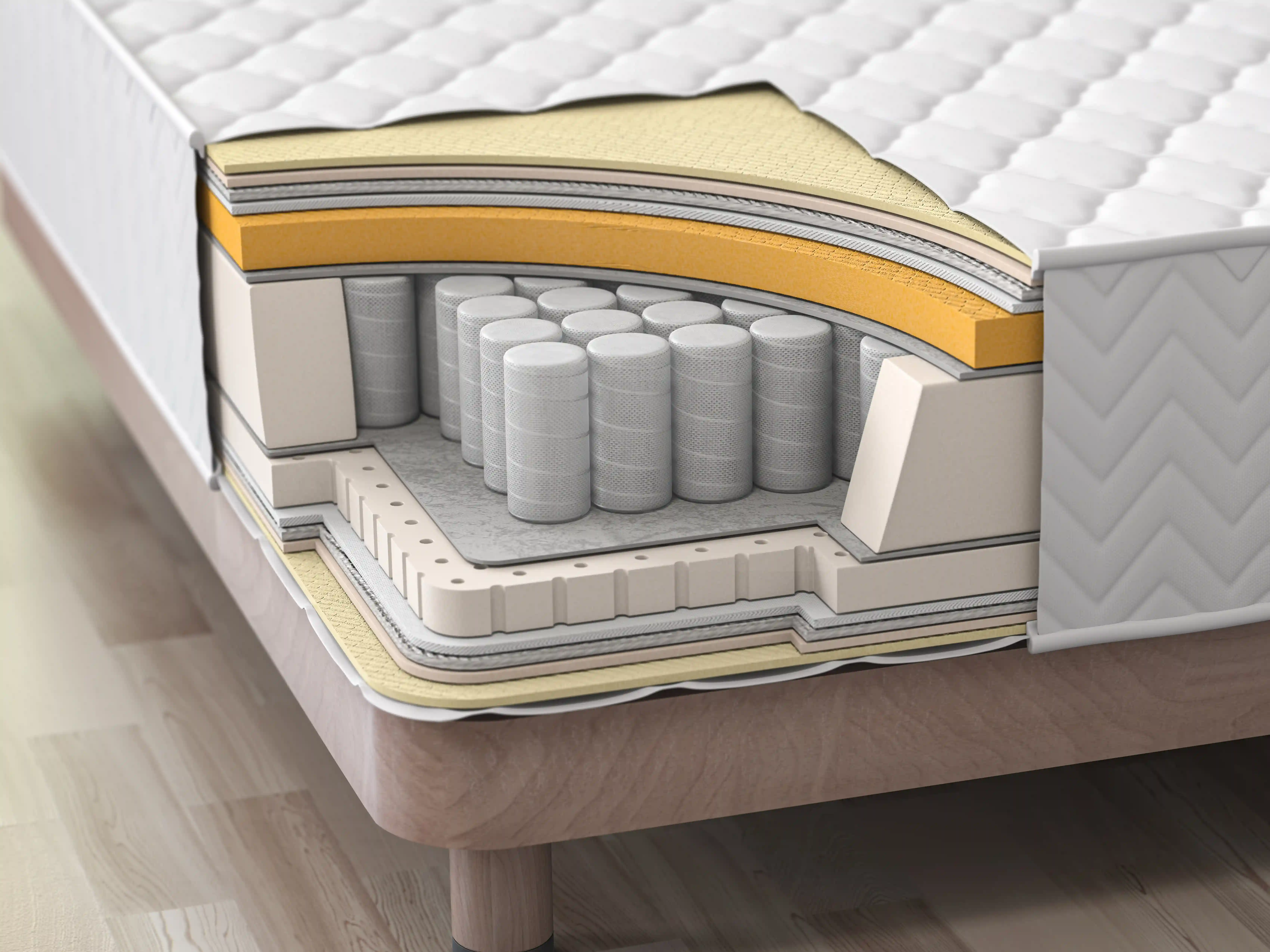

A mattress type tells you the broad architecture of the bed. It may tell you whether the support system is foam, latex, steel coils, air chambers, water, or a flexible futon fill. It does not tell you, by itself, whether the finished mattress will feel soft or firm, hold your body evenly, relieve a particular pressure point, stay cool, isolate movement, remain quiet, last a set number of years, or improve a health condition.
Use the category to understand what is inside and which questions to ask. Choose between exact models by examining the full construction, testing the performance that matters to you, and checking how the mattress works with the rest of the bed.
What a construction label can and cannot tell you
Two mattresses in the same category can perform differently because of:
- The type, thickness, firmness, density, and sequence of their comfort and transition layers.
- The support core design, zoning, coil connection, chamber layout, or water-bladder system.
- The cover, quilting, fire barrier, adhesives, edge structure, and base beneath the mattress.
- How the materials respond to load, temperature, repeated movement, moisture, and time.
- The sleeper's body proportions, positions, mobility, partner use, room, and bedding.
Research does not support turning a category name into a universal health prescription. A biomechanical review found that mattress evaluation still lacks adequately justified, standardized targets for pressure and spinal alignment and emphasized differences in body build and sleep position 1. A separate literature review found no agreement on one optimal mattress design and noted conflicting findings across varied products and study methods 2.
The practical conclusion is simple: construction helps form a shortlist. It does not diagnose your needs or guarantee an outcome.
Mattress construction families at a glance
| Family | Defining construction | Exact-model questions |
|---|---|---|
| All-foam | Foam comfort and support layers with no steel coil core | Which foams are used, how thick is each layer, how quickly do they respond, and what supports the edges? |
| Latex | Latex foam provides most or all of the comfort and support, or appears over another core | Is it all-latex or a latex hybrid, natural, synthetic, or blended, and how are the layers built and held together? |
| Innerspring | A steel coil unit is the main support core, usually with a comparatively modest upholstery package | Are the coils connected or individually wrapped, what sits above and below them, and how is the perimeter built? |
| Hybrid | A coil support core is paired with a more substantial foam, latex, fiber, microcoil, or mixed comfort system | What does the seller mean by hybrid, and what are the actual layer depths, coil design, edge, and total profile? |
| Adjustable-air | Refillable air chambers are the adjustable support element inside a bed intended for regular use | How many chambers and zones are there, what padding sits above them, and what do the pump, hoses, controls, power, and warranties cover? |
| Temporary inflatable | An air-filled shell is designed mainly for portable or occasional use | What surface, pump, valve, inflation range, repair method, temperature range, and intended-use limits does the maker specify? |
| Futon or folding sleep surface | Flexible fiber, foam, latex, coils, or a combination is designed to fold or work with a convertible frame | Is it built for the exact frame and folding pattern, and what are its open dimensions, fill, care, and primary-use limits? |
| Waterbed | A water-filled bladder or tubes provide the main load-bearing surface within a hard- or soft-sided system | What liner, heater, conditioner, frame, floor support, drainage, leak response, and service access are required? |
These families can overlap. A mattress described as "latex" may be all-latex or a coil hybrid with latex on top. A "memory foam mattress" may be all-foam, while a hybrid can also contain a memory foam comfort layer. The layer list resolves the ambiguity.
All-foam mattresses
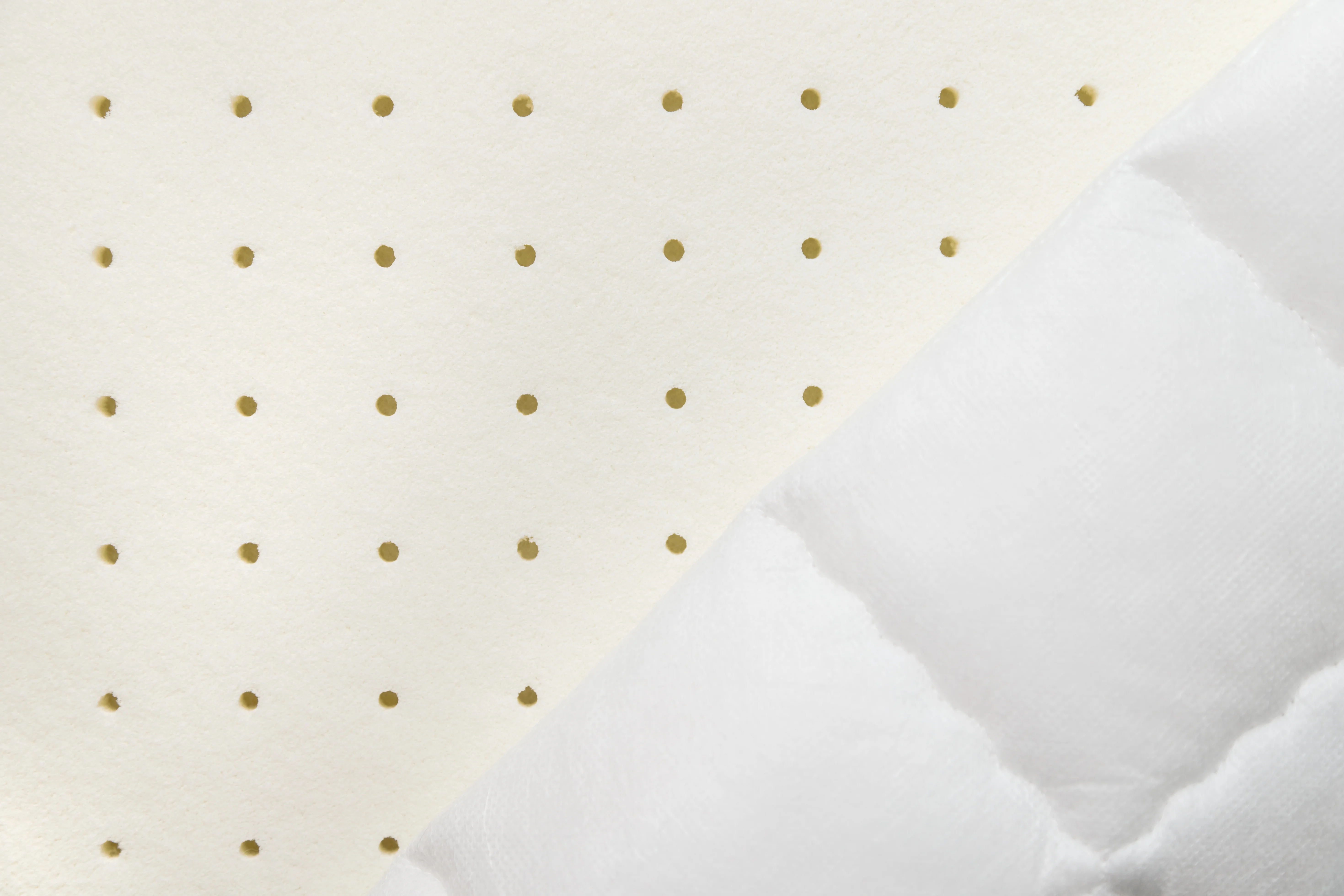
In retail use, an all-foam mattress usually combines one or more comfort or transition foams with a deeper foam support core. Memory foam is one possible layer, not the entire construction by definition. Other layers may use conventional polyurethane foam, responsive formulations, convoluted cuts, zoning, or different blends.
The absence of coils does not guarantee deep contouring, slow response, silence, motion isolation, heat retention, low weight, or a particular firmness. A thin memory foam layer over a firm, fast-responding core can behave differently from a thick, slow-responding stack. Edge rails, surface cuts, cover stretch, room temperature, and the base also matter.
Ask for the thickness and role of every layer, not merely the phrase "premium foam." When density or firmness specifications are provided, use them as construction details rather than as a complete quality score. Then test pressure, turning, edge use, partner movement, and temperature on the finished mattress.
Read our memory foam guide for a closer look at that material and its response.
Latex mattresses
Latex foam can form the complete mattress core, one comfort layer, or part of a hybrid. It may be made from natural rubber, synthetic rubber, or a blend, and manufacturers may use different production methods and layer arrangements.
"Latex mattress" does not establish that the whole bed is natural, organic, sustainable, spring-free, soft, firm, cool, durable for a fixed period, or suitable for a person with allergies. Check the percentage and type of latex, any non-latex foams or fibers, the support core, certifications and their scope, adhesives, cover, and whether layers can be rearranged or replaced.
A person with a known latex allergy should not infer safety from a marketing label or assume exposure from the category alone. Ask the manufacturer for the complete materials and covering design and discuss a clinically significant allergy with the treating professional.
Our latex mattress guide explains natural, synthetic, blended, Dunlop, and Talalay terminology in more detail.
Innerspring mattresses
An innerspring uses a steel coil unit as its main support structure. Traditional designs often have a thinner upholstery package than products sold as hybrids, but there is no single consumer-facing layer threshold that separates every innerspring from every hybrid.
Coil systems may be connected, made from a continuous wire, offset, or individually wrapped. Gauge, shape, count, working turns, zoning, precompression, and how the unit is joined all affect behavior. Coil count alone is not a universal performance or durability grade.
The category does not guarantee firmness, strong edges, airflow, bounce, noise, motion transfer, affordability, or resistance to sagging. Inspect the comfort layers, insulator system, perimeter, coil design, foundation requirements, and how the complete bed performs.
See our innerspring mattress guide and mattress coil guide for the construction details.
Hybrid mattresses
A hybrid combines a coil support core with a layered comfort system. That upper system may contain memory foam, other polyurethane foams, latex, fibers, microcoils, or several of those materials. The term is broad, and sellers do not all use one minimum comfort-layer thickness or one coil design.
Do not assume that every hybrid splits the difference between an all-foam mattress and an innerspring. A model with thick, slow-response foam can feel very different from one with latex and shallow quilting, even when both use pocketed coils. The exact construction determines contouring, turning effort, edge feel, partner motion, temperature, and weight.
Compare the layer depths, coil unit, edge design, base requirements, and total height. If a specification simply says "foam" or "support coils," ask for enough detail to compare it with the other finalist.
Our hybrid mattress guide covers the category in greater depth.
Adjustable-air mattresses
An adjustable-air mattress uses one or more sealed air chambers as a controllable support element. It is designed as a regular bed and usually adds foam, fiber, or another comfort system above the chambers. Some models let partners change chamber pressure independently.
A pressure setting is not a universal firmness scale. The same setting can feel different as the comfort layers, chamber shape, sleeper load, room conditions, and base change. More air is not automatically more supportive, and less air is not automatically better for pressure relief.
Treat the pump, hoses, seals, chambers, remote, app, power supply, and replaceable parts as part of the purchase. Air loss can come from a connection, hose, chamber, pump, or a normal pressure change that feels like a leak. Sleep Number's current troubleshooting, for example, separates air-loss checks from temperature, room pressure, and automatic adjustment behavior 3. That is an example of one system, not a diagnosis for every air bed.
Compare the mattress warranty separately from the pump, electronics, labor, and service terms. Ask what remains adjustable in a power or internet outage, whether a physical remote is included, and how long compatible replacement parts are expected to be available.
Temporary inflatable mattresses
A portable inflatable mattress is a different category from an adjustable-air bed intended for nightly use. It is usually an air-filled shell with a valve and a manual, battery, or electric pump. Some include a thin surface flocking or internal beams, but they do not have the same chamber, padding, service, or base system as permanent adjustable-air mattresses.
Check the maker's intended use, dimensions after inflation, load limit, inflation range, surface requirements, temperature limits, valve and pump instructions, patch method, and storage process. Overinflation, an unsuitable floor, a puncture, or temperature-related air change can affect the surface.
Never use a generic inflatable mattress for infant sleep. The U.S. Consumer Product Safety Commission warns that air mattresses are too soft for infants and can also create hazardous gaps if they lose air or sit beside furniture or a wall 4.
See our air mattress guide for setup, use, and storage details.
Futons and other folding sleep surfaces
A futon mattress is designed to work flat for sleep and, in many systems, fold with a convertible frame for sitting. Its fill can include cotton or other fibers, foam, latex, springs, or a combination. "Futon" describes the form and use as much as the internal material.
Match the mattress to the exact frame size, hinge pattern, retainer system, and folded profile. A thick or stiff replacement may not fold properly, while a mismatched thin unit may slide or leave frame areas exposed. Check whether the maker describes it for regular or occasional sleep rather than assigning a universal lifespan or user type.
Folding foam mattresses, rollaway mattresses, sofa-bed inserts, floor mattresses, RV mattresses, and Murphy-bed mattresses are also form-specific. Their foam, fiber, latex, or coil construction may fit another family in this guide, but dimensions, folding, clearance, retention, ventilation, and storage requirements can be the deciding factors.
Our futon mattress guide covers convertible systems in detail.
Waterbeds
A waterbed uses a water-filled bladder or multiple tubes as the main load-bearing surface. Hard-sided and soft-sided systems use different frames and containment. Internal fiber or baffles can change wave movement, while fill level and temperature affect the experience.
The mattress is only one part of the system. Verify the frame and floor capacity, safety liner, heater and thermostat compatibility, electrical instructions, water treatment, filling and drainage access, leak response, moving procedure, and any landlord, building, or insurance restrictions. Do not use a heater, frame, or repair method from another model without confirmation.
A waterbed is not an infant sleep surface. CPSC includes waterbeds among the soft adult surfaces that should never be used for infant sleep 4.
Adjustable bases and smart features are not mattress types
An adjustable base is the powered or manual platform beneath a compatible mattress. It bends the mattress to raise or lower sections of the bed. It does not change an innerspring, all-foam, latex, or hybrid mattress into an "adjustable mattress."
Compatibility is model-specific. The mattress must flex as the base moves without damaging its layers or interfering with retainers, hinges, cords, or clearances. A manufacturer's approval normally applies to its named combinations. Tempur-Pedic, for example, states that its mattresses are compatible with its own power and smart bases 5. That does not establish compatibility for another mattress or base.
"Smart bed" is also a feature label rather than one construction family. Sensors, temperature hardware, automatic air adjustment, vibration, speakers, lights, or sleep tracking may be built into a mattress, base, cover, pump, bedside component, or app. Read the system diagram to learn what you are actually buying.
Before choosing a powered or connected system, check:
- Which comfort and position functions work without Wi-Fi, an account, or a phone.
- Whether a remote is included and what works during a power outage.
- Required outlets, cord routing, surge protection, ventilation, and moving procedures.
- Pinch-point, child, pet, pacemaker, magnet, and medical-equipment warnings in the manual.
- Separate warranty periods and labor or service charges for the mattress, base, pump, chambers, controls, heating or cooling parts, and electronics.
- App compatibility, software support, account transfer, subscriptions, stored sleep data, privacy controls, and deletion options.
These boundaries are not theoretical. Sleep Number states that its bed can adjust without being online, but an internet connection is required for sleep tracking and Responsive Air, and it offers a Privacy Mode for session tracking 6. Another smart system may work differently.
Compare exact models in the same order
Once construction has narrowed the field, use the same questions for every finalist:
- Get the complete build. Record every layer, its thickness and material, the support core, edge design, cover, fire barrier description, total height, and finished dimensions.
- Confirm the base. Check allowed foundations, slat width and spacing, center support, floor use, adjustable-base compatibility, weight capacity, and warranty consequences.
- Test the outcomes, not the label. In each usual sleep position, notice pressure, bottoming out, unwanted sinking, stability, ease of turning, edge use, and morning symptoms. If sharing, test partner movement, usable space, and any split or center seam.
- Check the room and bedding. Compare temperature over a realistic period and consider the protector, sheets, pad, room, and bed base. A short showroom test cannot establish overnight heat or noise.
- Plan ownership. Review rotation or flipping instructions, cleaning, stain exclusions, moving, replacement components, service access, expected maintenance, and end-of-life options.
- Read the trial and warranty. Record minimum and maximum trial dates, return fees, pickup or donation requirements, comfort exchanges, indentation thresholds, support requirements, exclusions, prorated periods, labor, and transport charges.
Do not compare advertised prices without matching the same size, included base, delivery, removal, trial, and return terms. Do not compare weights or heights by category. Use the exact model specifications and decide whether the product can be safely installed, moved, and maintained in your home.
Our mattress buying guide turns these checks into a full shopping process. The mattress materials guide explains individual foams, fibers, coils, fabrics, and fire barriers without treating one material as a complete mattress.
Keep health and allergy claims proportional
A mattress can affect comfort and symptoms, but a construction family is not a treatment for back pain, insomnia, arthritis, poor circulation, stress, or another health condition. If a seller uses a medical claim, ask what exact product, population, comparison, and outcome were studied. Do not transfer a result from one tested mattress to every foam, latex, coil, or air bed.
"Hypoallergenic" also needs a specific explanation. A foam category does not guarantee freedom from dust mites, mold, latex, adhesives, fragrances, or another trigger. For dust mite control, the National Institute of Environmental Health Sciences recommends a combination of measures such as allergen-impermeable mattress and pillow encasements, humidity control, and regular bedding washing rather than choosing one mattress category 7.
For a known material allergy, asthma trigger, mobility limitation, chronic pain condition, implanted medical device, or pressure-injury risk, combine the exact construction and equipment manuals with advice from the relevant clinician. The final choice still needs to work as a complete sleep system.
Do not alter the safety construction
U.S. federal mattress standards address smoldering and open-flame performance 8. Those standards do not require every maker to use the same material or barrier.
Keep the law tag and follow the maker's cover and cleaning instructions. Do not unzip a cover merely because it has a zipper, cut into the mattress to inspect the layers, remove a fire barrier, or add a heater unless the manufacturer explicitly permits it. Alteration can expose fibers or components and can affect safety, performance, return eligibility, or warranty coverage.
The most useful mattress type is not the one with the strongest category reputation. It is the exact construction that performs acceptably for the people using it, fits the required base and room, and has ownership terms they can realistically manage.