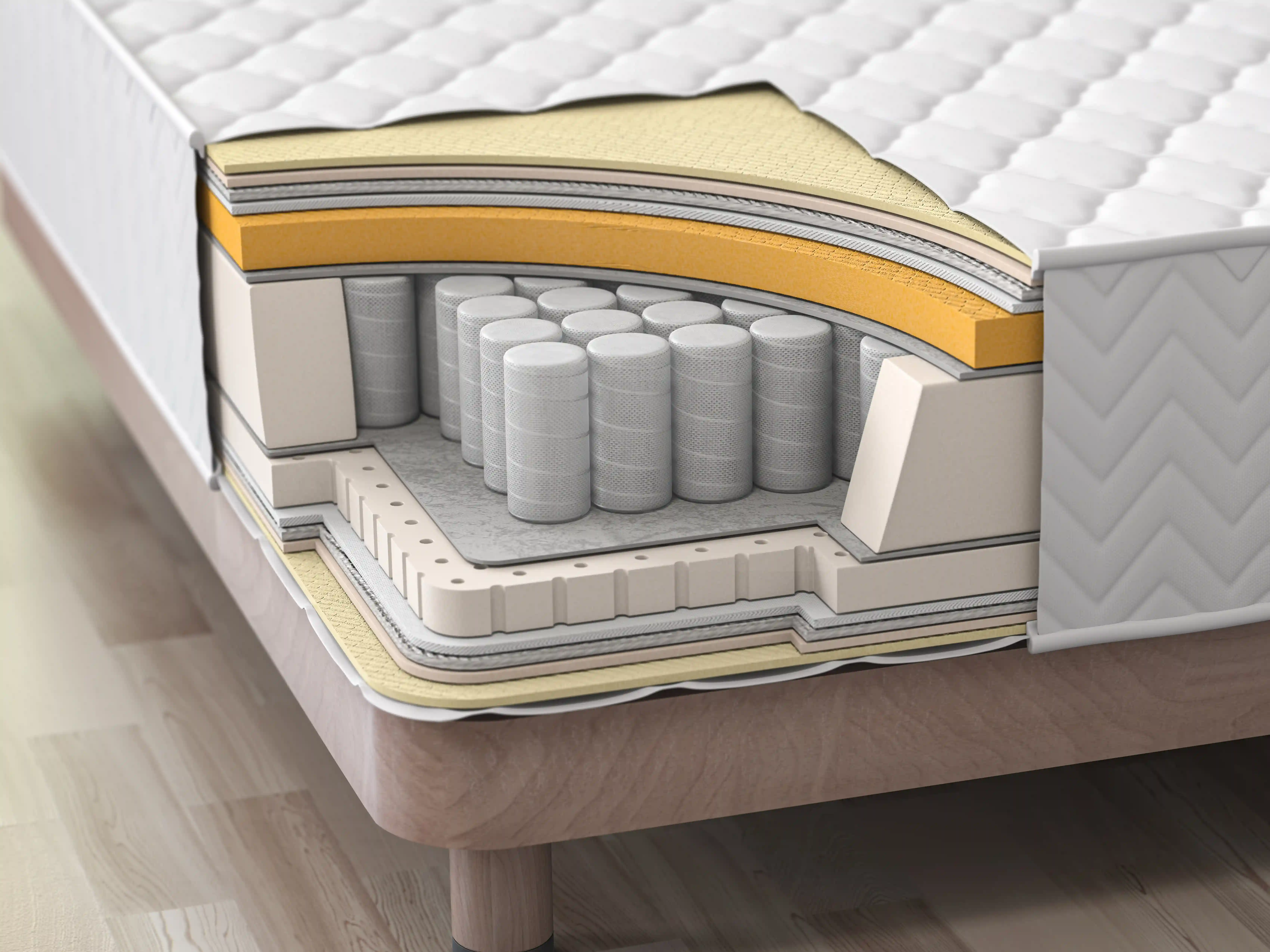

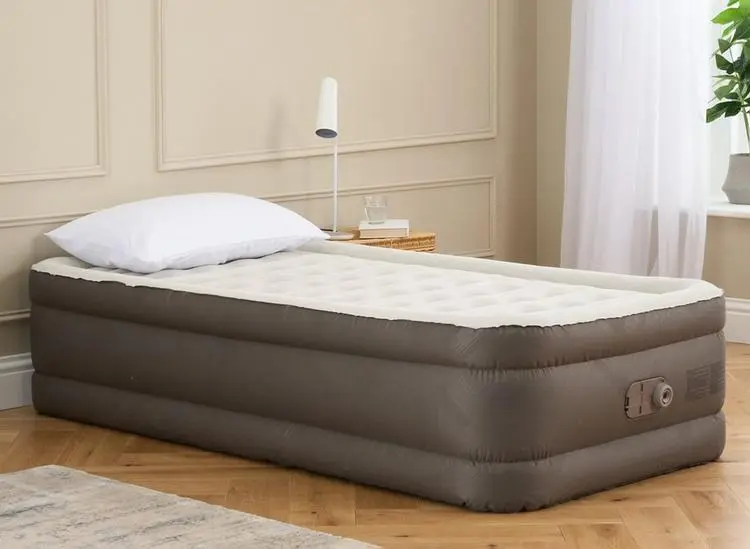
An air mattress is a portable sleep surface that gets its shape and firmness from pressurized air. It can make a practical guest bed or camping mattress, but the right model depends on where you will use it, who will sleep on it, how it inflates, and whether the manufacturer intends it for occasional or repeated use.
Size names, height, pump type, construction terms, and weight limits vary by model. Read the product label and manual rather than assuming every “queen” or “double-high” airbed works the same way.
If you want a sleep surface without an air chamber, valve, or pump, our guide to air mattress alternatives compares folding foam, floor futons, guest beds, cots, and other non-air options.
How is an air mattress built?
A recreational air mattress usually has welded top, bottom, and side panels made from PVC, TPU, or a laminated textile. Some have a flocked or fabric-like top to add grip and soften the feel under a sheet.
The outer shell would bulge like a balloon without internal restraints. Manufacturers attach flexible structures between the top and bottom to control the inflated shape:
- I-beams or wave beams are parallel internal strips.
- Coil beams are loops or column-shaped tethers. They are not metal mattress springs.
- Fiber beams replace some solid vinyl tethers with bundles of fibers.
- Multiple chambers divide the bed into sections or layers. Some models use separate chambers for the perimeter, upper surface, or two sleeper sides.
These names are not a universal grading system. They describe a layout, not proven comfort or durability. Intex, for example, describes I-beams as parallel internal structures and markets its fiber I-beam design as Dura-Beam 1.
Seams, valve design, shell thickness, internal welds, and quality control all affect how a bed holds its shape. A high airbed can still sway, while a lower one can still feel firm.
Pump types
Built-in electric pump
A built-in pump stays attached to the mattress and often handles both inflation and deflation. Most raised guest airbeds use an AC wall outlet, though USB and rechargeable versions also exist. Check voltage, plug type, cord length, indoor or outdoor rating, and whether there is a manual valve if power is unavailable.
“Self-inflating” in a guest-airbed listing often means a built-in motor does the work. It is different from a self-inflating camping pad, where expanding foam draws air through an open valve.
External electric pump
External pumps may plug into a wall outlet, a vehicle's 12-volt socket, a rechargeable battery, or replaceable batteries. The nozzle must fit the valve, and the pump must provide the high-volume, low-pressure airflow the mattress requires.
Hand or foot pump
A manual pump works without electricity and may suit camping or emergency use. It takes more effort and can be slow on a tall mattress, but it avoids dependence on an outlet or charged battery.
Do not substitute a shop compressor, tire inflator, or other high-pressure source unless the airbed manufacturer explicitly approves it. Intex safety guidance calls for a low-pressure inflator and warns against overinflation 2.
How to choose an air mattress
Intended use
Start with the label: indoor guest bed, outdoor camping mattress, vehicle mattress, child travel bed, or another specific use. An indoor model with an AC pump may not be designed for rain, dirt, or low outdoor temperatures. A lightweight camping model may trade height and roominess for packed size.
If you expect nightly use, check whether the manufacturer permits that frequency and whether the warranty covers it. There is no evidence-based rule that every air mattress becomes unhealthy after a set number of nights, but an occasional guest product should not be assumed to withstand permanent use.
Recreational airbeds are also different from powered medical support surfaces used in pressure-injury care. Do not substitute a consumer air mattress when a clinician has prescribed a medical surface.
Inflated size and height
Compare actual length and width with the sleeper, room, tent, or vehicle. Airbed dimensions are approximate and may not match standard mattress sizes or fitted sheets. Leave walking space and keep the inflated bed away from stairs, doors, heaters, and sharp furniture.
A raised model may be easier for some adults to get into and out of, but it is heavier, bulkier in storage, and may need more air and setup time. In a tent, extra height also moves the mattress closer to sloping walls.
Weight and occupancy limits
Read the exact total load limit. A “queen” label does not prove that a mattress supports any two adults, and height is not a capacity rating. If two people will share the bed, compare their combined weight with the manufacturer's limit and check whether the manual restricts the number of occupants.
Packed size and pump access
Check product weight as well as bag dimensions. A raised airbed with an internal pump can be awkward to carry even when deflated. For camping, confirm how many inflations the battery can provide and bring only a pump or adapter the manufacturer approves.
Published insulation
For indoor use, the room and bedding may matter more than a formal insulation rating. For camping, look for a tested R-value. ASTM F3340 provides a standardized method for comparing the thermal resistance of camping mattresses, while noting that field performance can vary with compression, posture, and heat loss around the edges 3.
Many household guest airbeds do not publish an ASTM R-value. Thickness alone does not tell you how warm one will feel on cold ground.
How to set up and inflate an air mattress
-
Read the model's manual. Find the approved pump, load limit, intended location, and firmness or inflation instructions.
-
Clear the surface. Remove sharp debris and check for splinters, rough hardware, hot surfaces, and enough clearance from walls and furniture.
-
Unfold without pulling at seams. Let a mattress brought in from very hot or cold storage reach a temperature allowed by its manual.
-
Close the deflation opening and attach the approved pump. Make sure caps, valve plugs, and pump controls end in the closed position described by the manufacturer.
-
Inflate gradually. Stop at the manufacturer's cue. Do not keep adding air to remove every wrinkle or make the surface drum-tight.
-
Test with the intended sleeper. If adjustment is allowed, add or release small amounts of air through the proper control. There is no universal firmness setting based on body weight.
-
Check the placement again. Keep a clear exit path and avoid gaps where a child could become trapped.
Built-in pump instructions are model-specific. One Intex AC-pump manual, for example, says the pump is for indoor use, should not be exposed to rain, and should not be run with a damaged cord 4. Follow the manual supplied with your own bed.
Why does an air mattress feel softer overnight?
A softer mattress does not always mean there is a hole.
New material can stretch
Vinyl and other flexible materials may relax during the first inflations, increasing the mattress volume and reducing firmness even though the same air remains inside. Coleman and Intex both describe initial softening from material stretch as normal 5 6.
Top up only as the manual directs. If the amount needed decreases after the first few uses, stretching was a likely contributor.
Air temperature changes pressure
Air molecules move more slowly when cooled and faster when heated. In a closed container, warming raises pressure and cooling lowers it 7.
A mattress inflated in a warm room or during a sunny afternoon may feel softer after the air and ground cool overnight. It may feel firmer again as temperatures rise. Because the shell is flexible and the sleeper changes its shape, the effect will not match one fixed household formula.
Do not compensate for a cold night by filling the mattress as hard as possible. Added air can increase pressure when the mattress warms again.
Altitude changes the pressure around the mattress
Atmospheric pressure decreases as elevation increases 7. From that physics, a sealed flexible mattress taken to higher elevation may expand or feel firmer relative to the outside air. The actual change depends on temperature, construction, and how flexible the bed is.
Recreational airbed manuals rarely provide a universal altitude adjustment. Check firmness after arriving, keep within the product's stated conditions, and release or add air only through the approved valve. Do not use a guessed pressure correction.
When to suspect a leak
A leak becomes more likely when:
- softness continues after the initial stretch period
- the mattress needs substantial air every time it is used
- one chamber loses shape faster than another
- the valve hisses or will not remain closed
- the sleeper bottoms out despite stable temperature
How to find and repair a leak
First, read the warranty. A seam, valve, or built-in pump failure may need manufacturer service rather than a patch, and an unauthorized repair can affect coverage.
Find the source
Inflate the bed to its normal firmness in a quiet room. Check the valve and pump housing first, then listen and slowly pass a hand over the top, sides, seams, and bottom. Coleman recommends listening and feeling around the surface before repairing 5.
If the manufacturer permits it, brush a mild soap-and-water solution over a suspected vinyl area and watch for growing bubbles. Keep liquid away from an electric pump, plug, control panel, and any area the manual says must stay dry. Do not immerse a mattress with electrical components.
Mark a small puncture after finding it. If you cannot locate a loss near a valve, seam, or pump, contact the manufacturer rather than cutting into the bed.
Make the repair
Unplug the pump and deflate the mattress. Clean and dry the repair area, use a patch and adhesive compatible with the exact surface, press it as directed, and wait the full cure time before reinflating. Flocking may require a product-specific preparation step.
Cure times and repairable damage sizes vary. Bestway's model-specific instructions, for example, require a clean area and a one-hour wait before reinflation, while Coleman's support page gives different methods for smooth and flocked PVC 8 5.
Never use an aerosol tire-repair product or introduce another flammable substance into an airbed. Manufacturer warnings note a risk of ignition or explosion 2.
Cleaning, drying, and storage
Check the care label before cleaning. A common approach is:
- unplug any electric pump
- wipe the surface with a damp cloth and mild soap
- avoid harsh detergents, solvents, and machine washing unless a removable cover allows it
- let every surface and seam dry completely
- deflate through the approved outlet without forcing or rolling air toward the pump
- fold along the manufacturer's directions and return the dry bed to its bag
- store it in a dry place away from sharp objects, heavy loads, chemicals, heat, and freezing conditions outside the manual's range
Bestway instructs users to dry the airbed fully before folding and to store it dry, away from chemicals and sharp or heavy objects. Intex advises mild soapy water rather than chemicals 8 2.
Do not seal a damp mattress in its bag. Inspect the bottom, valves, cord, and seams before the next use.
Children, pets, and infant safety
Never place an infant to sleep on an air mattress. The U.S. Consumer Product Safety Commission warns that even a properly inflated adult air mattress is too soft for infant sleep and that leaks can add suffocation and entrapment risks. Use a crib, bassinet, or play yard that meets current requirements, with only the mattress or pad intended for that product 9.
For older children, follow the model's minimum age, occupancy, and weight limits. Supervise setup and use, keep the bed away from stairs, windows, walls, and furniture gaps, and do not allow standing or jumping 2.
Pet claws, chewing, and jumping can damage the shell or valve. Keep pets off the mattress if the product instructions require it, and do not treat a blanket or cover as puncture-proof protection.
Camping, electrical, carbon-monoxide, and fire precautions
For camping, make sure the mattress is intended for outdoor use and fits within the tent without pressing against the walls. Use a clean tent floor or manufacturer-approved protective layer, and bring a repair method that matches the material.
A sleeping bag does not replace insulation beneath you. The National Park Service recommends a ground pad for cushioning and to limit moisture-related heat loss 10. Match the full sleep system to the expected weather.
Keep pumps, plugs, cords, and electrical controls dry. Do not use an indoor-only built-in pump outdoors. Arrange cords away from walkways, and stop using equipment with a damaged plug, cord, housing, or unusual heat or smell 4.
An electric pump does not produce carbon monoxide, but a running vehicle, generator, camp stove, grill, or fuel-burning heater can. Never run a vehicle or generator in an enclosed or partly enclosed space or where exhaust can enter a tent, camper, vehicle, or room. The CDC warns that carbon monoxide is odorless and that sleeping people may be overcome before they notice symptoms 11.
Keep the mattress away from open flame and high heat. Do not smoke on it or use flammable repair products 2.
Frequently asked questions
Is an air mattress suitable for every night?
There is no universal safe number of nights. Use the product for the frequency and setting its manufacturer allows. For ongoing nightly use, compare warranty coverage, repairability, pressure maintenance, pump dependence, and whether the model is actually sold for regular use.
Should an air mattress be completely hard?
No universal firmness is correct. Inflate to the model's instructions, then adjust through the approved control if the manual allows. A drum-tight surface is not a sign of better support and may indicate overinflation.
Can I use a tire compressor?
Usually not. Most recreational airbeds require high-volume, low-pressure airflow. Use only a pump the manufacturer approves.
How can I tell stretching from a leak?
Initial stretch usually needs less topping up after the first few uses. A leak is more likely when air loss continues, is rapid, affects one area, or can be traced to a valve, seam, pump housing, or puncture.
How long will an air mattress last?
There is no reliable universal lifespan. Frequency of use, storage, temperature exposure, load, seam and valve quality, punctures, and repair history all matter. The product warranty and intended-use statement are more useful than a fixed number of years.