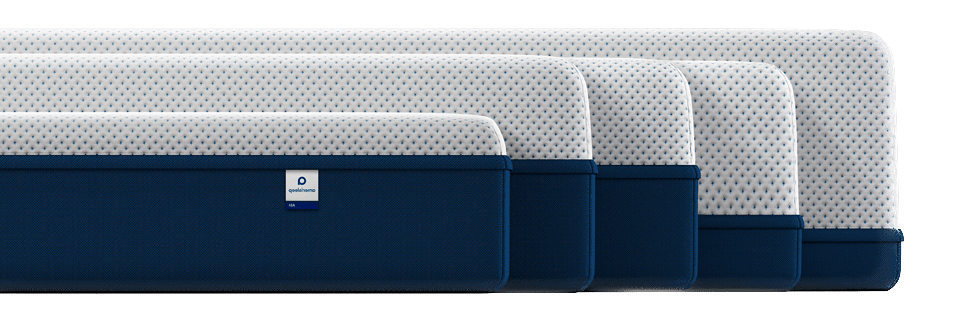
The practical difference between a queen and a king is width. A common U.S. queen is listed at 60 by 80 inches, while a common king is 76 by 80 inches. The king adds 16 inches of width but no nominal length 1.
For two people dividing the bed evenly, that works out to 30 inches of width each on a queen and 38 inches each on a king. Those numbers do not decide which bed will feel right. They let you test whether eight additional inches per person are worth the larger frame, tighter room, more demanding moving route, and possible changes to the base and bedding.
Exact dimensions still matter more than the size name. Saatva currently lists one mattress line at the common 60-by-80-inch queen and 76-by-80-inch king dimensions. Sealy lists queen and king lengths of 79 or 79.5 inches for several current lines, depending on the model 12. Use the seller's specification for the exact model and configuration you plan to buy.
For a broader comparison that includes twin, full, California king, and specialty sizes, see our mattress size guide.
Queen vs. king dimensions at a glance
| Comparison | Queen | King |
|---|---|---|
| Common nominal mattress width | 60 in | 76 in |
| Common nominal mattress length | 80 in | 80 in |
| Width per person when divided evenly between two people | 30 in | 38 in |
| Difference from queen | Baseline | 16 in wider |
| Common fully split arrangement | Model-specific | Two compatible twin XL mattresses |
These are planning figures, not guaranteed finished measurements 12. Confirm width, length, height, weight, tolerance, and number of pieces on the exact mattress, base, and frame listings.
Start with the sleep surface
The king's extra width is useful only if it solves a real space problem on the mattress. Before changing sizes, compare the proposed rectangles with the bed you already use.
- Measure the current mattress at its widest and longest points.
- Note how much surface each regular sleeper actually uses, including ordinary movement and any equipment that must remain on the bed.
- Mark a 60-by-80-inch rectangle and a 76-by-80-inch rectangle on the floor or over the existing bed using removable tape.
- Divide the width where each person would realistically sleep. Do not assume the center line will always be shared evenly.
- Check whether the same 80-inch nominal length works for the tallest sleeper.
Body weight and sleep position do not automatically determine queen or king size. They may affect the mattress construction, firmness, support, or load requirement, but the width decision is still about the sleepers' measured use of the surface.
Measure the frame, not just the mattress
A bed's room footprint is the outside of its assembled frame, including the headboard, footboard, posts, upholstery, storage, and moving parts. It is not the mattress rectangle.
A current product example shows why this distinction matters. IKEA lists its TARVA queen frame at 63 inches wide by 82 1/4 inches long, with a mattress space of 59 7/8 by 79 1/2 inches. The king version is listed at 79 1/8 inches wide by 83 1/8 inches long, with a mattress space of 76 by 79 1/2 inches 34. Those measurements apply to that frame, not to every queen or king bed.
Draw the exact frame footprint on a room plan. Then mark:
- Door and closet swings
- Dresser and storage-bed drawer travel
- The routes people actually use around the bed
- Nightstands, wall outlets, lamps, radiators, vents, and window access
- Space needed for mobility equipment, caregiving, or transfers
- Any clearance required for an adjustable base or reclining head section
There is no universal minimum bedroom size that makes a queen or king work. A room with generous floor area can still have a poor layout, while a smaller room may work if doors, storage, and access remain usable.
Check the full moving route
Measure from the delivery point to the final position, not only the bedroom door. Record the narrowest clear opening after accounting for door hardware, handrails, light fixtures, ceiling changes, and tight turns.
Check each part separately:
- The expanded mattress
- The shipping carton, if the mattress arrives compressed
- The foundation or adjustable-base sections
- The headboard, footboard, side rails, and longest rigid frame piece
- Elevator door, interior, and weight limits
- Stair width, landing depth, ceiling height, and turns
Do not assume a mattress that arrived in a box can be recompressed for a later move or return. Flexing rules also vary by construction. Sealy, for example, advises against folding its mattresses because bending may damage the innerspring unit and recommends only slight flexing through doorways 5. Follow the exact mattress maker's moving instructions.
A king setup can sometimes be easier to route when the foundation or adjustable base comes in sections, but a split support system does not make a one-piece king mattress smaller.
Match every part of the bed
A queen-to-king change is more than a mattress swap. Check the exact dimensions and compatibility of each component before ordering.
| Component | What to verify |
|---|---|
| Mattress | Finished width, length, height, weight, tolerance, and whether it is one piece or split |
| Frame | Inside mattress opening, assembled outside dimensions, required support, and moving parts |
| Foundation or base | Size, number of sections, permitted mattress type, and whether it replaces a foundation |
| Adjustable base | Exact deck dimensions, mattress compatibility, retainer position, controls, and inside-frame fit |
| Protector and fitted sheet | Width, length, corner shape, and pocket depth after adding any topper |
| Top bedding | Finished dimensions and the amount of side and foot overhang you want |
Even a matching label does not promise identical dimensions. Tempur-Pedic currently lists its adjustable bases slightly under the common mattress footprint: 59.8 by 79.8 inches for queen and 75.5 by 79.8 inches for king. Its split king base is listed as two 37.8-by-79.8-inch pieces 6. These specifications show why the inside of a decorative frame and the base itself should be measured rather than inferred.
Queen fitted bedding will not fit a common king mattress. Moving to king may also require a new protector, fitted sheet, top bedding, frame, foundation, or base. Check pocket depth against the mattress plus any topper instead of relying only on the queen or king label.
Understand split king before choosing it
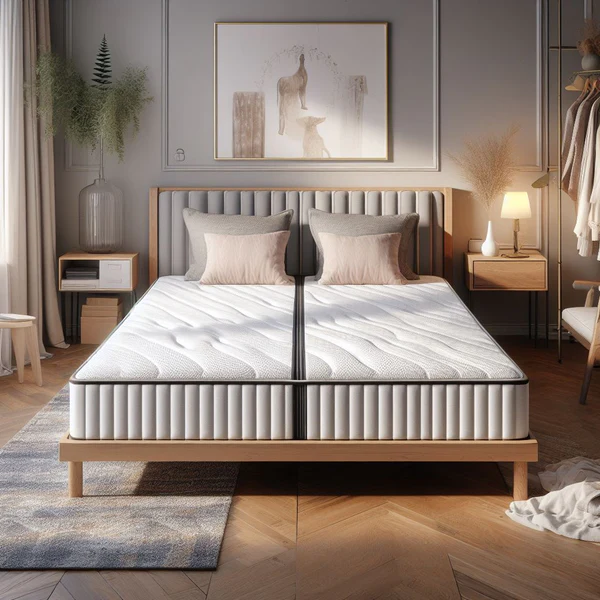
A split king commonly uses two twin XL mattresses side by side. Under the common nominal convention, two 38-by-80-inch pieces form a 76-by-80-inch surface. Tempur-Pedic describes its split king as two twin-long products and says two mattresses should have the same height; it also requires a split mattress when each side of a split base is to operate independently 7.
Confirm all of these details before treating two pieces as one split king:
- Exact width, length, height, and construction of both mattresses
- Whether different models or feels may be paired
- Independent or synchronized base controls
- Retainers, connectors, and center-gap management
- Separate fitted sheets or another compatible bedding arrangement
- Warranty and return terms when the two sides are ordered separately
Two regular twin mattresses are commonly shorter than a king because a regular twin is usually listed at 75 inches long, while a twin XL is commonly listed at 80 inches 1. Product measurements can still vary.
A split foundation under a one-piece king mattress is not the same as a split king mattress. Split queen is also a product-specific configuration, so do not infer its component dimensions or adjustable-base behavior from the queen name. Our split mattress guide covers those arrangements in more detail.
Verify support and total load
Mattress size does not establish weight capacity. Check separate requirements for the mattress, frame, foundation, adjustable base, storage mechanism, legs, and casters.
Clarify whether a stated limit:
- Includes the mattress, bedding, sleepers, pets, and other items on the bed
- Applies to the full bed or to each side
- Changes when the base is moving
- Requires a particular foundation, center beam, center leg, or floor contact
Support rules are model-specific. Saatva currently says its compatible slatted platforms should have slats spaced less than four inches apart and a center support leg touching the floor, with additional requirements for some mattress models 8. Do not apply that spacing to another brand unless its instructions say the same.
Recheck total bed height after combining the frame, foundation or base, mattress, and topper. The useful height is the one that allows the intended sleeper to sit, stand, transfer, and reach controls safely.
Compare the complete purchase and current terms
Do not assume a queen is always cheaper or a king always costs a fixed amount more. Model availability, promotions, split components, delivery, removal, and accessories can change the total.
Build one complete cart for each option:
- Mattress and any split surcharge
- Frame, foundation, or adjustable base
- Protector, fitted sheets, and top bedding
- Delivery, setup, old-bed removal, and stairs
- Financing cost, if used
- Return pickup, exchange, or restocking fees
Read the terms for every component, not just the mattress headline. Saatva's current policy, for example, gives mattresses a 365-night trial with a $99 pickup processing fee, but excludes adjustable bases from returns and exchanges 9. That is one seller's current policy, not an industry rule. Save the exact policy shown when you order and check whether opened bedding, foundations, frames, custom items, and split components have separate conditions.
Also plan the return route. A trial is of limited use if a rejected mattress cannot be moved out or if the buyer is responsible for disassembly or packaging that cannot be recreated.
A simple queen-or-king decision
A queen is the stronger fit when its measured surface works for the sleepers and the 16 inches saved in mattress width materially improves the room, access route, or complete purchase. It can also be the more practical choice when moving or replacing several king-size components would be difficult.
A king is the stronger fit when the extra eight inches per person would be useful, the exact assembled frame leaves the room functional, every component is compatible, and the full setup can be delivered, moved, supported, and returned under acceptable terms.
If the answer remains unclear, reproduce both footprints with tape and use your current bed as the comparison. That gives you more useful information than a generic rule based on couple status, body type, sleep position, or a supposed minimum room size.
Frequently asked questions
Is a king bed longer than a queen?
Not under the common U.S. convention. Both are usually listed at 80 inches long, while the king is 16 inches wider 1. Exact product lengths may be slightly different, so verify the model.
If you need a different shape, our king versus California king guide compares the wider 76-by-80-inch common king with the narrower, longer 72-by-84-inch common California king 1.
Can a king mattress go on a queen frame?
Not when the products follow the common dimensions. A 76-inch-wide king cannot fit correctly on a support intended for a 60-inch-wide queen. Use a support system that the mattress manufacturer identifies as compatible with the exact mattress and configuration.
Do two twin mattresses make a king?
Two common regular twins placed side by side approximate a king's width but are about five inches shorter. A common split king instead uses two compatible twin XL mattresses. Confirm the finished measurements and height of both pieces.
What bedroom size do I need for a queen or king?
There is no single useful minimum. Start with the exact assembled frame, then plan door and drawer swings, walking and transfer routes, storage, furniture, moving parts, and access to outlets or windows. Choose the option that keeps the particular room functional.
Can queen bedding be reused on a king?
Queen fitted sheets and protectors are not sized for a common king mattress. A flat sheet, blanket, or duvet may be reusable only if its finished dimensions give the coverage and overhang you want. Check the label and measure rather than relying on the product name.