
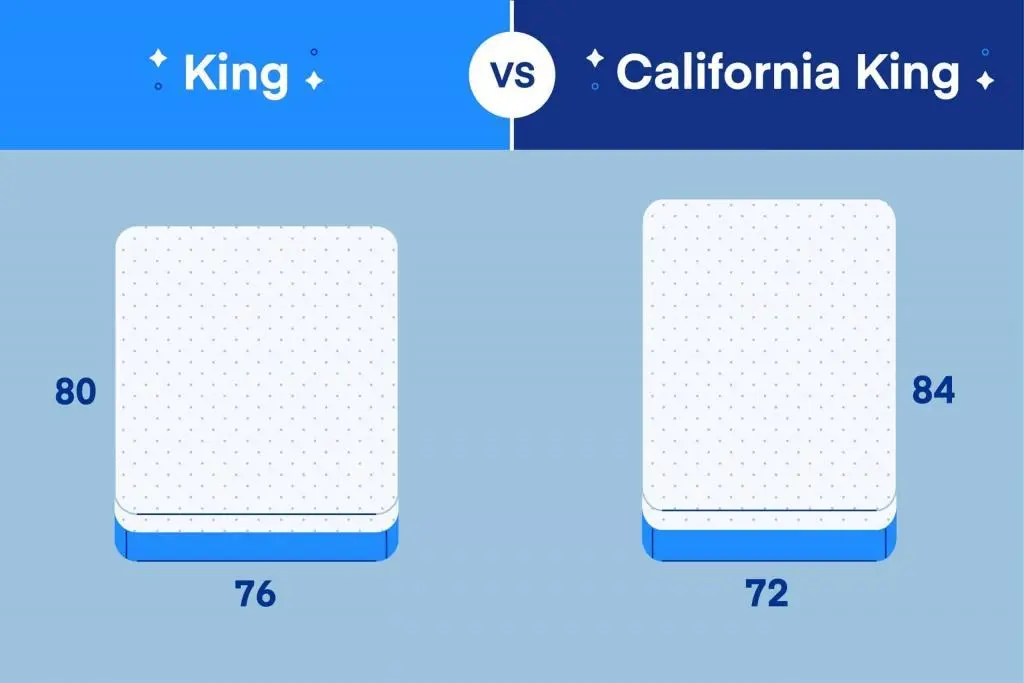
A standard U.S. king, also called an Eastern king, is wider. A California king is longer. Their nominal mattress dimensions are 76 by 80 inches and 72 by 84 inches, respectively. Choosing between them means trading four inches of total width for four inches of total length, not upgrading from an inferior size to a superior one 12.
| Comparison | Standard king | California king |
|---|---|---|
| Nominal width | 76 inches | 72 inches |
| Nominal length | 80 inches | 84 inches |
| Width if divided evenly between two adults | 38 inches each | 36 inches each |
| Main spatial advantage | Four more inches of total side-to-side room | Four more inches from head to foot |
| Size-specific items | King mattress, bedding, frame, foundation, or base | California king mattress, bedding, frame, foundation, or base |
These are category dimensions, not a promise that every finished product is exact to the fraction of an inch. Manufacturers may publish slightly different actual dimensions, and upholstered borders can change how a mattress fits inside a frame. Verify the product specification for the mattress you are buying and the inside dimensions of anything that will support or surround it. One major manufacturer, for example, lists the nominal sizes above while noting that individual mattress dimensions can vary 2.
Choose the four inches that solve your real constraint
A standard king gives two sleepers more side-to-side room. That may be useful if elbows meet, one person spreads out, or a pet regularly settles beside a sleeper. A California king gives more length, which may help when a sleeper's feet approach the bottom edge or a pet reliably sleeps at the foot of the bed.
Height is only a starting clue. Pillow placement, how far down the bed a person sleeps, whether the frame has a bulky footboard, and where a pet settles all affect usable space. Measure the length each sleeper actually occupies rather than applying a universal height cutoff.
Sleeping position does not determine the answer by itself. A side sleeper may use less length but more bent-knee width, while a back or stomach sleeper may lie straighter. Partners can lie in their usual positions on a marked floor area or showroom mattress and notice whether width or length runs out first.
Neither size guarantees better sleep or less disturbance. If both fit the sleepers, the more useful choice is the one that also fits the room, support system, bedding budget, and delivery path.
What about children and pets?
For a pet, mark where the animal actually sleeps. A dog at the foot can make California king length useful, while a pet between two adults consumes width. Account for the pet's full sleeping position rather than assuming the larger-sounding name provides more room in every direction.
Neither adult mattress size is a safe infant sleep surface. An infant should sleep on their back in a separate crib, bassinet, play yard, or bedside sleeper that is intended for infant sleep, with only a fitted sheet in the sleep space 3.
Measure the room using the outer frame, not the mattress alone
Mattress dimensions describe the sleeping surface. A headboard, footboard, upholstered rails, shelves, or storage drawers can make the assembled bed much larger. As one real-world example, an IKEA king frame specifies a 76-inch mattress width but an outer width of 82 1/4 inches. It also lists an outer length of 83 1/8 inches for a 79 1/2-inch mattress opening 4.
Use this measurement-first check:
- Find the exact outer width and length of the assembled frame. If no frame has been selected, mark a conservative rectangle and revise it once you choose one.
- Tape that footprint on the floor in the planned position.
- Open bedroom and closet doors, drawers, and any storage built into the frame.
- Check the walking route on both occupied sides and at the foot of the bed.
- Account for nightstands, outlets, vents, radiators, curtains, and an adjustable base's moving parts.
There is no single room dimension that makes one size correct. A wide room may accept a standard king more naturally, while a long, narrow room may work better with a California king. Furniture placement and usable clearance matter more than a generic "large bedroom" label.
Check the entire delivery path
Measure door openings, halls, stairways, landings, elevator doors, and tight turns between the entrance and bedroom. The Better Sleep Council specifically advises checking corridors, doors, and stairwells for a king-size delivery 1.
Ask how each item arrives. A compressed foam mattress, a rigid foundation, an adjustable base, and a one-piece frame present different delivery problems even when their size labels match. Record the packaged dimensions and weights, whether components separate, who carries them upstairs, and what happens if the delivery team cannot reach the room.
King and California king components are not interchangeable
Standard king and California king fitted sheets, protectors, encasements, toppers, frames, foundations, and adjustable bases have different proportions. A king fitted sheet is too wide and too short for the nominal California king surface, while a California king fitted sheet is too narrow and too long for a standard king. The Better Sleep Council likewise cautions that regular king sheet sets and other linens do not properly fit a California king 1.
Flat sheets, blankets, quilts, and comforters do not grip the mattress in the same way, so some cross-size combinations may give an acceptable drop. Do not decide from the label alone. Compare the finished bedding dimensions with mattress thickness, desired side drop, and whether two people share the covers.
Before ordering the support system, confirm all of the following in writing:
- The mattress manufacturer permits that exact platform, slat system, foundation, or adjustable base.
- Slat spacing, center support, legs, and floor contact meet the mattress warranty terms.
- The support unit fits the frame's inside dimensions and leaves the required moving clearance.
- The frame and support capacity cover the mattress, sleepers, bedding, and any expected dynamic load.
- The mattress is designed to flex on an adjustable base if one will be used.
A matching size name still does not prove that an adjustable base will fit inside decorative furniture. Tempur-Pedic, for example, tells buyers to compare a power base's actual dimensions with the frame's inside measurements and notes that individual bases may vary 5.
Capacities, required supports, compatible components, and warranty exclusions belong to the exact models. Do not transfer a specification from one mattress, frame, or base to another product from the same brand.
Split King and Split California King need separate checks
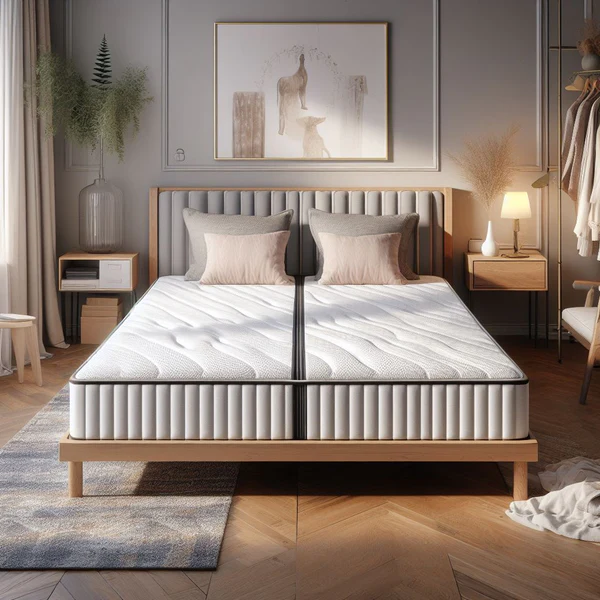
A Split King is commonly made from two Twin XL, also called Twin Long, mattresses. Each is nominally 38 by 80 inches, so the pair forms the same 76-by-80-inch footprint as a standard king 16.
Do not assume Split California King always means two freely interchangeable 36-by-84-inch products. Configurations and ordering rules are model-specific. Tempur-Pedic, for example, treats Split California King mattresses and bases differently from two separately ordered Twin Long units and directs buyers to confirm the split configuration 6.
Verify the mattress halves, base sections, furniture frame, retainers, synchronization method, and sheet set as one system. A split surface may allow different mattress feels or independent head and foot positions when the selected products support them. It also creates a center seam and may require two fitted sheets. Check whether each side can operate independently, whether the mattress halves must have the same height, and whether a standard king or California king flat sheet is included or suitable.
Size does not determine mattress performance
King versus California king describes width and length. It does not establish:
- firmness or pressure relief
- motion isolation
- edge stability
- cooling or heat retention
- ease of repositioning
- durability
- mattress height or weight
Compare those features within the actual mattress models. A wider surface may put more distance between two sleepers, but it does not change how strongly a particular construction transfers motion. A longer mattress does not provide better support unless its model, firmness, and support system suit the sleeper.
California king is longer than a standard king, but this comparison does not make it a universal maximum. Specialty oversized beds use less standardized names and dimensions. If you are considering one, work from its exact specifications rather than its category name.
Compare the full purchase, not a generic price claim
Neither size is always cheaper or easier to find. Price, inventory, colors, firmness options, and accessory selection change by brand, model, retailer, and sale period. Build two like-for-like carts that include:
- the same mattress model and firmness
- the required frame, foundation, or adjustable base
- sheets, protector, and any topper
- delivery, setup, and removal fees
- return shipping or pickup charges
Read the trial and return terms for every component. A mattress trial may not cover a foundation, adjustable base, bedding, or assembled furniture. Confirm what can be returned, the condition it must be in, whether an exchange resets the trial, and who pays for pickup before opening or assembling the order.
A quick decision
Choose a standard king when the four extra inches of total width solve the more important fit problem and its complete frame footprint works in the room.
Choose a California king when the four extra inches of length solve the more important fit problem, the narrower surface still gives every sleeper enough room, and size-specific components are available on acceptable terms.
If both work, compare the exact mattress models and total system cost. If neither leaves practical room clearance or reaches the bedroom safely, step down in size or change the frame rather than forcing the purchase.