
Most mattresses do not automatically need a box spring. You need a separate support unit when your bed frame cannot support the mattress on its own. Whether that unit can be a traditional box spring depends on the instructions for your exact mattress.
This distinction matters because manufacturers set different rules. Serta says its current mattresses can use a traditional box spring or a qualifying platform, slatted frame, or adjustable base 1. Tempur-Pedic, by contrast, says a traditional box spring does not provide the firm support its mattresses require and that using one can void the warranty 2.
The safest answer is therefore not based on whether a mattress is foam, hybrid, or innerspring. It comes from matching the mattress manufacturer's requirements to the support already built into your bed.
What is a box spring?
A traditional box spring is a fabric-covered frame with metal springs or coils inside. It sits beneath the mattress, usually on a bed frame with perimeter rails, and adds both height and some flex.
Many products now sold as "box springs" contain no springs. They are rigid foundations made with wood or metal supports under a fabric cover. The two products may look similar from the outside, but they behave differently under a mattress. Saatva's product guidance describes this shift and distinguishes its rigid slatted foundation from older coil-based box springs 3.
Check the product description and label rather than relying on the name alone. If the construction is still unclear, ask the manufacturer instead of opening or altering the cover:
- Traditional box spring: Contains springs and has some give.
- Rigid foundation: Uses fixed slats, a grid, or a solid structure without springs.
- Platform bed: A complete bed frame with a solid deck or closely spaced slats.
- Adjustable base: A powered support surface that raises or bends in sections.
- Bunkie board: A thin support panel used on some frames when the mattress maker permits it.
How to tell whether you need one
1. Read the requirements for your exact mattress
Start with the current warranty, care instructions, or support page for the mattress model. Look for:
- Whether a traditional spring unit is allowed
- Whether a rigid foundation is required
- Maximum spacing and minimum width for slats
- Center-support and leg requirements
- Whether the mattress may be used on an adjustable base
- The combined weight the support must hold
Do not borrow measurements from another brand. Published requirements vary even among major manufacturers. Serta allows no more than 2 inches between slats for the mattresses covered by its guidance, while Tempur-Pedic specifies slats at least 3 inches wide and no more than 4 inches apart for qualifying slatted frames 1 2.
Also inspect the permanent label on the mattress. Under the federal open-flame standard, a mattress set may be a mattress sold with an identified foundation or a mattress labeled for sale without a foundation. The label must state whether the manufacturer intends the mattress to be sold alone or with a foundation 4. If the label names a particular foundation, keep that information with the warranty paperwork.
2. Identify what your bed frame already supports
A bed frame and a mattress foundation are not always the same thing.
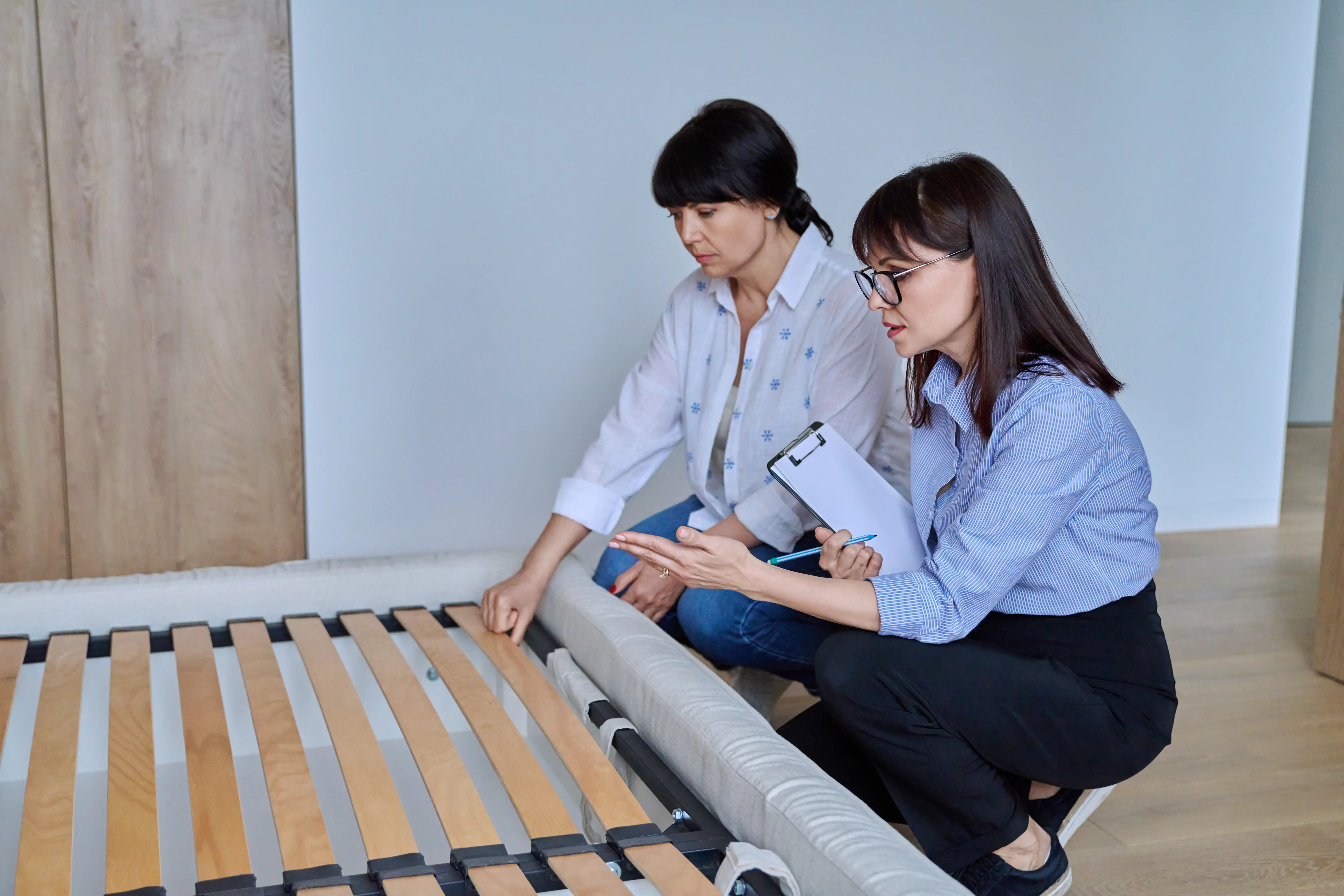
- A platform bed usually needs no separate box spring. Its solid deck or qualifying slats support the mattress directly. Confirm that its slat spacing, center support, and capacity satisfy the mattress instructions 1 2.
- A basic metal rail frame usually needs a box spring or rigid foundation. Perimeter rails and a small number of crossbars are meant to hold a support unit, not the mattress by itself.
- A slatted frame may support the mattress directly. It works only when the slats and center structure meet the manufacturer's specifications and remain flat and secure.
- An adjustable base replaces a box spring or foundation. The mattress must also be approved for bending on that base. Do not place a traditional box spring between the mattress and the adjustable base 1.
If you cannot identify the frame model or its capacity, inspect its construction and contact the frame or mattress manufacturer before adding more weight.
3. Check the condition of any support you plan to reuse
An allowed box spring can still be unsuitable if it is worn or damaged. Remove the mattress and examine the entire support. Replace or repair it when you find:
- Sagging, soft spots, or an uneven top
- Broken coils, slats, welds, or frame members
- A bowed perimeter or damaged corners
- Persistent squeaking linked to loose or broken parts
- Torn fabric that exposes sharp components
- Missing center support or legs
- A size mismatch that leaves part of the mattress unsupported
There is no useful universal age at which every box spring expires. Condition, construction, load, and the new mattress's requirements matter more than a single number. An older unit that looks flat can still flex in ways that a new mattress does not allow, so check its type as well as its appearance.
When a box spring makes sense
A box spring or similarly sized foundation can be useful when:
- The mattress manufacturer lists it as an acceptable or required support
- Your frame has perimeter rails but no deck or sufficiently close slats
- You want additional bed height and can still get in and out safely
- A split unit is needed to move a queen or king support through a tight stairway or doorway
- The mattress and foundation were designed and labeled as a set 4
A box spring should solve a defined support or height problem. It is not an automatic upgrade. A suitable unit may help the mattress stay level because it completes the support system, but a box spring cannot be assumed to make every mattress cooler, reduce partner disturbance, or extend its life. Those effects depend on the designs of the mattress, foundation, and frame.
When to skip it
Do not add a traditional box spring when:
- The mattress manufacturer prohibits spring-based support
- A platform bed or qualifying slatted frame already provides the required support
- An adjustable base is being used
- The box spring is damaged, uneven, or the wrong size
- Adding it would make the bed awkward to enter, unstable, or too tall for the frame's side rails
- Its construction, capacity, or compatibility cannot be confirmed
Mattress type alone is not a dependable rule. It is common to see general advice that foam and hybrid mattresses can never use a box spring, but manufacturer instructions are more specific. Some brands permit traditional box springs across their current mattress line, while others require a firm non-spring foundation 1 2.
Choosing the right support
Once you know which types are permitted, compare the details that affect fit and daily use.
Size
Match the mattress dimensions, not just the size name. Split configurations and component dimensions vary, so measure the frame's interior support area and check the manufacturer's dimensions before ordering.
Profile height
Low-profile and standard-profile foundations usually differ mainly in height. Choose the finished bed height by adding the frame, foundation, and mattress heights. Sit on a stable sample if possible. Your feet should have a secure path to the floor, and the mattress should remain adequately contained by any side rails.
Structural support
Confirm the unit's stated capacity for the mattress and sleepers together. Then confirm that the frame beneath it can carry that load. For wider beds, follow the required center rail, cross-support, and floor-leg instructions. A strong foundation cannot compensate for an undersupported frame.
Spring or rigid construction
Choose a true spring unit only when the mattress documentation permits that flex. When the instructions call for a firm, flat, non-spring surface, use a qualifying rigid foundation, platform, slatted frame, or adjustable base instead.
One piece, split, or folding
A split foundation can make delivery easier, but the halves need proper support and must match the mattress size. Folding metal foundations can also help with access, although their joints, slat spacing, capacity, and assembly still have to meet the mattress requirements. These formats solve access problems, not compatibility problems.
Warranty and labeling
Save the mattress and foundation labels, receipt, model details, and support instructions. Federal guidance explains that mattresses sold as sets are tested and labeled with their intended foundation, while mattresses may also be labeled for sale without one 4. The mattress warranty may impose additional support conditions.
Common setup questions
Can you put a box spring on a platform bed?
Usually, it is unnecessary because the platform already supplies support. Adding a box spring also raises the mattress and increases the load on the frame. Use this arrangement only if both product manufacturers allow it, the platform can carry the combined weight, and its rails can safely contain the taller setup.
Can a box spring sit directly on the floor?
The floor may physically hold the unit, but that does not mean the setup follows the mattress or foundation instructions. Some warranties require an approved frame or an elevated support surface. Tempur-Pedic, for example, says placing its mattress directly on the floor can trap moisture and void its warranty 2. Follow the requirements for both products rather than treating floor placement as universally acceptable.
Can you use an old box spring with a new mattress?
Sometimes. The old unit must be an approved support type, match the mattress, sit on a qualifying frame, and remain flat and structurally sound. Replace it if the new mattress requires rigid support and the old unit contains springs, even when the box spring has no visible damage.
Do memory foam and hybrid mattresses need a box spring?
There is no single rule for every foam or hybrid mattress. Many are designed for rigid support, but some manufacturers permit traditional box springs. Check the model's own documentation instead of choosing by material label alone.
What happens if you skip a required foundation?
If the frame does not support the mattress adequately, the surface may bow or sag and feel different from its intended design. Damage linked to inadequate support may also fall outside the warranty. If the bed already has a compliant platform, slatted frame, or adjustable base, skipping a separate foundation is normally the correct setup.
Bottom line
Buy a box spring only after confirming two things: your mattress permits that support type, and your bed frame cannot provide the required support by itself. For many modern setups, a platform bed, qualifying slatted frame, rigid foundation, or adjustable base is the better match. The mattress instructions, law label, frame specifications, and condition of the support are more reliable than a broad rule based on mattress material.