
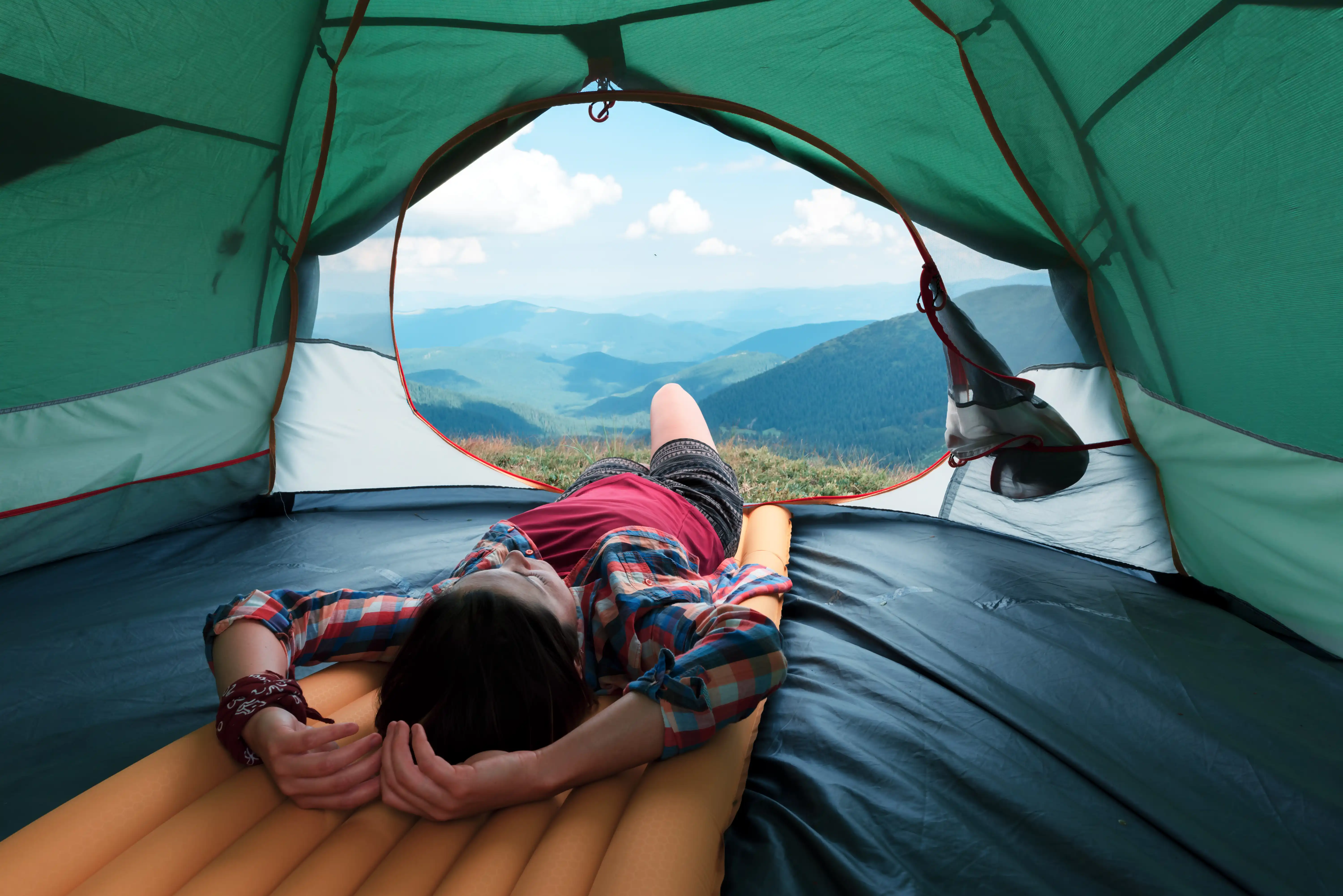
Sleeping comfortably in a tent is mostly a planning problem. The tent is only one layer. The site, forecast, ground insulation, sleeping bag or quilt, dry clothing, ventilation, and a workable nighttime exit all matter.
Start with safety because comfort cannot compensate for a campsite that may flood, a dead branch over the tent, or a thunderstorm with no route to safer shelter. The National Park Service advises campers to consider flash flooding, lightning, wind, dead trees and branches, drainage, fire separation, and local food-storage rules when choosing and arranging a site 1.
A tent can provide useful protection from wind and rain when it is suited to the conditions and pitched correctly. It is not a safe shelter from lightning, carbon monoxide, flash flooding, or dangerous cold or heat.
Plan the night before packing for it
Check the official forecast and active alerts for the campsite, not only the nearest city. Consider the full period from arrival through the next morning, as well as the road or trail you will use to leave. Conditions can differ with elevation, terrain, and distance.
Then check the land manager's current rules. Find out whether you need a designated site or permit, which fire restrictions apply, how food and scented items must be stored, whether reliable water is available, and what local hazards are active. Save the useful information before leaving coverage.
For a first trip, practice pitching the tent at home and spend the night somewhere with an easy exit. This tests the fit of the sleep system, exposes a leaking pad or missing part, and shows which ordinary sounds bother you without turning the trial into a remote emergency.
Pack around the actual conditions rather than a generic camping checklist. At minimum, the plan needs:
- a shelter designed for the expected weather;
- a pad that provides both workable cushioning and enough ground insulation;
- an adult sleeping bag or quilt chosen with the forecast and the rest of the system in mind;
- dry sleep clothing kept separate from wet daytime clothing;
- a headlamp or other battery-powered light within reach;
- required food and wildlife storage;
- water, essential medication, and a way to receive alerts or call for help when coverage exists; and
- a clear decision about where to go if the site becomes unsafe.
Choose the site for hazards first
Use a designated tent pad where one is required. Otherwise, look for firm, reasonably level ground that is not in a depression. Avoid dry washes, ravines, streambanks, visibly flood-prone ground, exposed ridges, cliff edges, and areas beneath dead or damaged branches. Make camp in daylight so you can see drainage, trip hazards, nearby water, the route to the toilet, and the route to safer shelter 1.
Remove loose sticks and stones without excavating or altering the site. Place a correctly sized footprint under the tent if the tent maker calls for one, with no exposed edge that can collect rain. A footprint protects the tent floor and can help manage surface moisture. It does not replace an insulating sleeping pad.
Pitch the shelter according to its instructions. Use the required poles, stakes, and guylines, and keep the fabric properly tensioned. Arrange the door so you can leave without stepping over a stove, fire, sharp equipment, or another sleeper. Keep the cooking and fire area outside the tent and separated as the site rules direct.
Before settling in, ask one final question: if the forecast changes at 2 a.m., can everyone find the vehicle, substantial building, higher ground, or other planned safe location in the dark? If the answer is no, change the site or the plan while there is daylight.
Build a complete sleep system
Warmth from below and comfort from below are related, but they are not the same property.
Separate cushioning from ground insulation
Cushioning controls how the pad feels at the hips, shoulders, and other pressure points. Ground insulation limits heat transfer between the sleeper and the ground. A thick or soft pad is not automatically warm, and a thin pad is not automatically inadequate.
When a pad reports an R-value measured under ASTM F3340, that value is a standardized comparison of thermal resistance. The standard itself cautions that a laboratory value will not always match real-world performance because factors such as edge losses, uncovered areas, compression, and sleeping posture can change heat transfer 2.
There is no single R-value prescription that is right for every sleeper and every trip. Consider the forecast, ground conditions, your previous experience, the sleeping bag or quilt, clothing, pad integrity, and what you will do if the system is not warm enough. Test the combination before relying on it in consequential conditions.
Read sleeping-bag ratings as reference points
ISO 23537-1 provides laboratory test and labeling requirements for adult sleeping bags within its scope. It describes steady-state cold protection, but it does not turn a printed temperature into a guarantee for a particular person or night. The standard does not apply to bags for children or babies 3.
Check whether the advertised number is a standardized rating and which value on the label it represents. Then account for the whole system. Ground insulation, bag fit, dampness, clothing, wind exposure, fatigue, individual cold sensitivity, and product condition all affect the result. Do not create a universal safety margin by simply subtracting a fixed number of degrees from the forecast.
A practical test is whether you can lie in your normal sleep position without compressing the insulation against the tent wall, sliding off the pad, or leaving gaps that expose you to cold air. If the forecast is close to the limits of your experience or equipment, choose a lower-consequence site or postpone the night.
Keep the insulation dry
Moisture can come from rain, wet clothing, damp ground, and the water vapor people exhale. Use the tent's vents and rain protection as designed. Ventilation can reduce condensation, but it cannot promise a dry inner wall in every combination of weather, site, and occupancy.
Keep wet footwear and clothing away from the sleeping insulation. If the shelter has a vestibule, use it only as the manufacturer and land manager allow, and keep the exit clear. Do not cook there. Avoid pressing the sleeping bag against a damp tent wall, and protect dry sleep clothing inside a reliable inner bag or container.
In hot conditions, shade that remains safe, open vents, less insulating bedding, and airflow may improve comfort. Do not remove weather protection when rain, wind, insects, or another hazard makes that unsafe. In cold conditions, avoid going to bed in sweaty clothing and adjust layers before sweat soaks the insulation.
Make the unfamiliar feel manageable
The first night may include voices, wind, wildlife sounds, campground lights, and an early sunrise. Try to reduce the controllable disruptions without blocking information you may need.
Choose a quieter site away from toilets, roads, group sites, and generators when the campground layout allows. Use an eye mask if you can remove it easily. Earplugs may help in a low-risk setting, but they can also make it harder to hear an alarm, a child, a companion, changing weather, or wildlife. Use them only when that tradeoff is acceptable.
Keep a headlamp, shoes, an appropriate warm or rain layer, and any time-critical medication in a consistent reachable place. Keep the doorway and guylines easy to identify. A short familiar routine, such as washing up, reading, or quiet audio, can make the transition easier. Camping does not need a special ritual, and it is not a proven cure for insomnia or a way to reset every sleep schedule.
A simple first-night plan
- Arrive with enough daylight to inspect the site, pitch correctly, and learn the route out.
- Check the latest forecast and alerts again before settling in.
- Inflate or unfold the pad early, inspect it, and lie on the full sleep system before dark.
- Finish cooking outside, clean up, and secure every attractant by the local rule.
- Change into dry sleep clothing and isolate wet gear from the sleeping insulation.
- Put light, shoes, layers, water, and essential medication where you can reach them without searching.
- Agree on the response to thunder, rising water, a fire, an animal at camp, or a person becoming ill.
- If the system is clearly too cold, too hot, too wet, or too exposed, use the exit plan. Enduring a worsening hazard is not part of learning to camp.
Safety boundaries that comfort advice cannot replace
Keep combustion out of the tent
Never use a fuel-burning stove, grill, charcoal, lantern, or portable heater inside a tent or other enclosed sleeping shelter. Never use a fuel-burning heater or lantern while sleeping. The U.S. Consumer Product Safety Commission reports deaths from camping heaters, lanterns, and stoves used in tents, campers, and vehicles, while the CDC specifically warns against indoor charcoal and portable gas camp stoves 45.
Carbon monoxide has no color or odor. Headache, dizziness, weakness, nausea, vomiting, chest pain, confusion, or unusual sleepiness can be warning signs. If carbon monoxide is possible, get everyone into fresh air, call emergency services, and do not go back for equipment 5.
Cook well outside and away from the tent, dry vegetation, and other flammable material. Follow current fire restrictions, never leave a flame unattended, and make sure a permitted campfire is fully out before sleep.
Treat cold exposure as a health issue
Hypothermia can develop in cool, wet conditions, not only during deep freezes. Warning signs include persistent shivering, exhaustion, confusion, fumbling hands, memory problems, slurred speech, and unusual drowsiness. A person with these signs may not recognize the danger clearly 6.
Move the person into warm, dry shelter, remove wet clothing, begin warming the center of the body with dry insulation or safe external warmth, and get medical help. Handle a severely affected person gently. Do not give alcohol, and do not give a drink to someone who is unconscious 6.
Act early in dangerous heat
Headache, nausea, dizziness, weakness, thirst, heavy sweating, and reduced urine can occur with heat exhaustion. Move to a cooler place, reduce excess clothing, cool the person, offer frequent sips of cool water if they are awake and able to drink, and seek medical evaluation if symptoms are significant or do not improve 7.
Confusion, altered behavior, slurred speech, seizure, loss of consciousness, or a very high body temperature can signal heat stroke. Call emergency services and cool the person rapidly while help is coming. Do not leave the person alone 7.
A tent is not lightning or flood shelter
At the first sound of thunder, move to a substantial building or an enclosed hard-topped vehicle. A tent and an open picnic shelter are not safe from lightning. The National Weather Service advises waiting at least 30 minutes after the last thunder before returning 8.
Do not pitch where water can collect or rush through. If a flash-flood warning is issued, water starts rising, or the site begins to flood, move to higher ground immediately. Do not walk or drive through water of unknown depth. Flash flooding can arrive from rain that fell elsewhere and is harder to recognize at night 9.
Follow the exact food and wildlife rule
Food storage is not a universal technique. Land managers may require a locker, approved hard-sided container, or closed vehicle, and may allow or prohibit hanging depending on the location. Rocky Mountain National Park, for example, treats food, drinks, toiletries, cosmetics, pet food, garbage, dirty cookware, and similar scented items as attractants 10. Isle Royale's 2026 rules require lockers or approved hard-sided containers in many situations and prohibit food hanging in campgrounds 11.
Keep food, trash, dirty cooking equipment, and scented items out of the sleeping tent. Read the current rule for the exact park, forest, or other land unit rather than assuming a generic bear-bag method is acceptable. Guidance for an animal encounter also differs by species and place, so use the land manager's instructions rather than one universal reaction.
If a time-critical medication must remain immediately available but the local rules treat it or its container as an attractant, ask the land manager how to handle that conflict before the trip.
Do not improvise with sleep medication or alcohol
Take regular medication as prescribed and plan how to keep it dry and accessible. Do not take an extra dose or add an unfamiliar sleep aid because the tent feels uncomfortable.
If you use a prescription insomnia medicine, follow its medication guide and the prescriber's instructions. The FDA warns that Z-drugs can cause complex sleep behaviors and next-day impairment, and it advises against combining them with alcohol or other sleep medicines 12. Alcohol can also increase hypothermia risk and should never be used to warm up a cold person 6.
If sleep remains difficult
One poor night in an unfamiliar place does not prove that you need new equipment or a sleep treatment. Make a note of the specific failure point: pressure from the ground, cold underneath, a damp bag, noise, light, worry about the site, or insufficient room. Change that factor before buying a completely new system.
If trouble falling asleep, repeated waking, unusual nighttime behavior, or substantial daytime sleepiness also happens at home, address it as a sleep or health concern rather than a camping problem. Loud snoring, witnessed breathing pauses, gasping, and daytime sleepiness are among the symptoms that can occur with sleep apnea 13. A clinician can help identify whether the cause is insomnia, a breathing disorder, medication effects, pain, or another condition.
The goal is not to make a tent behave like a bedroom. It is to create a dry, workable sleep system in a site you can leave quickly, then recognize when weather or health has moved the night beyond what that system can safely handle.