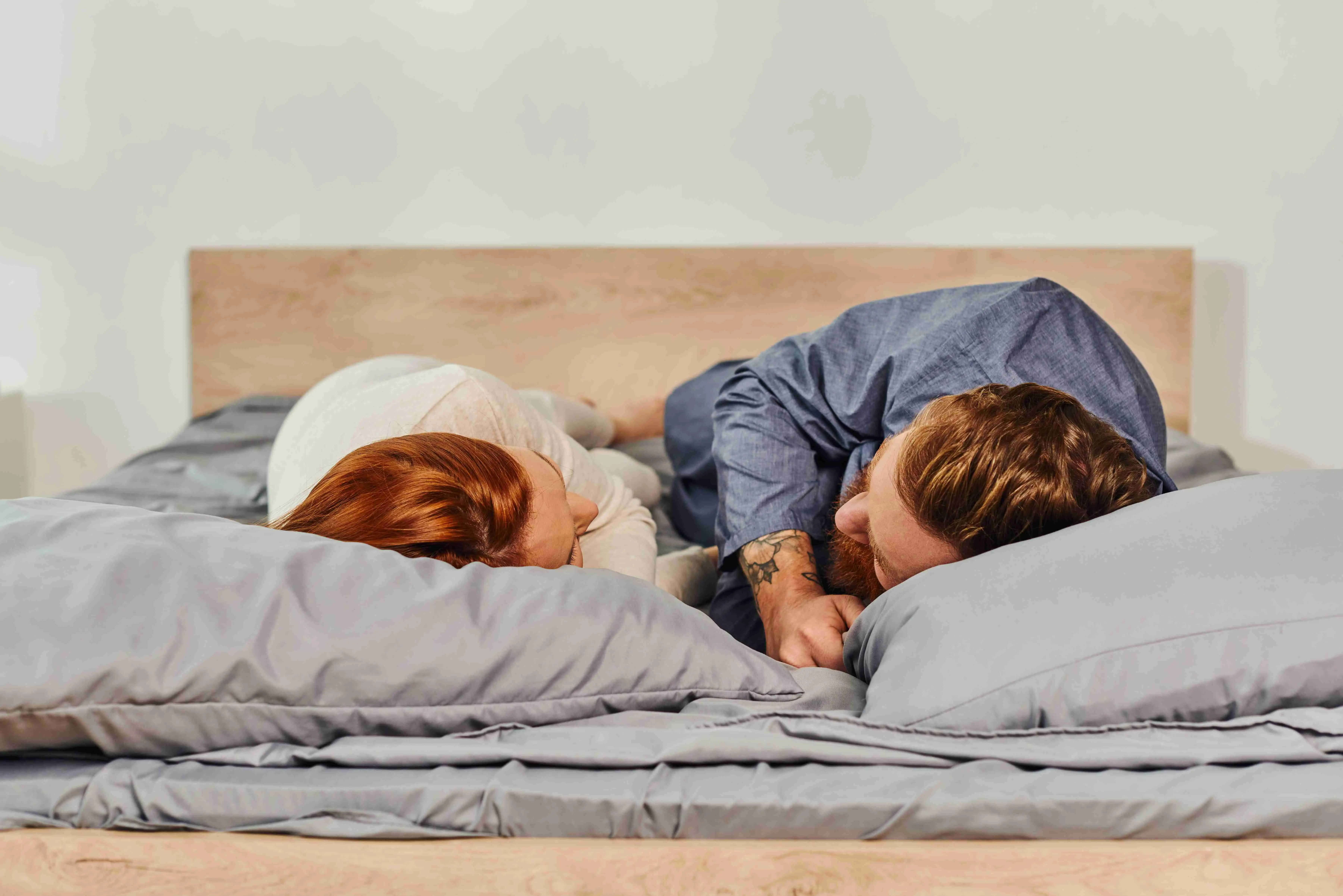


Sleeping on your stomach is not automatically harmful if you are an otherwise healthy adult, breathe comfortably, and do not wake with pain or numbness. There is no high-quality evidence that every adult needs to avoid the position 1.
The main practical issue is that most stomach sleepers must turn their head to one side to breathe. Depending on your body and setup, that position may irritate the neck, jaw, shoulder, arm, or back. The right question is not whether stomach sleeping is universally bad. It is whether it repeatedly worsens a symptom for you or conflicts with medical guidance that applies to your situation.
What the research can and cannot tell us
Confident rules about the healthiest posture go beyond the available evidence. A 2019 scoping review found only four eligible studies on adult sleep posture and spinal symptoms. The studies were small, used different methods, and often relied on people reporting their own position. Some results linked prone or partly rotated postures with waking symptoms, but the reviewers concluded that the evidence was not strong enough for firm recommendations 1.
A later cross-sectional study recorded 53 adults over two nights. Participants with waking neck symptoms spent more time in postures the researchers classified as potentially provocative than participants without those symptoms. Because the study was small and cross-sectional, it could not show whether the posture caused the pain, whether pain changed the way people slept, or whether another factor affected both 2.
These limitations matter. Stomach sleeping may aggravate symptoms in some adults, but an association in a small group does not make it dangerous for every comfortable stomach sleeper. Your repeated experience is more useful than a rigid position rule.
Signs that stomach sleeping may not suit you
Reconsider the position if you repeatedly notice:
- Neck pain, stiffness, headache, or reduced movement after waking.
- Jaw or facial pain on the side pressed into the pillow.
- Shoulder pain, arm numbness, tingling, or weakness.
- Lower- or upper-back pain that improves when you use another position.
- Breathing that feels restricted because of pressure on the face or chest.
- More awakenings because you must keep moving away from discomfort.
These symptoms do not prove that stomach sleeping caused an injury. Look for a repeatable pattern. If a symptom appears only once, consider other explanations such as daytime activity, illness, stress, or an existing condition. If it returns after several stomach-sleeping nights and eases in another position, that pattern is a reasonable reason to change the setup or position.
New weakness, persistent numbness, severe pain after an injury, chest pain, or shortness of breath needs medical assessment rather than more pillow experiments.
Try comfort changes one at a time
If you prefer sleeping on your stomach and remain comfortable, you do not need to force a change. If symptoms appear, test one small adjustment at a time so you can tell whether it helps.
You might try:
- Changing only the head support. Test less or more support based on comfort. There is no universal pillow height that corrects alignment for every stomach sleeper.
- Changing where your arms rest. Move an arm that is overhead, trapped under your body, or provoking shoulder or hand symptoms.
- Testing one body support. A small support under the pelvis, lower abdomen, or upper chest changes how the position feels for some people. Keep it only if it reduces symptoms and does not make breathing harder.
- Using a partial side position. Turning the torso slightly may reduce the amount of head rotation. Stop if it creates new pressure or twisting discomfort.
- Trying a side or back position. A different position is the simplest comparison when stomach sleeping repeatedly causes symptoms.
Treat these as comfort trials, not as methods that realign the spine or prevent future injury. Do not change the pillow, mattress, body supports, and sleep position all at once. Do not treat any mattress type or firmness as a proven best choice for every stomach sleeper.
Give priority to the outcome you can observe: less pain, fewer numb or tingling sensations, comfortable breathing, and sleep that is not repeatedly interrupted. Stop a trial that makes any of these worse.
Stomach sleeping is not an OSA treatment
A person may snore less in one position than another, but that does not show that obstructive sleep apnea (OSA) is controlled. Research on positional therapy largely concerns people with diagnosed positional OSA whose breathing events are worse on their backs. In a Cochrane review, positional therapy generally aimed to keep people on their sides, not specifically on their stomachs. The studies were short, and continuous positive airway pressure reduced breathing events more than positional therapy 3.
Do not start stomach sleeping to treat snoring, replace prescribed positive airway pressure, change device settings, or assume oxygen levels are safe. AASM guidance states that OSA diagnosis should be based on a comprehensive sleep evaluation and appropriate sleep testing, not a position preference or symptoms alone 4.
Ask for an assessment if you have repeated loud snoring, witnessed pauses, gasping or choking during sleep, morning headaches, or daytime sleepiness. If sleepiness makes driving unsafe, do not drive.
Breathing discomfort while lying on your stomach also deserves attention even when OSA is not the cause. Do not force the position if you feel that you cannot get a full breath. Seek prompt care for new or worsening breathlessness, especially when it occurs in more than one lying position.
Pregnancy changes the advice
In early pregnancy, stomach sleeping is generally fine if it remains comfortable. The NHS advises going to sleep on either side after 28 weeks, including for nighttime sleep and naps 5.
You do not need to keep using a stomach position as your abdomen grows or the position becomes uncomfortable. Use pillows only for comfort, and follow your midwife's or obstetric clinician's advice if your pregnancy has complications or you have been given different positioning instructions.
Follow recovery and condition-specific restrictions
A surgeon or clinician may temporarily restrict stomach sleeping after an operation, injury, procedure, or during treatment for another condition. The reason and duration depend on what was treated. Follow the written recovery instructions even if the position feels comfortable, and ask the treating team when it is safe to resume if the instructions are unclear.
Do not use stomach sleeping to press on, stretch, or test a healing area. New wound drainage, fever, worsening swelling, severe pain, or breathing difficulty after a procedure should be discussed promptly with the clinical team.
Adult advice does not apply to babies
Stomach-sleeping advice for adults must never be applied to infants. The American Academy of Pediatrics recommends placing babies on their backs for every sleep until age 1, on a firm, flat, noninclined sleep surface with soft objects and loose bedding kept out 6.
Once a baby can roll both ways independently, continue placing the baby down on their back and keep the sleep space clear. The baby can remain in the position they reach on their own. Tummy time belongs in awake, supervised periods, not sleep.
When a change is worth making
You do not need to train yourself out of a comfortable stomach-sleeping habit simply because it has a bad reputation. A change is reasonable when the position repeatedly provokes pain, numbness, breathing discomfort, or awakenings, or when pregnancy or clinical recovery guidance takes priority.
Make one adjustment, compare the symptom that matters, and keep only what helps. Persistent symptoms deserve an assessment for their cause rather than an endless search for a supposedly perfect sleep posture.