
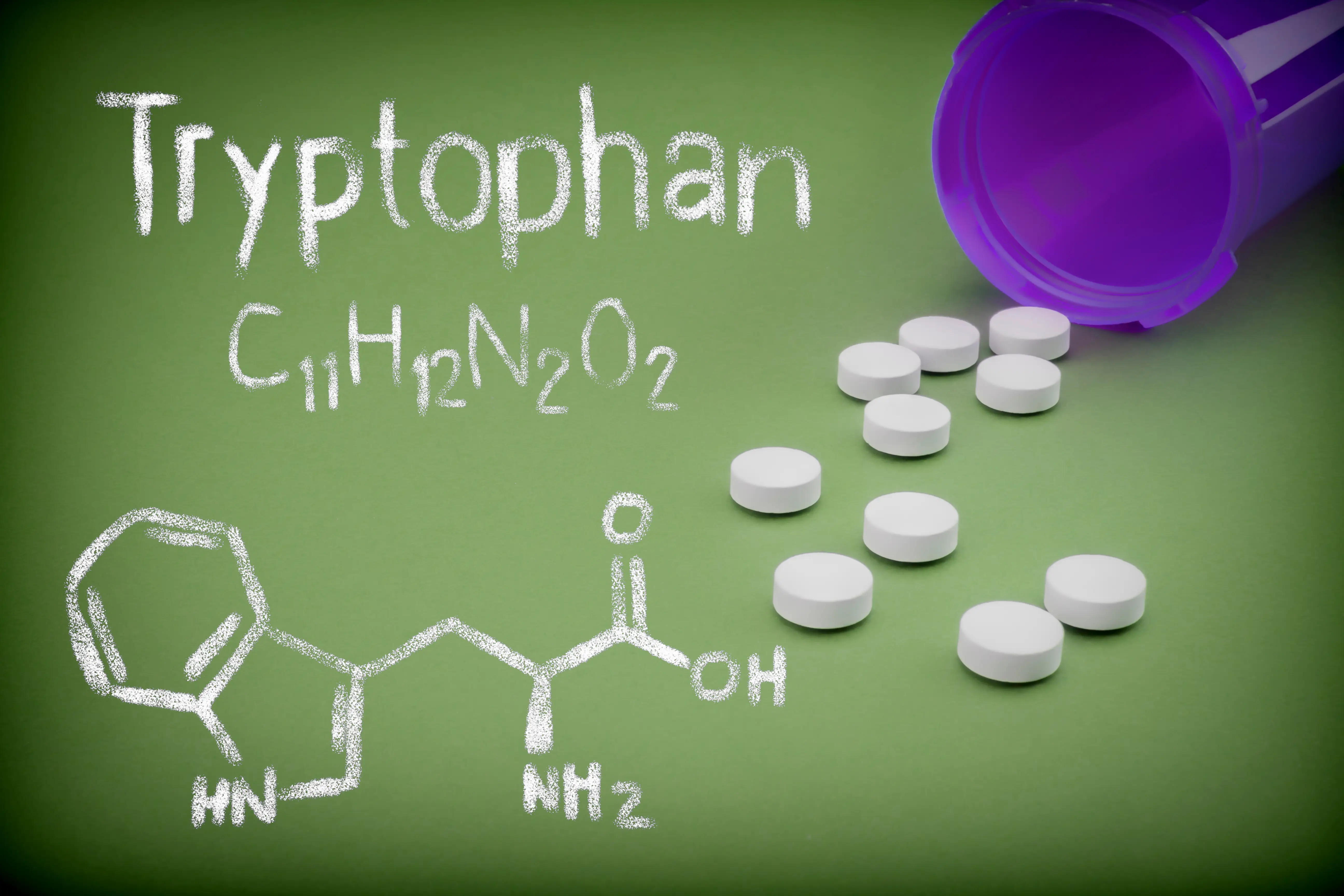
Tryptophan is an essential amino acid, one of the building blocks used to make and maintain proteins. The body cannot make it, so it has to come from dietary protein. The body can also use tryptophan in biochemical pathways that lead to serotonin and melatonin 1.
That precursor role is real, but it is often oversold. Eating a tryptophan-containing food does not send all of that tryptophan to the brain, and taking more does not automatically produce a predictable rise in serotonin, melatonin, or sleep. Transport into the brain, competition from other amino acids, enzyme activity, tissue location, dose, timing, and the rest of the meal all matter 2.
Food tryptophan, L-tryptophan, and 5-HTP are not interchangeable
These terms describe related but different exposures:
| Term | What it means | What not to assume |
|---|---|---|
| Tryptophan in food | Protein-bound tryptophan eaten as part of foods such as poultry, fish, eggs, milk, cheese, soy, peanuts, and seeds 1 | A normal serving is not equivalent to an isolated supplement or a tested insomnia treatment. |
| L-tryptophan supplement | An isolated form of the amino acid, sold alone or in a multi-ingredient product | Findings from one formulation, amount, or population do not establish the effect of another product. |
| 5-HTP supplement | 5-hydroxytryptophan, the next intermediate between tryptophan and serotonin in that pathway 3 | It is not another name for L-tryptophan. Efficacy and safety evidence for either ingredient cannot be transferred to the other. |
This distinction also separates nutritional adequacy from sleep treatment. A varied diet with adequate protein supplies tryptophan for normal physiology. The sources reviewed here do not establish poor sleep as a diagnostic test for tryptophan deficiency, and the sleep evidence does not support treating insomnia by simply chasing foods with the highest tryptophan number 14.
Does turkey make you sleepy?
Turkey contains tryptophan, but so do chicken, fish, dairy, soy, peanuts, and seeds 1. Turkey is not a uniquely sedating food.
Tryptophan shares a transporter into the brain with several other large neutral amino acids. A protein-containing meal supplies those competitors at the same time. Carbohydrate can change the ratio under tightly controlled conditions, but a 2022 mechanistic review concluded that the proposed carbohydrate effect would require protein levels too low to make the mechanism relevant to a normal mixed diet 2.
Someone can still feel sleepy after a large holiday meal. That experience does not show that turkey's tryptophan was the cause. The evidence does not justify a turkey bedtime prescription, a high-carbohydrate pairing rule, or a claim that eating tryptophan-rich food in the evening reliably increases deep or restorative sleep.
Does L-tryptophan improve sleep?
The direct human evidence is limited and inconsistent. It also combines studies that differ in formulation, amount, timing, population, comparator, and measurement method. Those differences matter because a food-source preparation, an isolated supplement, and a multi-ingredient or carbohydrate combination are not the same intervention.
| Evidence | What was studied | What the result means |
|---|---|---|
| 2017 AASM pharmacologic guideline | The formal recommendation relied mainly on a one-week study of 31 adults comparing food-source and isolated tryptophan preparations, with carbohydrate, against carbohydrate alone. Sleep was recorded in diaries. Two older short trials used higher amounts: one collected subjective reports from 52 adults with chronic insomnia, while another used laboratory sleep recordings in 20 young men with sleep-onset insomnia 4. | Small changes in wake time after sleep onset and reported sleep quality in the lower-amount study did not meet the guideline's thresholds for clinical importance. One higher-amount trial found no subjective sleep-latency benefit; the small laboratory trial found a later-night sleep-latency signal only. Harms were not reported systematically. AASM therefore suggests that clinicians not use tryptophan for sleep-onset or sleep-maintenance insomnia in adults. The recommendation is weak because the evidence base is sparse, not because a strong body of trials proved zero effect 4. |
| 2022 systematic review and meta-analysis | The review included 18 randomized trials of tryptophan supplements or tryptophan-enriched foods in adults, but only four articles contributed to the quantitative meta-analysis. Most included reports were from the 1960s through the 1980s. Formulations, populations, sleep measures, and dietary background varied 5. | The pooled analysis found a signal for less wake time after sleep onset but not for the other sleep components assessed. Its lower-versus-higher amount comparison grouped results across different study arms rather than assigning participants within one modern dose-ranging trial. With so few pooled studies, uncertain risk of bias in older reports, and little standardization, it does not establish a recommended product, amount, timing, or treatment duration 5. |
The later review does not turn a small pooled signal into a general insomnia recommendation. It is possible that a particular formulation has an effect in a particular population, but current evidence does not identify that combination reliably or show that routine use produces a meaningful overall improvement in sleep.
What to know before considering a supplement
In the United States, dietary supplements are not approved by the FDA for safety and effectiveness before they are marketed. Manufacturers must follow current good manufacturing practices, and the FDA can inspect facilities, monitor products, investigate reports, and take action after marketing 6.
A label also does not prove quality. Independent quality-testing seals can indicate that a tested product was properly manufactured, contains the listed ingredients, and does not contain harmful levels of tested contaminants. They do not prove that the product is safe, effective, or right for one person's medicines and health conditions 7.
Before buying, check the exact:
- active ingredient, including whether it is L-tryptophan, 5-HTP, or a blend;
- amount per serving and suggested serving size, without treating the label as a personalized dose;
- other active ingredients that could affect sleepiness or serotonin;
- manufacturer and any independent quality certification;
- medicines, over-the-counter products, and supplements that a pharmacist needs to review.
Avoid proprietary blends that conceal the amount of each active ingredient. A third-party seal is a quality clue, not an efficacy claim 7.
The EMS outbreak and what it means now
In 1989, U.S. surveillance linked L-tryptophan-containing products to an outbreak of eosinophilia-myalgia syndrome (EMS), a rare and sometimes severe illness marked by high eosinophil counts and debilitating muscle pain 8.
A subsequent case-control investigation found that nearly all cases with a known product source had used tryptophan from one manufacturer. Specific manufacturing changes and a chemical constituent found in implicated lots were associated with illness 9. This supports a major role for product contamination or manufacturing conditions, rather than ordinary tryptophan in food.
The history should not be distorted in either direction. It does not mean that all current L-tryptophan products are contaminated, and it does not prove that every current product is risk-free. It shows why ingredient identity, manufacturing quality, adverse-event reporting, and avoiding unsupported safety claims matter.
Interactions and safety boundaries
L-tryptophan and 5-HTP products can have sedating effects, while evidence about how they affect insomnia remains very limited 10. Until the response and combination have been reviewed, do not drive or operate machinery. Ask a clinician before combining a product with alcohol, cannabis, another sleep aid, or a medicine that slows alertness. Patient guidance for tryptophan specifically advises checking alcohol and other sedating products with a clinician and avoiding hazardous tasks until the effect is known 11.
The more urgent interaction concern is serotonin toxicity. NCCIH warns that L-tryptophan may cause life-threatening serotonin toxicity when combined with medicines that affect serotonin metabolism 10. Do not rely on a short internet list to clear a combination. A pharmacist or prescribing clinician should review the exact supplement and every prescription, over-the-counter medicine, and other supplement.
Seek urgent medical help if agitation or confusion, fever, heavy sweating, tremor or muscle stiffness, overactive reflexes, poor coordination, diarrhea, or a fast heartbeat appears after starting or changing a serotonin-affecting product. These can be signs of serotonin syndrome 12. Do not stop a prescribed medicine merely to make room for a supplement; contact the prescriber first.
Pregnancy, breastfeeding, liver or kidney disease, a medically managed protein or amino-acid plan, and other complex health conditions require an individual product review. General pregnancy guidance advises checking with a clinician before starting or stopping any dietary supplement 13. The evidence reviewed here does not establish a generally safe L-tryptophan or 5-HTP product, amount, or duration for these groups.
What to do for persistent insomnia
A supplement is a poor substitute for identifying why sleep is difficult. If trouble falling asleep or staying asleep persists, causes daytime impairment, or keeps returning, a clinician can assess sleep opportunity, schedule, medicines and substances, mental and physical health, and other sleep disorders.
For adults with chronic insomnia disorder, the AASM gives multicomponent cognitive behavioral therapy for insomnia (CBT-I) a strong recommendation 14. CBT-I uses a structured combination of sleep education, behavioral changes, and cognitive strategies. It has a much larger treatment evidence base than tryptophan and can be adapted with a trained clinician or a validated program.
Tryptophan remains nutritionally essential, and its connection to serotonin and melatonin is biologically important. Neither fact proves that turkey is a sleep aid or that an isolated precursor is an effective insomnia treatment. Keep food, supplement, and 5-HTP claims separate, and base any supplement decision on the exact product, evidence, interactions, and personal health context.