

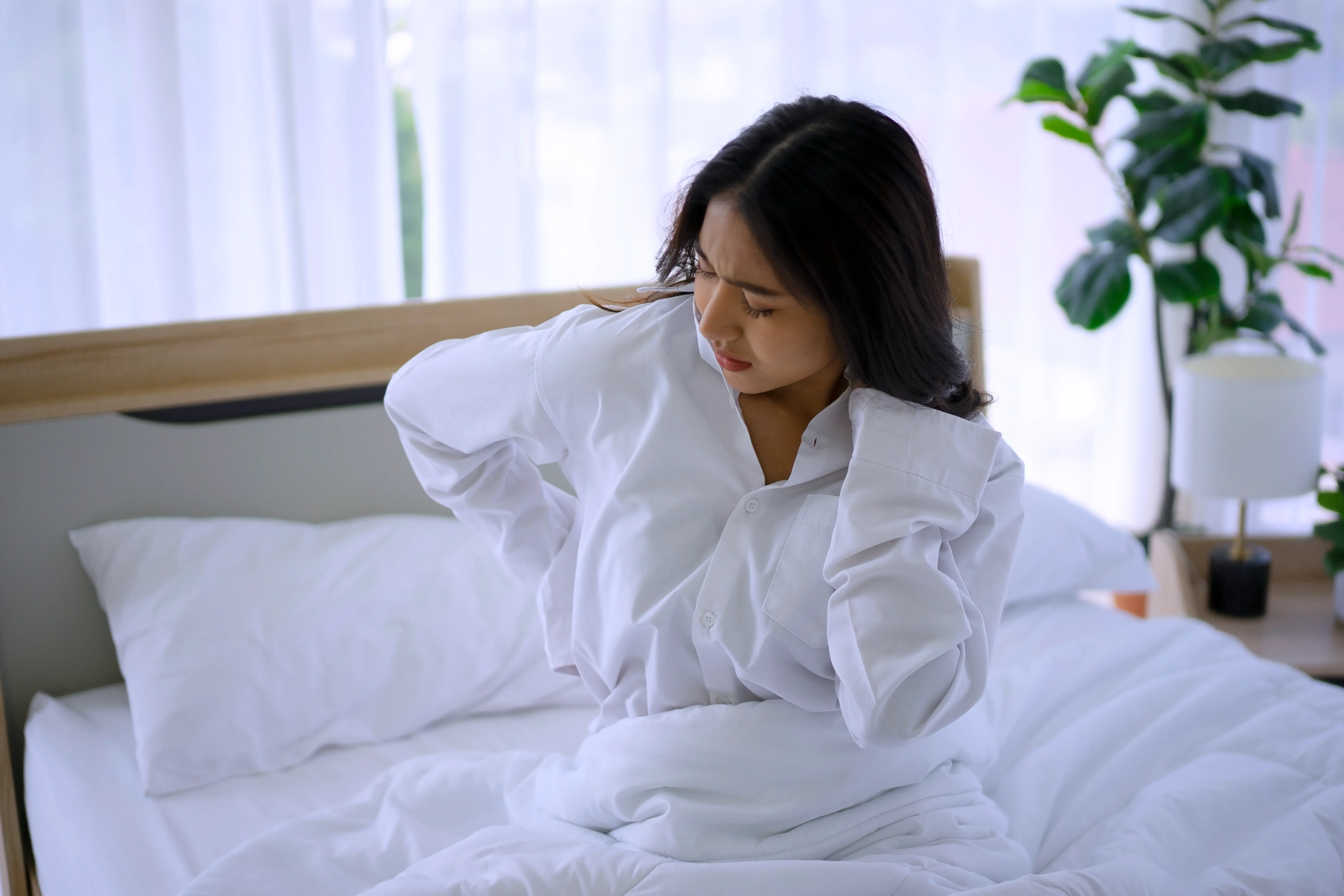
Waking up achy can follow unfamiliar physical activity, several hours without much movement, a sleep position or support setup that aggravates one area, or a night of fragmented sleep. It can also accompany a joint condition, infection, medication effect, nerve problem, or a disorder that causes persistent widespread pain.
The time of day is only one clue. Morning aches do not prove that a mattress is responsible, and they do not identify a diagnosis on their own. Start with what the symptom feels like, where it occurs, how long it lasts, and what else changed.
First, name the symptom more precisely
People use “body aches” for several different experiences. Separating them helps determine what to do next.
| What you notice | What it can tell you |
|---|---|
| Localized pain | Pain limited to the neck, shoulder, back, hip, or another area points toward a local muscle, joint, tendon, nerve, or support-related issue more than a whole-body process. |
| Widespread aching | Pain in several body regions raises different questions, including recent exertion, an acute illness, a medication effect, or a persistent widespread-pain condition. |
| Stiffness | Stiffness means movement feels restricted or difficult, especially at first. Note whether it eases as you move and whether joints are swollen or warm. |
| True muscle weakness | Weakness means you cannot produce the expected force, such as rising from a chair, climbing stairs, gripping an object, or lifting an arm. This differs from avoiding a task because it hurts. New or worsening weakness needs more attention than ordinary soreness. |
| Numbness or tingling | Pins and needles, reduced sensation, burning, or an electric quality can point toward nerve involvement. Location, persistence, and any accompanying weakness matter. |
| A swollen, warm, or discolored joint | Visible or palpable joint changes suggest a joint process rather than general muscle soreness. A suddenly hot, very painful joint with fever or feeling unwell needs urgent assessment 12. |
| Aches with illness symptoms | Fever or chills, cough, sore throat, marked fatigue, rash, vomiting, or diarrhea make an infection or systemic illness more plausible. Influenza, for example, commonly causes muscle or body aches alongside respiratory and constitutional symptoms, although symptoms alone cannot confirm the virus 3. |
The categories can overlap. A person may have joint stiffness and pain-related sleep disruption, or a recent workout and an unrelated area of numbness. Do not force every symptom into one explanation.
Common patterns to consider
Soreness after unfamiliar or harder activity
Delayed-onset muscle soreness, or DOMS, can follow activity that placed an unfamiliar load on muscles. It usually develops after the activity rather than during it and can be most noticeable over the next one to three days. A new strength session is one example, but moving furniture, gardening, a long hike, or returning to activity after a break can produce the same pattern 4.
DOMS is more plausible when the sore areas match the muscles used and the symptoms gradually settle. It is not caused by lactic acid remaining in the muscles overnight. The American College of Sports Medicine identifies that explanation as a misconception 4.
Severe pain out of proportion to the effort, marked weakness, swelling, or tea- or cola-colored urine is not routine post-exercise soreness. That combination needs immediate medical assessment for possible muscle breakdown 5.
Stiffness after rest
Several hours with little movement can make an existing muscle or joint problem more noticeable on waking. The pattern after movement is useful, but it is not a diagnostic stopwatch.
Osteoarthritis often affects one or a few joints and can cause pain with use plus a shorter spell of stiffness after rest. Inflammatory arthritis can cause warmth and swelling as well as stiffness that persists longer after waking or inactivity. Rheumatoid arthritis often affects joints on both sides of the body, especially the hands, wrists, and feet, but real presentations vary 62.
A rigid minute cutoff cannot reliably separate one condition from another. Persistent swelling, warmth, loss of function, symptoms in several small joints, or morning stiffness that keeps returning deserves clinical evaluation.
A position or support setup that aggravates one area
Position and bedding are reasonable variables to examine when pain is localized, begins during the night or on waking, and changes consistently with another setup. They are weaker explanations for fever, joint swelling, progressive weakness, numbness, or widespread pain that continues throughout the day.
Mattress studies have mainly examined sleep comfort, spinal symptoms, and back pain in selected groups. A systematic review found that medium-firm or adjustable setups often performed better than very firm mattresses on average, but the underlying studies varied in design and did not establish one best surface for every person or every pain condition 7.
This evidence does not support a universal rule about firmness, pillow height, sleep position, or replacement age. A mattress can be a testable part of the context without being the diagnosis. You do not need to buy a new product to begin investigating the pattern.
Pain and poor sleep reinforcing each other
Pain can interrupt sleep, and poor or fragmented sleep can make pain harder to tolerate. A 2024 systematic review of prospective studies found that sleep problems were associated with a higher later risk of chronic musculoskeletal pain. Evidence that the relationship works equally strongly in both directions was less certain, and the findings cannot explain one person's morning symptoms by themselves 8.
Loud snoring, witnessed breathing pauses, gasping, repeated awakenings, morning headaches, dry mouth, or significant daytime sleepiness are reasons to ask about sleep apnea. Sleep apnea can fragment sleep and leave a person unrefreshed. Those clues do not mean that apnea directly caused all-over pain, and a sleep study may be needed to determine whether apnea is present 9.
Persistent widespread pain
Fibromyalgia is a chronic condition involving widespread pain or tenderness, often with fatigue and trouble sleeping. Stiffness, concentration problems, or numbness and tingling can also occur. A single achy morning does not match that chronic, widespread pattern. Clinicians assess the full symptom history and consider other explanations 10.
Persistent widespread pain can have other causes. The useful next step is a clinical history and examination, not choosing a diagnosis from a symptom list.
Illness or a medication effect
A sudden onset of widespread aches with feverishness, respiratory symptoms, or marked fatigue points toward an acute illness more than a bedding problem. The absence of fever does not exclude influenza or another infection 3.
Medicines, over-the-counter products, and supplements can also produce unexpected symptoms or interact with one another. If the aches, weakness, or sleep disruption began after a new product, dose change, or timing change, record that relationship and contact the prescriber or pharmacist. Do not stop or change a medicine on your own, since some medicines need to be adjusted gradually or may be treating an important condition 11.
A new shoulder-and-hip stiffness pattern after age 50
Polymyalgia rheumatica almost always occurs after age 50. It typically causes pain and pronounced stiffness around both shoulders, the upper arms, hips, and sometimes the neck, especially after waking or resting. It can begin quickly and may occur with fatigue, low fever, reduced appetite, or weight loss 12.
This pattern needs prompt medical assessment rather than self-treatment. A related condition, giant cell arteritis, can cause a new headache, scalp tenderness, jaw pain while chewing, or visual symptoms. New visual loss, double vision, or other visual disturbance requires immediate care because untreated disease can cause permanent vision loss 12.
What morning aches do not prove
Several popular explanations sound specific but cannot be established from waking achy:
- “Lactic acid built up overnight.” DOMS is not caused by retained lactic acid 4.
- “I must be dehydrated.” Low intake, heat exposure, vomiting, diarrhea, marked thirst, and changes in urination provide useful context. Aches alone do not establish dehydration, and drinking more water is not a substitute for assessing severe pain, weakness, or dark urine.
- “Toxins accumulated while I slept.” “Toxins” does not identify a clinical cause unless a specific exposure or substance is named. It should not replace an assessment of the actual pattern.
- “Sleep should reset all inflammation.” Sleep supports many body systems, but it does not guarantee that joint inflammation, injury, infection, or persistent pain will disappear by morning.
- “My mattress is old, so it must be the cause.” Age alone cannot prove that a sleep surface caused pain. Consistent changes in a localized symptom are more informative than a product's age.
- “One pillow loft, firmness, or sleep position is healthiest for everyone.” Evidence does not establish a universal setup. Body dimensions, symptoms, preferences, and health conditions differ 7.
Use a one- to two-week pattern record
Unless symptoms need urgent care, a short record can make a medical conversation and low-risk self-checks more useful. Each morning, note:
- the exact locations and whether the feeling is pain, soreness, stiffness, weakness, numbness, or tingling
- approximate severity and how long it takes to ease
- whether gentle movement improves the feeling, worsens it, or makes no difference
- any joint warmth, swelling, discoloration, or reduced movement
- the previous day's exercise, physical work, long sitting, travel, injury, or unusual activity
- bedtime, awakenings, estimated sleep duration, and whether sleep felt fragmented
- snoring, gasping, dry mouth, morning headache, or daytime sleepiness reported by you or a bed partner
- feverishness, respiratory symptoms, rash, stomach symptoms, or unusual fatigue
- new medicines, supplements, dose changes, and timing changes
- menstrual, menopausal, work, caregiving, or stress changes that may affect both sleep and symptoms
The aim is not to diagnose yourself. It is to reveal whether the symptom follows activity, persists beyond the morning, clusters with poor sleep or illness, or has a joint or neurologic pattern.
Low-risk checks without guessing at treatment
Change one variable at a time so the result is interpretable.
- Compare activity with symptoms. Look for a repeatable relationship between unfamiliar exertion and the muscles that ache over the next few days.
- Check position and support without buying anything. If pain is localized, note whether a modest position adjustment or an available alternative support setup consistently changes that same pain. One better or worse night is not proof.
- Keep the room variable simple. If noise, heat, cold, or another room condition repeatedly wakes you, adjust only that factor and record whether sleep continuity and morning symptoms change.
- Use only gentle movement that feels safe and tolerable. Stop if movement produces sharp or escalating pain, new numbness, weakness, dizziness, chest symptoms, or instability. Do not use movement as a test after major trauma or with a hot swollen joint.
This process does not prescribe stretches, supplements, pain medicines, a diet, mattress firmness, pillow loft, or a purchase. The right response depends on the symptom pattern and any health conditions.
When to arrange medical care
Contact a primary care clinician if the aches:
- occur most mornings for more than one to two weeks, are worsening, or last increasingly far into the day
- interfere with walking, dressing, work, sleep, or other normal activities
- include persistent joint swelling, warmth, reduced movement, or pronounced stiffness
- are widespread and persistent, especially with fatigue, unrefreshing sleep, or concentration problems
- include fixed or progressive numbness, tingling, or weakness
- began after an injury, infection, new medicine, supplement, dose, or dosing-time change
- occur with unexplained fever, weight loss, night sweats, rash, or marked fatigue
- occur alongside loud snoring, breathing pauses, gasping, or dangerous daytime sleepiness
Seek urgent or emergency help for:
- major trauma, severe breathing trouble, chest pain or pressure, fainting, confusion, or sudden severe pain 13
- sudden one-sided facial, arm, or leg weakness or numbness, trouble speaking, a sudden vision change, loss of balance, or a sudden severe headache 14
- new trouble controlling or emptying the bladder or bowel, numbness around the buttocks, genitals, or inner thighs, or new leg weakness with back pain 15
- rapidly worsening weakness, especially with trouble breathing or swallowing 16
- a suddenly hot, swollen, very painful joint with fever, chills, or feeling very unwell 1
- one swollen, tender, painful leg, particularly if shortness of breath or pain with breathing develops 17
- severe muscle pain, marked weakness, or swelling with tea- or cola-colored urine after exertion, heat, illness, or injury 5
- after age 50, a new headache, scalp tenderness, jaw pain while chewing, or any visual symptom alongside new shoulder or hip aching and stiffness; visual disturbance needs immediate care 12
Morning aches are best understood as a pattern, not as a verdict on sleep quality or bedding. Precise symptom language, a short record, and clear red-flag boundaries make it easier to choose the right next step.