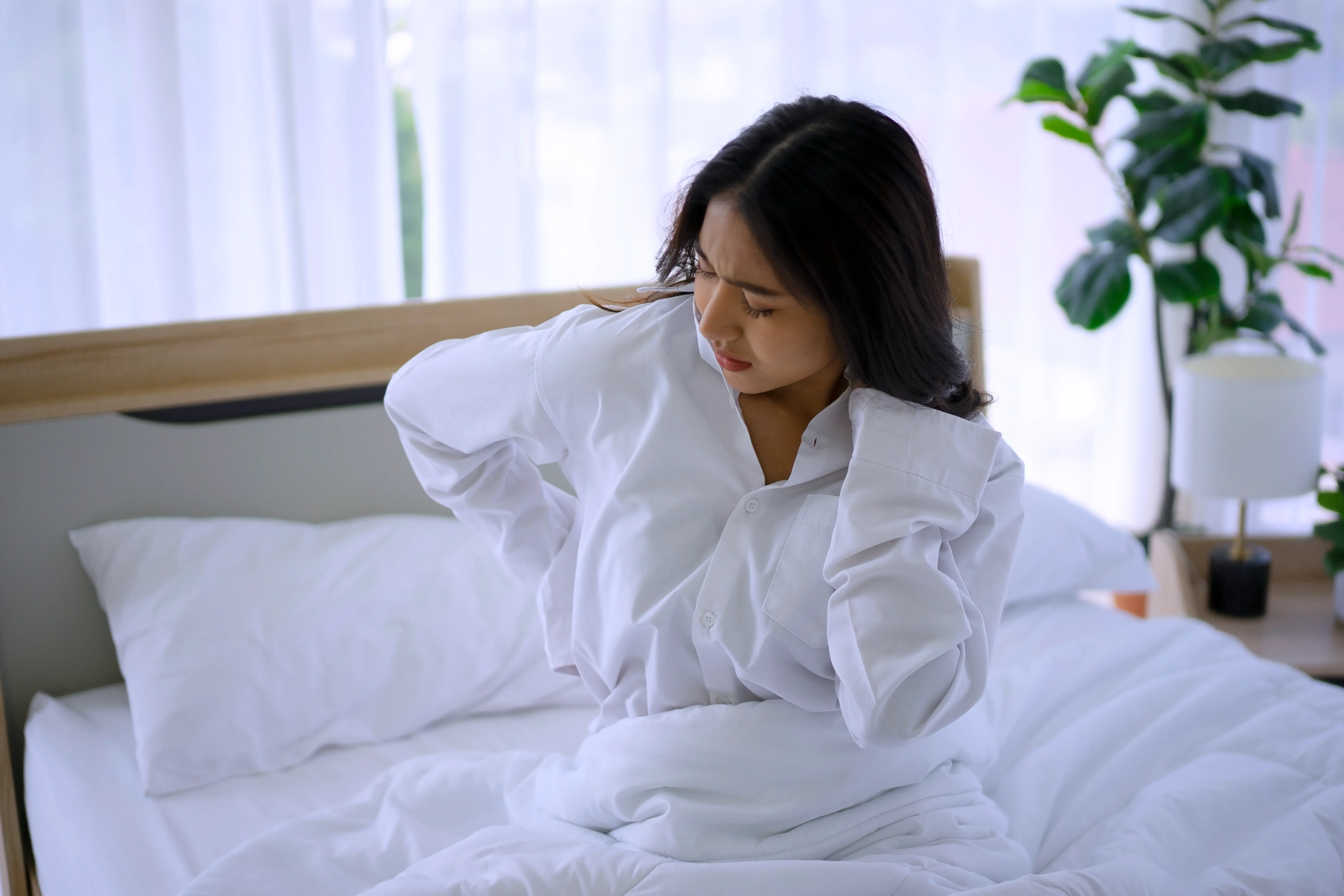

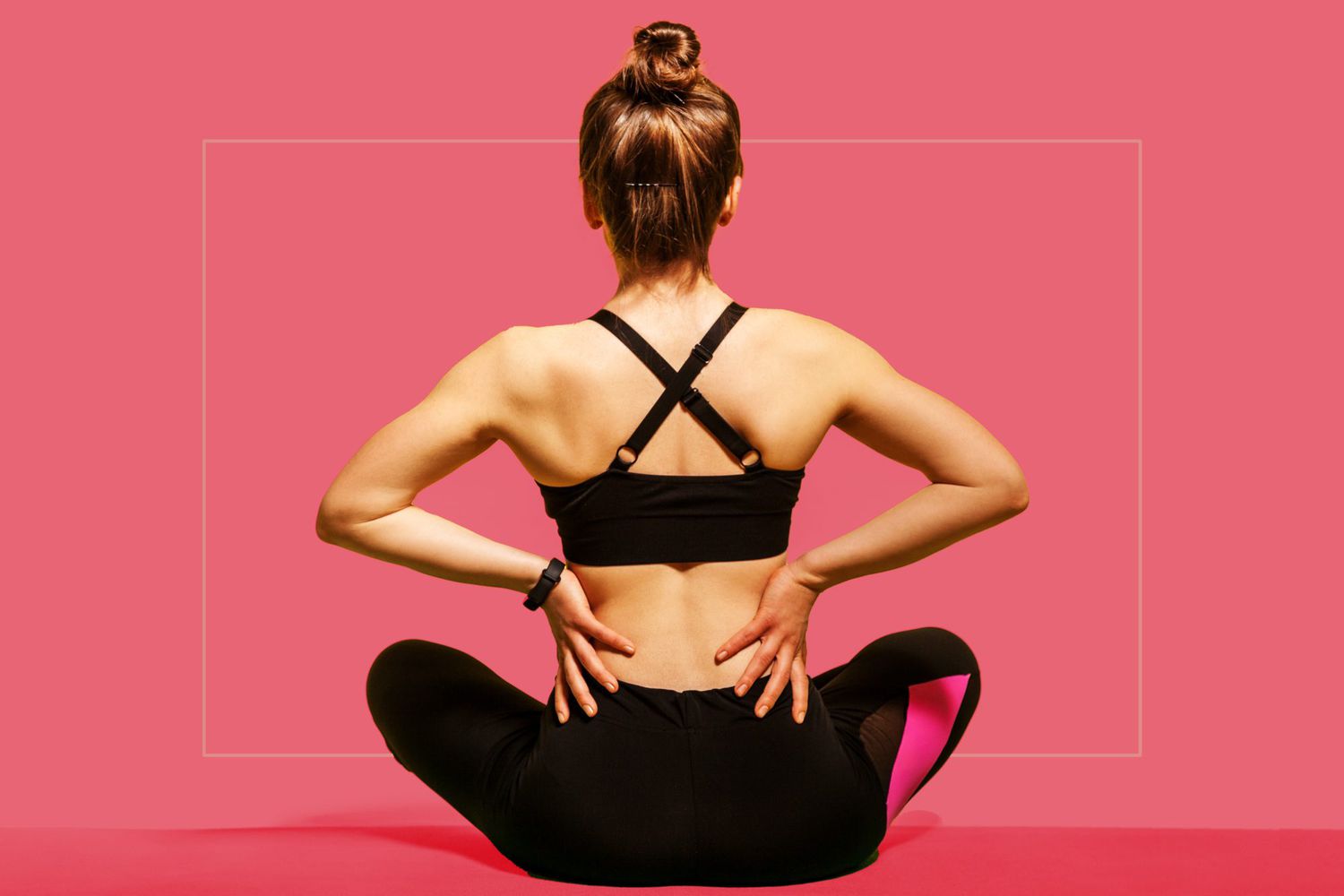
You do not need to hold your pelvis in a special position while you sleep just because it appears to tilt forward. Anterior pelvic tilt describes the angle of the pelvis. It is not, by itself, a disease, a diagnosis, or proof that the position is causing pain.
Researchers have not established a single cutoff that separates normal from “excessive” anterior tilt. A systematic review also found no overall evidence that nonsurgical treatments permanently reduce the tilt or related symptoms. The studies were few, small, varied, and judged to provide very low-certainty evidence 1.
If you have no pain or loss of function, sleep in the position that lets you rest comfortably. If your lower back, hip, or groin hurts, the useful goal is to make sleep more comfortable while the symptom itself is assessed. A pillow or position that feels better can help for the night. It does not prove that it has corrected your pelvic alignment.
Start with the symptom, not the shape
A side-view photo, a visible low-back curve, or an online posture test cannot tell you why something hurts. Before changing your sleep setup, identify the problem you are actually trying to solve:
- pain while settling into bed
- waking when you roll or change position
- stiffness or pain on getting up
- hip or groin pressure on one side
- pain, tingling, numbness, or weakness that travels into a leg
- concern about appearance without pain
The last situation does not require a corrective sleep routine. For the others, note where the symptom is, which position brings it on, and whether it eases after you move. This is more useful than trying to keep your pelvis “neutral” all night.
Research on sleep posture and spinal symptoms is limited, and it does not establish an anterior-pelvic-tilt sleep treatment. A 2019 scoping review found preliminary signals favoring side or back sleeping for some people with lumbar symptoms, but there were too few high-quality studies for firm causal recommendations 2.
Use a one-change comfort trial
Start with your usual position and change one variable at a time. That variable might be the position of one pillow, the thickness of a pillow, or the side you sleep on. Keep the rest of the setup the same.
There is no medically established number of nights for this type of home trial. A few nights is a practical starting point if the change is comfortable and safe. Compare:
- how easily you settle
- whether pain wakes you
- pain or stiffness when you get up
- how easily you can stand, walk, and begin the day
- whether your overall sleep feels better or worse
Stop the change if it increases pain, creates numbness or tingling, or makes it harder to turn or get out of bed. Keep it only if it produces a meaningful improvement. Do not judge success by whether your waist looks flatter against the mattress.
If you sleep on your back
Try placing a pillow under your knees or lower legs. Choose enough height to feel supported without forcing your knees sharply upward. This may relax the lower back and make the position more comfortable 3.
Do not force your lower back flat or add a firm roll under it because a diagram says that everyone needs one. If a small waist support feels good, it can be a separate trial. Remove it if it increases pressure or symptoms.
A knees-supported position may reduce discomfort while you are in bed. It is not retraining the pelvis or gradually correcting anterior tilt 1.
If you sleep on your side
Bend your knees only as much as feels natural. Try a pillow between the thighs and knees so the top leg does not pull uncomfortably forward or downward. A body pillow can serve the same purpose if it is easier to keep in place 3.
Adjust the pillow rather than trying to create a perfectly straight line through the spine and pelvis. A pillow that is too thick can be as uncomfortable as one that is too thin. You can also compare left and right sides if symptoms are one-sided, provided neither side conflicts with guidance you have received for another medical condition.
If you sleep on your stomach
Stomach sleeping is not proven to make anterior pelvic tilt permanently worse. The sleep-posture literature concerns symptoms rather than lasting pelvic correction, and the evidence is limited 21. You do not have to abandon a painless position because it looks less “neutral.”
If stomach sleeping aggravates your lower back, try a thin pillow under the hips and lower abdomen. You may also need a thinner head pillow if that is comfortable for your neck. Mayo Clinic presents this as a way to reduce back strain, not as a treatment for pelvic alignment 3.
If the added pillow does not help, compare a side or back position instead. Do not wedge yourself so firmly that normal turning becomes difficult.
What a pillow can and cannot do
A pillow can temporarily change how your weight is supported. It may reduce a painful pull or pressure point and help you sleep. It cannot diagnose the cause of pain, permanently reposition the pelvis, lengthen a supposedly “tight” muscle, or strengthen a supposedly “weak” one while you sleep.
Online explanations often reduce anterior tilt to tight hip flexors plus weak abdominal and gluteal muscles. That pattern should not be assumed from appearance. If symptoms persist, a clinician can assess movement, strength, hip and back symptoms, neurological findings, and the activities that matter to you rather than prescribing the same correction to everyone.
Do you need a firmer mattress?
Do not buy an extra-firm mattress solely to correct anterior pelvic tilt. Mattress firmness labels are not a diagnosis, and the anterior-tilt intervention review found no evidence that a mattress permanently changes this posture 1.
In one randomized trial, adults with chronic nonspecific low-back pain had better pain and disability outcomes after 90 days on a medium-firm mattress than on a firm mattress. The participants had back pain without referred pain, the study compared two spring-mattress firmnesses, and it did not study anterior pelvic tilt. Its result argues against the simple rule that harder is always better, not for one universal mattress prescription 4.
Before replacing the bed, check whether the mattress or its support base is visibly damaged or sagging. Then test the low-cost pillow changes first. If you do shop, prioritize a setup that is comfortable, lets you change position and get out of bed safely, and has a useful return or exchange period. Judge it by sleep and function, not a promise to force “perfect alignment.”
What to do during the day
If appearance is your only concern, you do not need to stretch or strengthen your body into a prescribed posture. If pain is persistent or limiting, staying active within your tolerance and using a clinician-guided plan may help. The World Health Organization includes education and exercise programs among recommended options for chronic primary low-back pain and emphasizes person-centered care rather than one intervention in isolation 5.
That recommendation is about managing pain and function. It does not show that planks, bridges, stretching, foam rolling, or any other standard routine will permanently correct anterior pelvic tilt. The review of anterior-tilt interventions found no overall evidence for such a correction, so an exercise plan should be chosen for your symptoms, abilities, and goals rather than a posture photo 1.
Arrange a nonurgent assessment if pain keeps returning, worsens, disrupts sleep or daily activity, or is accompanied by leg symptoms. A targeted history and examination can distinguish common nonspecific back pain from hip, nerve, inflammatory, traumatic, or other causes more reliably than a home posture label 6.
When back pain needs urgent care
Seek emergency care for back or pelvic pain with any of the following:
- a new inability to start urinating, loss of bladder or bowel control, or loss of awareness of bladder or bowel function
- new numbness around the genitals, anus, buttocks, or inner thighs, sometimes called the saddle area
- rapidly worsening weakness or numbness in both legs
- major trauma
- sudden severe back or abdominal pain with fainting, collapse, or signs of very low blood pressure
Seek prompt medical assessment for a new or worsening pain episode with fever or feeling seriously unwell, recent significant infection, immune suppression, a history of cancer, unexplained weight loss, or pain after even a smaller injury if you have osteoporosis or use corticosteroids. These features do not prove that a serious cause is present, but they change how quickly the pain should be evaluated 6.
The practical answer is simple: treat anterior pelvic tilt as a description, not a verdict. Keep a painless sleep position. If you hurt, test one small comfort change at a time, and seek assessment for symptoms that persist or suggest something more than an ordinary positional ache.