
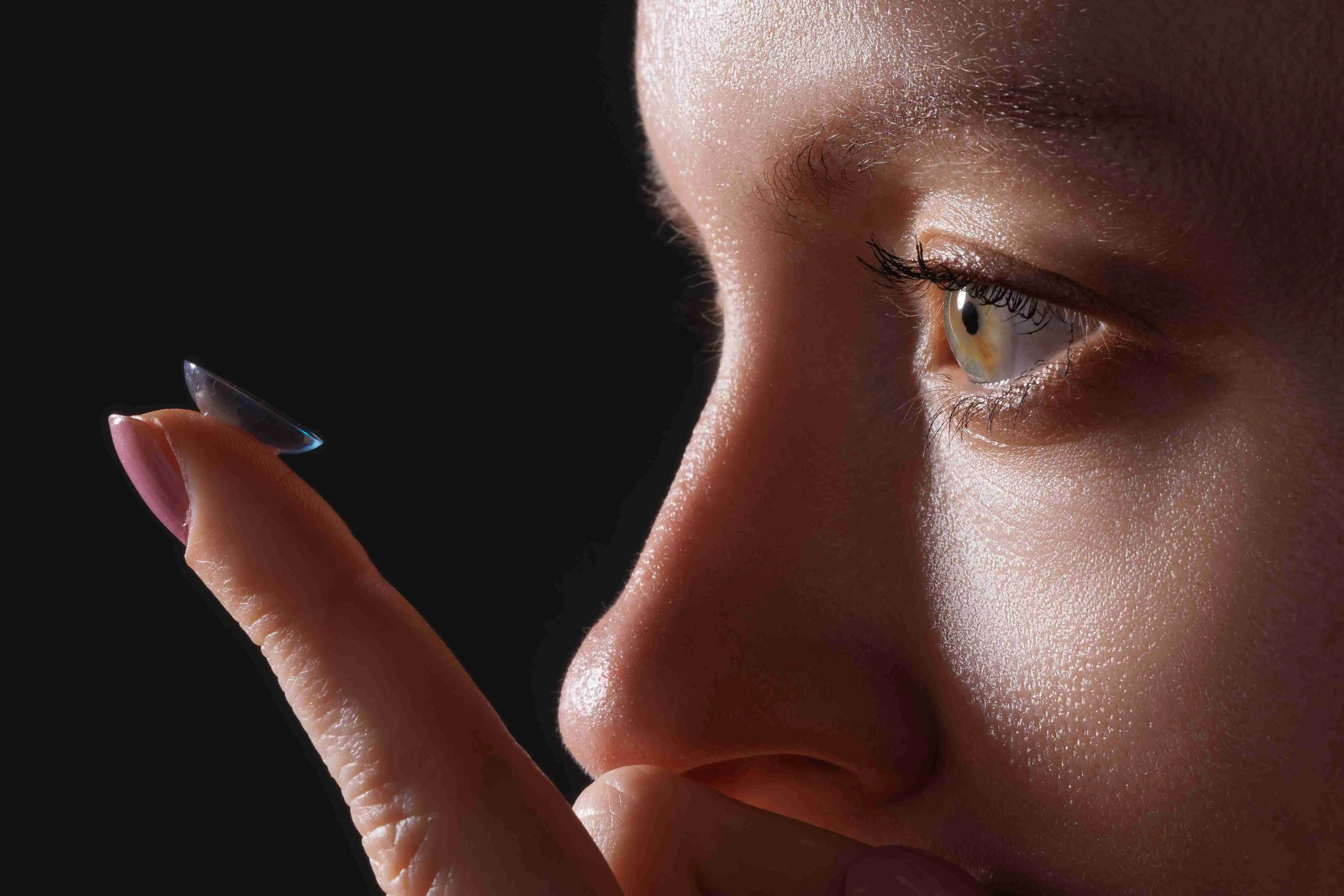
Do not sleep or nap in contact lenses unless the exact lens is authorized for overnight or extended wear and an eye-care professional has prescribed that schedule for you. Even then, overnight wear carries more risk of corneal infection and inflammation than removing lenses before sleep 12.
Authorization is specific to a lens model, use, and wearing schedule. A similar material, a familiar brand name, the word “disposable,” or a high-oxygen claim does not transfer overnight authorization from one lens to another.
Read both the wear schedule and the replacement schedule
Several contact-lens labels are easy to confuse because they answer different questions.
| Term | What it means | What it means for sleep |
|---|---|---|
| Daily-wear lens | The lens is intended for use while awake. It may be a single-use lens or a reusable lens. | Remove it before every sleep or nap. “Daily wear” does not authorize overnight wear. |
| Daily disposable lens | The replacement schedule is one use, then discard. A fresh lens is used the next day. | It is not reusable and is not automatically an overnight lens. Discard it after removal rather than cleaning or saving it for another day. |
| Planned-replacement lens | The same lens may be reused for a prescribed number of days, with the exact cleaning, disinfection, storage, and replacement routine. | The replacement interval does not authorize sleep. Many planned-replacement lenses are daily-wear only. |
| Extended-wear lens | The exact lens has authorization for a defined period that can include sleep. | Overnight wear still requires an individual prescription and schedule. Follow that schedule rather than the longest interval mentioned for another lens. |
| Overnight orthokeratology lens | A specially fitted rigid lens temporarily reshapes the cornea during a prescribed sleep schedule. Some orthokeratology lenses are daytime-only, while specific models are authorized for overnight use. | Use only the fitted model and maintenance schedule prescribed by a trained eye-care professional. It is not equivalent to sleeping in an ordinary rigid lens. |
Lens material is another separate property. Soft hydrogel, silicone hydrogel, rigid gas-permeable, hybrid, and other designs differ in oxygen transmission, movement, fit, surface behavior, and care. Those properties do not override the exact indication and prescription 13.
How much does sleeping in lenses raise infection risk?
The CDC commonly summarizes the risk as a six- to eightfold increase in contact-lens-related eye infection when people sleep in lenses, including occasional or prescribed overnight wear. Its 2018 report cites a prospective case-control study of contemporary contact-lens users as the main epidemiologic source. That study found overnight wear was strongly associated with microbial keratitis across lens types 24.
This is a relative-risk estimate from groups of lens wearers, not the probability that one person will get an infection after one nap. It does not mean every overnight episode causes damage, and it cannot calculate an individual's risk. Lens model, schedule, fit, handling, water exposure, replacement behavior, smoking, health, and the population studied can change the estimate.
The CDC report also described six serious infections linked to sleeping in lenses. Those cases show what can happen, but the authors explicitly noted that they were selected ophthalmology cases and were not representative of a typical contact-lens infection 2.
Why closed-eye lens wear is different
The cornea receives oxygen through its surface rather than through blood vessels. Closing the eyelids reduces the oxygen available at the surface, and a lens adds another barrier. During sleep, blinking stops and post-lens tear exchange also falls. Lens fit, movement, pressure, deposits, microbes, and the response of the corneal surface can contribute as well 5.
Laboratory work on corneal barrier function found that both low oxygen and tear stagnation were relevant during overnight lens wear. Improving oxygen alone did not eliminate the measured epithelial change 5.
This matters because “the lens breathes” is an incomplete safety argument. Modern higher-oxygen materials can reduce some hypoxia-related effects, but epidemiologic studies have not shown that oxygen transmission removes the infection risk of sleeping in lenses 4. The exact biological path from an overnight episode to infection is complex, and no single mechanism explains every event.
The problems are related but not interchangeable
Corneal abrasion
A corneal abrasion is a scratch or loss of surface cells on the clear front of the eye. A dry lens, debris, poor fit, or forceful removal can contribute. Abrasions can cause pain, tearing, a gritty feeling, light sensitivity, and blurred vision. Contact-lens-related abrasions need professional attention because a damaged surface can overlap with or increase concern for infection 6.
Corneal inflammatory event
Contact lenses can trigger a noninfectious inflammatory response, sometimes with small collections of inflammatory cells in the cornea. In a one-year study of 205 people using one silicone hydrogel lens for continuous wear, bacterial contamination on worn lenses was strongly associated with these corneal infiltrative events. The study applies to that extended-wear setting and does not provide an individual forecast for every lens or wearer 7.
Inflammation and early infection can feel similar. Redness, discomfort, tearing, or light sensitivity cannot reliably tell you which one is present at home.
Microbial keratitis and corneal ulcer
Microbial keratitis is an infection of the cornea caused by bacteria, fungi, amoebae, or other microbes. A corneal ulcer is an open sore in the corneal surface, often associated with infection. It may sometimes appear as a small white spot over the colored part of the eye 68.
These conditions can progress and may scar the cornea or reduce vision. Severe outcomes are possible, but they are not the result of every accidental nap. The practical message is to recognize concerning symptoms early rather than assume either harmless dryness or inevitable permanent damage.
What to do after accidentally sleeping in contacts
If you wake with severe pain, reduced vision, marked redness, light sensitivity, or discharge, treat that as an urgent eye problem and contact an eye-care professional the same day. Otherwise:
- Wash and rinse your hands, then dry them completely. Handle lenses only with clean, dry hands 9.
- Check whether the lens moves freely. Do not pinch, scrape, or force off a lens that feels dry or stuck.
- Use only a compatible in-eye product if your exact instructions allow it. FDA-cleared patient labeling for some lenses directs wearers to apply the recommended lubricating or rewetting solution and wait until a nonmoving lens moves freely before removal. That is model-specific guidance, not permission to put any saline, disinfectant, multipurpose solution, redness drop, or other liquid in the eye 1011.
- Remove the lens gently once it moves normally. If it remains stuck after the labeled steps, or removal is painful, contact your eye-care professional instead of repeatedly trying.
- Follow the exact replacement rule. Discard a single-use daily disposable lens. For a reusable lens, follow its instructions and your clinician's directions for rubbing, rinsing, disinfection, storage, and replacement. Do not put any lens back into a red, painful, light-sensitive, discharging, or blurry eye 126.
- Use glasses while you assess the eye. Do not improvise a fixed “recovery” period. If the eye is not back to normal, or symptoms develop or worsen, obtain same-day advice before resuming lens wear.
Do not rinse, wet, or store a lens in tap, bottled, distilled, lake, pool, or ocean water. Do not use saliva. Water can alter a soft lens and expose the eye to microbes, while saliva is not a sterile lens-care product. Use only the care products specified for the exact lens and system 61312.
Contact-lens solutions are not interchangeable. Multipurpose solution can clean, rinse, disinfect, and store compatible soft lenses. Saline rinses but does not disinfect. Hydrogen peroxide systems require their special neutralizing case and the full labeled process. Rigid lenses may use different wetting, cleaning, and disinfecting products. Follow the lens, solution, and case instructions together 1211.
When to get urgent eye care
Remove the lenses if you can do so without forcing them and seek same-day urgent eye care for:
- eye pain or pain that is increasing
- marked or persistent redness
- unusual sensitivity to light
- reduced, hazy, or blurred vision
- excess tearing or discharge
- swelling or a strong gritty or foreign-body feeling
- a white or gray spot on the clear cornea over the colored part of the eye
- symptoms that do not settle after lens removal or that are getting worse
The FDA advises people with irritation or infection symptoms to remove the lenses, avoid reinserting them, and contact an eye-care professional. It also advises keeping the removed lenses in their case and bringing them to the appointment because the clinician may want to examine them. Bring the case and care products too if available. Keeping a single-use lens for clinical inspection does not mean it can be reused 6.
Do not start leftover antibiotic, steroid, redness-relief, or anesthetic eye drops. Several problems can produce a painful red eye, and treatment depends on an eye examination 6.
Make accidental sleep less likely
Plan for the moment when removal is easiest, not the moment when you are already falling asleep.
- Keep current backup glasses available and carry them when away from home 9.
- Pack the exact lens supplies, compatible care system, a clean case if the lens is reusable, and spare prescribed lenses for travel.
- Remove daily-wear lenses before a flight, long ride, overnight shift break, or other situation in which you may doze.
- On evenings involving alcohol, illness, or extreme fatigue, switch to glasses before handling becomes rushed or you are likely to fall asleep.
- Do not wear lenses in a red, irritated, painful, or discharging eye. Ask your eye-care professional how illness, eye medicines, or other treatments affect your specific lenses.
- Never use water or saliva as an emergency substitute. If the correct supplies are unavailable, use glasses rather than inventing a storage or cleaning method.
Overnight authorization reduces none of the need for hygiene, replacement, follow-up, and symptom awareness. The safest rule is exact: wear the prescribed lens only for the schedule prescribed for your eyes, and remove daily-wear lenses before every sleep.