
A mattress works on an adjustable bed frame only if it can bend with the base and its manufacturer approves that use. Memory foam, latex, hybrid, and even some innerspring mattresses can qualify, but the material name alone is not enough.
Check the exact mattress model, height, size, and warranty against the exact base. If either manufacturer says the pairing is not compatible, choose a different mattress or base.
A quick compatibility check
Before buying or placing an existing mattress on an adjustable base:
-
Identify both products exactly. Find the mattress model, profile height, size, and model year, plus the base brand and model.
-
Find a written mattress approval. Look on the manufacturer's product page, support page, care guide, or warranty for “adjustable base compatible” or equivalent wording.
-
Check the base's approved mattresses. Some bases accept many flexible mattresses; others name compatible collections, profiles, or attachment systems.
-
Read both warranties. Confirm that a third-party base is allowed and note any support, weight, or installation requirements.
-
Match the configuration. Verify dimensions and whether you need one mattress, two Twin XL mattresses, a split-head model, or another brand-specific shape.
-
Confirm how the mattress is secured. Check for the required retainer bar, straps, magnets, or other model-specific attachment.
Save screenshots or written confirmation if compatibility is unclear. A retailer's verbal assurance may not help if a later warranty claim depends on the manufacturer's requirements.
“Adjustable mattress” usually means base-compatible
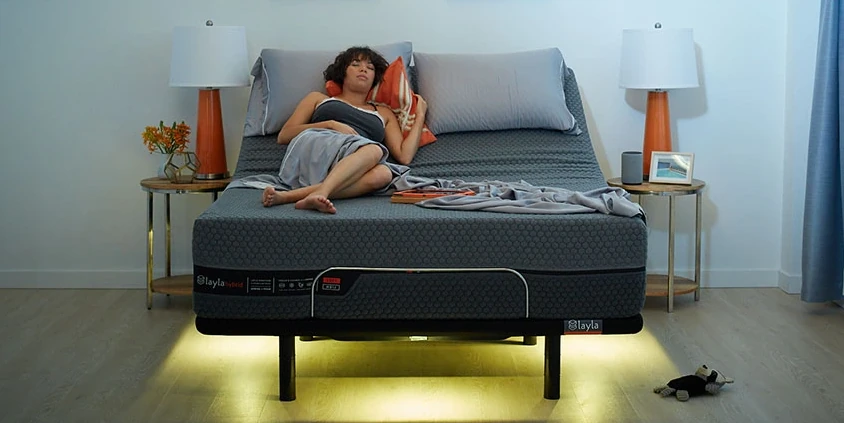
The powered part of an adjustable bed is normally the base, not the mattress. Motors and hinges raise the base platform, and the mattress bends with it.
Some mattresses have a separate firmness-adjustment system, such as internal air chambers. That is a different kind of adjustability. A mattress can change firmness without working on every moving base, and a base-compatible foam mattress does not need adjustable firmness.
For base styles, motors, controls, safety, and purchase decisions, see our adjustable bed frame guide.
What makes a mattress compatible?
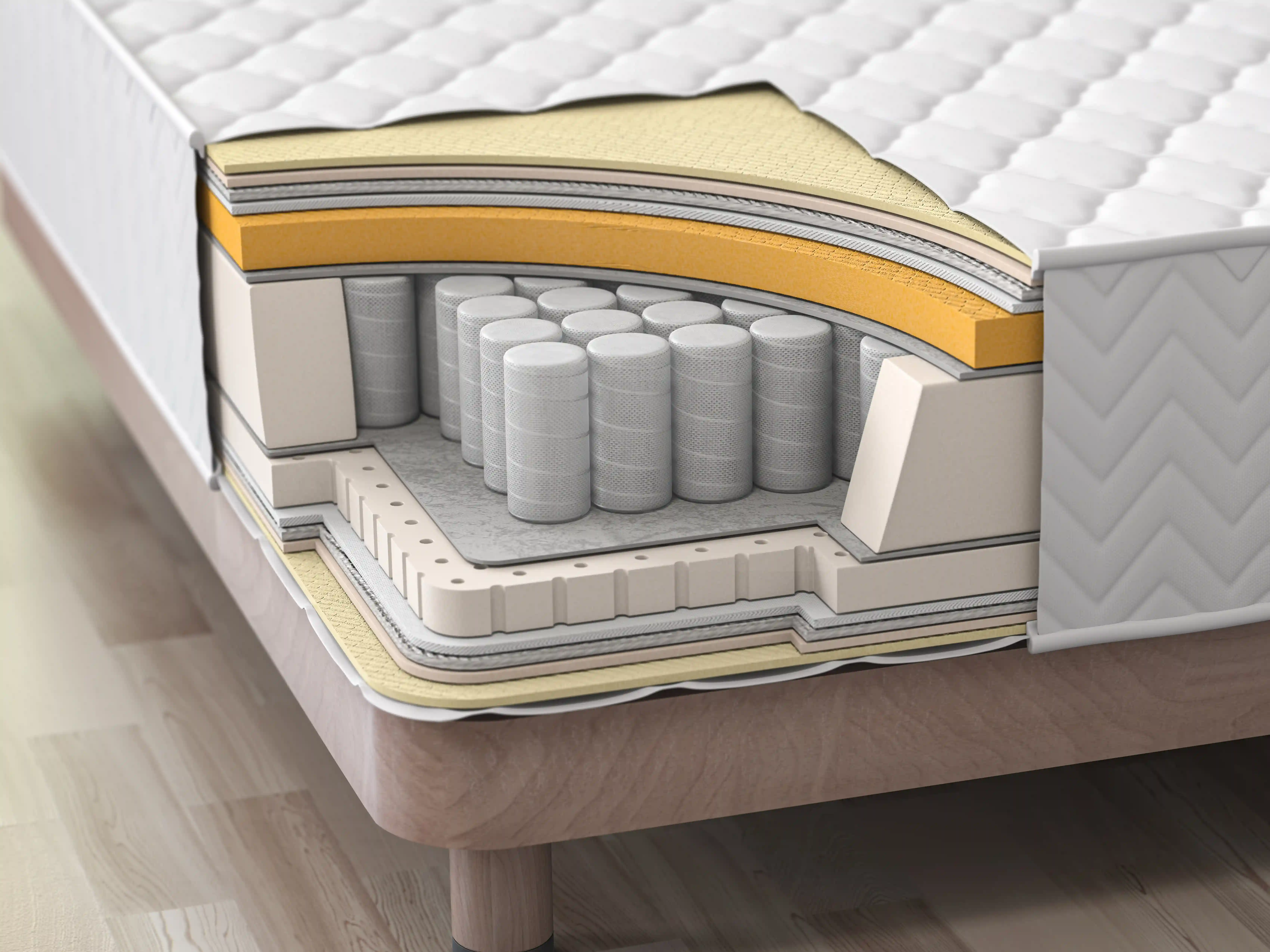
A compatible mattress must do more than bend once in a showroom. It needs to follow the platform through repeated head and foot movement without damaging its support system, bunching its layers, or placing too much resistance on the base.
Several design details affect that behavior:
-
Support-core construction: Foam blocks, latex layers, and different coil units bend in different ways. Coil shape, connection, gauge, and perimeter design can matter as much as the word “innerspring” or “hybrid.”
-
Profile and layer stack: A taller or more complex mattress may be less flexible, but height is not a universal pass-or-fail rule.
-
Edge construction: A rigid perimeter may resist articulation even when the center materials seem flexible.
-
Internal attachments: Tufting, glued layers, air hoses, sensors, magnets, and heating or cooling components may limit which bases the mattress can use.
-
Mattress weight: A heavy mattress may still be compatible, but its weight counts toward the base's total capacity and can make installation or repositioning harder.
-
Condition: Broken coils, torn seams, separated foam, or a badly sagging support core are reasons to replace or professionally assess a mattress rather than repeatedly flex it.
Compatibility by mattress construction
These categories help narrow the search, but none provides a blanket answer.
All-foam mattresses
Many all-foam mattresses can follow a moving base because their support and comfort layers are flexible. Still, density, profile, edge reinforcement, cover design, and internal features vary. Confirm the exact model rather than assuming every memory foam or polyurethane foam mattress will work.
Tempur-Pedic, for example, states that all of its current mattresses work with all of its power bases 1. That approval applies to the manufacturer's named products, not to every foam mattress on another brand's base.
Latex mattresses
Latex layers can flex, but a latex label does not establish compatibility. A thick stack, stiff edge, internal tufting, or high mattress weight may change how a specific model follows the platform. Check whether the manufacturer approves the complete mattress, not just the latex material inside it.
Hybrid and innerspring mattresses
Some coil mattresses are specifically designed and tested for adjustable bases. Others have a coil unit or profile that is too rigid. This is why the old rule that “innersprings never work” is not reliable.
Beautyrest says its current mattresses and mattresses it manufactured after 2015 work on its adjustable bases, while directing owners of other brands to the mattress manufacturer 2. That is a model-and-maker approval, not a general statement about all innersprings.
Even two versions of the same hybrid can differ. Saatva approves the 11.5-inch Saatva Classic for adjustable bases but says the 14.5-inch version lacks the required flexibility 3. The example shows why a universal recommendation such as “choose an 8- to 12-inch mattress” is too crude.
Adjustable-air and smart mattresses
Mattresses with air chambers, pumps, hoses, sensors, or powered temperature features may require a particular base, attachment method, or control system. Do not treat one like a simple portable air mattress or assume a matching size makes it compatible.
Sleep Number, for example, publishes different mattress and base configurations, including Split King and FlexTop King systems, and tells owners to follow model-specific instructions 4. Check every powered component and attachment, not just whether the mattress can physically bend.
Thickness matters, but there is no universal limit
A very tall or rigid mattress may not settle closely into the base's bends. It can bridge above the platform, slide toward the foot, or reduce the angle you feel at the surface. A thinner mattress is not automatically compatible, though, and thinness does not guarantee adequate comfort or durability.
Use the mattress maker's stated profile limit or compatibility list. If the base maker gives a separate maximum profile, meet both requirements. When the two sources disagree, follow the more restrictive instruction or ask both companies to confirm the pairing in writing.
Also calculate the finished bed height. Mattress profile does not determine flexibility alone, but it does affect sheet fit, ease of getting in and out, and whether the mattress clears a footboard or other furniture.
Retainers, attachments, and mattress sliding
Adjustable bases commonly use a manufacturer-supplied method to keep the mattress aligned. A frequent design is a retainer bar at the foot. Other systems use fabric straps, brackets, magnets, or mattress-specific fasteners. Purple's adjustable-base quick-start guide, for example, instructs owners to secure the supplied mattress retainer bar before use 5.
Install only the hardware approved for your model. Do not drill through the base, add an improvised rail, or tighten a strap around a mattress unless the instructions allow it. Unapproved hardware can damage the mattress or interfere with the moving mechanism.
If the mattress repeatedly slides or needs repositioning, confirm that:
- the mattress and base are the same stated size;
- the retainer or attachment is present and installed correctly;
- sheets, protectors, and bed skirts are not caught in the mechanism;
- the mattress is facing the correct direction; and
- the mattress is approved for the base and can follow it without excessive bridging.
Do not force a stiff mattress flat against a raised base. Lower the base and contact the manufacturer if the mattress buckles, shifts sharply, makes new structural noises, or stays suspended well above the platform.
One-piece, split, and split-head mattresses
The mattress configuration decides whether partners can move independently.
-
One-piece mattress on one base: The entire surface moves together.
-
One-piece king on two linked bases: Some manufacturers allow the bases to be synchronized so the mattress moves as one surface. Independent movement is not possible.
-
Two Twin XL mattresses on a split king base: Each side can usually move independently, provided the bases and controls are configured for it.
-
Split-head or flex-top mattress: Only the upper portion separates. This requires a base designed for the same split location and mattress shape.
Casper, for example, says its two-piece split king base can use two Twin XL mattresses for independent movement or one king mattress when the bases move together 6. Do not assume that arrangement applies to every brand, especially for California king and split-head systems.
With two mattresses, compare their height as well as width and length. Different profiles can create an uneven center seam. Also check whether each half may be a different model, because some brands require a matched pair for their attachment or warranty.
How to verify an existing mattress
Start with the law tag, receipt, or order history to identify the exact model and approximate purchase date. Compatibility can change between generations that share a similar name.
Ask the mattress manufacturer:
- Is this exact model and profile approved for an adjustable base?
- Are third-party bases allowed?
- Are there limits on the base type, movement, weight, or retainer?
- Will this pairing preserve the mattress warranty?
Tempur-Pedic's mattress warranty illustrates why this step matters. It allows a structurally suitable adjustable base but says an inappropriate base can void coverage and that the owner may need to prove the foundation or base was adequate 7.
Then ask the base manufacturer whether it accepts the mattress's construction, dimensions, profile, and weight. If both approve, place the mattress on the fully installed base and test partial movement slowly. Stop if it catches, buckles, slides past its restraint, or strains the mechanism.
FAQs
Can I use my current mattress on an adjustable base?
Yes, if the exact model is approved, is in sound condition, fits the base, and does not violate either warranty. Do not rely on appearance or material alone.
Is memory foam always compatible?
No. Many memory foam mattresses work, but profile, edge construction, layer design, weight, and manufacturer restrictions can still rule out a model.
What is the best mattress thickness for an adjustable bed?
There is no universal best range. Use the limits for the exact mattress and base. A profile that works in one product line may be too rigid in another.
Can I put one king mattress on a split king base?
Some brands allow it when the two base halves are synchronized. The mattress will move as one surface, so partners cannot choose different angles. Confirm the combination with the base maker before purchase.
Do split king mattresses have to match?
Not always, but both Twin XL mattresses must be individually approved for the bases. Matching heights usually produces a more even surface, and a manufacturer may require a matched set for its attachment system or warranty.
Do I need special sheets?
A one-piece adjustable mattress may use ordinary fitted sheets if the pockets fit securely through movement. A split king normally needs two Twin XL fitted sheets. Deep pockets are not automatically better because loose fabric can slip or bunch; match the sheet depth to the mattress profile.