
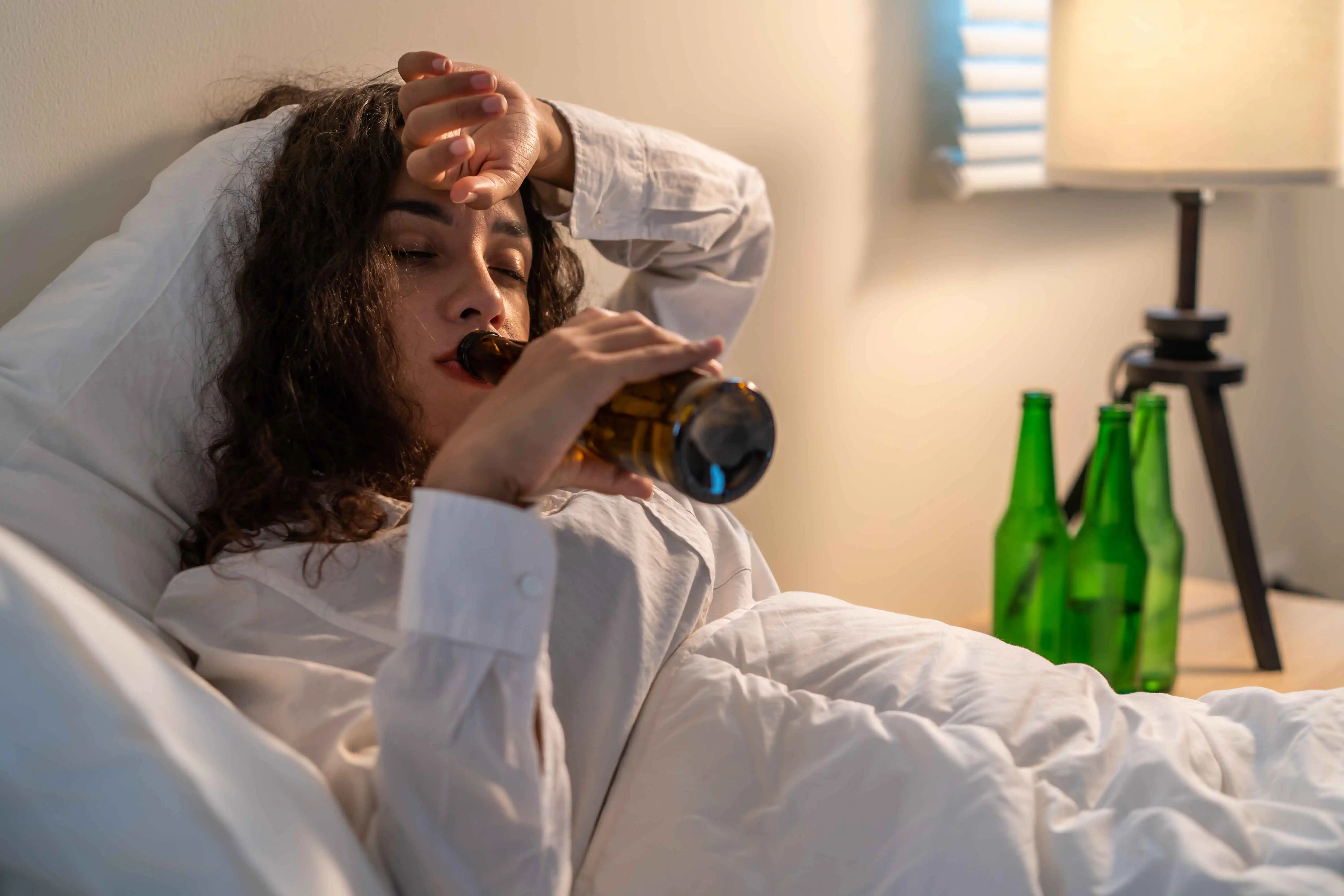
Alcohol may make you feel sleepy, but it is not a reliable sleep aid. The strongest recent evidence finds that lower doses can reduce rapid eye movement (REM) sleep, while only high doses consistently shorten the time it takes to fall asleep. Drinking more to fall asleep faster trades a possible short-term sedating effect for greater disruption and more acute risk 1.
How much you drink matters. Timing, body size and composition, sex, food, medications, drinking pace, tolerance, and individual metabolism can also change the response. This is why one person's “nightcap” cannot predict another person's night.
What acute studies show
A 2025 systematic review and meta-analysis combined 27 studies of healthy adults. REM sleep started later and took up less of the night after alcohol. The effect appeared at doses of 0.5 grams of alcohol per kilogram of body weight or less, which the researchers described as roughly two standard drinks, and became larger as the dose increased 1.
Falling asleep faster was a different story. The review found a shorter sleep-onset time only at high doses of at least 0.85 grams per kilogram, described as roughly five standard drinks. That is not a useful insomnia treatment. It is a high exposure that further disrupted REM sleep and can bring substantial safety risks.
The studies do not establish an exact effect for every person. They generally tested measured doses in healthy adults under controlled conditions, often close to bedtime. Results were too inconsistent to determine a clear overall effect on total sleep time, sleep efficiency, or minutes awake after initially falling asleep 1.
Why the first and second halves of the night can feel different
Alcohol's sedating effect is strongest while blood alcohol concentration is rising or high. Early in the night, a person may feel drowsier and sleep may seem more consolidated. As the alcohol is metabolized, that sedation fades. Sleep can become lighter and more broken later.
A controlled study of 93 healthy adults ages 21 to 31 illustrates this pattern at an intoxicating dose. Compared with placebo, alcohol consolidated sleep in the first half of the night but increased disruption in the second half. Across the whole night, participants had less REM sleep, lower sleep efficiency, and more wakefulness. Women in this study had greater disruption in several measures than men 2.
That study reached an average peak breath alcohol concentration of about 0.11%, so it should not be used to predict what one lower-dose drink will do. It does show why feeling deeply asleep at the start of the night is not proof that the full night's sleep improved.
How alcohol changes REM and non-REM sleep
Healthy sleep cycles repeatedly through non-REM and REM stages. Alcohol changes that sequence rather than reproducing normal sleep.
REM sleep
REM is the clearest and most consistent sleep-stage finding. Alcohol delays the first REM period and reduces REM duration across the night. The 2025 analysis found a dose-response pattern, with progressively more REM disruption as alcohol dose increased 1.
You may see claims that REM always “rebounds” later and makes up for the early loss. The evidence does not support treating that as a guaranteed recovery. Even where later REM increases, the night's sequence has still changed, and the recent meta-analysis found an overall reduction rather than a dependable full catch-up.
Non-REM sleep
Higher doses may bring on stage N3, sometimes called deep sleep, sooner. That does not mean alcohol creates better or more restorative deep sleep. In the 2025 review, earlier entry into N3 occurred only at high doses, and many other whole-night sleep measures remained uncertain 1.
A tracker may label a block of early sleep “deep” and still miss the broader issue. Consumer devices estimate sleep stages rather than measuring them with the full set of brain, eye, and muscle signals used in a sleep laboratory.
Alcohol, urination, and nighttime waking
Alcohol suppresses vasopressin, a hormone that tells the kidneys to retain fluid. This can increase urination and fluid loss 3. Drinking a large volume of any beverage late in the evening can also leave the bladder fuller during the sleep period.
Whether that produces nocturia, meaning waking to urinate, varies. The amount and timing of alcohol and other liquids matter, as do age, bladder capacity, diuretic medicines, diabetes, heart or kidney conditions, and sleep disorders. Sometimes a person wakes for another reason and then decides to use the bathroom, so every nighttime trip is not proof that the bladder caused the awakening.
Water can help replace fluid, but it cannot restore REM sleep or cancel alcohol's sedating effects. Drinking a large amount immediately before bed may create another reason to wake.
What you may notice the next day
A disrupted night can leave you tired even after enough hours in bed. A hangover may add headache, thirst, nausea, weakness, anxiety, or irritability. Hangover symptoms often peak as blood alcohol concentration returns to around zero and can last 24 hours or longer 3.
The concern is not just comfort. Attention, decision-making, and coordination can remain impaired during a hangover, affecting driving, operating equipment, work, or caring for another person 3. Coffee, a shower, more alcohol, or a supplement does not speed the brain's recovery. Time is required.
Do not drive because a clock, wearable, or home breath tester seems reassuring if you still feel impaired or sleepy. Arrange another driver or delay the task.
What changes with regular use
Tolerance can hide the sedating effect
With repeated use, the same amount may no longer produce the same drowsiness. Needing markedly more alcohol for the desired effect, or getting much less effect from the usual amount, is tolerance. It is one possible symptom of alcohol use disorder (AUD), but tolerance by itself does not make the diagnosis 4.
Increasing the dose to “make it work again” raises the chance of sleep disruption, injury, overdose, and dependence. Sleep may also become linked with the expectation of drinking, even though objective sleep remains poor.
Sleep problems and alcohol can reinforce each other
Some people drink because they cannot fall asleep. They may then wake early or sleep poorly and drink again the next night. Among people with AUD, sleep disorders are common, and sleep changes can persist into recovery before gradually improving. The relationship runs both ways: alcohol can worsen sleep, and ongoing sleep difficulty can make recovery harder 5.
AUD is a medical condition diagnosed from a pattern of symptoms over time, not from one bad night or a single drink count. Possible signs include repeatedly drinking more than intended, unsuccessful efforts to cut down, craving, continued use despite harm, hazardous use, tolerance, and withdrawal 4. A primary care clinician or addiction specialist can assess the full pattern without relying on a sleep complaint alone.
Withdrawal-related insomnia is different from an ordinary restless night
Feeling more alert or restless as one evening's alcohol wears off is not automatically alcohol withdrawal syndrome. Withdrawal is more likely after the nervous system has adapted to frequent, heavy use.
Symptoms can include insomnia, tremor, sweating, anxiety, nausea or vomiting, and a fast pulse. Severe withdrawal can involve seizures, hallucinations, or delirium and can be life-threatening 4 6.
If you drink heavily most days, have had withdrawal symptoms before, or drink to stop shaking or feeling ill, get medical advice before stopping suddenly. Seek emergency care for a seizure, hallucinations, severe confusion, inability to stay awake, or trouble breathing. Managing withdrawal is a safety step, not a complete treatment plan for AUD 6.
Sleep may remain unsettled during early recovery. That does not mean the body needs alcohol to sleep. A clinician can address both the drinking pattern and insomnia rather than using one problem to maintain the other.
Alcohol, snoring, and sleep apnea
Alcohol can relax the upper airway and worsen snoring or obstructive breathing in susceptible people. If you snore habitually, wake choking or gasping, have witnessed breathing pauses, or remain very sleepy during the day, see alcohol and sleep apnea for the focused evidence and treatment guidance 7.
A quieter alcohol-free night does not rule out obstructive sleep apnea. Likewise, alcohol is not a diagnostic test. Continue prescribed PAP or oral-appliance treatment whenever you sleep.
Medication and overdose safety
Do not mix alcohol with opioids or benzodiazepines. Together they can suppress breathing and increase the risk of profound sedation, overdose, and death. Labels for “Z-drug” insomnia medicines such as zolpidem, zaleplon, and eszopiclone also warn against alcohol 8.
Other prescription, over-the-counter, and herbal products can interact with alcohol too. Check the label and ask a pharmacist or prescriber about the specific product. Taking alcohol and a sedating medicine at different clock times does not necessarily prevent an interaction.
Call emergency services if a person who drank alcohol cannot be awakened, has slow or irregular breathing, vomits while not fully conscious, has a seizure, or develops blue, very pale, or clammy skin. Stay with the person and do not assume they can sleep it off 9.
Practical ways to protect sleep
If sleep is the priority, the most dependable choice is not to drink that evening. If you choose to drink, these steps can reduce risk without pretending there is a perfect formula:
- Keep the amount lower. Current public-health limits are general risk limits, not a promise of undisturbed sleep 10.
- Count standard drinks rather than glasses or cans. In the United States, one standard drink contains 14 grams of pure alcohol, and a strong beer, large wine pour, or mixed drink may contain more than one 11.
- Finish earlier than you usually do and compare how you sleep. More time between drinking and bed is a practical harm-reduction approach, not a scientifically guaranteed cutoff.
- Do not drink more because the first amount did not make you sleepy.
- Keep prescribed sleep-apnea treatment in place and avoid combining alcohol with sedating medicines.
- Record the amount, last-drink time, awakenings, bathroom trips, wake time, and next-day alertness for several drinking and non-drinking nights.
Changing from wine to beer or spirits does not remove the ethanol dose. Different ingredients may change hangover symptoms for some people, but the dose-response research on sleep is based on the amount of alcohol itself 1 3.
There is no universal “safe bedtime cutoff.” Alcohol absorption and clearance vary, and the sleep studies do not identify one interval that protects everyone. Moving drinking earlier and reducing the amount may lower exposure near sleep, but neither guarantees unaffected sleep.
If you are using alcohol for insomnia
Regular trouble falling asleep, staying asleep, or waking too early deserves a direct treatment plan. Cognitive behavioral therapy for insomnia (CBT-I) is the strongest recommended behavioral treatment for chronic insomnia in adults. It combines strategies that address sleep timing, time awake in bed, habits, and unhelpful beliefs about sleep 12.
A generic sleep-hygiene list, supplement, or herbal drink is not an automatic substitute for alcohol or for an insomnia evaluation. Bring a one- to two-week sleep diary to a clinician. Include alcohol, caffeine, medications, naps, awakenings, and daytime sleepiness so the underlying pattern can be addressed.
The bottom line
Alcohol can create drowsiness without creating reliably better sleep. Lower doses can reduce REM sleep, while only high doses consistently shorten sleep onset. Later-night fragmentation, increased urination, and next-day impairment may add to the cost, but the size of each effect varies.
If you drink, less and earlier is a reasonable harm-reduction approach, not a guaranteed sleep-safe formula. Do not use alcohol as insomnia treatment, do not mix it with opioids or benzodiazepines, and get medical guidance before abruptly stopping frequent heavy use. Persistent insomnia, possible sleep apnea, tolerance, or withdrawal symptoms deserve targeted care.