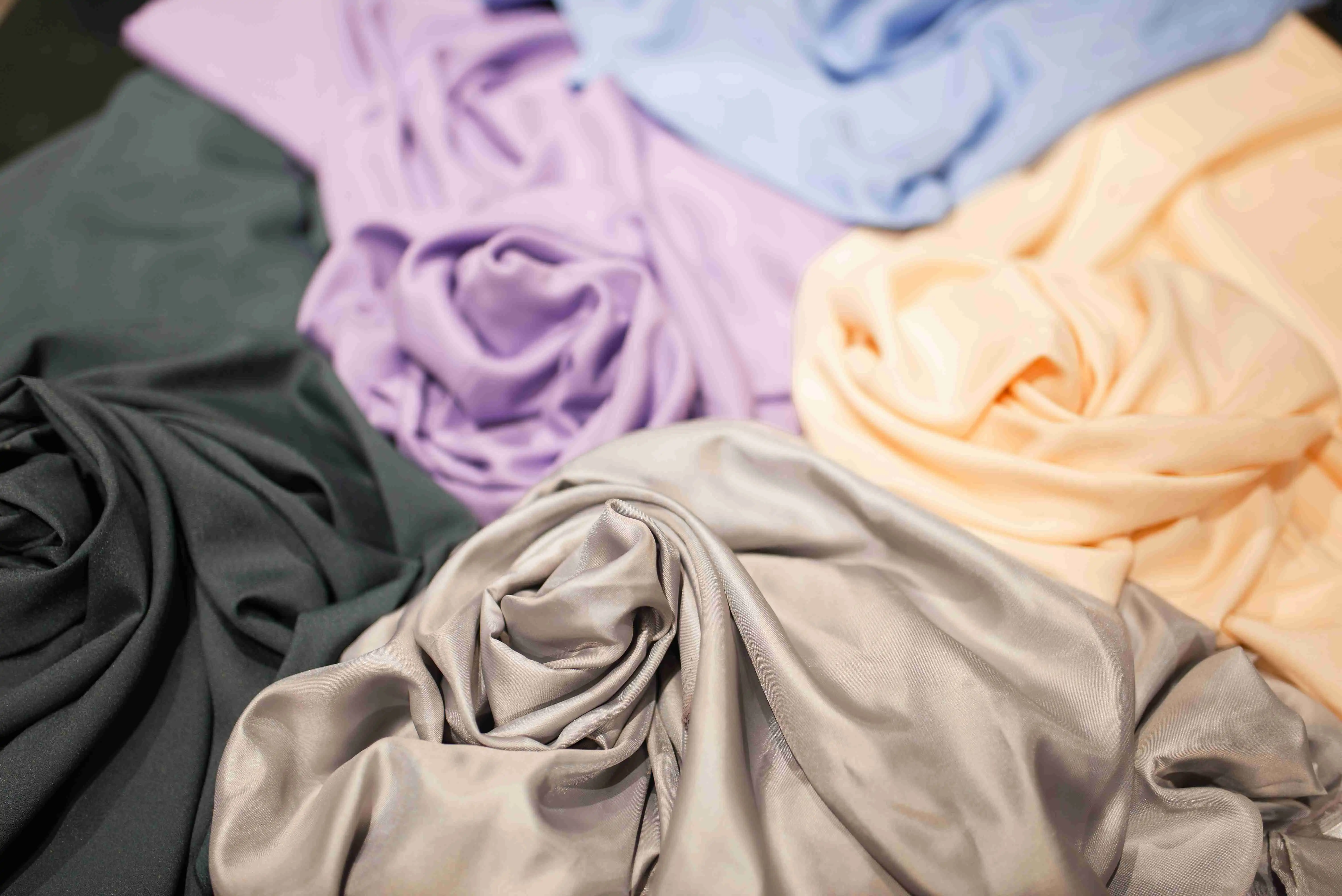
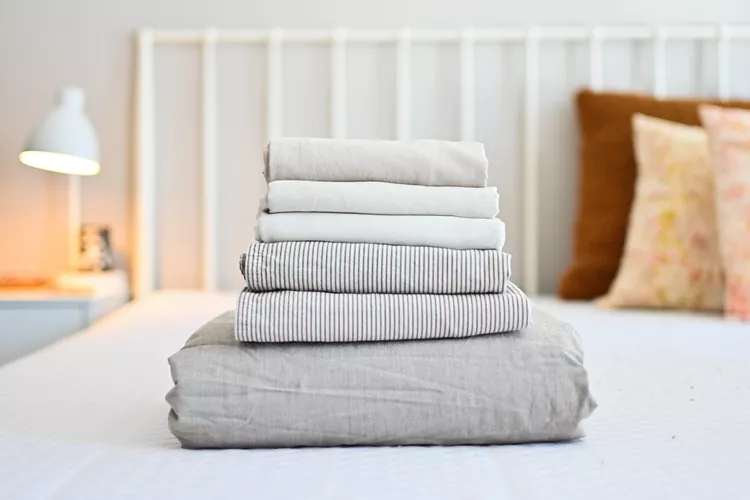
There is no single best sheet material. Cotton and linen absorb moisture but tend to wrinkle. Polyester usually dries quickly and resists wrinkles but absorbs little perspiration and can hold oily soil. Regenerated cellulose fibers such as viscose, lyocell, and modal often feel soft and fluid. Silk feels smooth but can require gentler care.
Those are tendencies, not guarantees. A light cotton percale and a dense cotton sateen contain the same fiber but do not feel or sleep alike. Yarn size, fabric weight, weave or knit, brushing, chemical finishes, and laundering can matter as much as the fiber name.
The useful order is:
- Fiber: What the yarn is made from, such as cotton, flax, polyester, or lyocell.
- Construction: How the yarn becomes fabric, such as percale, sateen, jersey, or flannel.
- Finish and specification: Treatments and measurements such as brushed, wrinkle-resistant, washed, thread count, and fabric weight.
Percale and sateen are therefore constructions, not materials. "Bamboo" and TENCEL™ also need careful reading because one usually identifies a plant source and the other is a trademark, not a generic fiber name.
How to read a sheet's fiber label
In the United States, most textile labels must disclose the generic fiber names and percentages by weight in descending order, the manufacturer or responsible business, and the country where the product was processed or made. A fiber present below 5% is normally listed as "other fiber" unless it has a definite functional role 1.
A clear fiber-content statement might read:
100% cotton60% cotton, 40% polyester100% viscose made from bamboo100% lyocell
The content statement does not have to tell you the weave, yarn quality, fabric weight, finish,
or how the sheet performed in testing. A label that says 100% cotton can accurately describe
crisp percale, smooth sateen, stretchy jersey, or brushed flannel.
Trademarks may appear with the generic fiber name, but they do not replace it. TENCEL™, for
example, is Lenzing's brand for certain lyocell and modal fibers. It is not itself a generic
fiber category 2 1. A precise description is
TENCEL™ Lyocell, not simply "Tencel fabric."
Sheet fibers at a glance
This table describes common tendencies in comparable fabrics. A different weave, weight, yarn, or finish can change the feel and performance 3 4.
| Fiber on the label | Typical feel and moisture behavior | Common tradeoffs |
|---|---|---|
| Cotton | Soft to crisp depending on construction; absorbs moisture | Can wrinkle and shrink; drying is usually slower than polyester |
| Linen or flax | Crisp, textured, and absorbent; low elasticity gives it a rumpled look | Wrinkles readily; repeated sharp creasing can weaken the same spot |
| Polyester | Smooth or brushed; absorbs little moisture and usually dries quickly | Can collect static and oily soil, retain odor, and form persistent pills |
| Microfiber, usually polyester | Very fine fibers can make a light, smooth, densely constructed fabric | "Microfiber" does not identify the polymer; check whether the label says polyester, nylon, or a blend |
| Viscose or rayon | Soft, drapey, and absorbent | Often wrinkles; dimensional stability and wet-care tolerance depend on the fiber variant and finishing |
| Lyocell | Soft, fluid regenerated cellulose with good absorbency | Can wrinkle or abrade depending on construction; branded claims do not apply to every lyocell sheet |
| Modal | Soft regenerated cellulose often used alone or in blends | The percentage, fabric structure, and finish matter more than the word alone |
| Silk | Smooth, lustrous, drapey, and absorbent | Can snag and is vulnerable to prolonged light, high heat, and unsuitable detergents |
| Blends | Combine traits, such as cotton absorbency with polyester wrinkle resistance and faster drying | The result depends on percentages and construction; a blend does not automatically deliver every benefit of both fibers |
Fabric thickness and construction usually tell you more about warmth than the fiber name alone. A brushed cotton flannel can retain more still air and feel warmer than a lightweight polyester sheet, while a dense fabric may move less air than an open one made from the same fiber.
Cotton sheets and cotton labels
Cotton is a natural cellulose fiber. It is absorbent, comfortable against the skin, relatively strong when wet, and tolerant of repeated laundering. It also has low elastic recovery, so untreated cotton wrinkles. It may shrink as the fibers and yarns relax in washing 4 3.
Cotton quality cannot be reduced to one label term. Fiber length, fineness, maturity, strength, yarn spinning, weave, finishing, and sewing all affect the finished sheet. The U.S. Department of Agriculture classifies cotton using measurements that include length, strength, fineness and maturity, and length uniformity, which illustrates why a species or origin name is not a complete quality grade 5.
Pima, Egyptian, Supima, and long-staple cotton
Pima identifies a type of extra-long-staple cotton. The FTC allows Pima, Egyptian, Sea Island, and similar cotton descriptors only when they are truthful and not deceptive. If only part of the cotton is Pima, the claim must make that proportion clear 1.
Egyptian cotton describes origin, not a guaranteed staple length, weave, softness, or
finished-sheet quality. A truthful 100% Egyptian cotton statement tells you where the cotton
came from. It does not establish that the sheet uses only extra-long-staple fibers.
Supima is a licensed trademark used for American-grown, extra-long-staple cotton 6. Like any trademark, it should be considered alongside the generic fiber content and any traceability information, not as a substitute for them.
Long-staple and extra-long-staple refer to fiber length. Longer fibers can be spun into fine, smoother yarn with fewer exposed ends, but that potential can be lost through poor spinning, an unstable construction, harsh finishing, or weak seams. A staple-length claim alone does not predict how many years a sheet will last.
Combed, organic, and wrinkle-resistant cotton
Combed cotton has passed through an added fiber-preparation process that removes short fibers before spinning. It describes yarn preparation, not a separate cotton species 7.
Organic cotton refers to the agricultural status of the fiber. It does not, by itself, say which dyes, softeners, resins, or other processing aids were used after harvest. A finished-product certification such as GOTS covers additional processing and supply-chain criteria, but only when the actual product carries a valid certification label 8.
Wrinkle-resistant or easy-care cotton usually indicates a finish that changes how the cellulosic fabric recovers from creasing. The finish can also change softness, strength, odor, and bleach tolerance, so follow the product's care instructions rather than assuming all cotton can be treated the same way 3.
Linen and flax sheets
Linen is the textile fiber obtained from the flax plant. A product described as
linen-look cotton may imitate linen's texture, but a U.S. fiber-content label should still
identify the actual fiber as cotton.
Flax fibers are strong, absorbent, and low in elasticity. That combination helps explain linen's crisp hand and easy wrinkling. Linen may feel firm or textured when new, but softness varies with yarn, weave, washing, and finishing. "Stonewashed" or "garment washed" describes a treatment, not a different fiber 4 3.
Linen is often marketed as automatically cooling. Its moisture handling and the loose construction used in many linen sheets can feel comfortable in heat, but a dense or heavy linen fabric is not guaranteed to feel cooler than every cotton, polyester, or lyocell sheet. The same caution applies to durability. Strong flax fiber does not prevent seam failure, abrasion, or damage caused by repeated hard creases.
Polyester and microfiber sheets
Polyester is a manufactured synthetic fiber. It absorbs little perspiration, resists wrinkling, and is usually strong, abrasion-resistant, and quick to dry. It can also build static, attract lint, hold oily soil and odor, and pill. Because polyester fibers are strong, pills that form may remain attached to the surface 4 3.
Microfiber describes very fine manufactured fibers, not one chemical composition. Sheet microfiber is commonly polyester, but the fiber-content label should resolve the ambiguity. Fine fibers and a dense construction can create a smooth hand, low price, and easy care. Neither fineness nor density proves that a sheet is breathable, hypoallergenic, or stain-proof.
Synthetic textiles can shed small fibers during production, use, and laundering. How much a specific sheet sheds depends on fiber, yarn, construction, wear, and washing, so the word "microfiber" alone does not provide a lifecycle score 9.
Polyester is heat-sensitive. High dryer or iron temperatures can damage it or set oily stains and odors. Use the product's own care directions.
What "bamboo sheets" are usually made from
Most soft sheets sold as bamboo are regenerated cellulose, usually rayon or viscose whose
plant feedstock included bamboo. The bamboo is dissolved and re-formed into a manufactured
fiber. Under FTC guidance, that product should be described as rayon made from bamboo or
viscose made from bamboo, not simply bamboo 10.
Actual bamboo fiber may be labeled bamboo when it is made directly from the plant, but the FTC says marketers need competent evidence for that claim. It is uncommon in the silky bedding usually advertised as bamboo.
Regenerated rayon can be soft, drapey, and absorbent. Those properties do not mean it retains the bamboo plant's antimicrobial properties. The FTC says there is no evidence that rayon made from bamboo does so 11.
Bamboo as a fast-growing feedstock also does not establish that a finished sheet is sustainable, biodegradable in customary disposal, non-toxic, or made without harmful chemicals. Those claims require evidence about the relevant processing, emissions, inputs, durability, and end-of-life conditions, not just the plant source 12 10.
Lyocell and TENCEL™ sheets
Lyocell is a generic regenerated-cellulose fiber name and an FTC-recognized subclass of rayon.
The process differs from conventional viscose production, and the FTC permits lyocell as
the fiber name 13.
Lyocell sheets are often soft, fluid, and absorbent. Their actual airflow, drying rate, pilling, wrinkling, and strength still depend on the yarn, fabric, finish, and care. A broad claim that all lyocell is cooler, stronger, or more sustainable than every alternative is not supported by the generic name.
TENCEL™ is a Lenzing trademark that can identify the company's branded lyocell or modal
fibers. It should appear with the relevant generic name, such as TENCEL™ Lyocell or
TENCEL™ Modal 2. Claims Lenzing substantiates for its own branded
supply chain should not be extended to unbranded lyocell, modal, or all regenerated cellulose.
Modal sheets
Modal is another recognized generic name for a manufactured cellulosic fiber. It is commonly made from wood pulp and used for a soft hand, drape, and absorbency. It may appear alone, in a cotton-modal blend, or under a fiber brand such as TENCEL™ Modal 1 2.
"Modal" does not identify the forest source, processing plant, chemical-recovery rate, weave, weight, or finish. It also does not guarantee cooling, resistance to pilling, or a particular environmental outcome. Read the percentage and certification details rather than treating the word as a complete specification.
Silk sheets
Silk is a natural protein filament. Its long, smooth fibers can produce a lustrous fabric with fluid drape and low surface roughness. Silk is absorbent and strong, but prolonged light, perspiration, abrasion, high heat, and unsuitable alkaline cleaning products can damage it 4.
A silk sheet may be woven in satin, but silk is the fiber and satin is the weave. Satin can also be made with polyester or other fibers. A listing that says only "satin sheets" has not told you the fiber content.
Momme is a traditional fabric-weight measure used for silk. A higher figure usually means more silk mass in a comparable area, not automatically better fiber, construction, colorfastness, or sewing. Follow the exact care label because washable finishes and dyes vary.
Blended sheets
Blends combine two or more fibers in one fabric. A cotton-polyester sheet may retain some cotton absorbency while drying faster and wrinkling less than a comparable all-cotton sheet. Polyester can add abrasion resistance, but it can also change hand, static, odor retention, and pilling 14.
The percentages matter. 80% cotton, 20% polyester is a different material balance from
50% polyester, 50% cotton, even before construction and finishing are considered. Small
amounts of another fiber may serve a specific function, but phrases such as "cotton-rich" or
"linen blend" are not substitutes for the numerical content label.
Blending does not always produce a simple average of two fibers. Strong polyester can anchor pills that would otherwise break away, while a finish can dominate the initial feel. Judge claims against the whole fabric specification.
Percale and sateen are weaves, not materials
Woven fabric interlaces lengthwise warp yarns with crosswise weft yarns. Knitted fabric forms interlocking loops. The structure changes surface smoothness, stability, drape, stretch, snagging, airflow, and how much still air the fabric holds.
| Construction | Structure and usual feel | Typical tradeoff |
|---|---|---|
| Percale | A plain weave, usually with an alternating over-one, under-one interlacing; often crisp and matte | Many interlacings make it stable, but it usually drapes less than sateen |
| Sateen | A satin-family weave with longer yarn floats; often smoother, more lustrous, and more fluid | Floats can be more exposed to snagging, picking, or surface abrasion |
| Jersey | A knit with loops rather than woven intersections; usually stretchy and T-shirt-like | Can curl, stretch, or pill depending on yarn and weight |
| Flannel | A fabric whose surface is brushed or napped to raise fibers; commonly cotton or polyester in sheets | The raised surface feels warmer and can pill or shed with friction |
Plain weaves have frequent interlacings and tend to be stable. Satin-family weaves use longer floats to create smoothness and luster, with greater exposure to snagging and picking 15.
Percale is often described as "cool" and sateen as "warm," but those are not universal test results. A lightweight sateen can feel less insulating than a heavy percale. Fiber, yarn count, fabric mass, porosity, finish, room conditions, bedding layers, and the sleeper all affect the experience.
Flannel is not necessarily cotton, and jersey is not a fiber. The content label should still say what the flannel or jersey is made from.
What common marketing claims do and do not show
Cooling, breathable, and moisture-wicking
These terms describe different ideas:
- Air permeability is how readily air passes through a fabric under defined conditions.
- Absorbency is the fiber or fabric taking liquid into itself.
- Wicking is liquid spreading through or along a material through capillary action.
- Drying rate is how quickly moisture leaves under specific temperature, humidity, and airflow conditions.
- Thermal feel includes how quickly the fabric initially draws heat from skin and how much insulation the whole bedding system provides.
A sheet can absorb a great deal of moisture yet dry slowly. Another can absorb little into the fiber but spread liquid across yarn surfaces. "Cooling" has little meaning unless the seller explains what was tested, how it was tested, what it was compared with, and whether the result applies after laundering.
Hypoallergenic, antibacterial, and odor-resistant
No fiber name proves a sheet is hypoallergenic. Skin reactions can involve dyes, finishes, detergents, fragrances, friction, heat, moisture, or an unrelated condition. Dust-mite exposure also depends on humidity, cleaning, bedding encasements, and the surrounding sleep environment, not simply whether the sheet is cotton, silk, or microfiber.
Antibacterial and odor-control claims should identify the treatment or material, the test method, the organisms tested, the size and duration of the effect, and performance after washing. The FTC specifically warns that rayon made from bamboo does not inherit bamboo's natural antimicrobial properties 11.
Sustainable, non-toxic, and chemical-free
"Sustainable" is too broad to verify from a fiber name. Agriculture or forestry, feedstock, energy, water, chemical management, worker conditions, transport, product life, laundering, and disposal can point in different directions.
No textile is literally chemical-free. Cotton cellulose, silk protein, polyester polymer, water, dyes, and detergents are all chemicals. A useful claim names a substance or group that was restricted, the limit used, the part of the product tested, and the certification or laboratory responsible. The FTC advises marketers to qualify broad environmental and "free-of" claims so consumers can understand the exact basis and limits 12.
What textile certifications verify
Certifications answer defined questions. They do not turn one sheet into the best option or verify every claim a seller makes.
Global Organic Textile Standard (GOTS): The GOTS label grade organic requires at least
95% certified organic fibers. The made with organic materials grade requires at least 70%.
GOTS also applies environmental, human-rights, and social criteria to post-harvest processing
and uses third-party certification 8 16. Check for the
label grade, certifier, and license number. A casual phrase such as "made with organic cotton"
is not the same as a GOTS-certified finished sheet.
OEKO-TEX® STANDARD 100: This certification tests a textile article and its components against limits for specified harmful substances. Bed linens fall in Product Class 2 for direct skin contact. The certificate can be checked by number in the organization's database 17. STANDARD 100 does not, by itself, certify that the fiber is organic, that the product has no chemicals, or that its entire supply chain meets a comprehensive sustainability standard.
Other logos may cover recycled content, forestry, factory practices, or emissions. Read the standard's scope, certificate number, certified company, product coverage, and validity rather than treating every green logo as interchangeable.
Care, wrinkling, and pilling
Fiber gives only a starting point for care. Dyes, printed designs, finishes, elastic, seams, and blends may impose stricter limits than the main fiber.
- Follow the sewn-in care label, especially for silk, viscose, lyocell, and treated cotton.
- Wash before first use if the manufacturer recommends it.
- Use enough room for sheets to move. Overloading increases friction and makes rinsing harder.
- Use detergent as directed. More detergent does not mean cleaner fabric and can leave residue.
- Avoid hotter drying than the label allows. Heat can shrink cellulosic fabrics and damage polyester or finishes.
- Remove sheets when dry rather than repeatedly overdrying them.
Wrinkling reflects fiber elasticity, weave, finishing, load size, spin speed, and when the sheet is removed from the dryer. Pilling reflects exposed fiber ends, yarn twist, fabric structure, abrasion, and laundering. Polyester is associated with persistent pills, but a well-constructed polyester fabric may outlast a poorly constructed cotton one. Neither problem can be predicted from fiber name alone.
Common questions
Is percale cotton?
Not necessarily. Percale is a plain-weave construction. Cotton percale is common, but a percale sheet can contain polyester or a blend. Check the fiber-content label.
Is sateen the same as satin?
Both belong to the satin-weave family and use longer floats. In traditional textile usage, satin often refers to a satin weave made with silk and sateen to a filling-faced satin weave made with other fibers. Retail terminology varies, so the fiber label is more reliable than the fabric name 15.
Are bamboo sheets a natural bamboo fabric?
Usually not. Most silky products marketed as bamboo are viscose or rayon made from bamboo cellulose. The accurate U.S. label identifies that manufactured fiber 10.
Are TENCEL™ and lyocell the same?
Lyocell is a generic fiber. TENCEL™ is a Lenzing brand used for qualifying lyocell and modal fibers. All TENCEL™ Lyocell is lyocell, but not all lyocell is TENCEL™ 2.
Which sheet material is least likely to pill?
No fiber wins in every construction. Long, well-secured fibers, suitable yarn twist, a stable fabric, low surface fuzz, and gentle laundering all help. Polyester pills can be persistent, while short-fiber cotton, brushed flannel, loose knits, and blends can also pill.
Does a higher thread count mean better material?
No. Thread count describes yarns in a woven area, not fiber identity or overall quality. Multi-ply yarns, construction, finishing, and counting method can change the figure. Fiber content, weave, fabric weight, workmanship, and transparent specifications provide different information.