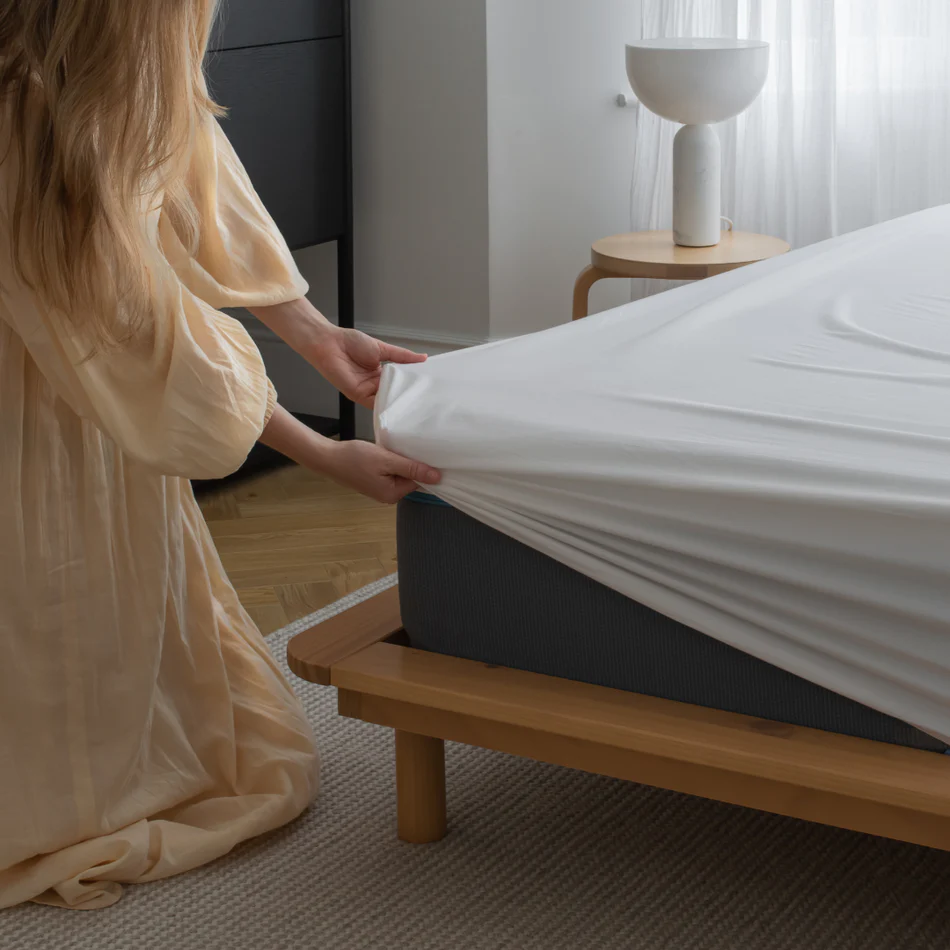
The most reliable way to size bed sheets is to measure the mattress you actually own, including every topper, pad, and protector that will sit inside the fitted sheet. Then compare those measurements with the finished dimensions and fit range for the exact sheet.
A label such as queen or king is a useful starting point, but it does not tell you the pocket depth, how much fabric a flat sheet provides, or whether a split set matches your bed. Sizing up from queen to king will not fix a shallow fitted-sheet pocket. It usually adds width and length in the wrong places.
Measure the mattress before ordering
Remove the current sheets, but leave in place any mattress protector, pad, or topper that will stay under the new fitted sheet. Use a tape measure and record:
- Width: Measure straight across the widest part of the sleep surface, from one side edge to the other.
- Length: Measure from the top edge to the foot edge. Do not include the headboard or bed frame.
- Total depth: Measure from the bottom edge of the mattress to the top of the highest layer that will be inside the sheet. Keep the tape vertical and do not press the padding down.
Measure the depth at several corners and along the sides if the mattress has a pillow top, rounded edges, or uneven layers. Use the largest measurement. If a topper overhangs the mattress, measure the widest and longest points as well.
Also note whether the bed is one mattress, two fully separate halves, or one mattress split only at the head. Those configurations need different fitted sheets even when all are sold under a king-size label.
Mattress labels and sheet dimensions are not the same thing
Twin, full or double, queen, king, and California king are size designations. They are not a promise that every mattress or sheet with the same designation has identical finished measurements.
NIST Handbook 130 contains a model packaging regulation that makes this distinction clear. For fitted sheets, it calls for the intended mattress length and width as well as any size designation. For flat sheets and pillowcases, it also distinguishes the intended mattress or pillow from the finished size of the textile itself 1. Because this is a model regulation rather than a universal manufacturing tolerance, use the measurements on the product you are considering.
Current product charts show how the same label can vary. Brooklinen lists its twin fitted sheet at 39 by 75 inches with a 16-inch pocket 2. Parachute lists its cotton twin fitted sheet at 39 by 76 inches with a 16-inch pocket 3. These are specifications for those products, not a replacement for measuring your mattress.
If a product page gives only a nominal label and no dimensions or fit range, ask the manufacturer before ordering. This matters most with pillow-top mattresses, handmade mattresses, older beds, RV mattresses, and other nonstandard sizes.
How to choose a fitted-sheet size
A fitted sheet has to match three measurements at once:
- its width must fit across the mattress * its length must reach both ends * its pocket must cover the full mattress stack and leave enough fabric and elastic to grip underneath
Pocket depth usually describes the vertical fabric at the corner. Usable fit depth is the mattress height the finished sheet can actually cover while still wrapping under the bottom edge. Those numbers are not always interchangeable. Elastic stretch, corner construction, shrinkage, and the amount of underlap all affect the working fit.
Treat “deep pocket” and “extra deep” as product names, not measurements. Compare the stated pocket dimension and any separate “fits mattresses up to” range. For example, one Cozy Earth set lists an 18-inch fitted-sheet pocket and says the sheet can stretch to fit depths up to 20 inches 4. That is a specification for that set only.
A pocket at the exact height of your mattress stack may still be hard to pull underneath. Look for some underlap rather than expecting the elastic to sit on the side wall. If the seller gives a fit range, keep your measured depth within that range. If it gives only a pocket measurement, ask how much mattress depth the sheet is designed to fit.
Elastic around the full perimeter can distribute tension more evenly than elastic placed only at the corners, but it cannot correct the wrong width, length, or depth.
Calculate flat-sheet coverage and tuck allowance
Flat-sheet sizing is about the finished sheet dimensions, not just the mattress label. Decide whether you want the sheet to reach the lower edge, tuck under the sides and foot, or leave extra fabric at the head.
For equal coverage on both sides:
Side drop = (flat-sheet width minus mattress width) divided by 2
If a queen mattress is 60 inches wide and the flat sheet is 92 inches wide, the side drop is 16 inches on each side. If the full mattress stack is 14 inches deep, about 2 inches remains below the lower edge for a side tuck. Real-world placement and laundering can change that slightly.
For the foot:
Foot allowance = flat-sheet length minus mattress length minus the amount reserved at the head
Subtract the mattress depth once more if you want to know how much can tuck underneath the foot. A generous top fold reduces the fabric available at the bottom.
Manufacturers sometimes use one flat sheet for more than one mattress label. Brooklinen, for example, lists the same 110-by-104-inch flat sheet for its king and California king sets even though the fitted sheets have different dimensions 2. Check the actual width and length rather than assuming a California king flat sheet is always longer or a king flat sheet is always wider.
Split king, split California king, and split-top beds
These names are easy to confuse:
- Split king: Usually has two independently moving mattress halves. Many systems use two Twin XL-size fitted sheets, but the exact half measurements still need to be checked.
- Split California king: Uses two narrower, longer fitted pieces. It is not the same as a split king and is not made from two Twin XL fitted sheets.
- Split top, FlexTop, or flex head: Uses one mattress that separates near the head but remains joined below. It needs a fitted sheet made for that split shape, not two fully separate fitted sheets.
A current Tempur-Pedic product provides a useful example of the first two configurations. Its ActiveBreeze split-king set lists two 39.5-by-80-inch fitted sheets, while the split California king version lists two 36.5-by-84-inch fitted sheets. Both sets include one shared flat sheet and two king pillowcases 5. Those dimensions and contents apply only to that product.
Boll & Branch describes a different configuration for its split-top king: one king fitted sheet with a 33-inch split at the head. Its fully split king set instead contains two Twin XL fitted sheets 6. This is why “split king” and “split top king” should not be used interchangeably.
For an adjustable bed, each independently moving mattress half needs its own fitted sheet. A shared top sheet may pull toward the raised side. If that is a frequent problem, two flat sheets or separate top bedding may work better than one shared sheet. Check the adjustable-base manual before adding sheet straps or clips, which can interfere with moving parts.
Choose pillowcases by finished size
Measure the pillow from seam to seam, then check its height or loft. A thick, firm pillow can use more of a case's internal space than a flatter pillow with the same length and width. Also check whether the case has an envelope closure or an internal flap that reduces usable length.
“Standard,” “queen,” and “king” are not enough on their own. Some brands combine standard and queen cases, and set contents can change by bed size. As one product-specific example, Brooklinen lists its standard pillowcase at 20 by 27 inches and its king case at 20 by 37 inches 2. Euro shams, body-pillow cases, and decorative shams have separate dimensions and should be measured independently.
Check what the sheet set includes
A size label does not tell you what is in the package. Before ordering, confirm:
- the number and dimensions of fitted sheets * whether a flat sheet is included * the number and size of pillowcases * whether the listed measurements are per piece or for the combined bed * whether a split set uses one shared flat sheet or two
In Brooklinen's Core set, for example, Twin and Twin XL share one flat sheet size, Full and Queen share another, and King and California king share another. The fitted sheet still follows the selected mattress size, and the pillowcase size changes for king-size sets 7. Other collections may be bundled differently.
Allow for laundering without guessing at shrinkage
Sheets can fit differently after washing, but there is no single shrinkage allowance that applies to every material, weave, finish, and care method. Do not buy a sheet too small because you expect it to stretch, or too large because you expect it to shrink.
Follow the instructions for the exact product. Brooklinen, for example, directs owners of its sheets to wash on a cool or cold cycle and tumble dry on low 8. That advice belongs to those sheets, not every product.
If a sheet fit before laundering and changed afterward, compare what you did with the product instructions. Heat, an overloaded dryer, or worn elastic may be part of the problem. For surface wrinkles rather than a sizing problem, remove the sheet promptly when the cycle ends and smooth it while making the bed.
Troubleshoot a sheet that will not stay fitted
Corners keep popping off
- Rotate the sheet 90 degrees in case its width and length are reversed. 2. Remeasure the mattress with the protector and topper in place. 3. Compare that depth with the product's usable fit range, not only the words “deep pocket.”
- Check whether the elastic is stretched out or limited to the corners. 5. On an adjustable bed, see whether raising the head or foot is pulling the opposite corners free.
If the pocket is too shallow, choose a deeper pocket in the same mattress width and length. Do not jump to the next mattress size.
The sheet wrinkles or bunches
Pull all four corners fully under the mattress, then smooth and tuck the long sides. Persistent loose folds often mean the sheet is too wide, too long, or much deeper than the mattress. If it fit previously, inspect the elastic and confirm that the topper or protector has not shifted.
There is too much fabric
Check both the nominal size and the pocket depth. A queen sheet on a full mattress will be loose across the surface, while an overly deep queen pocket can leave excess fabric around an otherwise correctly sized queen mattress. Replace the mismatched dimension instead of trying to hide all of the extra fabric under the mattress.
The sheet shifts even though the corners stay on
Check each layer. A loose protector or topper can slide beneath a correctly fitted sheet. Recenter and secure those layers according to their instructions, then remake the bed. If the mattress is split or adjustable, confirm that every moving section has the correct dedicated fitted piece.
The flat sheet will not stay tucked
Use the coverage formulas above. You may have enough side drop but not enough length after allowing for a top fold, or the mattress stack may be using most of the available drop. Choose by finished flat-sheet dimensions rather than moving up one nominal mattress label without checking the numbers.
What about RV, crib, and other nonstandard mattresses?
Labels such as short queen, RV king, three-quarter, antique double, and round bed can vary by manufacturer. Record the actual width, length, depth, and shape. Compare those figures with the sheet maker's exact dimensions or use a custom fitted sheet.
Crib sheets require a stricter safety boundary. The U.S. Consumer Product Safety Commission says a crib sheet should fit snugly, overlap the mattress so it cannot dislodge, and never be replaced with an adult sheet. Loose bedding should not be added to the crib 9. Use only a fitted sheet made for the exact crib mattress, with nothing loose tucked around it.
Ordering checklist
Before paying, make sure you can answer all of these:
- What are the mattress's actual width and length? * What is the full depth with every layer under the fitted sheet? * What mattress depth does the fitted sheet claim to fit? * What are the flat sheet's finished width and length? * How much side and foot coverage will those dimensions provide? * Is the bed standard, fully split, split California king, or split only at the head?
- What size and number of pillowcases are included? * Are the measurements per piece, and is a flat sheet included? * What laundering instructions apply to this exact product?
The right label narrows the search. The measurements decide whether the sheet will fit.