
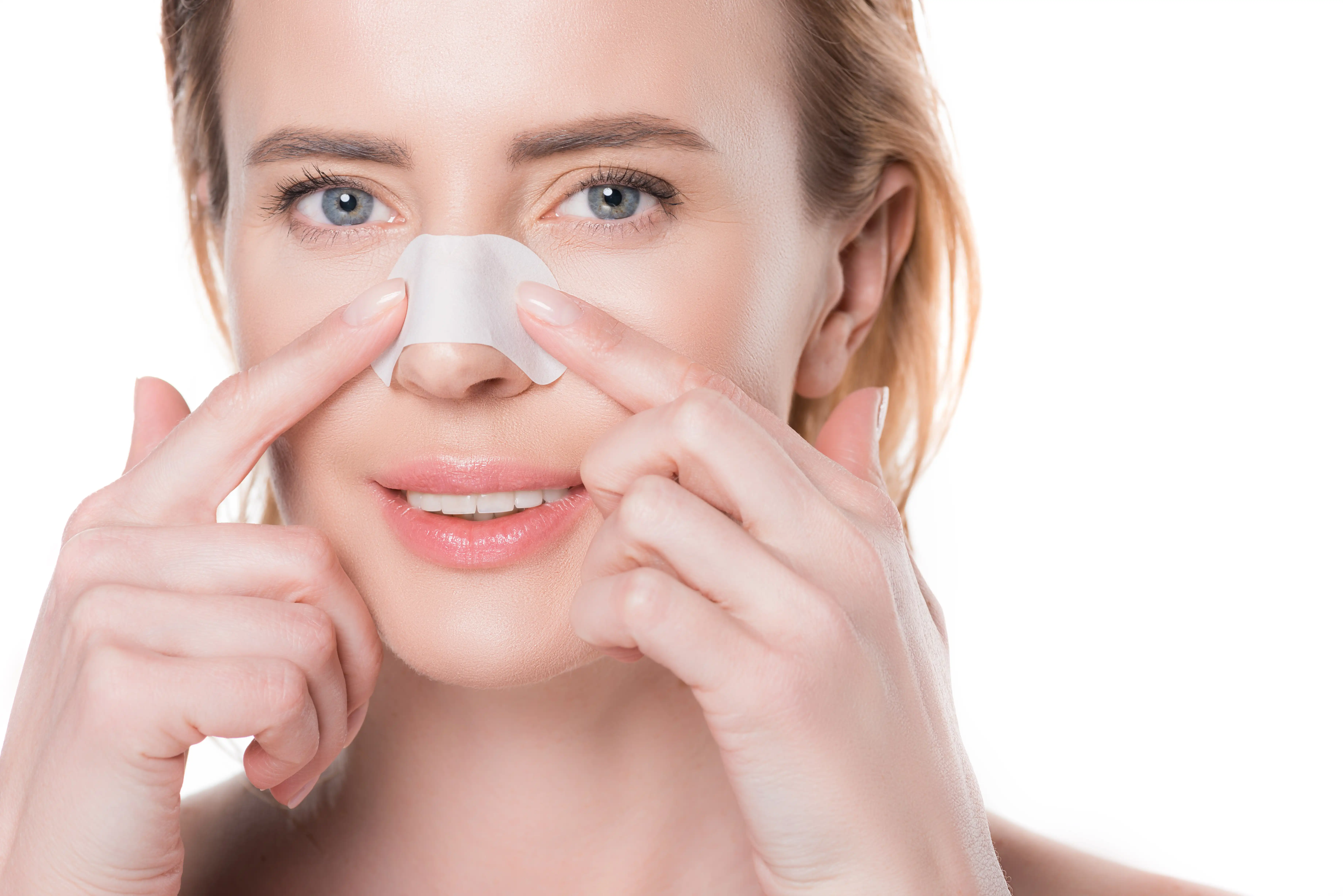
An external nasal strip can make nasal breathing feel easier when narrowing near the front of the nose is part of the problem. Flexible, spring-like bands try to straighten after the strip is attached. Because the adhesive holds the ends to the skin, that force gently pulls the nasal sidewalls outward over the nasal valve 1 2.
The effect is mechanical and temporary. A strip does not shrink inflamed tissue inside the nose, drain the sinuses, or open a collapsing throat. Evidence does not show that it increases oxygen uptake. The benefit depends on where the resistance comes from.
What part of the nose does the strip affect?
The nasal valve is a narrow area inside the front of the nose. Its shape and the stability of the nearby sidewall have a large effect on resistance to airflow. In some people, the valve is narrow at rest. In others, the sidewall moves inward during a strong breath through the nose.
External strips support this area from the skin surface. Studies using airflow and imaging measurements show that these strips can enlarge the valve area or reduce resistance in at least some users 1. The effect ends when the strip is removed.
The strip is most logically matched to anterior nasal narrowing, meaning resistance close to the nostril opening or nasal valve. If pulling the side of your cheek gently outward makes nasal breathing feel easier, the nasal valve may contribute. That observation is not a diagnosis. Persistent obstruction still needs an examination because the septum, turbinates, inflammation, polyps, or another structure may also be involved 3.
What a nasal strip is not
Several products used around the nose work in different ways:
- An internal nasal dilator sits inside the nostrils and braces the nasal valve from within. It is a separate device with its own sizing, cleaning, material, and safety instructions. Evidence from an internal device cannot automatically be applied to an external adhesive strip 1.
- Saline spray or irrigation adds moisture and can loosen or flush mucus, pollen, dust, and other debris. It does not pull the nasal sidewalls outward. Nasal irrigation also has separate water-safety and cleaning requirements 4.
- A medicated decongestant reduces swelling in nasal blood vessels. An external strip contains no decongestant and does not treat inflammation. Decongestants have medicine- specific precautions, interactions, age limits, and duration limits 5.
- A PAP nasal mask or nasal pillows interface delivers pressurized air from a positive airway pressure device to hold the throat open during sleep. Despite the word “nasal,” it is an interface for an established sleep apnea treatment, not a nasal dilator 6.
- Mouth tape tries to keep the lips closed and does not widen the nasal valve. It can be risky when the nose is blocked and should not be paired with a strip as a do-it-yourself treatment for snoring or sleep apnea 7.
- Nasal surgery changes or supports anatomy after a clinical evaluation. A strip may be used as a short-term conservative option when nasal valve dysfunction is suspected, but it is not a permanent substitute for evaluation or a procedure when one is indicated 3.
Essential oils are not nasal dilators and are not an established treatment for an anatomical blockage. Do not put essential oil inside the nostrils or under a nasal strip. Intranasal safety is not established for peppermint oil, and topical exposure can cause rash or irritation 8.
Who might find a strip useful?
A short trial is most reasonable when:
- the blockage feels close to the nostrils
- the sidewall seems to pull inward during nasal inhalation
- gently supporting the side of the nose produces an immediate, noticeable improvement
- a clinician has identified nasal valve narrowing or collapse
- temporary congestion makes a known nasal-valve bottleneck feel worse
A strip may still make the nose feel more open during a cold or allergy flare, but it does not remove the inflamed tissue causing the congestion. It is less likely to solve a blockage located farther back, severe septal deviation, enlarged turbinates, a polyp, sinus disease, or swelling after an injury. These conditions should not be diagnosed from a strip response.
What does the research show?
The evidence depends on the outcome. Feeling more air through the front of the nose is not the same as treating snoring, improving sleep, controlling sleep apnea, or increasing exercise capacity.
Nasal airflow and the feeling of congestion
A systematic review of over-the-counter mechanical dilators found objective studies supporting external strips for internal nasal valve obstruction. Outcomes included valve area, airflow, and resistance rather than sleep quality or long-term symptom control 1.
How that mechanical change feels is less predictable. One small manufacturer-sponsored randomized trial of 59 adults with chronic nighttime congestion found improvements in some patient-reported breathing and sleep measures compared with a placebo strip 9. Two later manufacturer-sponsored trials totaling 270 adults found no significant advantage over placebo for their main measures of sleep problems, waking unrefreshed, or congestion after 7 or 14 days 10.
Taken together, a strip can improve perceived airflow for some people, but the response is individual and placebo-controlled evidence for congestion-related sleep benefit is inconsistent.
Snoring, sleep quality, and obstructive sleep apnea
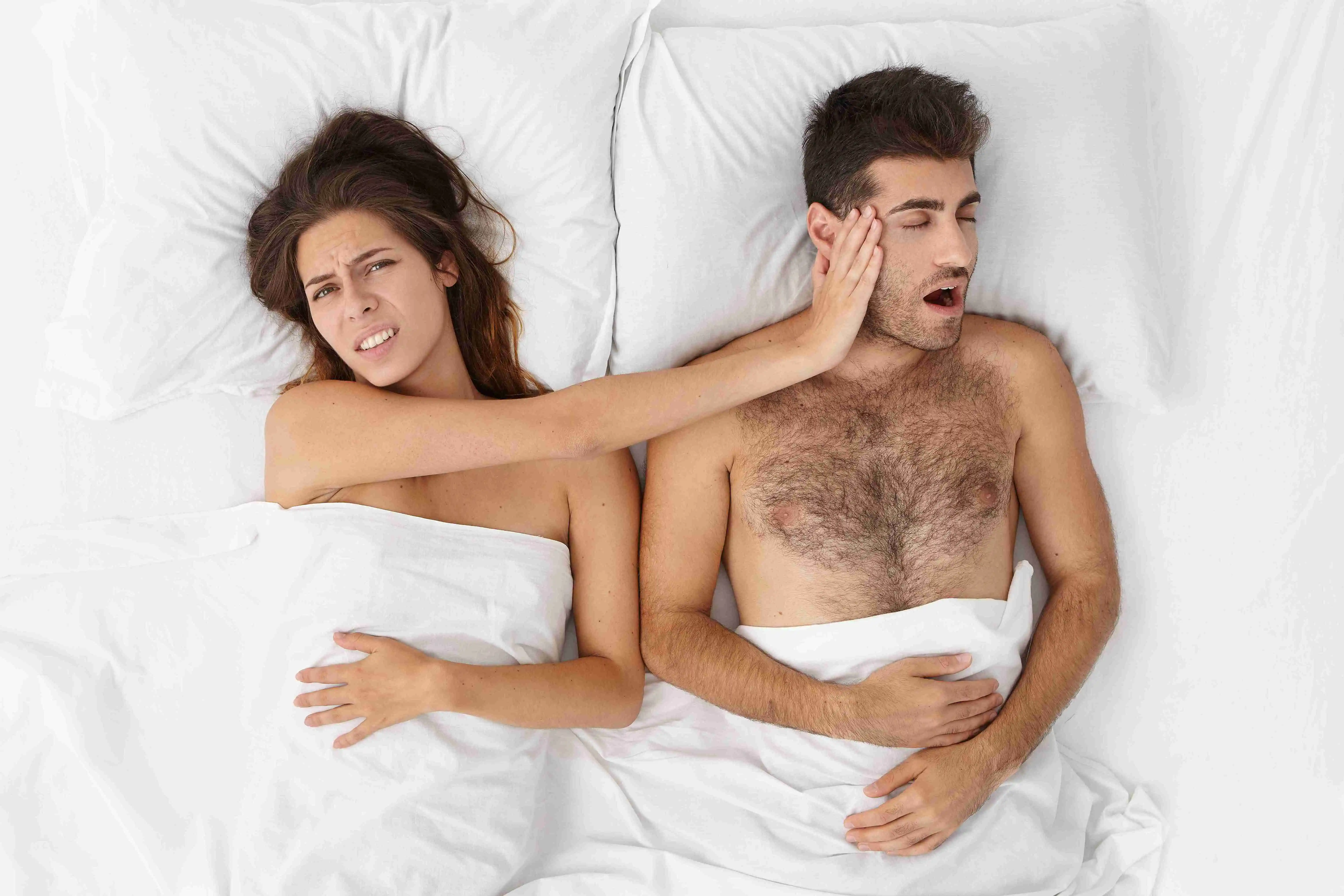
Snoring can arise from the nose, soft palate, tongue, or other parts of the upper airway. A nasal strip can only act at the front of the nose, so it will not relieve snoring for everyone.
A systematic review and meta-analysis of external strips and internal dilators found no significant overall improvement in the apnea-hypopnea index, lowest oxygen saturation, or snoring index. The included studies were generally small and had important quality limitations 11. This evidence does not support a universal snoring claim, a promise of deeper sleep, or the use of a strip as treatment for obstructive sleep apnea (OSA).
A strip may reduce ordinary snoring in an individual whose snoring has a meaningful nasal component. The useful sign is a clear, repeatable change while the strip is worn. Even then, less noise does not prove that breathing events or oxygen levels are normal.
Exercise and athletic performance
Reducing resistance at the nasal valve does not necessarily increase oxygen delivery to working muscles. A systematic review and meta-analysis found no significant improvement in maximal oxygen uptake, heart rate, or perceived exertion in healthy people using external nasal strips during exercise 12.
An athlete may prefer how nasal breathing feels with a strip, but current evidence does not support claims of greater oxygen uptake, endurance, or performance.
How to try a nasal strip correctly
Product designs differ. Treat the exact package and insert as the authority for the strip in your hand, especially for sizing, age eligibility, wear time, materials, and warnings.
- Read the label first. Choose a size and strength intended for the user's nose and age. Do not assume that an adult strip fits a child. For example, one current U.S. Breathe Right insert says not to use that product in children under 5 and not to wear it longer than 12 hours, but those limits are product-specific rather than universal 2.
- Start with clean, dry, intact skin. Wash away oil, makeup, lotion, or sweat, then dry the nose fully. Do not place the strip over a sore, cut, sunburn, rash, or already irritated skin 2.
- Use the placement diagram for that product. The spring bands need to sit over the intended sidewall area. Too high or too low may reduce the effect or pull uncomfortably. Press the ends and rub gently as directed rather than repeatedly peeling and repositioning the adhesive 2.
- Use it once and stay within the label duration. A disposable strip loses adhesion and shape after use. Reusing it also makes the material and hygiene less predictable.
- Remove it slowly. Loosen the adhesive with warm water while washing your face or in the shower, then peel gently. Do not pull it off quickly, especially from dry, sensitive, or fragile skin 2.
- Judge the result it can actually deliver. A useful response is an immediate, reproducible feeling of easier nasal inhalation while the strip is on, with the strip staying in place and no skin reaction. Better nasal comfort is a valid result. A sleep score, less snoring, or feeling better the next morning does not by itself show that a sleep disorder has been treated.
If a correctly sized and placed strip makes no clear difference, stronger adhesive or repeated repositioning is unlikely to solve a blockage elsewhere in the nose. Stop the trial and consider what symptom needs evaluation.
Skin, allergy, and child-safety precautions
Adhesives, spring materials, and packaging differ by product. Check the label if you have a latex or adhesive-bandage allergy. One U.S. Breathe Right insert states that its packaging contains natural rubber latex, while its reported reactions include redness, itching, swelling, pain, peeling, and bleeding at the application site 2. Do not transfer that exact material statement to every brand.
Stop using the strip if it causes persistent redness, itching, swelling, pain, blistering, skin peeling, or bleeding. Remove it immediately and seek urgent help if a reaction includes facial or throat swelling, wheezing, or trouble breathing.
Avoid adhesive strips if the skin is wounded, sunburned, actively inflamed, or too fragile for safe removal. If you have eczema or another skin condition on the nose, have reacted to medical adhesive, take a medicine that makes skin fragile, or cannot remove the strip without pain, ask a clinician or pharmacist before trying another model.
For children, follow the exact product's minimum age and sizing instructions and supervise application and removal. Keep unused and discarded strips out of reach. A loose strip is not a toy and may be swallowed or become a choking hazard.
When easier nasal breathing is not enough
Easier breathing through the nose or quieter snoring does not rule out OSA. Talk with a healthcare professional if snoring is loud and habitual, breathing repeatedly pauses or restarts during sleep, there is gasping, or daytime sleepiness is persistent. A sleep study may be needed, and a nasal strip cannot diagnose the condition 13 14.
Arrange a nasal examination for blockage that is persistent, mostly on one side, or not responding to ordinary care. Recurrent nosebleeds, blood-stained discharge, lasting facial pain or pressure, or symptoms following a nasal injury also need assessment. One-sided symptoms can have common causes, but they should not be covered up indefinitely with a strip 15 16.
Seek medical care for severe facial pain or headache, symptoms that worsen after improving, congestion lasting more than 10 days without improvement, or fever lasting more than 3 to 4 days 17. Get prompt care after a significant nose injury, especially if the nose looks displaced, bleeding is heavy or will not stop, or swelling blocks breathing.
Call emergency services for severe trouble breathing, blue lips or skin, fainting, sudden confusion, or swelling of the face or throat with difficulty breathing. Do not try to manage these symptoms with a nasal strip 18.