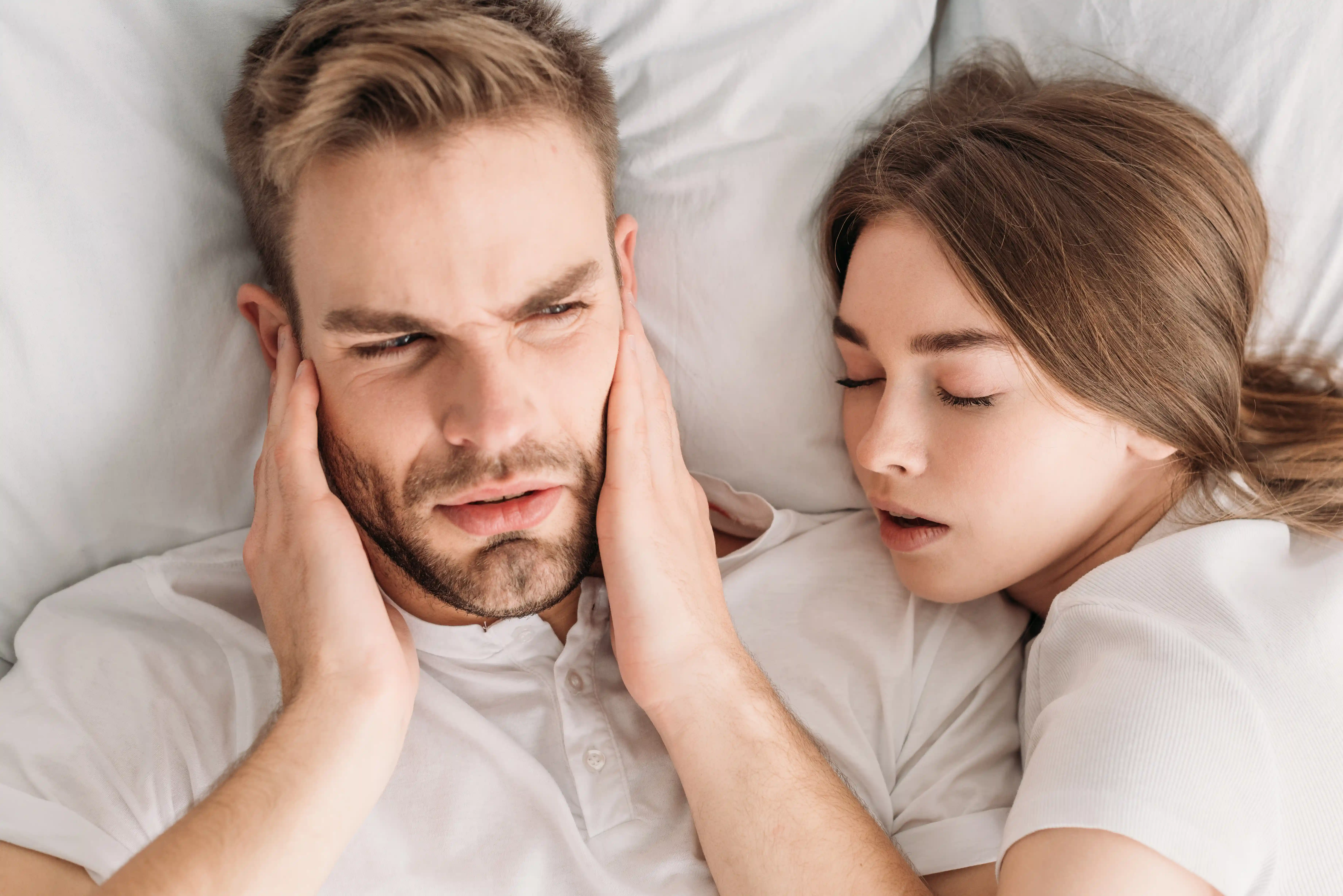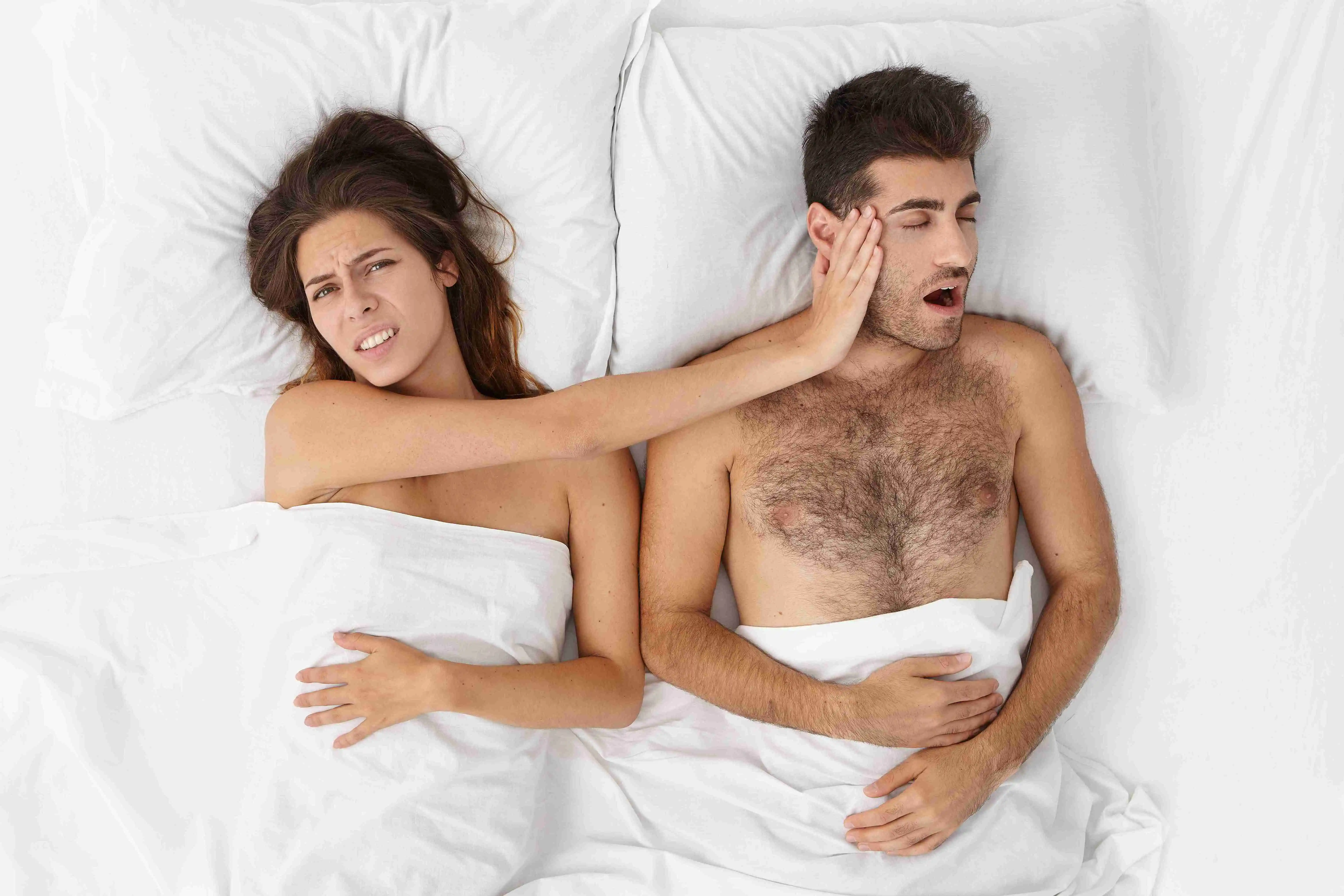

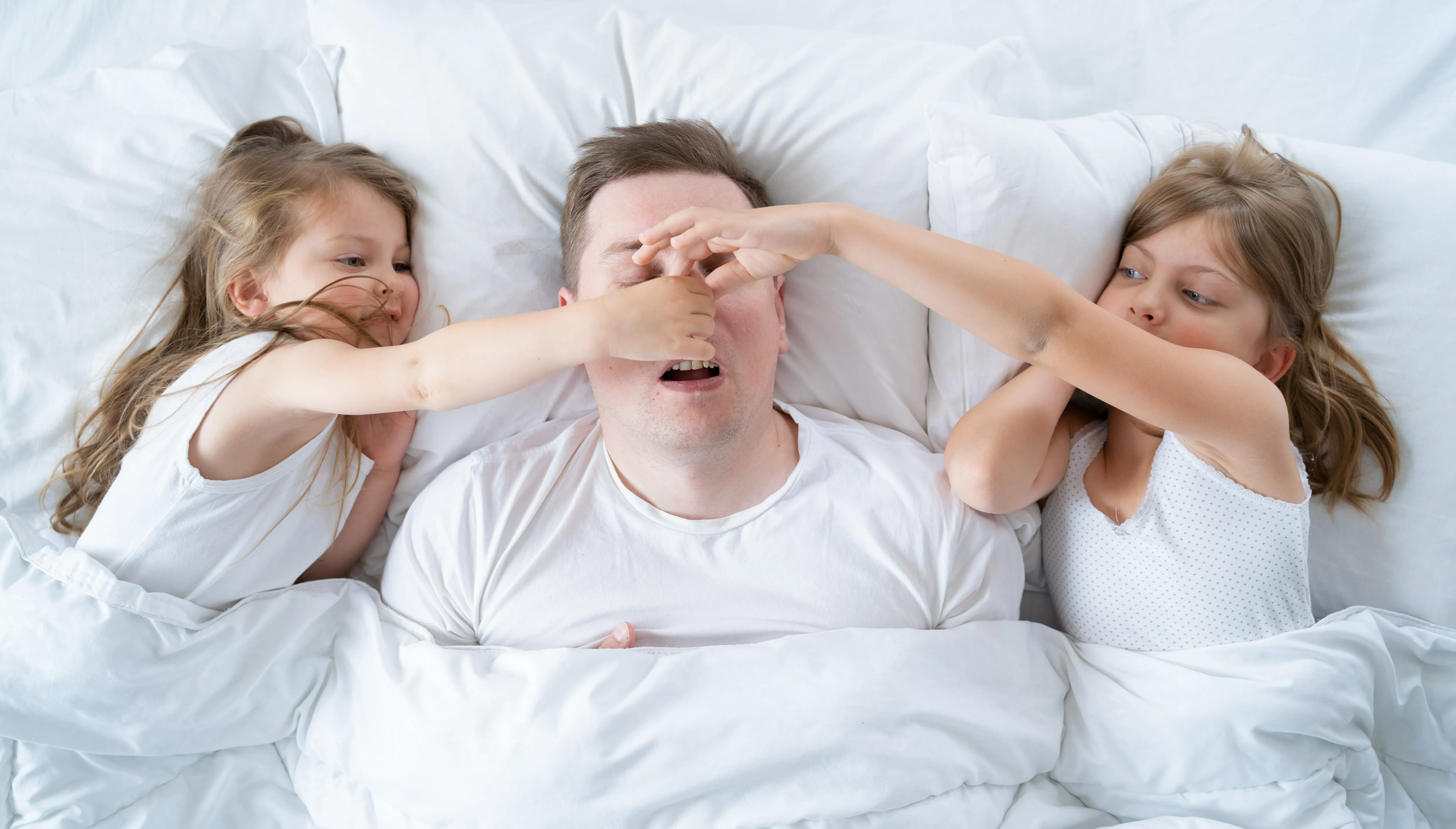
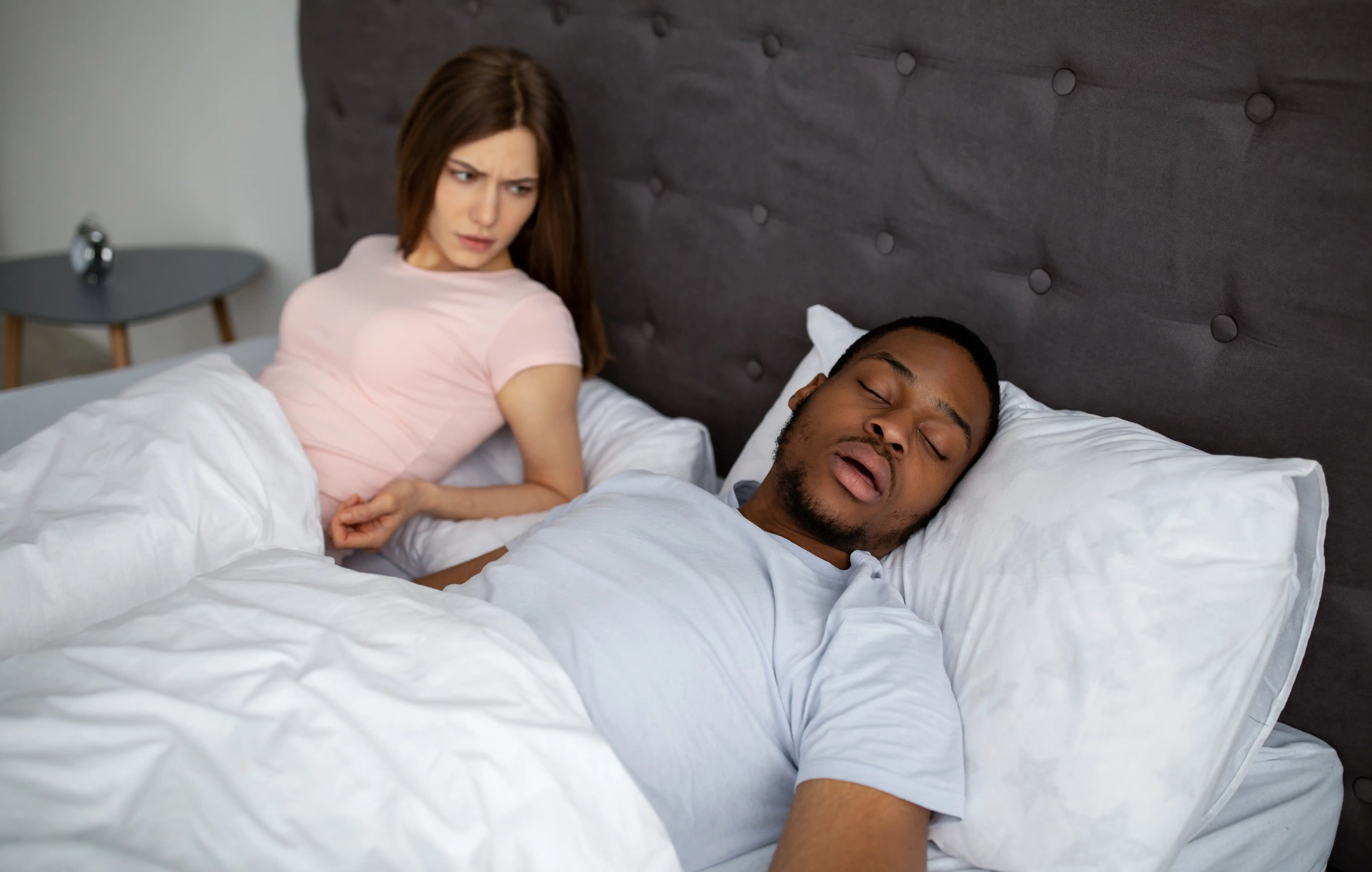
If someone else's snoring keeps waking you, you have two problems to solve, and they need different solutions.
The first is tonight. Reducing how much of the noise reaches you, with well-fitted earplugs, modest sound masking, and changes to where and when you sleep, is the part you control on your own.
The second is bigger. Frequent loud snoring, breathing that starts and stops, and gasping for air are among the main signs of obstructive sleep apnea, and many people do not realize they have those symptoms until someone else tells them 1. Blocking the sound protects your sleep. It does nothing for your partner's airway. Working on both at once is what usually ends the problem instead of managing it indefinitely.
This article is written for the person being kept awake. If you are the one who snores, or you want the full picture of causes and treatments, see how to stop snoring and snoring.
Your sleep loss is real, not an overreaction
Being kept awake by someone else's breathing is not oversensitivity, and it has been measured directly.
The clearest demonstration comes from a small study in which 10 married couples had simultaneous overnight sleep studies. Halfway through the night, the patient being evaluated for sleep apnea was placed on CPAP at a pressure that eliminated snoring and obstructive breathing events. Their spouses' arousal index fell from a median of 21 to 12 per hour, and their sleep efficiency rose from 74% to 87%. The authors calculated that, over eight hours in bed, the improvement was worth about 62 extra minutes of sleep per night for the spouse 2.
That was 10 couples on a single night, all with male patients, so treat the exact minutes as an illustration rather than a promise. The direction of the finding is echoed more broadly. A review of 38 studies on partners of people with obstructive sleep apnea found that most reported a negative effect of untreated apnea on partners' sleep, measured both objectively and by questionnaire, along with effects on mood, quality of life, and relationship quality 3.
A questionnaire study of 1,032 Swedish women aged 30 to 64 found that those living with heavy snorers more often reported insomnia symptoms, morning headache, daytime sleepiness, and fatigue than women living with non-snorers, with a pattern suggesting more symptoms at higher estimated noise exposure 4.
Not every study agrees, and the disagreement is informative. In a community sample from the Sleep Heart Health Study, 110 couples had home sleep studies. Partners without sleep-disordered breathing slept better than their affected partners, but their sleep was not measurably different from that of people whose bed partners also had no sleep-disordered breathing 5.
The likely explanation is who gets studied. Clinic-based studies recruit couples in which the snoring is loud enough and the sleep loss troubling enough to bring someone in for testing. Community samples include many people with milder breathing problems and no complaint at all. So group averages will not tell you whether your own nights are being wrecked. If the noise wakes you repeatedly, that is the finding that matters.
First, protect your own sleep
Choose earplugs for fit, not for the biggest number
Hearing protectors sold in the United States carry a Noise Reduction Rating, a single number in decibels that the Environmental Protection Agency has required on the label since 1979. The EPA notes that these products are used across a wide range of situations, from firing ranges and concerts to snoring 6.
That number is a laboratory value, and it is not what you will personally get. The National Institute for Occupational Safety and Health states plainly that the rating on the packaging often does not reflect the actual protection an individual achieves, and that almost any hearing protector, fitted correctly, reduces noise by about 10 decibels 7. The National Institute on Deafness and Other Communication Disorders makes the same point from the other direction: a higher rating blocks more sound only if the device is worn correctly, and proper fit is what determines success 8.
NIOSH also warns against overprotection, because too much sound reduction leaves you less aware of your surroundings and more likely to take the protection off 7. In a bedroom, that translates into a simple goal: enough reduction to sleep through the snoring, not the maximum reduction you can buy.
The main options are foam plugs that you roll and insert so they expand in the canal, pre-formed plugs already shaped to fit most ears, and custom plugs made from an impression of your ear. Canal caps and earmuffs also exist, and earmuffs are usually easier to fit correctly but heavier and warmer 7. NIDCD notes that earplugs can be hard to size and that discomfort or difficulty inserting them is a reason to try a different type rather than to push harder 8.
As practical guidance rather than a tested protocol, buy two or three types and give each a few nights. Foam usually gives the most attenuation and the least comfort for side sleepers. Pre-molded silicone is easier to insert, reuse, and sleep on. Custom plugs cost more but tend to be the ones people still wear a year later.
You can check your own fit without equipment. NIOSH suggests counting out loud while slowly cupping and uncupping your hands over your ears. If the plugs are seated well, your voice should sound about the same either way 7.
Make sure you can still hear what matters
Earplugs do not filter selectively. If you are the person who gets up for a baby, a young child, an elderly parent, or a medical alarm, blocking the snoring also blocks those sounds. The same applies to a smoke alarm.
The fix is to add a signal that does not depend on hearing. The U.S. Fire Administration advises people who are deaf or hard of hearing to use smoke alarms with a vibrating pad, a flashing light, or a strobe, and to use a pillow or bed shaker to wake a sleeping person 9. The same logic applies to a vibrating alarm clock under your pillow and to a baby monitor with a light or vibration alert.
There is one more thing earplugs take away. If your partner has untreated sleep apnea, you are the only person positioned to notice the pauses, the gasping, and the choking. Blocking the sound every night can quietly remove the main clue that anything is wrong. That is not a reason to avoid earplugs. It is a reason to get the snoring assessed rather than treating noise blocking as a permanent solution.
Sound masking is popular, and the evidence is weaker than you would expect
A systematic review examined 38 studies of continuous white noise or similar broadband sound and sleep. The studies varied widely in the noise used, how sleep was measured, and what the comparison condition was, and their results ranged from improved sleep to disrupted sleep. Graded formally, the quality of evidence that continuous noise improves sleep was very low. The reviewers also flagged that continuous noise may itself affect sleep and hearing, and called for better research before it is promoted as a sleep aid 10.
That does not mean you should not try it. It is cheap, reversible, and many people find it genuinely helps. It does mean the honest framing is a personal experiment rather than a proven intervention, and that volume deserves attention. Set the machine or app to the lowest level that softens the peaks of the snoring, and turn it down rather than up if you find yourself competing with the noise. For context, hearing protection is generally advised for sound at or above 85 dBA 8, which is far louder than a sound machine kept at a low, conversational level, so the caution is about turning it up night after night rather than about using masking at all.
Masking also works better on the steady rasp of snoring than on the sudden snort or gasp that follows a breathing pause. Those abrupt sounds are the hardest to cover and the most worth reporting to a clinician. For more on the different sound types and how people use them, see white noise and soundscapes.
Noise-cancelling headphones and sleep earbuds
Active noise cancellation is designed for steady, low-frequency sound. Bose describes it as working best on things like the hum of an air conditioner or passing traffic, and as reducing mid and high frequencies less effectively, particularly sudden and sharp noise 11. Snoring is closer to the second description than the first, since it comes in loud bursts rather than a steady drone, which is why noise-cancelling headphones often do less for it than people expect.
Keep one distinction in mind. NIOSH notes that active noise cancellation in headphones or earbuds reduces noise electronically but should not be treated as hearing protection unless the product carries a Noise Reduction Rating 7. A headphone is not a substitute for a well-fitted plug.
Comfort usually decides this one. Over-ear headphones are difficult to sleep in on your side. Low-profile sleep earbuds and audio headbands are easier, and many people pair a quiet masking track with a snug-fitting bud so the physical seal does most of the work.
Change the geometry and the timing
None of the following is a medically established threshold. They are reasonable defaults worth trying in order of effort.
- Increase the distance. Moving your side of the bed away from a shared wall, pushing two beds slightly apart, or moving to a wider bed all reduce how much sound reaches your ear.
- Use separate duvets. This removes the cover-pulling and the movement that often compounds the noise.
- Fall asleep first. Going to bed 30 to 45 minutes earlier gives you a head start before the snoring builds, but only if you are also going to bed earlier rather than shortening your own sleep opportunity.
- Soften the room. Curtains, rugs, and a closed door absorb and block some sound, and cost nothing to test.
- Fix the basics that make you a lighter sleeper. A cool, dark room and a consistent schedule raise your tolerance for interruption. See bedroom environment and sleep hygiene.
The step that changes things: get the snoring assessed
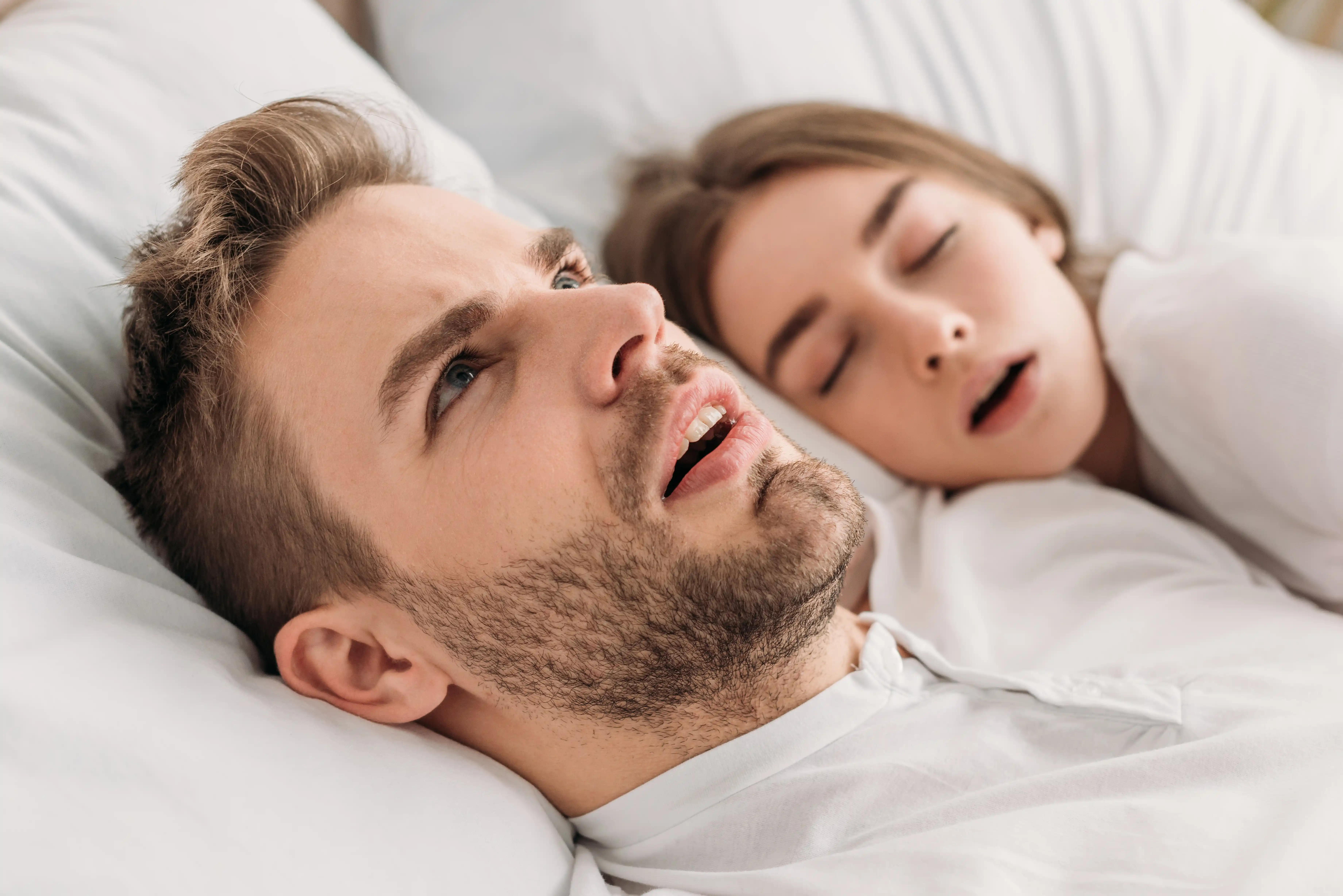
You have information no clinician and no wearable can collect. You are in the room. Write down what you actually observe over a week or two, because that record is often what moves a reluctant partner to make an appointment.
The signs most worth noting are the ones a bed partner is uniquely placed to see: breathing that starts and stops, frequent loud snoring, and gasping for air. Daytime symptoms belong on the list too, including excessive sleepiness and fatigue, dry mouth, morning headaches, trouble staying asleep, reduced sexual interest, and frequent urination at night 1.
Loudness is a clue rather than a verdict. In a study that made acoustic recordings during the sleep studies of 1,139 patients at one sleep laboratory, snoring intensity was significantly associated with the respiratory disturbance index, a measure of how often breathing was disturbed. In that same sample, men with a body mass index above 30 whose average snoring exceeded 38 dBA were 4.1 times more likely to have a disturbance index above 10, and men snored louder on average than women 12. So louder snoring raises the probability of a breathing disorder without settling the question.
Sleep apnea is also common and frequently undiagnosed. A modeling analysis that extrapolated from 17 studies across 16 countries estimated that 936 million adults aged 30 to 69 worldwide have mild to severe obstructive sleep apnea, and 425 million have moderate to severe disease. The study was funded by a device manufacturer and relies on extrapolation, so read it as an indication of scale rather than a precise count 13.
What an assessment involves is well defined. American Academy of Sleep Medicine guidance states that diagnostic testing should be part of a comprehensive sleep evaluation with adequate follow-up, that polysomnography is the standard test, and that either polysomnography or a technically adequate home sleep apnea test can be used in uncomplicated adults who show signs of moderate to severe apnea. The same guideline recommends strongly that clinical tools, questionnaires, and prediction algorithms not be used to diagnose sleep apnea on their own 14.
That matters for what you bring to the appointment. A screening score such as the STOP-BANG questionnaire or a phone app's snore recording is useful for starting a conversation, and neither can diagnose or rule anything out. For what testing looks like in practice, see how a sleep study works and at-home sleep studies. If the conversation with a clinician feels daunting, how to talk to your doctor about your sleep covers how to prepare.
When you raise it, lead with what you saw rather than with how tired you are. "You stopped breathing three times last night and then gasped" is harder to dismiss than "your snoring is unbearable," and it is also the clinically relevant part. Offer to come to the appointment. In the partner review, perceived partner support was associated with greater CPAP use, so involvement tends to help rather than intrude 3.
There is a health argument as well, and it is usually more persuasive than the noise. Untreated sleep apnea raises the risk of stroke, heart attack, and other serious problems, and can affect concentration, decision-making, and memory 15. If you want the distinction between ordinary snoring and something that needs testing, see snoring vs. sleep apnea.
What treatment realistically changes for you
Quieter nights are the most reliable gain. In the split-night study above, the spouses' sleep improved the same night that CPAP eliminated the snoring and the obstructive events, even though those spouses had been living with the noise for years 2.
The broader picture is more mixed. Across the 38 studies in the partner review, improvements in partner-assessed sleep quality were reported after CPAP, oral appliance therapy, and surgery, while results for partners' mood, quality of life, daytime sleepiness, and relationship quality conflicted between studies 3.
A more recent review identified 27 studies and pooled 9 of them, covering 1,806 patients and 916 bed partners. It found improvements after CPAP in conflict resolution and in bed partners' emotional functioning and social relationships, along with improved erectile function in male patients, and no significant improvement in female patients' sexual functioning. All the outcomes were subjective, the questionnaires varied between studies, most patients were men, and the analysis showed signs of possible publication bias 16.
So the fair expectation is this: if apnea is found and treated, your sleep is likely to improve fairly quickly. Improvements in mood and in the relationship happen for some couples and not others, and it is reasonable to want the first without banking on the second. For treatment options, see sleep apnea treatment, CPAP, and oral appliances for sleep apnea.
If testing shows no apnea, the snoring is still treatable. Sleep medicine guidance supports prescribing an oral appliance for adults who want treatment for primary snoring without sleep apnea 17. Simpler measures such as side sleeping, treating nasal congestion, and nasal strips are covered in how to stop snoring.
Sleeping apart: a reasonable choice with limited evidence
Separate sleeping is more common than people assume. In a survey of 2,005 U.S. adults conducted in March 2023, 20% said they occasionally slept in another room to accommodate a bed partner and 15% said they did so consistently, with 45% of men and 25% of women reporting one or the other 18.
Whether it actually improves the non-snoring partner's sleep has been studied very little, and the results are not clean. In one study, women who complained of poor sleep because of a partner's snoring had sleep studies on a shared night and on a night alone in the same bedroom. Among the 16 women analyzed, sleep time, sleep efficiency, arousal index, deep sleep, and REM sleep did not differ significantly between the two nights, although sharing the bed was associated with more awakenings and more light stage 2 sleep when the male partner had sleep-disordered breathing 19. That was a single night in each condition with a small group.
The Swedish questionnaire study went further and found that women who slept in separate bedrooms did not appear to get relief from the symptoms measured, though a questionnaire cannot establish cause and cannot say how completely those bedrooms were separated 4.
Read together, that is a thin evidence base rather than a verdict either way. Sleeping apart is neither a failure of the relationship nor a cure for it. It is a practical arrangement that some couples find works and others do not. If you try it, decide it together rather than one person leaving in the night, protect deliberate time for closeness, and treat it as revisable.
One caveat is not a matter of preference. Moving to another room does not treat sleep apnea. A person sleeping alone with untreated apnea still has untreated apnea, and now nobody is there to notice the pauses. If snoring was the reason for the move, keep the assessment on the to-do list.
What not to do
Do not diagnose or treat your partner. A snore recording, a symptom checklist, or a wearable's apnea alert is not a diagnosis, and guideline authors recommend specifically against using clinical tools and questionnaires to diagnose sleep apnea in the absence of proper testing 14.
Do not buy them an over-the-counter mouthpiece and call it treatment. Sleep medicine and dental sleep medicine guidance says oral appliance therapy for sleep apnea is prescribed by a sleep physician, that a qualified dentist should use a custom, titratable appliance rather than a non-custom device, that dental oversight is needed to catch side effects and bite changes, and that follow-up sleep testing should confirm the appliance is working 17. The same restraint applies to other fixes marketed at snoring that you might be tempted to introduce for someone else, including mouth taping.
Do not start, stop, adjust, or hide anyone's treatment. Changing a CPAP pressure, swapping a mask, or putting a prescribed device away because it is inconvenient belongs to the person being treated and their clinician.
Do not drink to sleep through it. A meta-analysis of 27 studies found that even a low dose, roughly two standard drinks, delayed and shortened REM sleep, with worse disruption as the dose rose. Only high doses shortened the time it took to fall asleep, and that came at the cost of more REM disruption later in the night 20. Alcohol also makes the problem you are trying to escape worse. A review of 14 randomized studies found that alcohol raised the apnea-hypopnea index by an average of about 2.33 events per hour, with larger effects in people who already snore or have sleep apnea 21. See alcohol and sleep apnea.
Do not borrow or self-prescribe sedatives. In 2019 the U.S. Food and Drug Administration added a boxed warning to eszopiclone, zaleplon, and zolpidem after rare but serious injuries and deaths caused by complex sleep behaviors such as sleepwalking and sleep driving while not fully awake. These behaviors have occurred at the lowest recommended dose and after a single dose, in people with and without any history of them 22.
Do not block more sound than you can afford to lose. Overprotection reduces awareness of your surroundings 7, so if you need to hear an alarm, a smoke detector, or a child, pair the earplugs with a vibrating or visual alert 9.
Do not drive while fighting sleep. If a partner's snoring has left you chronically short of sleep, this is the risk that matters most. The National Highway Traffic Safety Administration reported 644 deaths from drowsy-driving crashes in 2024, and estimated 91,000 police-reported crashes involving drowsy drivers in 2017, with roughly 50,000 injuries and nearly 800 deaths, while noting that these figures are widely considered an underestimate. Coffee and an open window are not reliable substitutes for sleep, and alcohol adds to sleepiness and impairment 23. If you are sleepy at the wheel, stop driving and arrange another way home. See sleep deprivation.
When to push for an appointment sooner
Move this up the list, rather than continuing to manage the noise, if any of the following applies:
- You have witnessed breathing pauses, gasping, or choking during sleep.
- The snorer falls asleep unintentionally during the day, or feels sleepy while driving.
- Loud snoring comes with morning headaches, waking unrefreshed, or high blood pressure.
- You have become sleepy enough that your own driving, work, or mood is affected.
- Snoring is new or clearly worse in pregnancy, or a child snores loudly most nights. For children, see snoring in children.
- Snoring changed noticeably after weight gain, a new sedating medication, or persistent nasal blockage.
Treat it as an emergency, not a sleep problem, if someone cannot be woken, is struggling to breathe, has blue or gray lips, has chest pain, or shows signs of a stroke such as face drooping, arm weakness, or slurred speech.
The bottom line
Protecting your own sleep and getting the snoring assessed are both worth doing, and they are not the same task. Well-fitted earplugs, modest sound masking, more distance, and falling asleep first are the practical measures most likely to help tonight, and fit matters more than the rating printed on the box.
The larger opportunity is that habitual loud snoring, especially with witnessed pauses or gasping, may be a treatable medical condition rather than a personality trait. You are the person who can see it. Write down what you observe, ask for an evaluation, and let the testing and the treatment decisions belong to clinicians.
One last thing worth watching. If the noise stops and you still cannot sleep, the sleeplessness has become its own problem and deserves its own attention rather than more earplugs. See insomnia for what that looks like and how it is treated.
FAQs
What noise reduction rating should I look for in earplugs?
Treat the rating as a rough guide, not a target. NIOSH says the Noise Reduction Rating on the packaging often does not reflect the protection an individual actually gets, and that almost any hearing protector reduces noise by around 10 decibels when it is fitted correctly. It also advises against overprotection, because heavy attenuation leaves you less aware of your surroundings 7. NIDCD makes the related point that a higher rating only helps if the device is worn properly 8. For a snoring partner, the practical test is not the number on the box. It is whether you fall asleep, stay asleep, and can still wear the plugs comfortably at 3 a.m.
Is it safe to wear earplugs every night?
Research has not established a safe nightly duration for using earplugs as a sleep aid, so the sensible approach is comfort plus hygiene. NIDCD advises that proper fit matters and that discomfort or trouble inserting a plug is a reason to try a different type rather than to force it in 8. Keep reusable plugs clean, replace foam plugs regularly rather than reusing dirty ones, and see a clinician if you develop ear pain, discharge, itching, blocked-feeling ears, or any change in hearing. If you are the person who needs to hear a child or an alarm, add a vibrating or visual alert rather than relying on hearing through the plugs 9.
Should I wake my partner when they seem to stop breathing?
You do not need to wake someone to get their breathing going again during ordinary obstructive events. In sleep apnea, breathing starts and stops repeatedly through the night and then resumes, often with a gasp 1. A nudge may shift their position and quiet things for a while, but it does not treat anything and it costs them sleep too. The pauses are worth recording and reporting rather than policing. Do treat it as an emergency if the person cannot be woken, is struggling to breathe, or looks blue or gray around the lips.
Does white noise actually mask snoring?
Sometimes, and the evidence is thinner than the popularity suggests. A systematic review of 38 studies of continuous white or broadband noise found highly variable results, ranging from improved to disrupted sleep, and graded the quality of evidence that continuous noise improves sleep as very low. The reviewers also noted possible negative effects on sleep and hearing 10. It is cheap and reversible, so it is reasonable to try. Keep the volume at the lowest level that softens the peaks, and expect it to cover the steady rasp better than the sudden snorts.
Can I train myself to sleep through snoring?
Not as completely as people hope. In one split-night study of 10 couples, the spouses had been habitually exposed to their partner's snoring for years, and their arousals still dropped and their sleep efficiency still rose the moment the snoring and obstructive events were eliminated 2. In other words, getting used to the noise is not the same as sleeping through it. Sound can keep fragmenting sleep without waking you fully enough to remember it.
Is sleeping in separate bedrooms bad for a relationship?
There is no good evidence that it is, and no good evidence that it fixes a relationship either. Roughly a third of surveyed U.S. adults said they sleep in another room at least occasionally to accommodate a bed partner 18, and the few studies that measured the non-snoring partner's sleep away from the snorer found limited or no clear benefit on most measures 194. Treat it as a practical arrangement to decide together and revisit, and remember that it does not treat sleep apnea and removes the person most likely to notice the breathing pauses.
My partner snores but testing showed no sleep apnea. What now?
Primary snoring without sleep apnea is still treatable. Sleep medicine guidance supports prescribing an oral appliance for adults who ask for treatment of primary snoring, and recommends that a qualified dentist fit a custom, titratable device rather than a non-custom one 17. Position changes, nasal treatment, reducing alcohol near bedtime, and weight management are the other common routes, covered in how to stop snoring. Meanwhile, keep using the noise-control measures that work for you, since they are what protect your sleep while the snoring is being addressed.