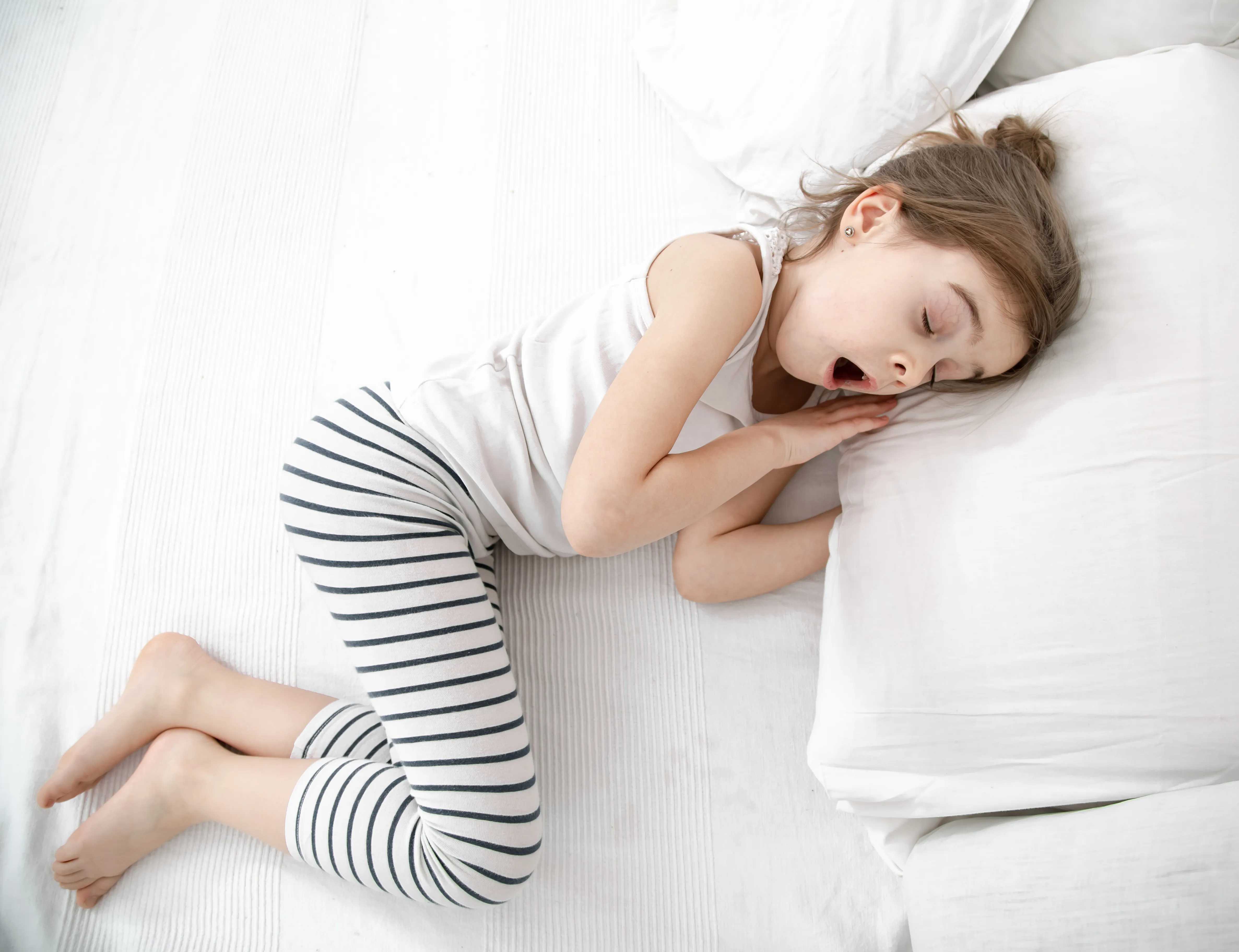
A child may snore temporarily when a cold blocks the nose. Snoring that happens frequently when the child is otherwise well, continues after congestion clears, or comes with breathing or daytime symptoms deserves medical evaluation. Listening alone cannot tell whether the child has primary snoring or obstructive sleep apnea (OSA) 12.
Primary snoring means snoring without the airflow obstruction, gas-exchange changes, or sleep disruption used to diagnose OSA. It is not a label parents can confirm at home. Loudness, tonsil size, and the absence of an obvious pause are not reliable enough to settle the question.
This guide focuses on deciding what to do about the symptom. For the full diagnosis and treatment pathway, see sleep apnea in children.
When snoring may be temporary
Snoring is the sound of soft tissue vibrating as air moves through a narrowed upper airway. A cold can temporarily narrow the nasal passages with swelling and mucus. Snoring that appears only during that illness and clears when the child is breathing comfortably again is less concerning than a pattern that continues while well.
There is no household stopwatch or loudness rule that diagnoses a problem. Pay attention when snoring:
- happens on many nights or repeatedly across otherwise healthy weeks
- continues after a cold or other congestion has resolved
- becomes louder, more frequent, or newly associated with breathing effort
- affects the child’s sleep, mornings, behavior, learning, or alertness
Pediatric guidance recommends asking about regular snoring and evaluating it alongside other symptoms or findings rather than dismissing it as a normal habit 1.
Clues to report to the pediatrician
A child with OSA does not always look like a sleepy adult. Irritability, impulsivity, hyperactivity, attention difficulty, or a change in school function may be more visible. These concerns have many possible causes, so they should prompt a broader sleep and health assessment rather than an automatic sleep apnea label.
During the night
Note whether snoring occurs with:
- breathing that looks unusually forceful or makes the skin pull in between or below the ribs
- repeated pauses, gasps, choking sounds, or snorts
- persistent mouth breathing or a blocked-sounding nose
- restless sleep, repeated awakenings, sweating, or unusual neck extension
- bedwetting that is frequent or returns after a sustained dry period
In the morning or daytime
Also report:
- morning headache or dry mouth
- difficulty waking or seeming unrefreshed
- excessive sleepiness, unplanned naps, or falling asleep in class or during rides
- irritability, emotional outbursts, hyperactive behavior, or attention problems
- a meaningful change in learning, memory, grades, or classroom participation
- feeding, growth, or exercise concerns
Frequent snoring, difficult nighttime breathing, daytime sleepiness, attention difficulty, and behavior problems are recognized pediatric OSA clues. None is specific enough to make the diagnosis by itself 31.
A child does not need every item on these lists before a caregiver raises the concern. Likewise, a child who snores quietly or has no witnessed pause can still need evaluation.
Why children snore
Several factors can narrow or destabilize a child’s airway, and more than one may be present:
- Temporary nasal congestion: A cold can temporarily reduce nasal airflow.
- Allergic rhinitis or other persistent nasal blockage: Swollen nasal tissue can promote mouth breathing and add resistance.
- Tonsils and adenoids: Enlarged tissue can reduce airway space during sleep. Large tonsils raise suspicion but do not prove OSA, and smaller tonsils do not rule it out.
- Craniofacial anatomy: Jaw position, palate shape, midface development, or another structural difference can affect airway size.
- Muscle tone and neuromuscular conditions: These can change airway stability or nighttime ventilation and usually require specialist assessment.
- Weight-related airway factors: A higher body weight can increase OSA risk in some children. Weight is one medical factor, not a parenting failure and not the only possible cause.
The same snoring sound can come from different combinations of nasal blockage, throat anatomy, airway muscle control, and sleep state. That is why a remedy aimed at one location cannot be promised to work for every child 32.
What you can do before the appointment
Keep the next step simple:
- Note which nights the child snores and whether they are sick or congested.
- Describe breathing effort, pauses, gasps, position, restlessness, and morning symptoms.
- Ask teachers or caregivers about sleepiness, attention, or behavior changes if relevant.
- Record a short video from a safe distance if it captures the concern without disturbing the child or delaying urgent care.
- Bring a current list of medicines and supplements to the appointment.
A phone recording can show sound, position, and visible effort. It cannot measure airflow, sleep stage, carbon dioxide, or the type of respiratory event. A normal-looking recording also does not rule out OSA.
Avoid unproven or unsafe shortcuts
Do not tape a child’s mouth shut. Mouth taping does not identify why the child is mouth breathing and could interfere with airflow when the nose is blocked.
Do not rely on essential oils, “anti-snore” pillows, or a universal side-sleeping rule in place of evaluation. None identifies why the child snores. Do not use a pillow, wedge, or inclined mattress for a baby. Infants should sleep on their backs on a firm, flat, noninclined surface without pillows or other soft items 4.
Do not start a decongestant, antihistamine, medicated nasal spray, or other over-the-counter protocol solely to treat snoring. Age limits, side effects, the cause of congestion, and the child’s other conditions matter. A clinician can decide whether allergy or nasal treatment is appropriate.
How pediatric evaluation works
The pediatrician may ask about the pattern during illness and health, nighttime breathing, sleep schedule, bedwetting, morning symptoms, school function, medicines, and relevant family history. Examination may include the nose, tonsils, palate, jaw and facial structure, lungs, growth, blood pressure, and signs of a neurologic or neuromuscular condition.
The history and examination help identify likely contributors and urgency. They cannot reliably distinguish primary snoring from OSA or determine severity 12.
When polysomnography is considered
An attended overnight polysomnogram records sleep and breathing together. A pediatric setup can measure airflow, chest and abdominal effort, oxygen, carbon dioxide, sleep stages, arousals, heart rhythm, body position, and video. These signals show whether breathing events are obstructive, central, or mixed and whether they affect gas exchange or sleep.
Pediatric guidelines recommend polysomnography or specialist referral when regular snoring occurs with symptoms or findings that suggest OSA. Access and the exact pathway vary, so some children are triaged first through pediatric sleep medicine, pulmonology, or ear, nose, and throat care 12.
Adult thresholds should not be copied onto a child’s result. Pediatric scoring rules differ from adult rules, including how event duration is defined. Age, event type, oxygen and carbon dioxide, arousals, growth, symptoms, and medical conditions all affect interpretation. The event index is only one part of the report 52.
Consumer devices cannot clear a child
The American Academy of Sleep Medicine does not recommend a home sleep apnea test for diagnosing OSA in people younger than 18. Most limited home devices do not capture sleep stages, arousals, or carbon dioxide, and validation in children is insufficient 6.
A smartwatch, phone app, consumer oximeter, or audio monitor has even narrower information. A concerning result should be discussed, but a normal result cannot prove that habitual snoring is benign.
Treatment depends on the cause
Snoring is a symptom, so treatment starts after the clinician identifies what is being treated. Depending on the child, the plan may address persistent nasal inflammation, enlarged tonsils and adenoids, confirmed OSA, a craniofacial factor, neuromuscular disease, or another source of airway or ventilation difficulty.
Tonsil and adenoid surgery can help selected children with obstructive sleep-disordered breathing, but it is not appropriate for every child who snores and does not guarantee that OSA will resolve. Current American Thoracic Society guidance specifically addresses children whose OSA persists after surgery, reinforcing the need for follow-up when symptoms or risk factors remain 7.
Nasal treatment may improve congestion without correcting obstruction elsewhere. Weight-related support may be part of a broader plan, but it should be respectful, family-centered, and should not delay assessment of tonsils, anatomy, sleep apnea, or another medical contributor. Positive airway pressure and other treatments require a pediatric diagnosis and follow-up rather than home experimentation.
The pediatric sleep apnea guide explains testing, surgery, positive airway pressure, persistent disease, and follow-up in more detail.
Infants need a separate approach
A newborn or infant with noisy breathing, snoring, pauses, color change, feeding difficulty, poor growth, or visible breathing effort needs age-specific pediatric assessment. Normal periodic breathing, apnea of prematurity, obstructive apnea, central apnea, and a brief resolved unexplained event are different patterns.
Do not treat infant snoring by side positioning, stomach sleeping, pillows, wedges, or an inclined sleep surface. Follow flat, firm, clear, back-sleeping guidance unless the infant’s treating medical team has provided a specific plan 4.
See sleep apnea in infants and newborns for the age-specific warning signs and evaluation.
When breathing is an emergency
Call emergency services if a child:
- has blue, purple, or gray lips, tongue, or face
- is struggling for each breath or has severe pulling in around the ribs or collarbone
- stops breathing and does not promptly resume normal breathing
- is unresponsive, has decreasing responsiveness, or is unusually difficult to wake
These are acute breathing or responsiveness problems, not routine snoring questions. The American Academy of Pediatrics lists difficulty breathing, blue or gray color, decreased alertness, and unresponsiveness as reasons to call emergency medical services 8.
For nonurgent snoring, the useful question is not “How loud is it?” It is “Does this happen regularly when my child is well, and is breathing or daytime function affected?” That pattern gives the pediatrician a better starting point for deciding whether observation, targeted treatment, referral, or a sleep study is appropriate.