
An at-home sleep study usually means a home sleep apnea test, or HSAT. It is a medical test for obstructive sleep apnea in selected adults, not a general check of sleep quality. It can support a diagnosis when a clinician already suspects moderate to severe obstructive sleep apnea and there are no health or sleep problems that call for more detailed monitoring.
Most HSATs record breathing, oxygen, and pulse without measuring brain waves. That makes them easier to use at home, but it also means they can underestimate obstructive sleep apnea and cannot evaluate many other sleep disorders. If one home test is negative, unclear, or technically inadequate and concern remains, the recommended next test is in-lab polysomnography, not another unsupervised home test 1.
What is a home sleep apnea test?
An HSAT is a clinically ordered, unattended recording used to help diagnose obstructive sleep apnea in an appropriate adult. Obstructive sleep apnea causes repeated narrowing or closure of the upper airway during sleep while the body continues trying to breathe.
The test is one part of a care pathway. A medical provider first reviews your symptoms, health history, medicines, and the possibility of another sleep disorder. The AASM states that an HSAT should be ordered after an in-person or telemedicine evaluation, and that diagnosis and treatment should not rely only on a device's automatic score. The raw recording needs qualified clinical review 2.
The word "home" describes where the recording happens, not whether it is self-diagnosis. A kit bought online can be part of a legitimate HSAT service if it includes the appropriate evaluation, medical order, diagnostic device, professional interpretation, and follow-up. A phone app, smartwatch, snoring recorder, or overnight pulse oximeter used on your own is not automatically an HSAT.
What can an HSAT diagnose?
A technically adequate HSAT can help confirm obstructive sleep apnea in an adult who was selected for home testing after a clinical evaluation. Depending on the device, it may also show whether recorded breathing events were associated with oxygen drops, pulse changes, snoring, or body position.
It is not a broad test for every reason someone sleeps poorly. A typical HSAT cannot diagnose:
- chronic insomnia
- narcolepsy or another central disorder of sleepiness
- parasomnias, such as unusual behaviors during sleep
- nocturnal seizures
- periodic limb movement disorder
- the cause of every overnight oxygen drop
- central sleep apnea or sleep-related hypoventilation when either is a meaningful clinical concern
Some home devices label events as central or obstructive based on respiratory effort. That information can be useful, but it does not make a limited-channel test a complete evaluation for central apnea, hypoventilation, or a complex mixture of breathing disorders. Those concerns generally call for polysomnography 1.
Who is a good candidate?
The AASM recommends HSAT as an option for an uncomplicated adult with signs and symptoms that indicate an increased risk of moderate to severe obstructive sleep apnea. In the studies supporting that recommendation, increased risk meant excessive daytime sleepiness plus at least two of the following: habitual loud snoring, witnessed apnea or gasping or choking during sleep, and diagnosed hypertension 1.
That is a guide for clinicians, not a self-scoring rule. Someone may need testing without meeting that exact combination, but polysomnography may be the more appropriate test. Likewise, hypertension is a risk clue. It is not by itself the kind of significant cardiopulmonary disease that automatically makes every person unsuitable for HSAT.
When an in-lab study is preferred
Polysomnography is preferred when limited home signals could miss another breathing problem, another sleep disorder, or the reason a test result is abnormal. The AASM specifically recommends PSG rather than HSAT for people with:
- significant heart or lung disease
- possible respiratory muscle weakness from a neuromuscular condition
- awake hypoventilation or suspected sleep-related hypoventilation
- chronic opioid medication use
- a history of stroke
- severe insomnia
PSG is also the better fit when the evaluation raises concern for central sleep apnea, narcolepsy, parasomnia, sleep-related movement disorders, or another condition that needs brain-wave, muscle, or video monitoring. Personal or environmental factors that make reliable self-setup unlikely can also favor a lab study 1.
The adult HSAT pathway should not simply be applied to a child. The AASM's current pediatric position paper does not recommend HSAT for diagnosing obstructive sleep apnea in people younger than 18 3.
HSAT, polysomnography, and a sleep tracker are not the same
| Clinically ordered HSAT | In-lab polysomnography | Consumer tracker | |
|---|---|---|---|
| Main purpose | Diagnose obstructive sleep apnea in selected adults | Evaluate obstructive apnea and a wider range of sleep and breathing disorders | Show wellness trends or personal estimates |
| Sleep stages | Usually not measured directly | Measured with brain, eye, and chin-muscle signals | Estimated by proprietary algorithms |
| Breathing data | Airflow or a validated surrogate, breathing effort, and oxygen, depending on device | Detailed airflow, effort, oxygen, and often carbon dioxide when needed | Varies; may use movement, pulse, sound, or estimated oxygen |
| Arousals and movements | Usually cannot identify brain-wave arousals or diagnose limb-movement disorders | Can measure arousals and leg movements | Cannot provide a clinical diagnosis |
| Nighttime oversight | Usually self-applied with no technologist present | Technologist monitors signals and can correct sensors | None |
| Typical index | Respiratory event index, or a device-specific estimate | Apnea-hypopnea index based on measured sleep time | Brand-specific score or estimate |
Most consumer sleep technologies have not been validated as substitutes for polysomnography or HSAT. The AASM says their data may help a conversation with a clinician but should not replace validated diagnostic testing 4.
What sensors does a home test use?
Devices vary, and fewer parts do not necessarily mean lower or higher quality. The important question is whether the device and signals are appropriate for the clinical task.
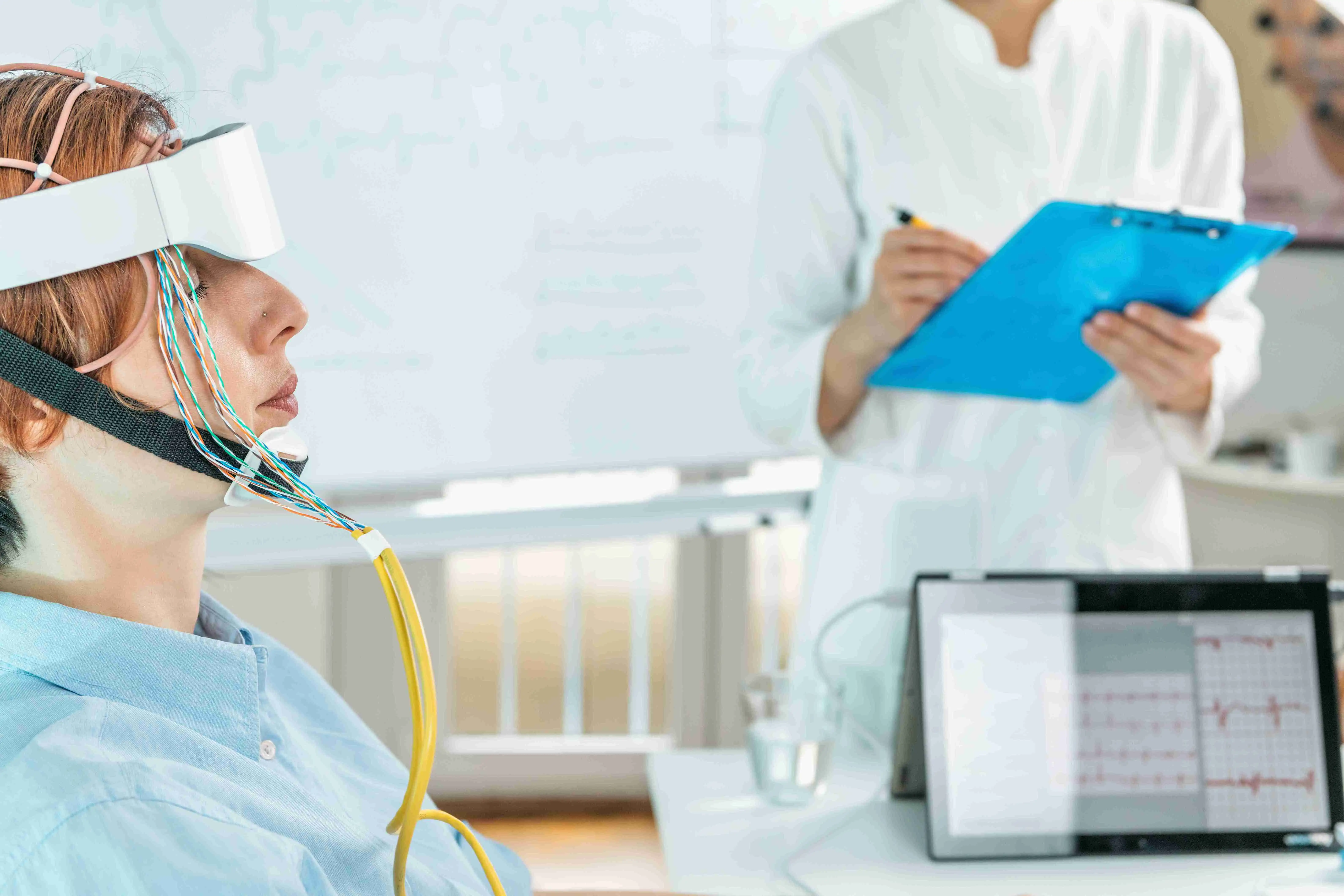
A conventional multichannel HSAT may include:
- A nasal cannula or pressure sensor to estimate airflow.
- Belts around the chest and abdomen to record breathing effort.
- A fingertip pulse oximeter to record oxygen saturation and pulse.
- A position sensor to show whether events cluster on the back or side.
- A snoring sensor or sound channel.
- A small recorder that stores or transmits the signals.
Another validated design uses peripheral arterial tone, oxygen, pulse, and movement rather than the same cannula-and-belt arrangement. The AASM guideline describes either nasal pressure with chest and abdominal effort and oximetry, or peripheral arterial tone with oximetry and actigraphy, as technically adequate configurations used in the evidence supporting HSAT 1.
Some unattended home studies record brain waves and are closer to full polysomnography. These Type II studies are different from the more common limited-channel HSAT. CMS technical categories also distinguish attended Type I polysomnography from Type II and Type III studies and certain multichannel Type IV devices. The category and number of sensors matter, so a single oxygen or snoring gadget should not be assumed equivalent to a diagnostic HSAT 5.
How to prepare and set up the test
Follow the instructions from the service that issued your device because startup steps and sensor placement differ. Ask for help before test night if a diagram or indicator light is unclear.
Before bed
- Keep your schedule and routine as close to normal as practical.
- Avoid a nap on the test day.
- Follow the provider's directions about caffeine and alcohol.
- Ask in advance what to do with prescription medicines, over-the-counter sleep aids, and supplements. Do not stop or change them on your own.
- Check that all listed parts are present and that the device is charged or otherwise ready.
- Save the support number or instructions where you can reach them at night.
AASM patient instructions advise keeping a regular routine, avoiding a nap and caffeine after lunch, and discussing regular medicines with the healthcare provider 6. Your own test service may give different directions based on your usual schedule and health.
At bedtime
Put on each sensor exactly as shown. With a conventional kit, that usually means the cannula at the nostrils, effort belts around the torso, and the oximeter on a finger. Start the recording and confirm the device shows that it is collecting data before you settle down.
Try to sleep in your usual position rather than forcing yourself onto your back to make apnea appear. If a sensor comes off, reattach it only as the instructions show. Note prolonged awakenings, bathroom trips, a detached sensor, or an unusual night if the service provides a log.
In the morning
Stop the recording, remove the sensors, and follow the directions for return or disposal. Reusable kits may go back by mail or drop-off; some systems upload the recording and use disposable parts. Return the kit promptly so the signals can be reviewed while details of the night are still easy to recall 6.
How much usable data is enough?
The AASM guideline's supporting studies treated at least four hours of technically adequate airflow and oxygen data across the usual sleep period as a minimum acceptable recording 1. That is a clinical quality rule, not a reason to remove the equipment after four hours. Wear it for the full instructed night.
A study can be technically inadequate if the airflow signal is lost, the oximeter repeatedly disconnects, the effort channel fails, the recording is too short, or the available signals cannot be interpreted together. A device saying "complete" does not guarantee that the raw traces are diagnostically usable.
REI versus AHI
An in-lab study measures when you are actually asleep using brain, eye, and muscle signals. Its apnea-hypopnea index, or AHI, is the number of apneas and hypopneas divided by hours of measured sleep.
Most HSATs do not directly know when sleep begins or how long you are awake. Their respiratory event index, or REI, commonly divides breathing events by monitoring time. If the recorder is on for seven hours but you sleep for only five, those events are spread across the longer denominator and the REI can look lower. A test without brain waves may also miss hypopneas recognized mainly by an arousal from sleep 2.
Some newer devices estimate sleep time from movement or other signals, and some reports use the label AHI for a home-derived value. Read the methods section of the report before comparing numbers. The calculation, sensors, hypopnea rule, usable monitoring time, sleep position, and oxygen pattern all affect interpretation. The apnea-hypopnea index is useful, but it is not the whole report.
What happens after the test?
Automatic scoring can help organize a recording, but the result should include professional review of the raw signals, artifacts, event types, oxygen data, and monitoring time. Your medical provider then interprets the report alongside your symptoms and health history 2.
There are three broad outcomes:
-
Obstructive sleep apnea is established. Your provider should explain the event index, oxygen findings, uncertainty, and treatment options. Depending on the full picture, next steps may include positive airway pressure, an oral appliance, positional measures, weight management, or another individualized approach.
-
The result is negative or does not explain the symptoms. A low REI does not rule out obstructive sleep apnea, especially after substantial wake time, little sleep on the back, a night unlike usual, or a borderline recording.
-
The recording is inconclusive or technically inadequate. Missing or conflicting signals may prevent a defensible answer even if the device generated a number.
If a single HSAT is negative, inconclusive, or technically inadequate and obstructive sleep apnea is still suspected, the AASM strongly recommends polysomnography. Repeating another HSAT is not recommended in this situation because it may produce the same uncertainty and delay a definitive diagnosis 1.
How to evaluate a direct-to-consumer offer
A wearable or app sold for general wellness may summarize sleep trends without being a regulated diagnostic test. Current FDA guidance distinguishes products intended only to encourage a healthy lifestyle from products intended to screen for, diagnose, monitor, or manage a disease 7.
Before paying for an online home apnea service, ask:
- Is there a medical evaluation before the order?
- Is the exact device authorized for its stated diagnostic use?
- Who reviews the raw signals rather than only the automated score?
- Will you receive the complete interpreted report?
- Is follow-up included for positive, negative, and inadequate results?
- Can the service arrange or refer for polysomnography when needed?
- What are the total fees for the evaluation, equipment, interpretation, return shipping, and follow-up?
In the United States, prescription and over-the-counter medical devices can both exist, so store availability alone does not tell you what a product can diagnose. CMS recognizes only specified home-testing configurations in its national Medicare policy for OSA 5. Other insurers and health systems use their own ordering, authorization, and coverage rules. Ask the testing service and your plan about the exact test rather than relying on a universal price or coverage promise.
Frequently asked questions
Can an at-home sleep study diagnose insomnia?
No. A typical HSAT does not measure the sleep stages and wake periods needed to characterize insomnia, and insomnia is diagnosed clinically rather than from a breathing monitor. Severe insomnia can also make HSAT less accurate, which is one reason PSG may be preferred when apnea is suspected too.
Can it diagnose central sleep apnea?
It may record events that look central, but an HSAT is not the preferred test when central sleep apnea is a meaningful concern. Polysomnography provides the additional signals and clinical context needed to evaluate central, obstructive, and mixed breathing patterns 1.
What if I barely sleep during the test?
Tell the testing service. The interpreter will assess the usable monitoring period and signal quality. Do not decide from clock time alone that the study passed or failed. A short or mostly awake recording may be inadequate or may underestimate apnea.
Should I repeat a negative home test?
Not on your own. When symptoms or clinical concern continue after one negative, inconclusive, or technically inadequate HSAT, the AASM recommends in-lab polysomnography rather than a second HSAT 1.
How soon will I get results?
Timing depends on device return, data quality, staffing, and the clinical service. Ask when the interpreted report and follow-up visit will be available. A same-day automated score is not a substitute for the final clinical interpretation.