
Preparing for a sleep study is mostly logistics, not medicine. Confirm which test was actually ordered, read the sleep center's own instructions, settle every medication question with the clinician who prescribed the medicine, keep your normal sleep schedule, skip naps and afternoon caffeine on the day, arrive with clean hair and skin free of products, and pack as if you were spending one night in a hotel.
The American Academy of Sleep Medicine's day-of instructions for an in-lab study are short: follow your regular routine as much as possible, avoid napping, avoid caffeine after lunch, avoid hair sprays or gels that can interfere with the recording, and avoid alcohol or other sedatives unless your doctor prescribed them 1. MedlinePlus, from the National Library of Medicine, adds a few more: skip lotions, hair gels, and makeup, and leave off nail polish and artificial nails, because the oxygen sensor reads through a fingertip 2.
The rest of this guide covers what those lists leave out, including scheduling, the questions worth asking before the night, accessibility and caregiver arrangements, children, night-shift schedules, home testing kits, and getting home safely the next morning.
One rule outranks everything here. Preparation differs by test and by facility, so if a letter, portal message, or phone call from your sleep center contradicts general advice, follow the sleep center.
Start by confirming which test was ordered
"Sleep study" is an umbrella term. Preparation for an attended overnight recording in a laboratory looks nothing like preparation for a kit you set up in your own bed, and a daytime nap study can occupy the whole following day.
Ask the ordering clinician or the lab to name the test:
- In-lab polysomnography (PSG), an attended overnight recording at a sleep center. Our guide to how an in-lab sleep study works walks through the night itself.
- A home sleep apnea test (HSAT), a smaller set of sensors you apply at home. See our at-home sleep study guide.
- A split-night study, which starts as a diagnostic recording and may move to positive airway pressure later the same night if the lab's criteria are met.
- A positive airway pressure titration study, explained in our CPAP titration guide.
- A Multiple Sleep Latency Test (MSLT) or Maintenance of Wakefulness Test (MWT), daytime trials that usually follow an overnight study and need the most advance preparation.
Which test you get is a clinical decision, not a preference. For uncomplicated adults whose symptoms suggest an increased risk of moderate to severe obstructive sleep apnea, AASM guidance recommends either polysomnography or a home sleep apnea test using a technically adequate device. It recommends polysomnography rather than a home test for people with significant heart or lung disease, possible respiratory muscle weakness from a neuromuscular condition, awake or suspected sleep-related hypoventilation, chronic opioid use, a history of stroke, or severe insomnia. If a single home test comes back negative, inconclusive, or technically inadequate, the guideline recommends going on to polysomnography rather than stopping there 3.
Two more scheduling realities are worth knowing. Accredited facilities must keep written patient-acceptance policies covering age limits and the information a referring clinician has to send before any sleep test, and before testing your record must contain a questionnaire or screening assessment, a history and physical, and a medication record 4. In practice, a missing referral packet or an unreturned questionnaire is a common reason an appointment slips, so confirm that the lab has everything it needs. For what the test will cost and how billing works, see our guide to sleep study costs.
Questions worth asking when you book
A five-minute call can remove most of the anxiety about the night:
- What time should I arrive, and what time will I be released in the morning?
- Is this a diagnostic study, a split-night study, or a titration night?
- Should I eat before I come, and is food or a fridge available?
- May I bring my own pillow or blanket?
- Is the bathroom in the room, and how do I call for help to get up during the night?
- Are the room and bathroom accessible if I use a wheelchair, walker, or transfer aid?
- May a partner, parent, or caregiver stay overnight, and where would they sleep?
- I react to adhesives. What alternatives do you have?
- I use CPAP, oxygen, an oral appliance, or a nighttime medicine. What should I bring or do?
- Who do I call if I get sick or need to cancel?
Medicines, supplements, and sleep aids
This is the one area where general advice can do real harm, so treat it as a conversation rather than a checklist. Your prescriber may want you to take everything as usual, or may want a specific medicine paused, and only they can weigh that against the reason you take it. AASM patient information notes that a provider may recommend temporarily discontinuing some medications before a sleep study 1, and MedlinePlus advises anyone who normally takes sleep medicine to ask their provider whether to take it on the night of the test 2.
Do not stop, start, halve, or delay anything on your own. Both directions can distort a study. A sedative taken for the first time can change how you sleep, and abruptly stopping a medicine that affects sleep or breathing can produce rebound effects that have nothing to do with your usual nights.
Ask about prescriptions, over-the-counter sleep aids, melatonin and other supplements, cannabis, and anything you take only occasionally. Then bring the medicines themselves or an accurate written list, including doses and times. The lab is required to have a medication record before testing 4, and the technologist is responsible for knowing your history, allergies, and current medical status well enough to adjust the procedure or call a physician if needed 5. Say clearly if you are allergic or sensitive to adhesives 1.
Preparation for an MSLT is stricter and starts earlier. AASM patient guidance describes keeping a sleep diary for two weeks while holding a regular schedule, discussing stimulants including caffeine with the sleep physician, and expecting that some medicines may need to be stopped a couple of weeks beforehand. The night before, you have an overnight sleep study, and you need to sleep at least six hours during it for the MSLT to be meaningful. A urine drug test on the morning of the test may also be required, and the result stays between you and your doctor 6. The AASM's protocol guidance for clinicians covers the same ground, including patient preparation, medication and substance use, sleep before testing, and test scheduling 7. Because parts of that take weeks, ask about it as soon as the test is ordered.
Caffeine, alcohol, nicotine, and naps on the day
Caffeine
Most labs ask for no caffeine after lunch 1. The underlying evidence supports being generous with that margin. A meta-analysis of 24 studies found that caffeine cut total sleep time by about 45 minutes and sleep efficiency by about 7 percent, added roughly 9 minutes to the time it took to fall asleep, increased light sleep, and reduced deep sleep. To avoid losing total sleep time, the authors calculated that a 250 mL coffee containing about 107 mg of caffeine should be finished at least 8.8 hours before bedtime, and a standard serving of a pre-workout supplement at about 218 mg needs roughly 13.2 hours 8.
Those numbers are averages for healthy adults rather than a personal threshold, and they are a useful reason to stop earlier than you think you need to. If you normally drink several caffeinated drinks a day, ask the lab how far to cut back rather than quitting outright, since a sudden change to a daily habit is its own disruption.
Alcohol
Skip it on the day, and not only because it makes falling asleep in a strange bed feel easier 12. Alcohol relaxes the muscles that keep the upper airway open. In a meta-analysis of 14 randomized trials covering 422 adults, most of them men, the apnea-hypopnea index rose after alcohol by about 2.3 events per hour on average, with larger increases in snorers, around 4.2 events per hour, and in people already diagnosed with obstructive sleep apnea, around 7.1 events per hour. Average oxygen saturation fell slightly, the lowest saturation of the night fell more, and breathing events lasted longer 9.
In other words, a couple of drinks can make one night look worse than your ordinary nights, which is the opposite of what the recording is meant to capture.
Nicotine
Mention it when you book. A review of 52 studies found that nicotine use is mainly linked with insomnia-type changes, including a longer time to fall asleep, more fragmented sleep, less deep sleep, lower sleep efficiency, and more daytime sleepiness, along with suppression of REM sleep. The authors also noted that findings varied considerably between studies because of differing methods and populations 10. Sleep facilities are smoke-free and vape-free, so an unplanned night without nicotine can unsettle sleep on its own. Raise it in advance rather than at bedtime, and ask what the lab allows before lights out.
Naps and the rest of the day
Do not nap on the day of the study 12. Otherwise keep the day ordinary. Follow your usual routine as closely as you can, since the point is to record a typical night rather than an unusually tired or unusually wired one 1.
Two practical habits help without being medical rules. Eat a normal dinner a few hours before you leave rather than a very large or very late one, especially if heavy meals usually give you reflux. And if a hard evening workout normally leaves you keyed up, move it earlier in the day.
Hair, skin, and nails
Electrodes only work when they make direct contact with skin. The stated goal of electrode application is the lowest possible impedance without compromising comfort or skin integrity: scalp electrodes are filled with conductive paste and pressed against the scalp, and electrodes elsewhere are secured with tape or medical adhesive 5. Anything slick in between works against that, which is why product-free hair and skin is one of the few preparation rules that is genuinely about data quality.
Before you leave home:
- Wash your hair with ordinary shampoo and let it dry. Skip leave-in conditioner, gel, hairspray, mousse, pomade, oils, and dry shampoo 1.
- Skip body lotion, oil, and moisturizer on your face, chest, and legs 2.
- Arrive without makeup, and pack remover for the morning 12.
- Remove nail polish and take off artificial nails, since the pulse oximeter reads through a fingertip 2.
Call the lab ahead of time if standard setup may be awkward: braids, locs, extensions, a weave, a wig or hairpiece, freshly styled hair you would rather not wash, a scalp condition, a recent scalp procedure, or skin that reacts to tape. Technologists place electrodes at fixed positions on the scalp and need to part hair to reach them, so it is worth agreeing on a plan rather than improvising at 9 p.m. Facial hair is not a problem, but mention a full beard so the technologist can choose how to secure the breathing sensor and chin electrodes.
Expect paste in your hair in the morning; it washes out. Mild skin irritation from the electrodes is the main risk of the test, and it settles after they come off 2.
What to pack

AASM patient guidance sums this up well: bring what you need for your nightly routine, and prepare as if you were staying in a hotel for one night. Its list includes comfortable pajamas or sleep clothes, a toothbrush, toothpaste and floss, makeup remover, reading material, and clean clothes for the morning 1.
Worth adding:
- Your medicines in their containers, plus a written list with doses and timings.
- Your CPAP mask and tubing, oral appliance, or oxygen details if you already use nighttime treatment.
- Insurance card, photo ID, and any paperwork the lab asked for.
- Glasses, hearing aids, and any mobility aid you use to get to a bathroom at night.
- Phone and charger, plus something to occupy the setup hour.
- A familiar pillow or blanket if the lab allows it.
Two-piece, loose, breathable sleepwear is easier to work with than a long nightgown or a one-piece, because belts sit around the chest and abdomen and sensors go on the lower legs. Very slippery fabrics make tape less secure. Leave valuables at home.
The evening: arrival, setup, and consent

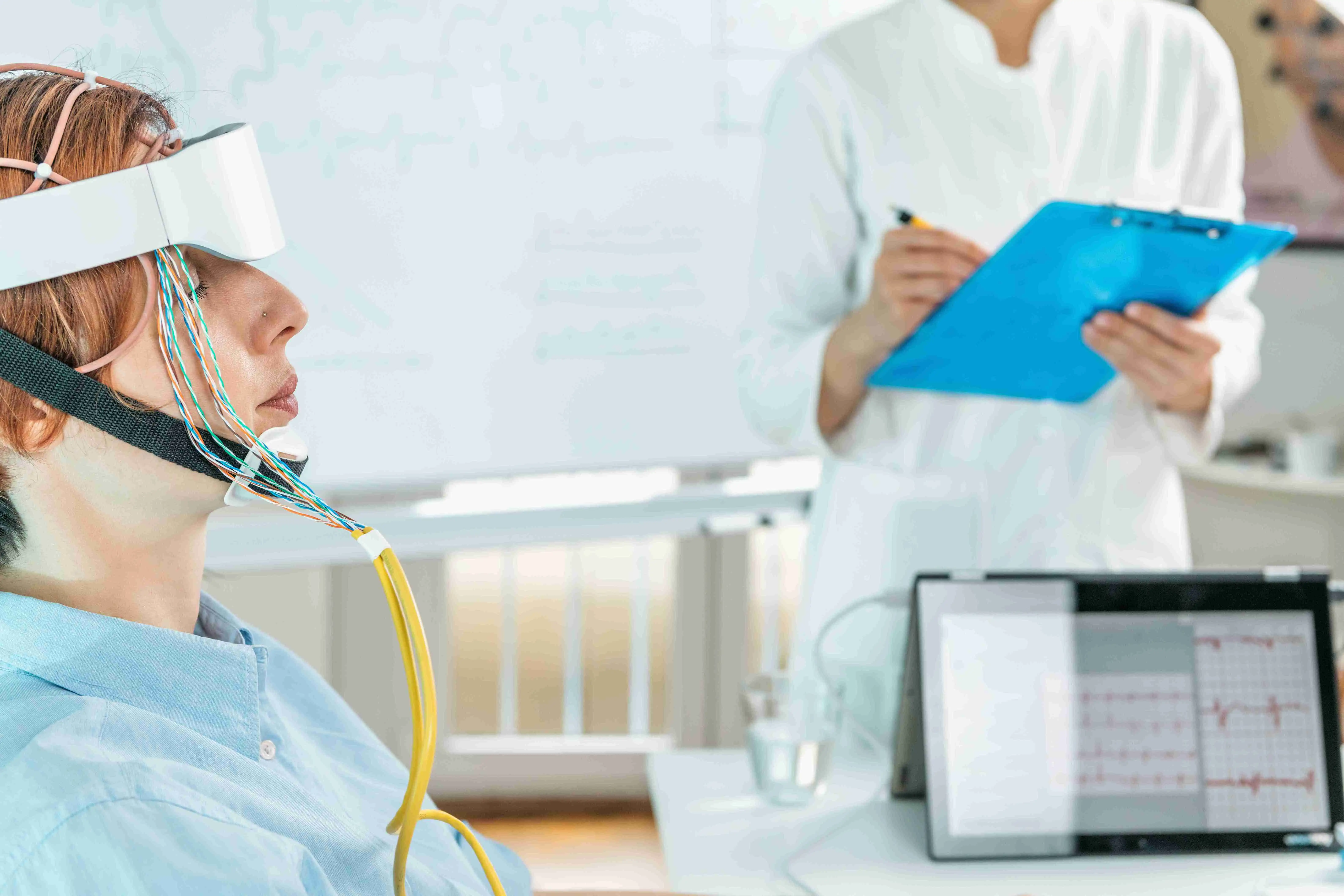
Most people are asked to report in the early evening rather than at bedtime, because setup takes time 1. On arrival, a sleep technologist asks about your sleep habits and there may be a questionnaire to complete. You get time to settle into a private room with a bathroom, then sensors are glued or taped in place. They are painless, and the wires are long enough to let you move and turn over. Before lights out you are asked to move your eyes, clench your teeth, and move your legs so the technologist can confirm the sensors are recording properly 1.
Two things about the room are worth knowing in advance. Accredited facilities must provide continuous visual monitoring and video recording during testing 4, and you should be told where the camera is and asked to acknowledge the audio and video recording on a consent form 5. There must also be a two-way communication system between the bedroom and the control room, which is how you call for help or ask to be unhooked for the bathroom 4.
Our companion guide covers the sensors, the overnight monitoring, and how the recording becomes a report in how an in-lab sleep study works.
If you need extra support, say so before the night
Technologists are expected to identify special needs while reviewing your sleep history and physical, including physical limitations, emotional needs, and language barriers 5. That only works if the information reaches them before you arrive.
Accreditation standards give you some concrete things to ask about. At least one testing bedroom and bathroom at each accredited facility must be accessible as defined by local building regulations and the Americans with Disabilities Act. Testing bedrooms must be single occupancy and private, and caregivers staying overnight must have somewhere to sleep, such as a recliner or cot 4. If you need the accessible room, ask whether it is free on your date rather than on the night.
Facilities must also publish patient rights covering help for someone who speaks another language or has a physical or mental disability, so that they can make informed decisions about their care, and recognizing that a parent, guardian, or family member may speak for a patient who cannot decide for themselves 4. If privacy during hookup concerns you, facilities are required to have explicit policies to reduce the risk of assault or of allegations of inappropriate behavior during an attended study, which may include continuous video monitoring of bedrooms and hookup areas or training in the use of a chaperone 4. You are entitled to ask how yours handles it.
Worth raising in advance: help with transfers or toileting, positioning or pressure care, a catheter, ostomy, or feeding tube, tremor or chronic pain, claustrophobia or trauma around masks, autism or sensory sensitivity, hearing or vision needs, an interpreter, a service animal, or a bedtime much earlier or later than the lab's default.
Preparing a child for a sleep study
Facilities that test patients under 13 must maintain age-specific protocols for comprehensive polysomnography, positive airway pressure titration, and carbon dioxide monitoring 4. Ask whether the site regularly tests children your child's age, and confirm who may stay overnight and where they will sleep, since accredited facilities must provide a sleeping space for a caregiver staying the night 4.
The preparation that helps most is ordinary and undramatic:
- Describe it simply and truthfully. Stickers and wires go on the head, face, chest, and legs, there are no needles, and the sensors do not hurt 1.
- Ask whether the lab offers a photo tour, a video, or a short daytime visit beforehand.
- Keep the usual bedtime routine at the lab, including the same book, song, or order of events.
- Bring familiar pajamas, a comfort object, and a blanket that smells like home.
- Wash and dry their hair with plain shampoo and skip all styling products.
- Try to avoid a nap in the car on the way, since labs ask patients not to nap on the day of the study 1.
- Bring the medication list, and plan the next morning, including whether school is realistic.
Night-shift workers and irregular schedules
Tell the scheduler when you actually sleep, not when most people sleep. The point of the recording is to capture the sleep you normally get, and someone who habitually sleeps from 8 a.m. to 3 p.m. is being asked to do something unusual by an overnight appointment. Ask whether the lab runs daytime studies, and do not flip your schedule to suit the appointment unless the clinician tells you to.
If your pattern is genuinely irregular, expect the clinician to want a record of it first. AASM guidance suggests using actigraphy when assessing adults with a circadian rhythm sleep-wake disorder, the category that shift work disorder belongs to 11, and a two-week sleep diary is already standard practice before an MSLT 6. Our guide to actigraphy explains what that wrist recording can and cannot show.
If your test is a home sleep apnea test
The day-of rules are much the same: follow your regular routine, avoid napping, cut out alcohol and caffeine after lunch, and tell your doctor about any regular medicine, because they may recommend temporarily stopping one 12.
The logistics are different. You either collect the kit from an office or have it delivered, and a member of the sleep team explains how to use the device. That handover is the moment to ask questions, not test night 12. Before bed, check that every listed part is present and the device is charged or otherwise ready, and keep the instructions and a support number within reach. Go to bed at your regular time, attach the sensors exactly as instructed, and keep the sleep log or press the marker button if you were asked to. In the morning, remove the sensors and return the equipment as directed, since some kits go back in person, some by mail, and some are disposable 12.
Keep the limits in mind too. Home testing is aimed at adults with a high likelihood of moderate to severe obstructive sleep apnea and no significant complicating conditions, and a negative or inconclusive home test should lead to an in-lab study rather than to reassurance 312. Our at-home sleep study guide covers setup and interpretation in more detail.
The morning after, and getting home safely
The technologist tests the sensors once more, removes them, and may ask you to complete a short questionnaire about how the night compared with sleep at home. The study is finished once you are awake and the sensors are off 1. Nobody can give you a diagnosis at the bedside, because the recording still has to be scored and interpreted.
Plan the trip home before you arrive. Professional guidance for sleep technologists says the technologist should make certain a patient has had enough sleep and does not appear to be under the influence of medication or alcohol before release, that patients who have not slept enough should be encouraged to stay and sleep under visual monitoring even after the recording has stopped, and that it may be good policy to suggest patients arrange transportation for discharge 5. Treat that as your cue to line up a ride, especially if you were prescribed something to help you sleep during the study, you expect a rough night, or you face a long drive.
The timing is the part people underestimate. You will be leaving early in the morning, possibly on less sleep than usual. The National Highway Traffic Safety Administration recorded 644 deaths in drowsy-driving crashes in 2024 and notes that these crashes happen most often between midnight and 6 a.m. and in the late afternoon. It also cautions that precise counts are not possible, because investigators cannot always confirm that drowsiness contributed, and that its own figures are widely regarded as an underestimate 13. If you feel impaired, do not drive.
Most people go on with their day afterward, but decide in advance whether you want a late start at work or a lighter day. Results usually take longer than people expect: a technologist scores the recording, a sleep physician interprets it, and the clinician who ordered the study contacts you, a process that can take up to about two weeks 1.
Frequently asked questions
Should I take my usual medicines before a sleep study?
Ask the clinician who prescribed them, and ask early rather than on the day. AASM patient information notes that a provider may recommend temporarily discontinuing some medicines before a study 1, and MedlinePlus advises asking your provider specifically about your usual sleep medicine 2. Do not change anything on your own, and bring your medicines and a written list with you.
Can I have coffee on the day of the study?
Morning coffee is usually acceptable, and most labs ask you to stop caffeine after lunch 1. Research on timing supports stopping earlier still: to avoid losing total sleep time, a 250 mL coffee is best finished about 8.8 hours before bedtime, and a pre-workout serving needs roughly 13.2 hours 8. If you drink a lot of caffeine, ask how far to cut back rather than stopping altogether.
Do I really have to wash my hair, and can I use conditioner?
Wash and dry it with plain shampoo, and skip leave-in conditioner, gel, spray, oil, and dry shampoo. Scalp electrodes have to make direct contact with skin, and the goal of applying them is the lowest impedance possible without hurting your comfort or skin 51.
What if I hardly sleep at the lab?
That is common and usually manageable. A full eight hours is generally not required for a diagnosis 12, although the physician still has to judge whether enough usable data were recorded to answer the clinical question. Our guide on what to do if you cannot sleep during a sleep study covers the options.
Can my partner or a caregiver stay overnight with me?
Ask, because policies vary. Testing bedrooms are single occupancy and private, and accredited facilities must provide a sleeping space such as a recliner or cot for a caregiver who stays overnight 4. Treat a companion as something to arrange in advance rather than assume.
Will I be able to drive home in the morning?
Plan as though you might not want to. Guidance for technologists says it may be good policy for patients to arrange transportation at discharge, and that a patient should not be released while appearing to be under the influence of medication or alcohol or after too little sleep 5. Drowsy-driving crashes cluster in exactly the early-morning window when you will be leaving 13.
A simple timeline
- When you book: confirm which test was ordered, ask the logistics questions above, and flag accessibility, caregiver, child, shift-work, or equipment needs.
- Two weeks out, for an MSLT: start the sleep diary and settle medication timing with the sleep physician 6.
- A week before: have the medication conversation with your prescriber, arrange your ride home, and sort out work or childcare for the next morning.
- The day of the study: normal routine, no nap, no caffeine after lunch, no alcohol, ordinary dinner, clean product-free hair and skin, no makeup or nail polish, bag packed.
- At check-in: tell the technologist anything unusual about the day, including a missed dose, an accidental nap, or a late coffee.
- The next morning: do not drive if you feel impaired, and ask when and how you will get the results.