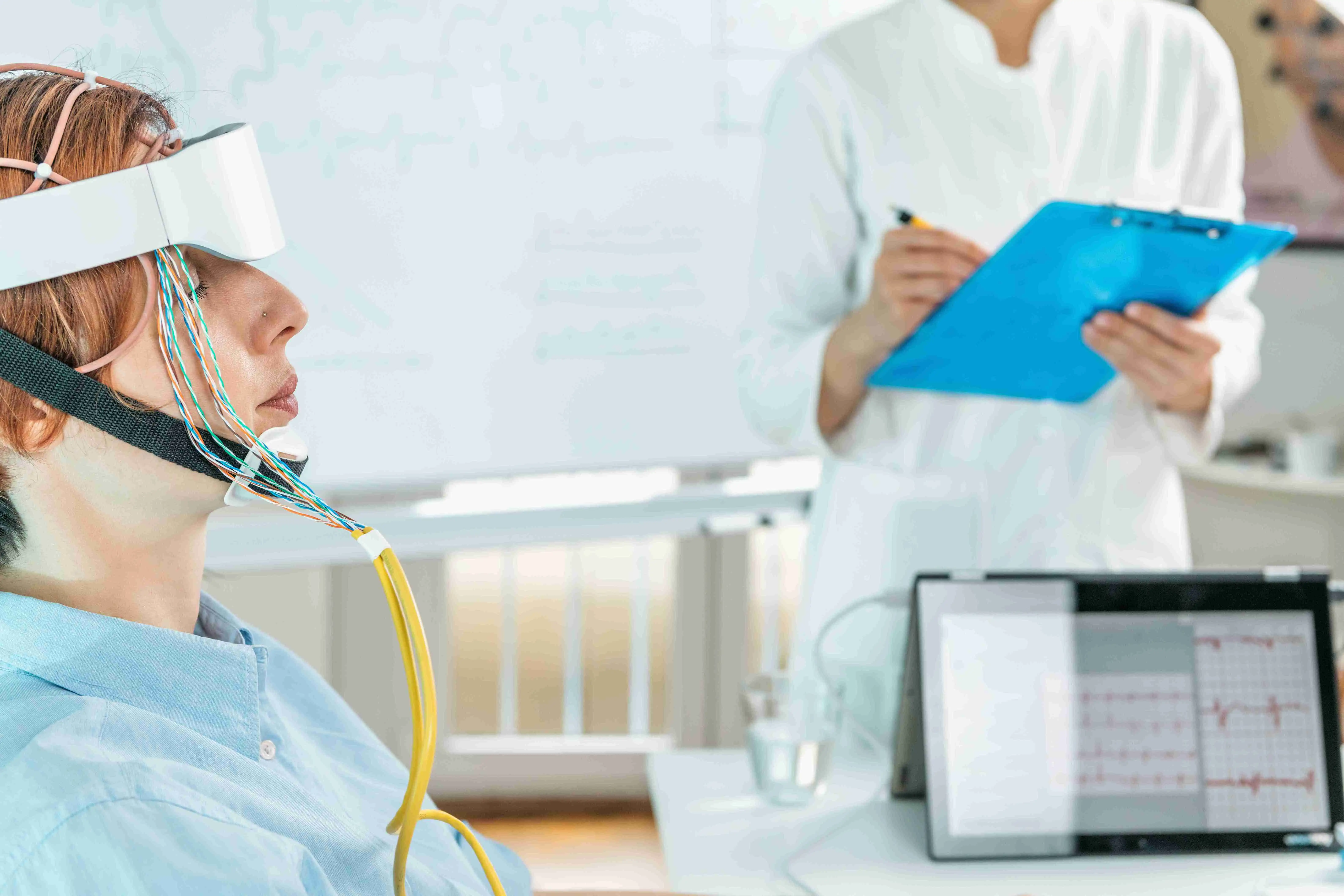


A positive airway pressure (PAP) titration is an attended sleep study used to find a treatment setup that controls sleep-related breathing events while remaining usable. You wear a mask and sleep with PAP while a technologist monitors the signals from a full polysomnogram and adjusts pressure or, when ordered, the treatment mode.
The result is not always one perfect pressure for life. It is evidence from one night that the interpreting clinician combines with the original diagnosis, health conditions, sleep-stage and position sampling, comfort, oxygen or carbon dioxide findings, and follow-up data.
Diagnostic study versus PAP titration
A diagnostic polysomnogram (PSG) records sleep without starting PAP so the clinician can determine whether obstructive, central, or another form of sleep-disordered breathing is present and how it changes across the night. It can also help identify arousals, limb movements, unusual behaviors, and other findings that a limited home sleep apnea test may not measure.
A PAP titration PSG starts after sleep apnea has been objectively diagnosed. The same kinds of sleep and breathing signals are recorded, but PAP is applied and adjusted to see which settings control events in the sleep stages and positions that occur. AASM guidance states that PAP treatment should be based on an objective OSA diagnosis, not on symptoms, snoring, an oximeter, or a treatment trial alone 1.
There are two common laboratory formats:
- Full-night titration: The prior diagnostic study is already complete, so the treatment trial can use the whole recording night.
- Split-night study: The first part is diagnostic. If enough moderate to severe OSA is documented early and at least 3 hours remain for titration, the team may begin PAP during the same night. If those conditions are not met, the night remains diagnostic 2.
A split night can avoid a second visit, but its shorter treatment portion may not capture enough rapid eye movement (REM) sleep, back sleeping, or time at a stable setting. An inconclusive split-night titration does not undo the diagnosis. It means more treatment information may be needed.
Does everyone need an in-lab titration?
No. The AASM recommends either home initiation with auto-adjusting PAP (APAP) or in-lab titration for adults with confirmed OSA and no significant comorbidities 1. In the evidence review supporting that recommendation, home and laboratory initiation produced similar patient outcomes in the studied populations 3.
Home APAP initiation is not a diagnostic home sleep study. The diagnosis comes first. The APAP device then works within a prescribed pressure range and changes pressure in response to its algorithm. Mask support, education, troubleshooting, and clinical follow-up are still part of treatment.
Laboratory titration provides more direct observation. It can be especially useful when the clinician needs to see sleep stages and body position, correct major mask leak in real time, evaluate persistent oxygen or ventilation concerns, distinguish obstructive from central events, or test a more complex mode. The right route depends on the diagnosis, health context, prior treatment experience, available support, and what the clinician needs to learn.
What is recorded during the night?
PAP titration is still a polysomnogram. The exact montage can vary with the clinical question, but the core signals let the team tell whether you are asleep, how you are breathing, and how breathing changes after an adjustment.
Common measurements include:
- Brain waves, eye movements, and chin muscle activity to identify wake, non-REM sleep, REM sleep, and arousals.
- PAP airflow and pressure to show the delivered setting, breath shape, and reductions or pauses in airflow.
- Chest and abdominal effort to help distinguish an obstructed breath from a central event with reduced or absent effort.
- Blood oxygen saturation and pulse throughout the study.
- Heart rhythm or heart rate, usually through an electrocardiogram channel.
- Body position, snoring, and leg movements, along with technologist observations.
- Intentional and unintentional leak from the mask system.
Carbon dioxide is not required for every adult CPAP titration. When hypoventilation or impaired ventilation is a concern, the clinician may add arterial or transcutaneous carbon dioxide monitoring. AASM respiratory-scoring guidance recommends arterial or transcutaneous carbon dioxide when hypoventilation is being assessed during PAP titration, while also stressing calibration and clinical judgment because a surrogate sensor is not automatically exact 4.
Oxygen and carbon dioxide answer different questions. Normal-looking oxygen saturation does not by itself prove that ventilation is normal, and a low oxygen reading does not show whether the cause is obstruction, hypoventilation, lung disease, artifact, or another problem.
Mask fitting comes before pressure testing
A pressure cannot be interpreted well through a poorly fitting mask. AASM manual-titration guidance calls for PAP education, hands-on demonstration, careful mask fitting, and acclimatization before titration 5.
The technologist may let you try more than one mask size or style while awake. The aim is a stable seal without overtightening, a clear exhalation port, and a setup you can tolerate long enough to sleep. Tell the technologist about pressure on the nose or teeth, air in the eyes, mouth leak, nasal blockage, dryness, claustrophobia, or trouble exhaling.
Every PAP setup needs an intended route for exhaled gas. In the usual vented CPAP system used for titration, that route is a vent built into the mask or a nearby circuit component, and it must remain open. A nonvented mask is different: it must be paired with the specific external exhalation system prescribed for that circuit and cannot be substituted for a vented interface on its own 6. Unintentional leak is air escaping around the cushion or through the mouth with a nasal interface. A single universal leak cutoff does not fit every mask and pressure. The AASM guideline instead relates significant leak to the expected vent characteristics of the fitted interface and recommends refitting or readjusting when substantial unintentional leak appears 5.
Raising pressure to chase events while a large leak continues can make the night harder to interpret. The team may reseat the cushion, adjust headgear, address tubing pull, change mask size or style, or use another ordered strategy before deciding that the pressure itself failed.
What does the technologist adjust?
The technologist follows a laboratory protocol and the interpreting clinician's order. The goal is not simply to stop snoring or reach the highest pressure you can tolerate.
With continuous positive airway pressure (CPAP), the technologist increases a single pressure in steps while watching for obstructive apneas, hypopneas, respiratory-effort-related arousals, snoring, oxygen changes, leak, awakenings, and comfort. Pressure may also be reduced if a higher setting creates intolerance or if central events appear.
The team tries to observe an effective setting across non-REM and REM sleep and in relevant positions. Back sleeping and REM can require different pressure from side sleeping or non-REM sleep, so the report should show what was actually sampled. AASM titration guidance considers stable supine REM especially informative, but it also warns that obtaining enough sleep matters 5.
If CPAP is poorly tolerated at higher pressure or obstructive events remain at high CPAP, the protocol may allow a trial of bilevel positive airway pressure (BPAP), which sets a higher pressure during inhalation and a lower pressure during exhalation. That does not make BPAP automatically better or more powerful. For routine adult OSA treatment, the AASM suggests CPAP or APAP over BPAP 1.
A technologist does not independently diagnose a new condition or choose long-term treatment. They collect and annotate the overnight data under protocol. A qualified clinician interprets the full recording and makes the prescription.
How to prepare
Follow the sleep center's written instructions because arrival times, medication plans, meals, caffeine limits, and what to bring differ. General preparation is simple:
- Keep your usual sleep schedule unless the center specifically asks for a change.
- Do not deprive yourself of sleep to force a result unless the sleep clinician directs it.
- Do not alter prescribed medicines, oxygen, or PAP on your own. Follow the center's instructions for caffeine, alcohol, cannabis, sedatives, and stimulants.
- Give the center a current medication and supplement list, including opioids and medicines that affect breathing or alertness.
- Ask whether to bring your current machine, mask, tubing, chin strap, oral appliance, oxygen equipment, or prior reports.
- Bring comfortable sleepwear and any permitted item that helps you sleep.
- Tell the center in advance about severe nasal blockage, skin injury, latex or adhesive sensitivity, claustrophobia, mobility or transfer needs, fall risk, implanted devices, a usual caregiver, or a need for accessible equipment.
If you are already using PAP, ask whether to use it as usual before the study. Do not assume you should stop treatment for several nights. If you are worried that you cannot tolerate the mask, ask whether daytime fitting or acclimatization is available.
What can make a titration incomplete?
A titration can provide useful information without establishing a well-tested final setting. Common reasons include:
- too little total sleep
- little or no REM sleep
- no sleep in a clinically important position, often on the back
- too little time after a split-night switch to PAP
- persistent mask or mouth leak
- repeated awakenings, nasal blockage, pain, anxiety, or pressure intolerance
- lost or unreliable sensor signals
- obstructive events that remain across the settings tested
- central apneas that emerge or persist as pressure changes
- low oxygen or rising carbon dioxide that is not explained by obstruction alone
These are limitations of the sample, not a failure by the patient. Sleep in a laboratory is not fully controllable, and forcing more pressure or a particular position can worsen sleep and reduce the usable data.
AASM manual-titration guidance grades studies by event control, oxygenation, leak, and whether relevant sleep and position were observed. It recommends considering repeat titration when the first study does not reach an optimal or good grade, particularly when a split-night titration was too short 5. Depending on the clinical situation, the next step might instead be home APAP with close review, mask work, a repeat laboratory study, or evaluation for another breathing disorder.
How to read the report
The report should give more context than a single pressure number. Look for:
- total sleep time and sleep efficiency
- time in REM and non-REM sleep
- positions recorded at the recommended setting
- mask type and size, whether the mask changed, and leak observations
- each PAP mode and pressure range tested
- residual obstructive apneas, hypopneas, arousals, snoring, and central events
- oxygen levels and time at low saturation
- carbon dioxide findings, if monitored
- comfort or tolerance problems that affected the study
- the titration quality grade and the reason for the recommendation
Ask whether the recommended setting controlled breathing during REM and back sleeping or only during the stages and positions that happened. Also ask whether central events were present before PAP, appeared during treatment, or were too few or too uncertain to interpret.
Why the recommended pressure may not be the final setting
A laboratory recommendation is based on the mask, sleep, position, and physiology recorded that night. The prescriber may choose:
- a fixed CPAP pressure observed to work
- an APAP range that covers observed needs while allowing night-to-night variation
- a slightly different setting to improve tolerance while follow-up data are collected
- BPAP or another mode when the clinical problem is not routine obstruction
- another evaluation before prescribing a more complex treatment
Pressure needs and measured events can vary with body position and sleep stage, and the treatment plan may need review after a major weight change or a change in health 7. A single titration also cannot show long-term adherence, repeated-night leak, or how proprietary home-device algorithms will classify every breath.
Do not change prescribed pressure, mode, backup rate, or oxygen flow on the basis of the report alone. Two settings with similar names may control different problems, and an unreviewed change can worsen leak, intolerance, obstruction, central events, or ventilation.
If ordinary CPAP does not solve the problem
A difficult CPAP titration does not automatically mean “more pressure” or “stronger PAP” is the answer. The event type and cause matter.
- APAP varies pressure within a prescribed range. It is a common initiation and ongoing option for uncomplicated adult OSA, but it is not a substitute for evaluating unexplained central events, hypoxemia, or hypoventilation.
- BPAP without a backup rate provides separate inhalation and exhalation pressures. It may be used in a selected obstructive or stable chronic hypoventilation plan, but it is not interchangeable with a mode that supplies timed breaths 18.
- BPAP with a backup rate can deliver a timed breath when spontaneous breathing is absent or too slow. It is considered for selected central-apnea or stable chronic hypoventilation patterns, not routine OSA 8.
- Adaptive servo-ventilation (ASV) changes support breath by breath and is designed for selected central or unstable breathing patterns. It requires a specific diagnosis and clinical review.
- Supplemental oxygen raises inspired oxygen but does not splint open a collapsing upper airway and does not directly correct inadequate ventilation. It is prescribed for a defined oxygen or central-apnea indication, not added to PAP as a general fix.
The 2025 AASM central sleep apnea guideline conditionally supports CPAP, BPAP with a backup rate, ASV, or low-flow oxygen for particular central-apnea causes and circumstances. It suggests against BPAP without a backup rate for the central-apnea conditions it addresses. It also says ASV in heart failure with reduced ejection fraction should be limited to experienced centers with close monitoring and follow-up 9. These modes therefore cannot be ranked as simple upgrades.
New or persistent central events may prompt review of heart failure, neurologic or lung disease, altitude, opioid or other medication exposure, treatment-emergent central sleep apnea, or another contributor. Persistent low oxygen or high carbon dioxide may require evaluation for hypoventilation or cardiopulmonary disease. The correct response is to define the physiology, not to self-select a device mode.
Follow-up after titration
After the interpreting clinician reviews the study, the prescription should identify the device mode and settings, and the equipment setup should match the mask and comfort plan. Early follow-up is part of treatment, not an optional check after the machine has already succeeded or failed.
Useful follow-up includes:
- how often and how long PAP is actually used
- whether symptoms and daytime function are improving
- mask seal, skin pressure, dryness, congestion, swallowing air, and trouble exhaling
- device-estimated residual events, their reported type, pressure behavior, and leak
- whether oxygen, carbon dioxide, or another condition needs separate reassessment
PAP-device event estimates come from proprietary algorithms. They can help reveal patterns, but they do not contain the same sleep-stage, arousal, effort, and verified-signal context as attended PSG. AASM follow-up guidance notes that unexplained device data, persistent symptoms despite good use, suspected ongoing hypoxemia or hypoventilation, clinically important weight change, or a change in cardiovascular disease can justify follow-up testing. It does not recommend routine repeat testing for an asymptomatic patient doing well on PAP 7.
A repeat titration is most useful when it can answer a defined question, such as whether leak prevented the first interpretation, whether events persist in REM or on the back, whether central events remain after an observation period, or whether a different mode improves ventilation. Sometimes careful clinical troubleshooting and a reviewed setting adjustment can answer the question without another laboratory night.
Do not drive or perform hazardous work when sleepiness makes it unsafe, even if the titration looked successful. PAP benefit depends on effective treatment during actual use, and one monitored night does not prove that alertness has recovered.
Questions to ask the sleep team
Before the study:
- Is this a diagnostic, split-night, CPAP, BPAP, ASV, or ventilation titration?
- What clinical question is the study meant to answer?
- Should I bring or use my current mask, PAP device, oral appliance, or oxygen?
- Which medication, caffeine, alcohol, and sleep-schedule instructions apply to me?
- Will oxygen or carbon dioxide be monitored because of my health history?
After the study:
- How much REM and back-sleep time occurred at the recommended setting?
- Was leak controlled, and which mask worked best?
- Were residual events obstructive, central, or unclear?
- Did oxygen normalize, and was carbon dioxide measured?
- Is the prescription fixed CPAP, APAP, BPAP, or another mode, and why?
- What data and symptoms will be reviewed after I start at home?
- What result would trigger an adjustment, another evaluation, or repeat titration?
A note about children
The adult home-APAP recommendation and adult pressure decisions should not be transferred to a child. Pediatric event scoring, equipment, anatomy, pressure limits, causes of obstruction, and follow-up differ. A child undergoing PAP titration needs a pediatric sleep team and a child-specific protocol.
Bottom line
A CPAP titration sleep study is a monitored treatment experiment. It shows how breathing, oxygen, sleep stages, body position, comfort, leak, and sometimes carbon dioxide respond as the team tests a mask and PAP settings.
A full-night titration offers more treatment time, while a split night can diagnose and begin treatment in one visit when enough time and diagnostic evidence are available. Some uncomplicated adults can start with home APAP instead. Whichever path is used, the recommended pressure is the beginning of a follow-up process that checks real-world use, symptoms, leak, residual events, and any unresolved central, oxygen, or ventilation concern.