A sleep study is a medical recording designed to answer a particular question about sleep, breathing, movement, or daytime alertness. It is not one universal test. The sensors, setting, and length of testing should match the disorder a clinician is investigating.
An overnight polysomnogram in a sleep laboratory records sleep stages as well as breathing and movement. A home sleep apnea test records a smaller set of signals and is mainly used for suspected obstructive sleep apnea in selected adults. Daytime tests such as the multiple sleep latency test and maintenance of wakefulness test answer different questions and cannot replace the overnight study 12.
Which sleep test answers which question?
| Test | Main question | What makes it different |
|---|---|---|
| Attended polysomnography (PSG) | What happens to sleep, breathing, oxygen, heart rhythm, and movement through the night? | A technologist monitors a broad set of signals in real time, including brain activity used to identify actual sleep and sleep stages. |
| Home sleep apnea test (HSAT) | Is obstructive sleep apnea likely in an uncomplicated adult who already has a higher clinical risk? | It records fewer signals at home, usually without the brain-wave channels needed to measure sleep stages and arousals. |
| Split-night study | Can obstructive sleep apnea be identified and PAP treatment tested during the same night? | The first part is a diagnostic PSG. The second becomes a PAP titration only if enough diagnostic evidence appears early and enough night remains for a useful titration. |
| Full-night PAP titration | Which PAP approach and settings control breathing events while remaining usable? | The diagnosis is already established. A technologist adjusts prescribed treatment while recording sleep and breathing. |
| PSG followed by MSLT | How readily does someone fall asleep during the day, and does REM sleep appear unusually soon? | The overnight PSG is followed by a series of daytime nap opportunities. This sequence is used in the evaluation of narcolepsy and other central disorders of hypersomnolence. |
| Maintenance of Wakefulness Test (MWT) | How well can someone remain awake in a quiet setting? | The person is asked to stay awake during repeated daytime trials. It measures alertness rather than the tendency to fall asleep when given a nap opportunity. |
| Actigraphy | What are the likely sleep and wake patterns across days or weeks? | A wrist-worn movement sensor supports evaluation of sleep timing and duration. It does not provide the same physiological recording as PSG 3. |
The order should state the exact test. If it only says "sleep study," ask whether it means diagnostic PSG, HSAT, titration, split-night testing, or an overnight-plus-daytime protocol.
What an attended polysomnogram records
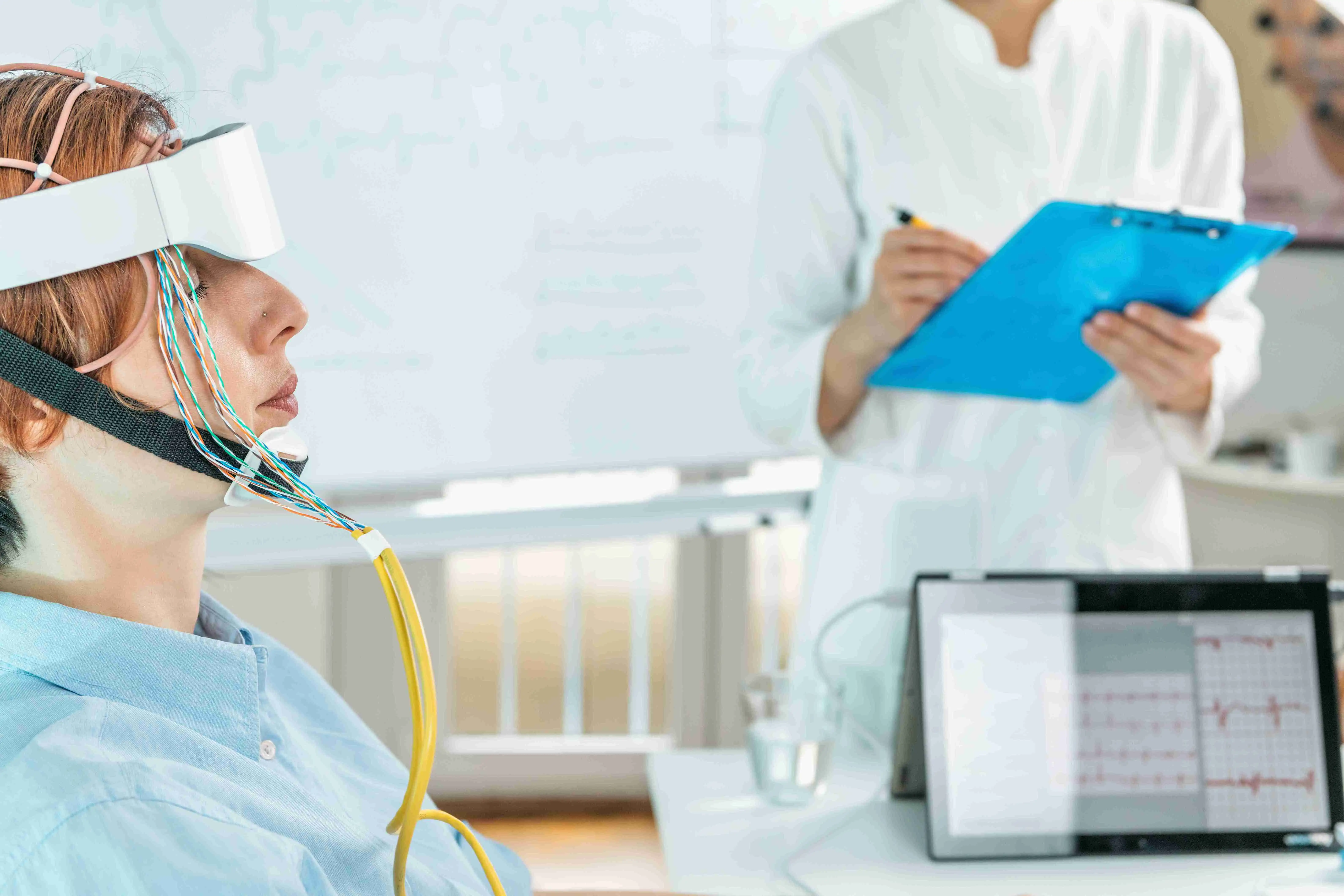
Polysomnography combines several signals because no single sensor can describe sleep. The AASM scoring manual supplies the standard rules for sleep stages, arousals, breathing events, movements, and cardiac events 4.
A routine overnight PSG commonly includes:
- EEG, or brain-wave sensors, to distinguish wakefulness and sleep stages;
- EOG, or eye-movement sensors, to help identify rapid eye movement sleep;
- chin and leg muscle sensors to measure muscle tone and movements;
- airflow sensors at the nose and mouth;
- chest and abdominal belts to show breathing effort;
- pulse oximetry to estimate blood oxygen saturation;
- an ECG lead to record heart rate and rhythm;
- body-position and snoring signals when included in the laboratory's setup; and
- synchronized video and audio to provide context for movement, position, sounds, and unusual behavior.
Extra channels are added when the clinical question requires them. Carbon dioxide can be measured through the skin or exhaled breath when sleep-related hypoventilation is suspected. An expanded EEG montage and added muscle leads may be used for possible nocturnal seizures, unusual parasomnias, or dream-enactment behavior. Routine PSG uses enough EEG to stage sleep, but it is not automatically a full epilepsy evaluation 5.
The sensors sit on the skin rather than entering the body. Setup can feel lengthy, and adhesive or belts may be uncomfortable, but the test is generally painless. The wires are arranged so you can change position. A technologist can disconnect or assist you if you need to use the bathroom.
How a home sleep apnea test differs
A technically adequate HSAT can be an alternative to PSG for an uncomplicated adult whose history and examination suggest a higher risk of moderate to severe obstructive sleep apnea. It is not a general screening test and is not designed to diagnose every sleep disorder 16.
Most HSAT systems focus on airflow, breathing effort, oxygen saturation, pulse, and sometimes snoring, position, movement, or peripheral arterial tone. Devices differ, so the exact channels should be listed on the report.
Many HSATs cannot determine exactly when you were asleep because they do not record routine EEG. For that reason, a conventional home report often uses a respiratory event index (REI) based on monitoring time rather than a PSG apnea-hypopnea index (AHI) based on measured sleep time. If someone lies awake for a substantial part of the recording, the REI can make the event rate look lower than an AHI calculated from actual sleep 4.
If a single HSAT is negative, inconclusive, or technically inadequate while obstructive sleep apnea is still suspected, the AASM recommends attended PSG rather than treating the home result as a complete exclusion 1.
PSG is generally preferred when the clinical picture includes significant heart or lung disease, possible respiratory muscle weakness from a neuromuscular condition, awake or suspected sleep-related hypoventilation, chronic opioid use, previous stroke, severe insomnia, or concern for another sleep disorder. These situations may require sleep staging, carbon dioxide, video, expanded EEG, or other channels that a routine HSAT does not provide 1.
Children are not scored as small adults
Pediatric respiratory rules and diagnostic thresholds differ from adult rules. The current AASM position does not recommend HSAT for diagnosing obstructive sleep apnea in people younger than 18 because the available home devices and validation evidence do not capture enough of the pediatric picture reliably 7.
An attended pediatric study can use child-specific scoring, added carbon dioxide monitoring, and direct technologist observation. The sleep center should explain whether a parent or caregiver stays overnight, how the sensors will be introduced, and how the child's usual sleep needs will be accommodated.
Split-night and PAP titration studies
A split-night study starts as an ordinary diagnostic PSG. If a clear moderate to severe obstructive pattern appears early enough and sufficient time remains, the technologist follows the order to begin positive airway pressure, or PAP, and adjust it during the rest of the night. The AASM guideline supports a split-night approach when it is clinically appropriate, but it also recognizes that limited diagnostic or titration time can make the study inconclusive 1.
If the study remains diagnostic all night, that does not necessarily mean the result was normal. There may not have been enough early evidence or enough remaining time to complete a useful titration.
A full-night titration is different because the breathing disorder has already been established. The laboratory may assess CPAP, bilevel PAP, or another ordered mode while observing breathing events, oxygen, leaks, sleep stages, body position, and tolerance. The report should explain which settings were tested and whether control was demonstrated in the relevant sleep stages and positions.
Do not stop using prescribed PAP before a study, bring equipment, or change settings unless the ordering clinician or laboratory tells you to. A diagnostic retest, titration, and next-day MSLT can require different PAP plans.
MSLT and MWT are daytime tests
The multiple sleep latency test (MSLT) measures how quickly a person falls asleep during a series of quiet daytime nap opportunities. It also records whether REM sleep begins soon after sleep onset. Clinicians interpret the mean sleep latency and sleep-onset REM periods alongside symptoms, adequate prior sleep, the overnight PSG, medications, substances, and treatment of any existing sleep disorder 2.
An MSLT is normally performed after an attended overnight PSG that documents enough sleep. It should not follow a split-night or PAP titration night because changing treatment during the preceding night can affect the daytime result. The test can support an evaluation for narcolepsy or idiopathic hypersomnia, but one number does not establish the diagnosis by itself 2.
The maintenance of wakefulness test (MWT) asks the person to remain awake during repeated trials in a quiet, dim setting. It can help assess alertness after treatment or in circumstances where the ability to remain awake matters. It is not an interchangeable substitute for the MSLT and should not be used as the only judgment of whether someone is safe to drive or perform safety-critical work 2.
Matching the test to the suspected problem
A good referral starts with the clinical question rather than requesting the broadest possible test.
- Likely uncomplicated adult OSA: PSG or a properly ordered and interpreted HSAT may be appropriate.
- Possible central apnea, hypoventilation, or neuromuscular weakness: attended PSG is usually more informative, often with carbon dioxide and channels that distinguish airflow from breathing effort.
- Unusual, violent, or injurious behavior during sleep: video PSG with added EEG or muscle channels may help distinguish a parasomnia from a seizure or another mimic. A routine night without a captured event may not settle the question.
- Possible narcolepsy or another central hypersomnolence disorder: an adequate overnight PSG followed by a properly prepared MSLT is the usual objective sequence.
- Chronic insomnia: insomnia is usually diagnosed from the history rather than PSG. Testing is more useful when another disorder is suspected, the diagnosis is uncertain, or treatment has not explained the symptoms.
- Restless legs symptoms: restless legs syndrome is primarily a clinical diagnosis. PSG records periodic limb movements during sleep, but a movement count alone does not prove restless legs syndrome or periodic limb movement disorder 8.
How to prepare without changing the result
Use the written instructions from the specific laboratory. Preparation differs between an overnight PSG, HSAT, titration, MSLT, and MWT, and it may also differ according to your work schedule and medicines.
Before the appointment, give the ordering team a complete list of prescription medicines, over-the-counter products, supplements, caffeine and alcohol use, nicotine or other substances, PAP treatment, and your usual sleep schedule. Also tell the laboratory about adhesive allergies, skin conditions, mobility or bathroom assistance, implanted devices, oxygen, caregiving needs, and anything that may affect sensor placement.
The team may give instructions about naps, caffeine, alcohol, hair or skin products, and when to arrive. Follow their timing rather than a generic online checklist. For MSLT and MWT, some medicines can alter sleepiness or REM sleep, but abruptly stopping them can be unsafe and can also distort the test through withdrawal or rebound. Make any medication plan with the ordering clinician and the original prescriber 2.
Ask what to do with prescribed PAP, oxygen, or other overnight treatment. The correct answer depends on whether the study is diagnostic, testing treatment effectiveness, performing a titration, or preparing for an MSLT.
What happens during an overnight lab study
Arrival and setup
A technologist reviews the order, confirms the study type, and applies the planned sensors. You may be asked to move your eyes, clench your jaw, breathe, or move your legs so the technologist can verify each signal. The room generally has a bed, audio connection, and a low-light camera. The technologist monitors the recording from another room and can speak with you if a sensor loosens or you need help 9.
Tell the technologist if a sensor hurts, a belt restricts breathing, or an adhesive irritates your skin. Mild temporary skin irritation can occur, but significant discomfort should be addressed during the setup rather than endured all night 9.
While you sleep
It is common to sleep differently in an unfamiliar room with sensors attached. This is called the first-night effect. Research in people with insomnia has found that the first laboratory night can include longer time to fall asleep, shorter total sleep, and altered sleep-stage patterns compared with a later night 10.
A different night does not automatically make the study useless. The interpreting clinician checks whether there was enough sleep, whether the necessary stages and positions occurred, and whether the signals were reliable enough to answer the referral question.
The morning after
The technologist removes the sensors and may ask how the night compared with your usual sleep. Unless a daytime MSLT or MWT is scheduled, you generally leave after the equipment is removed. A technologist collects and scores the recording, but the medical interpretation and diagnosis come from the clinician who reviews the raw data, report, symptoms, and health history 6.
Why a study may be incomplete or need follow-up
A repeat or different test does not always mean the first study was performed badly. Common reasons include:
- too little sleep to answer the question;
- little or no REM sleep or no sleep in a relevant body position;
- a sensor that detached or produced unusable airflow, oxygen, EEG, or effort data;
- a home recording that was too short or technically inadequate;
- a negative HSAT despite continuing clinical concern for OSA;
- insufficient time to complete both parts of a split-night study;
- an unusual behavior or suspected seizure that did not occur that night;
- inadequate prior sleep, unstable treatment, or medication and substance effects that limit an MSLT; or
- a test that answered one question while symptoms point to a different disorder.
Breathing events can also vary from night to night. A systematic review found substantial individual variation in AHI and frequent changes in OSA severity classification across repeated nights, even though the average difference between first and second nights was small across the whole group 11.
The AASM advises considering a second PSG when an initial PSG is negative but clinical suspicion for OSA remains. Follow-up should be based on the symptoms, test quality, and what the first study actually measured, not on repeating every test automatically 1.
How to read the report
A sleep report is a set of measurements plus a clinical interpretation. No single number summarizes the whole night.
| Report item | What it means | What it does not tell you by itself |
|---|---|---|
| Total sleep time and sleep efficiency | How much measured sleep occurred and how much of the sleep opportunity was spent asleep | Whether the recorded night was typical or why sleep was disrupted |
| Sleep latency and REM latency | Time to first sleep and to the first REM period | A diagnosis without the schedule, medicines, prior sleep, and full pattern |
| Sleep stages | The amount and timing of N1, N2, N3, and REM sleep | A simple score of sleep quality; age, timing, medicines, illness, and the first-night effect matter |
| AHI | Apneas and hypopneas per hour of measured sleep during PSG | The full burden, cause, or treatment need without event type, symptoms, oxygen, arousals, position, REM, and health context |
| REI | Respiratory events per hour of monitoring time in a conventional HSAT | The same denominator as PSG AHI, especially when wake time is included |
| Oxygen measures | Baseline saturation, drops linked to events, lowest value, and time spent low | Whether the cause is obstruction, hypoventilation, lung disease, artifact, or another process |
| Arousal index | Brief EEG shifts out of deeper sleep per hour | Why each arousal occurred or whether the number alone explains symptoms |
| Limb movement index | Repetitive scored leg movements and how often they coincide with arousal | Restless legs syndrome or clinically important periodic limb movement disorder without symptoms and context |
| Carbon dioxide | Whether ventilation appears inadequate during sleep | The cause of hypoventilation without the respiratory and medical evaluation |
Adult and pediatric thresholds differ, and laboratories may report more than one respiratory index depending on the device and scoring rule. Ask which hypopnea definition was used, whether the denominator was sleep time or monitoring time, and whether the result changed in REM sleep or while sleeping on your back.
A "normal" result means the test did not show the targeted abnormality under the conditions and channels recorded. It does not rule out every sleep, neurological, respiratory, or circadian disorder.
Consumer wearables are not diagnostic sleep studies
A watch, ring, phone, mattress sensor, or over-the-counter oxygen device may show a trend worth discussing. It usually does not record the complete set of signals needed to identify sleep stages, arousals, breathing effort, carbon dioxide, or the cause of an oxygen change.
The AASM advises that even apps and devices cleared to assess sleep-apnea risk cannot diagnose sleep apnea or confirm that it is absent. Most also cannot distinguish obstructive apnea from other breathing problems such as central apnea 12.
Bring repeated alerts or concerning trends to the clinician, along with the device name and raw report if available. Do not use a consumer score to rule out symptoms, select PAP settings, or replace a medically ordered PSG or HSAT.
The bottom line
A useful sleep study begins with the right question. Attended PSG measures actual sleep and a broad range of body signals. HSAT is a narrower breathing test for selected adults with suspected OSA. Split-night and titration studies add treatment assessment, while MSLT and MWT measure different aspects of daytime sleepiness and alertness.
Ask which test was ordered, what channels it records, how to prepare, and what a negative or incomplete result would mean. The final interpretation should combine the recording with your symptoms and health history rather than treating one index as the whole diagnosis.